
Certeg Skid Steer Loaders: Expert Guide to Choosing the Right Machine for Your Job (2026)
Content Menu
● Why Your Skid Steer Choice Matters
● What a Modern Skid Steer Loader Really Does
● Certeg at a Glance: Focused on Real-World Conditions
● Track vs Wheel Skid Steer: Which Is Right for Your Work?
>> Key differences in everyday use
>>> Track vs Wheel Skid Steer Overview
● Understanding Lift Paths: Radial vs Vertical
● Key Specifications That Matter Most
>> Rated Operating Capacity and Machine Size
>> Hydraulic System and Attachment Capability
● Operator Comfort, Safety, and Control
● Real-World Use Cases: Matching Certeg Machines to Jobs
>> Urban demolition and recycling yards
>> Road shoulders, landscaping, and soft ground projects
>> Precast yards and industrial plants
● How Certeg Aligns with Industry Benchmarks
● Practical Selection Checklist for Skid Steer Buyers
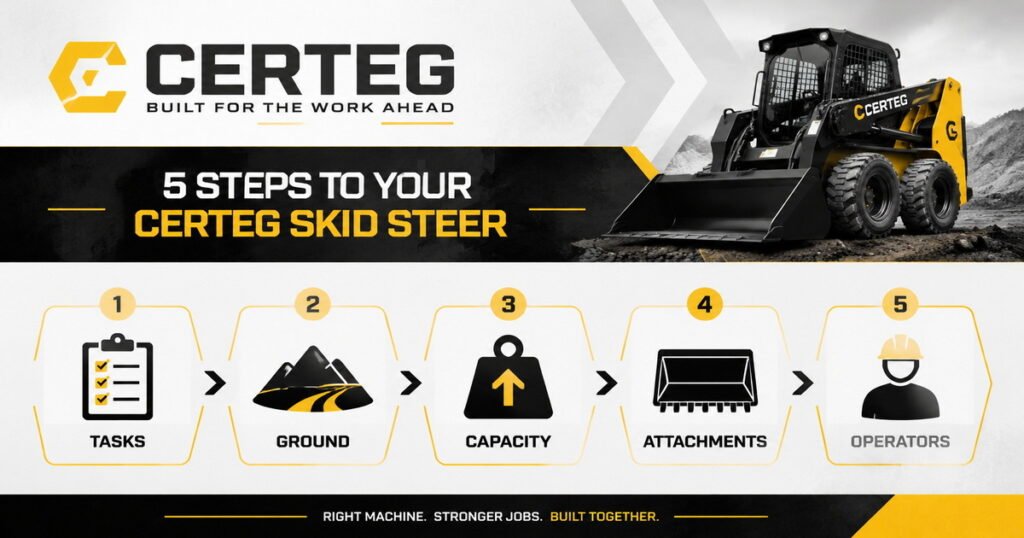
>> Step 1: Define primary tasks
>> Step 2: Choose track or wheel based on ground conditions
>> Step 3: Match ROC to your heaviest job
>> Step 4: Plan your attachment roadmap
>> Step 5: Audit operator and shift requirements
● Summary and Next Steps with Certeg
>> 1. Should I choose a track or wheel skid steer for mixed urban and rural projects?
>> 2. How do I know if I need high-flow hydraulics on a Certeg skid steer?
>> 3. What is the main advantage of vertical-lift skid steers?
>> 4. How important is cab comfort on a skid steer loader?
>> 5. Can Certeg support fleets operating in different regions and climates?
Why Your Skid Steer Choice Matters
After years of working with contractors, rental houses, and industrial plant managers, one pattern has become very clear: many jobsite delays and cost overruns come not from operator error, but from choosing a skid steer that simply does not match the work. A machine that is underpowered, unstable with heavier loads, or uncomfortable for long shifts quietly drains productivity day after day.
For global buyers evaluating Certeg alongside more established brands, the stakes are even higher. The wrong decision can lock a fleet into mismatched attachments, higher operating costs, and complex maintenance across different climates and regulations. This guide shares a practical, field-tested framework for choosing the right Certeg skid steer, whether you are equipping a single crew or coordinating a multi-country fleet.
What a Modern Skid Steer Loader Really Does
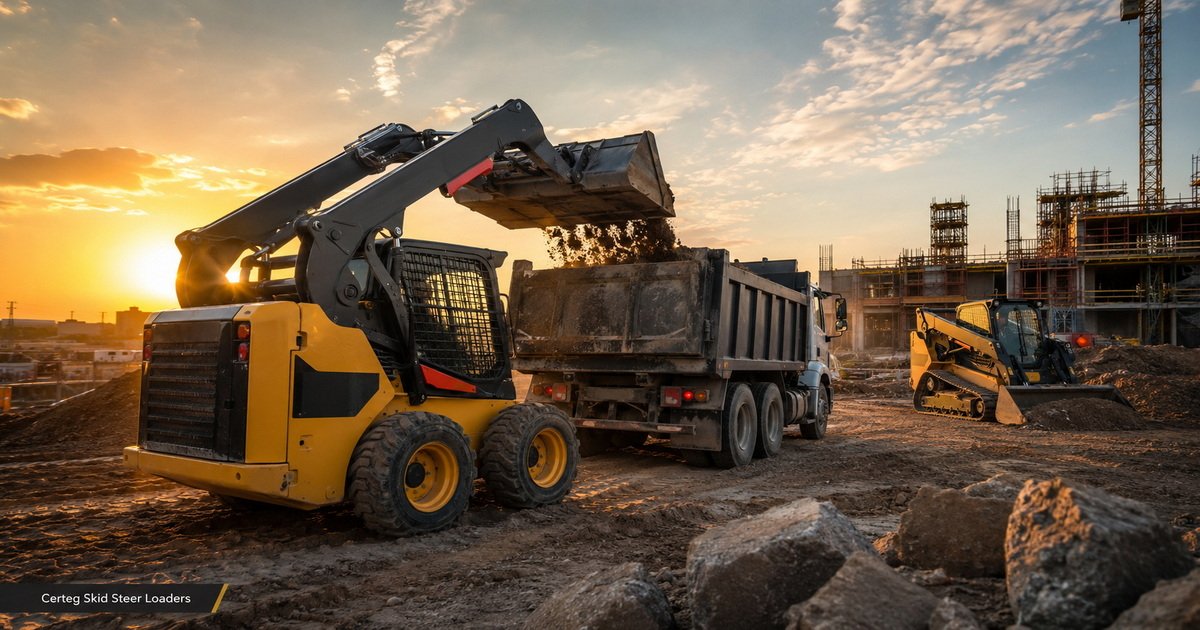
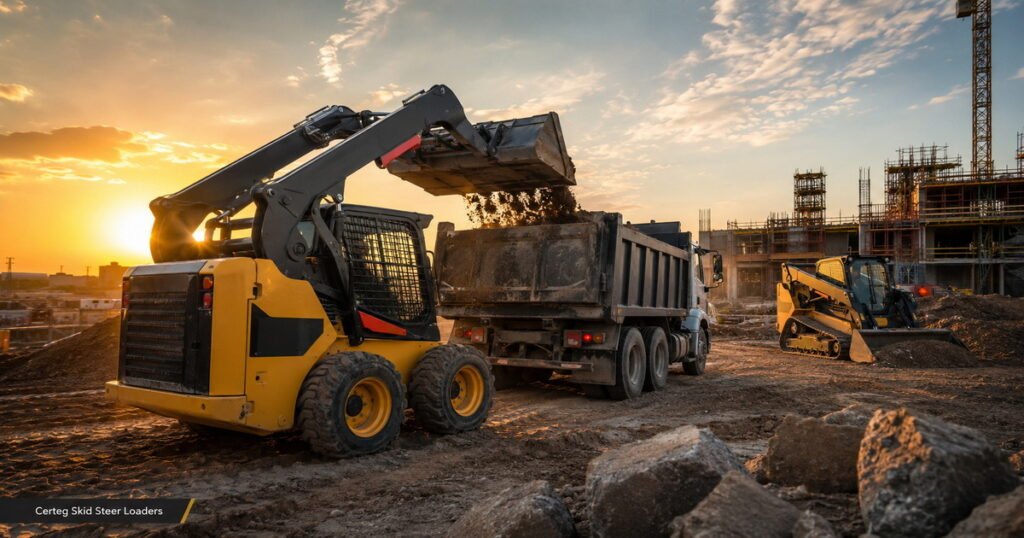
A skid steer loader is far more than a compact bucket machine. It is a versatile work platform with lift arms designed to handle a wide range of tools: general-purpose and heavy-duty buckets, pallet forks, augers, trenchers, cold planers, mulchers, sweepers, and more. Modern models cover a wide capacity spectrum, from compact units capable of working inside tight urban sites to large-frame machines handling heavy industrial materials.
Manufacturers increasingly design skid steers as “tool carriers” rather than just loaders. The machine’s hydraulic system, quick-attach interface, and auxiliary circuits allow an operator to switch quickly between roles throughout the day: loading trucks in the morning, grading sub-base in the afternoon, and running a sweeper or planer in the evening. For a producer like Certeg, the real challenge is balancing hydraulic power, stability, durability, and operator comfort so the same base machine can support very different types of work.
Certeg at a Glance: Focused on Real-World Conditions
Certeg specializes in the design and manufacture of skid steer loaders, offering both rubber track and wheel configurations. This focus makes it possible to optimize machines for a wide range of ground conditions and duty cycles: soft soils, mud, snow, compacted gravel, and paved yards. Rather than building one “generic” model, the range is structured so that buyers can choose the undercarriage, lift path, and powertrain that suit their primary tasks.
Because the company serves customers worldwide, machines are configured with international transport, emissions, and attachment standards in mind. This approach helps global fleets keep parts inventories manageable, standardize on common attachments, and roll out consistent operating practices across different regions. Whether a machine is working in a North American quarry, a European industrial yard, or a Southeast Asian construction site, Certeg aims to provide a familiar and reliable operating experience.
Track vs Wheel Skid Steer: Which Is Right for Your Work?
Key differences in everyday use
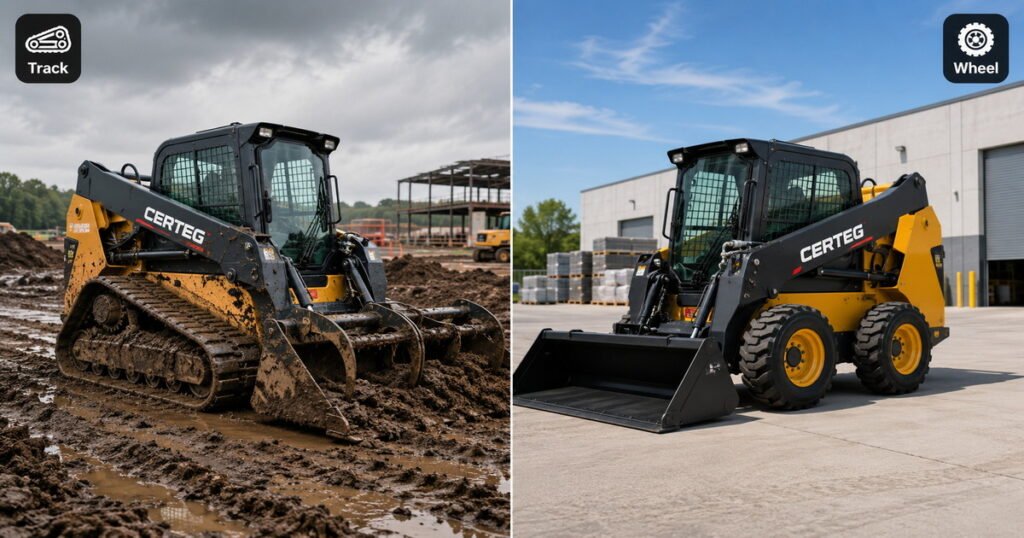
The first major decision for any buyer is whether to choose a track or wheel skid steer. Although both may share similar lifting and hydraulic capabilities on paper, they behave very differently on real jobsites.
– Track skid steers
– Excel on soft, muddy, sandy, or snowy ground.
– Spread the machine’s weight over a larger area, reducing ground pressure and rutting.
– Offer a smoother ride on rough, uneven terrain and slopes.
– Have a higher undercarriage cost and slower travel speed on hard surfaces.
– Wheel skid steers
– Perform best on firm, paved, or compacted surfaces.
– Provide faster travel speeds on concrete and asphalt.
– Are more economical in terms of upfront cost and tire maintenance for mixed-use fleets.
– Can experience faster tire wear on abrasive, uneven ground.
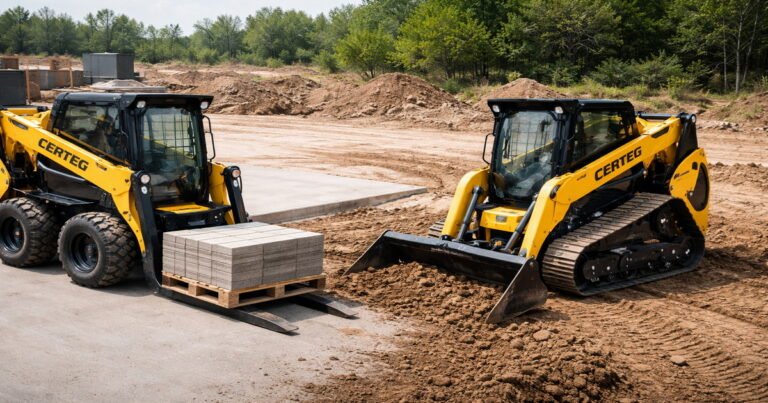
In practice, track skid steers are favored for landscaping, road shoulders, and building pads on weak soils, where flotation and traction are critical. Wheel machines tend to dominate urban construction, demolition, warehouses, and recycling yards where most travel happens on firm ground. Many fleets use a mix: track units for off-road and seasonal work, wheel units for year-round tasks on hard surfaces.
Quick comparison table
Track vs Wheel Skid Steer Overview
| Factor | Track Skid Steer | Wheel Skid Steer |
|---|---|---|
| Ground conditions | Soft, muddy, sandy, snowy | Firm, paved, compacted |
| Ground pressure | Lower; minimal rutting | Higher; more point loading |
| Ride comfort | Smoother on uneven ground | Rougher off-road, smoother on pavement |
| Travel speed | Slower on hard surfaces | Faster on roads and yards |
| Wear and maintenance | Higher track cost; good life off-road | Cheaper tires; may wear faster on abrasive surfaces |
| Typical applications | Landscaping, road shoulders, soft ground projects | Demolition, urban construction, industrial yards |
Understanding Lift Paths: Radial vs Vertical
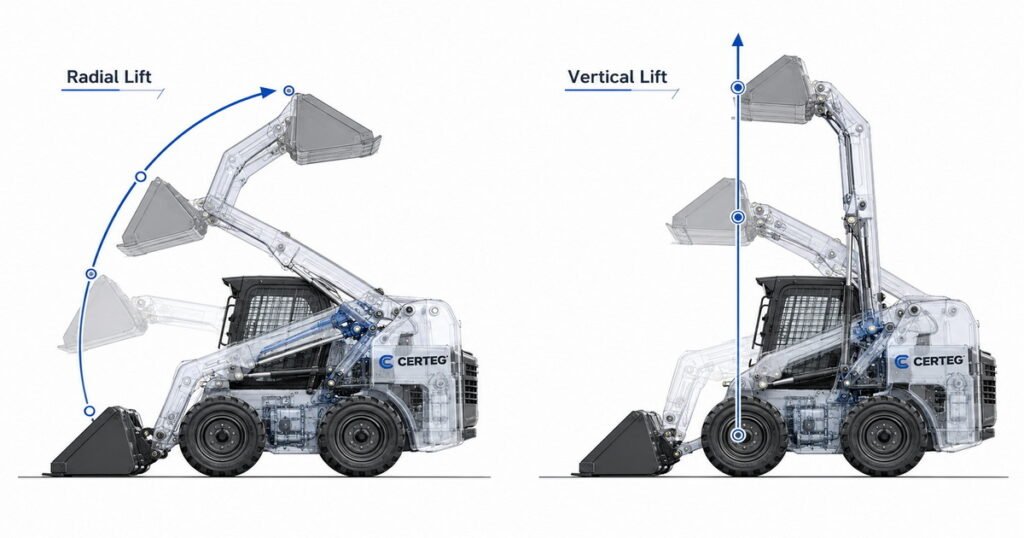
Another key decision point is lift geometry. Two main options exist, and each has clear advantages depending on the work.
– Radial lift
The boom follows an arc as it raises, usually delivering strong breakout force and stability at mid-lift. This design is ideal for digging, grading, pushing into piles, and general-purpose loading at moderate heights.
– Vertical lift
The linkage keeps the load closer to the machine and provides a higher hinge-pin height with better reach at full lift. This is especially useful for loading high-sided trucks, hoppers, and silos or handling pallets that need precise placement at height.
On many underperforming jobsites, the wrong lift path is assigned to the wrong task. Radial machines end up loading tall trucks with limited reach, while vertical-lift units spend their days grading building pads. An optimized fleet aligns radial models with earthmoving and site prep, while vertical-lift units focus on truck loading, warehouse handling, and material transfer.
Certeg structures its lineup with this distinction in mind. Radial-lift skid steers are tuned for earthmoving, backfilling, and grading, while vertical-lift models target high-load, high-lift applications such as precast yards, mixing plants, and logistics hubs.
Key Specifications That Matter Most
Rated Operating Capacity and Machine Size
Rated operating capacity (ROC) is often the first specification buyers notice, and for good reason: it directly affects how much weight the machine can carry safely. Compact units are designed to work in tight spaces with moderate loads. Larger-frame machines handle significantly heavier materials but require more space and often higher transport capacity.
A practical rule used by many experienced fleet managers is to size ROC to the heaviest regular load plus a safety margin. That load must include the attachment, bucket contents, and any uneven ground conditions that might affect stability. As a guideline, aiming for at least 10–15% headroom above your typical heaviest load allows for variations in material density, fuel level, and operating angle.
Certeg’s range is designed to cover the same kind of working envelope seen across leading global brands—from compact, highly maneuverable units up to powerful large-frame machines. This allows buyers to build a tiered fleet where each model has a clear role and workload.
Engine Power and Torque
Engine power is not just a headline number; it shapes how quickly a machine can cycle, how effectively it can push into piles, and whether it can run demanding attachments. A smaller machine with modest horsepower may be perfectly adequate for light construction or rental use, but underpowered in heavy industrial or quarry environments.
Beyond peak horsepower, torque at low engine speeds makes a big difference in real-world performance. A machine tuned for strong low-end torque delivers more confident control when pushing into piles, climbing ramps, or operating with both drive and hydraulics under load. Certeg focuses its powertrain setups around this kind of usable power, striking a balance between performance and fuel efficiency.
Hydraulic System and Attachment Capability
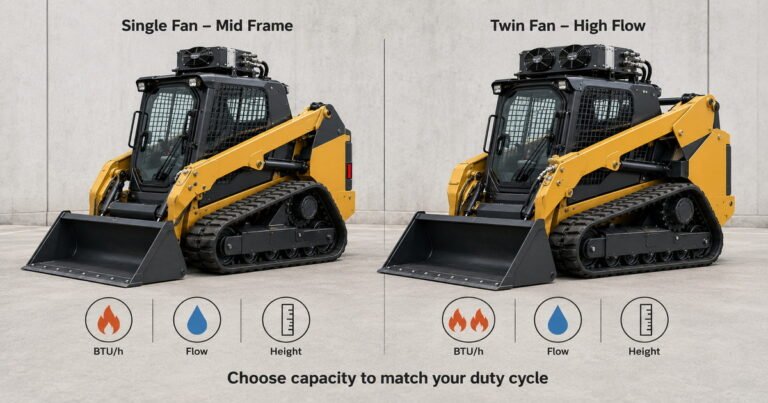
The hydraulic system is central to a modern skid steer’s versatility. Standard-flow auxiliary circuits are suitable for everyday tasks like operating buckets, pallet forks, general-purpose brooms, and many trenchers. High-flow circuits expand the machine’s ability to power cold planers, heavy mulchers, large sweepers, and other attachments that demand more oil flow and pressure.
Certeg equips selected models with high-flow options and designs them to work with widely used quick-attach interfaces. When planning a purchase, it is wise to consider not only the attachments you already own but also those you might acquire in the next two to three years. Selecting a machine that can power your most demanding future attachment avoids costly upgrades or limited usage later.
Operator Comfort, Safety, and Control
Two machines can share similar specifications yet deliver entirely different experiences from inside the cab. Operators consistently highlight several factors that influence both day-to-day productivity and long-term retention:
– Cab space and visibility
Clear sight lines to the bucket edge, corners of the attachment, and surrounding jobsite build confidence and reduce mistakes.
– Seating and climate
Suspension seats, supportive cushions, and heating or air conditioning matter on long shifts or in extreme temperatures.
– Noise and vibration
A quieter, less harsh cab reduces fatigue, especially for operators who spend full days in the machine.
– Controls and ergonomics
Intuitive levers or joysticks, adjustable armrests, and programmable auxiliary controls all contribute to fine, precise work and reduced learning curves.
Certeg outfits its machines with enclosed cabs, robust protective structures, and ergonomic control layouts, aiming to keep operators focused and comfortable for the entire shift. Safety systems such as interlocks, clear labeling, and effective lighting further support confident operation during night work or low-visibility conditions.
Real-World Use Cases: Matching Certeg Machines to Jobs
Abstract specifications only become meaningful when connected to real working scenarios. The following examples reflect typical decisions made by experienced buyers and fleet managers.
Urban demolition and recycling yards
– Preferred configuration: Wheel skid steer, vertical lift, mid-to-high ROC, heavy-duty or solid tires.
– Why it works: Most travel occurs on hard surfaces, often with debris. High lift height and reach are essential for loading tall containers, trailers, and bins. Strong breakout force and robust tires support work with buckets, grapples, and waste handling tools.
Road shoulders, landscaping, and soft ground projects
– Preferred configuration: Track skid steer, radial lift, high-flow hydraulics where brush cutters or mulchers are planned.
– Why it works: Low ground pressure protects finished surfaces and prevents machines from getting bogged down. The track undercarriage offers traction and a smoother ride on slopes and uneven terrain. Radial lift geometry shines in digging, grading, and backfilling tasks.
Precast yards and industrial plants
– Preferred configuration: Wheel skid steer, vertical lift, high ROC, equipped with pallet forks and material handling attachments.
– Why it works: These sites typically feature firm surfaces with repetitive material-handling tasks. High ROC and lift height support safe stacking and loading, while wheel machines provide quick movements and efficient fuel usage.
In each case, the machine’s undercarriage, lift path, and hydraulic capacity together determine how well it can serve that environment. Certeg’s range allows buyers to tune these variables without sacrificing core reliability.
How Certeg Aligns with Industry Benchmarks
Many buyers use well-known brands as reference points when validating a newer or less familiar supplier. While exact one-to-one comparisons require specific model data, it is helpful to understand how Certeg positions its machines relative to commonly known ranges.
Typical benchmark ranges from established manufacturers cover multiple skid steer models, from small-frame units around the one-ton ROC class up to large-frame machines exceeding three tons of rated operating capacity. Within those ranges, there are both radial and vertical lift paths, high-flow hydraulic options, and a broad ecosystem of compatible attachments.
Certeg structures its portfolio along similar lines:
– Coverage from compact to large-frame models.
– Both radial and vertical lift configurations.
– Track and wheel undercarriages across key capacity bands.
– Compatibility with common attachment interfaces and high-flow options on selected models.
– Cab and control features designed for long-shift comfort and safety.
The result is a set of machines that can fit into global fleets without forcing a complete overhaul of existing practices, while still offering room for tailored configurations and localized support.
Practical Selection Checklist for Skid Steer Buyers
Over many fleet assessments and purchase consultations, a simple checklist has proven very effective in guiding the decision-making process. It helps cut through the noise of marketing claims and focus on what really matters.
Step 1: Define primary tasks
List the three to five tasks that generate most of the machine’s workload or revenue. Be specific: loading high-sided trucks, grading building pads, operating a cold planer, or handling pallets in a yard. A clear task list is the foundation of every other decision.
Step 2: Choose track or wheel based on ground conditions
Estimate how many hours the machine will operate on soft, unstable ground versus firm, paved, or compacted surfaces. If the majority of hours are on soft soils, snow, or mud, track machines are usually more productive and less damaging to the ground. If most hours are on firm ground, wheel machines tend to be more economical and faster.
Step 3: Match ROC to your heaviest job
Identify the heaviest regular load, including attachment weight and material. Add a reasonable margin, often 10–15%, to account for variations in material density and field conditions. Use this number to target a ROC band and narrow down candidate models within the Certeg range.
Step 4: Plan your attachment roadmap
Think beyond the bucket. Consider which attachments you use now and which you might need over the next few years. If heavy-duty tools such as mulchers, large sweepers, or cold planers are on the horizon, ensure the selected machine offers suitable high-flow hydraulics and any required electrical connections.
Step 5: Audit operator and shift requirements
Review shift patterns, climate, and operator expectations. Long hours, hot or cold climates, and precision work all increase the importance of cab comfort, climate control, seat quality, and control ergonomics. Equipping machines to meet these needs helps protect both productivity and operator retention.
Summary and Next Steps with Certeg
Selecting the right skid steer loader is not a matter of choosing the biggest model or the one with the most complicated specification sheet. It is about understanding your work, ground conditions, attachments, and operator needs, then aligning these realities with the right combination of undercarriage, lift path, capacity, and hydraulic power.
Certeg’s range of track and wheel skid steer loaders is designed to meet diverse international requirements, from compact urban projects to large industrial operations. By applying the frameworks and checklists in this guide, buyers can shape a clear strategy for their next machine or fleet rollout, avoid costly mismatches, and build a strong foundation for reliable, productive work in the years ahead.
Frequently Asked Questions
1. Should I choose a track or wheel skid steer for mixed urban and rural projects?
If most of your operating hours are on firm surfaces with only occasional soft ground, a wheel skid steer is usually more economical and faster for everyday tasks. For fleets that regularly face wet seasons or soft jobsite conditions, maintaining at least one dedicated track unit can provide valuable flexibility without over-investing in tracks for every machine.
2. How do I know if I need high-flow hydraulics on a Certeg skid steer?
You should consider high-flow hydraulics if you plan to run power-intensive attachments such as cold planers, heavy mulchers, large sweepers, or certain rock tools. These attachments require more oil flow and pressure than standard circuits provide. If your work is focused on buckets, forks, light trenchers, and general-purpose brooms, standard-flow is typically sufficient and more cost-effective.
3. What is the main advantage of vertical-lift skid steers?
Vertical-lift skid steers provide better reach at maximum lift height, making them ideal for loading high-sided trucks, bins, and hoppers. The load stays closer to the machine throughout the lift cycle, which can improve stability and control when placing materials at height or stacking pallets.
4. How important is cab comfort on a skid steer loader?
Cab comfort is crucial for operators who spend long hours in the machine. Features such as supportive suspension seats, low noise levels, effective heating and cooling, and intuitive controls contribute directly to reduced fatigue and higher day-long productivity. Over time, comfortable machines also help with operator satisfaction and retention.
5. Can Certeg support fleets operating in different regions and climates?
Certeg designs its machines to perform reliably in a wide range of climates and regulatory environments. Options for engine configurations, cooling, filtration, and operator comfort features allow the same basic platform to serve in very different conditions. This makes it easier for international fleets to deploy consistent models while adapting details to local needs.
References
1. Compact Equipment – “Manitou Skid Steers Summarized — 2022 Spec Guide.”
<https://compactequip.com/skid-steers/manitou-skid-steers-summarized-2022-spec-guide/>
2. Hashmeta – “Buyer’s Guide SEO: Creating High-Converting Comparison Content That Drives Revenue.”
3. SEO for Manufacturers – “SEO for Manufacturers: Strategies to Dominate Search in B2B.”
<https://robertsiegers.com/en/seo-for-manufacturers>
4. Backlink Works – “How to Write Product Comparison Pages That Improve Organic Traffic.”
<https://articles.backlinkworks.com/write-product-comparison-pages-improve-organic-traffic/>
5. EdenRank – “How to Rank Comparison Pages in Google.”
<https://seosandwitch.com/rank-comparison-pages-google/>
6. RankDraft – “eCommerce Content Strategy for AI Search: The 2026 Playbook.”
<https://rankdraft.io/blog/ecommerce-content-strategy-ai-search/>
7. AISEOShift – “How to Write E-E-A-T Content: A Practical Guide for 2026.”
<https://aiseoshift.com/blog/how-to-write-eeat-content/>
Hot Tags: Skid Steer Loader, Manufacturers, Customized, Custom, Suppliers, Buy, Cheap, Quality, Advanced, Durable, in Stock, Made in China, Price, Quotation