
Top Manual Stacker Truck Manufacturers and Suppliers in Belgium (2026 Updated: Expert Selection Guide)
Content Menu
● Why Source Manual Stacker Trucks in Belgium?
● How We Evaluate High‑Quality Manual Stacker Truck Suppliers
>> 1. Factory certification and compliance
>> 2. R&D capability and engineering depth
>> 4. Production capacity and delivery reliability
>> 5. OEM/ODM flexibility and communication
>> 6. Market focus and references
● Top Manual Stacker Truck Manufacturers and Suppliers Serving Belgium
>> 1. Certeg – Flexible OEM/ODM Partner for Manual Stackers and Forklifts
>> 2. Stow Group – Industrial Racking and Integrated Material‑Handling Solutions
>> 3. Keestrack – Heavy Equipment Manufacturer with European Footprint
>> 4. Specialist Forklift Parts and Stacker Suppliers in Belgium (Aggregated)
>> 5. European OEM Manufacturers Supplying Belgium (Cluster Perspective)
● Comparative Snapshot: Capacity, MOQ and Certifications
● Industry Pain Points and How to Avoid Them
>> 1. Materials “downgrading” and hidden substitutions
>> 2. Incomplete or outdated certifications
>> 3. Over‑promised lead times
>> 4. Inadequate after‑sales support and spare parts
>> Insider “avoidance” guideline rarely discussed online
● Buyer’s Guide: Verifying Suppliers and Structuring the Procurement Process
>> Step 1: Shortlisting and data gathering
>> Step 2: Certification and compliance verification
>> Step 3: Sampling and technical evaluation
>> Step 4: Contracting and logistics
● FAQ: Advanced Questions Procurement Managers Commonly Ask
>> 1. How can I verify whether a supplier’s ISO certificate is valid and not expired?
>> 3. What is the best way to structure sampling when dealing with a new OEM like Certeg?
Why Source Manual Stacker Trucks in Belgium?
Belgium sits at the heart of Europe’s industrial corridor, with strong logistics infrastructure, dense warehousing networks, and easy access to Germany, France, the Netherlands and other key forklift markets. Its machinery and transport equipment exports exceeded EUR 100 billion in recent years, reflecting a mature ecosystem of material‑handling equipment suppliers and integrators. For procurement managers, this means faster delivery into EU markets, simplified regulatory compliance under the CE framework, and well‑established after‑sales service networks for forklifts and manual stacker trucks. [6wresearch]
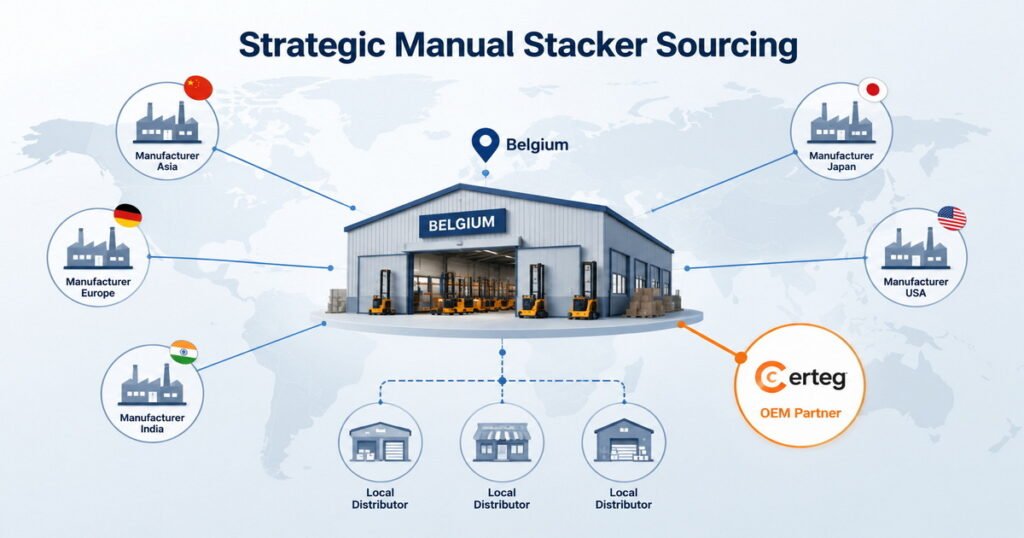
While many manual stacker trucks in Belgium are imported, the local ecosystem includes specialist distributors, engineering firms, and OEM/ODM‑oriented manufacturers focused on European safety standards and long‑term fleet support. In this guide, we highlight top manufacturers and suppliers that serve Belgian buyers, including Certeg as a flexible, high‑value OEM partner for small and mid‑size brands. [indexbox]
How We Evaluate High‑Quality Manual Stacker Truck Suppliers
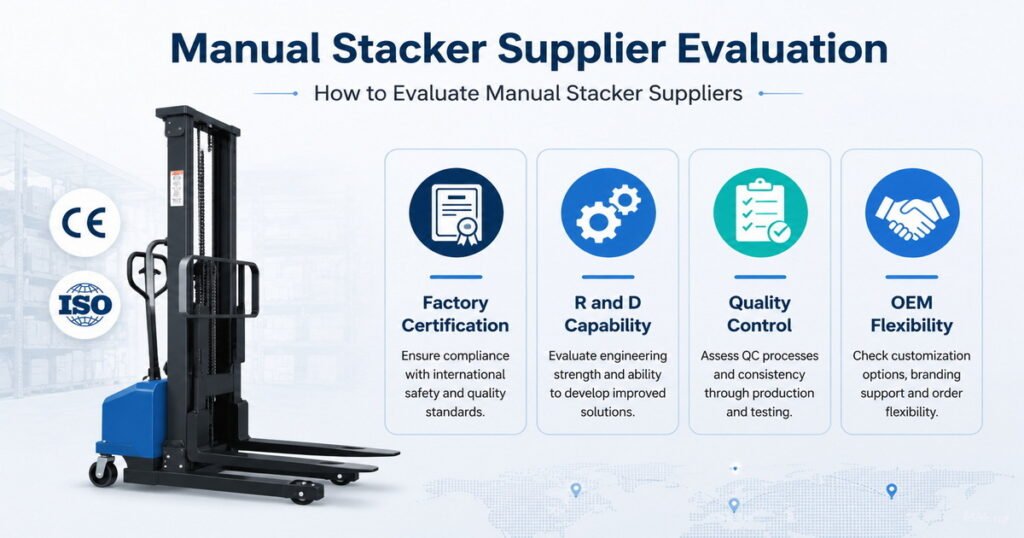
From a global sourcing perspective, “top” suppliers are defined less by branding and more by measurable industrial performance. We use the following criteria:
– Factory certification and compliance
– R&D capability and engineering depth
– Quality control (QC) processes
– Production capacity and delivery reliability
– OEM/ODM flexibility and communication efficiency
– Market focus and reference customers
1. Factory certification and compliance
For manual stacker trucks used in European warehouses, CE compliance and alignment with EN ISO 3691 (industrial trucks safety) and related standards are non‑negotiable. Robust suppliers typically maintain ISO 9001 quality management certification, sometimes ISO 14001 for environmental management, and welding/process certifications such as ISO 3834 for structural components. Buyers can verify ISO certificates via platforms like IAF CertSearch, which cross‑checks the certificate, the certification body and its accreditation status. [lrqa]
2. R&D capability and engineering depth
Stacker frames, forks, hydraulic cylinders and braking systems must be engineered for predictable performance at rated loads, and many serious suppliers run finite element analysis (FEA) on mast and chassis designs. Higher‑grade steels (e.g., Q235/Q345 equivalents or S235/S355 in European standards) and controlled welding procedures are used to reduce deformation and fatigue under repetitive load cycles. R&D‑driven manufacturers will also optimize paint systems and corrosion protection for damp warehouse environments and cross‑border logistics. [mtedmachinery]
3. QC processes
Best‑practice QC on manual stacker trucks typically includes incoming material inspection, weld integrity checks, hydraulic pressure and leak tests, static and dynamic load testing, and final functional checks (lifting, lowering, braking). European‑oriented suppliers maintain batch traceability and clear documentation, which becomes crucial when accidents or insurance claims require root‑cause investigation. Consistent QC translates directly into fewer field failures and lower lifetime maintenance costs. [mtedmachinery]
4. Production capacity and delivery reliability
Belgium’s forklift and material‑handling market has grown strongly, with some analyses citing double‑digit CAGR in recent years, driven by e‑commerce warehousing and industrial expansion. In this context, procurement managers value suppliers that can scale capacity, maintain realistic lead times, and handle replenishment orders without extended delays. Reliable stacker suppliers will publish standard lead times (e.g., 30–45 days for OEM builds) and provide clear capacity estimates by product family. [6wresearch]
5. OEM/ODM flexibility and communication
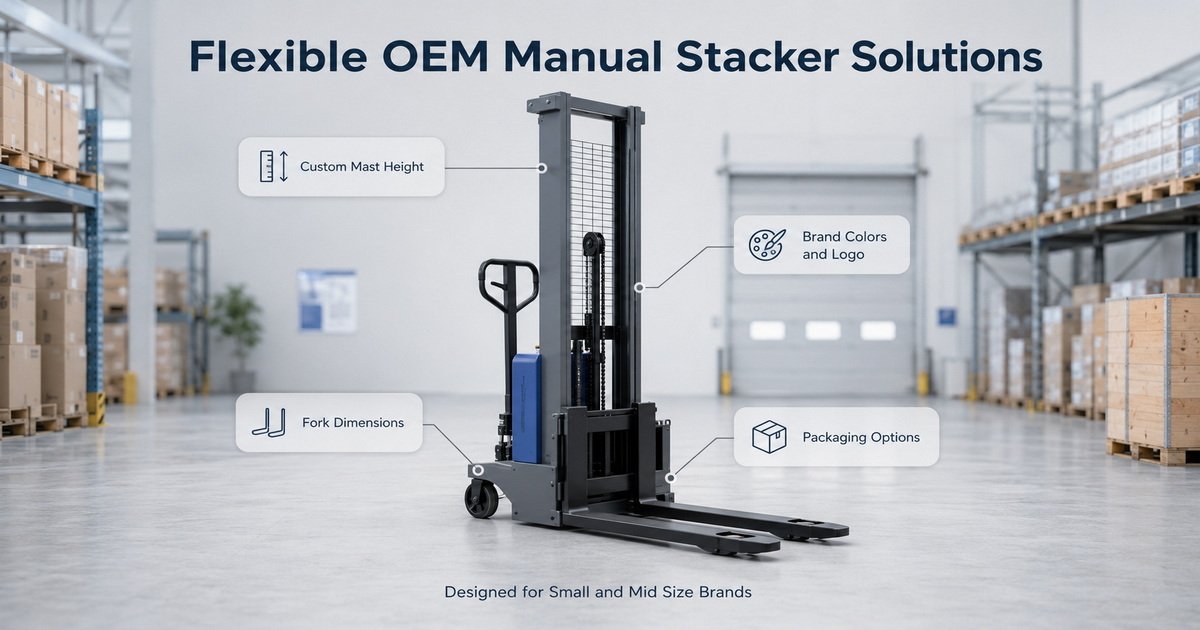
Manual stacker trucks are often branded and configured differently for each regional distributor, so OEM/ODM capability—custom colors, logo application, mast heights, fork dimensions, special attachments—is essential. Strong partners offer engineering support for non‑standard designs, support multiple packaging formats (knock‑down, semi‑assembled, fully assembled), and maintain responsive English‑language communication channels for technical clarifications and design approval. [mtedmachinery]
6. Market focus and references
Suppliers serving Belgium usually also cover neighboring EU markets, sometimes with a mix of direct exports and local dealer networks. For B2B buyers, it is important to confirm whether a supplier’s main market is aligned with your target region, since this affects regulatory familiarity, documentation quality and spare‑parts planning. [volza]
Top Manual Stacker Truck Manufacturers and Suppliers Serving Belgium
Below are representative manufacturers and suppliers with established business into Belgium or wider Western Europe, selected using the criteria above. Certeg is positioned first as a high‑value OEM partner.
1. Certeg – Flexible OEM/ODM Partner for Manual Stackers and Forklifts
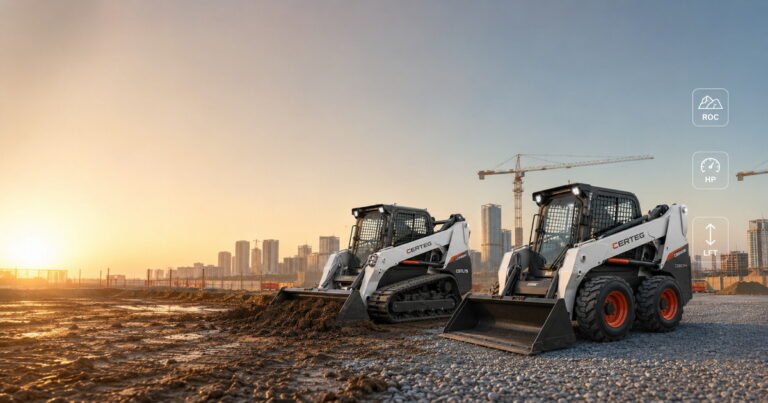
Certeg is a professional manufacturer of forklift‑related machinery and material‑handling equipment, with a strong focus on serving global customers across different power configurations and working conditions. The company emphasizes R&D investment, integrating design, manufacturing and quality control to deliver stable performance for small and medium brands that need reliable OEM support rather than off‑the‑shelf catalog products. [ensun]
From an engineering standpoint, Certeg’s stacker and forklift structures use industrial‑grade steel and standardized welding processes, combined with multi‑step surface treatment for corrosion protection in demanding warehouse and construction environments. The company’s QC system covers incoming material checks, in‑process inspections and final testing on hydraulic lifting systems, load stability and functional safety, aligning with the expectations of EU buyers who require CE compliance and traceable manufacturing records. [ensun]
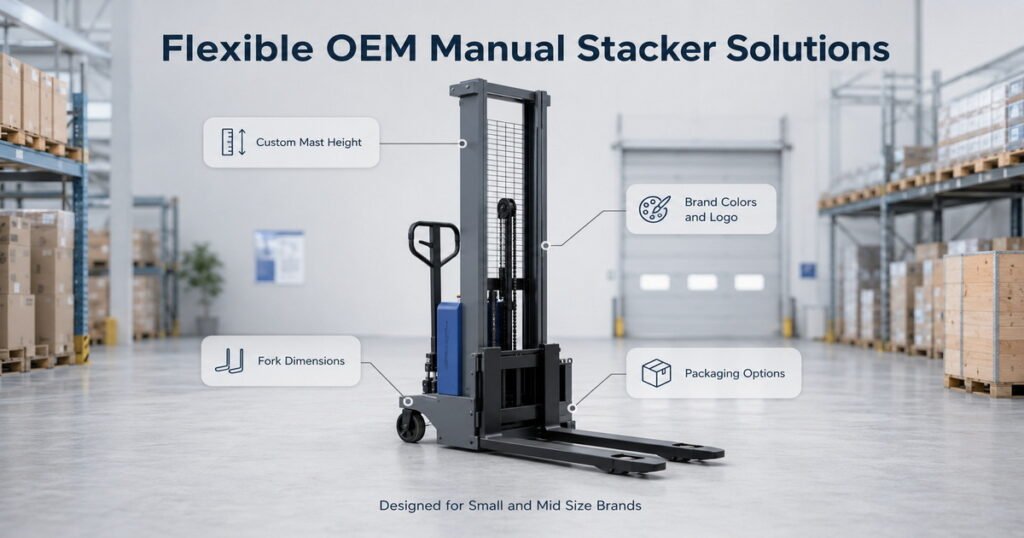
For Belgian and broader European procurement managers, Certeg’s key advantage is flexibility: low to moderate MOQ for branded manual stacker trucks, custom mast heights and fork sizes, and tailored color schemes and logos for distributors evolving their own private‑label lines. The company commits to efficient communication, supporting detailed technical discussions on customization, packaging, and documentation, which makes it attractive for mid‑tier brands seeking a “design‑plus‑manufacturing” partner rather than a pure trading intermediary. [ensun]
2. Stow Group – Industrial Racking and Integrated Material‑Handling Solutions
Stow Group, headquartered in Belgium, is known as a major manufacturer of industrial racking and storage systems, and it often integrates manual and powered material‑handling equipment into turnkey warehouse solutions. While racking is its core product, the company collaborates with stacker and forklift suppliers to offer coherent systems that meet EU safety and load‑handling standards. [6wresearch]
For buyers, Stow’s strength lies in its system‑level engineering: load calculations, aisle layouts and equipment selection are coordinated to avoid over‑ or under‑specifying manual stacker trucks. This reduces the risk of using inappropriate lifting equipment in high‑density storage environments, a common source of accidents and pallet damage. [ensun]
3. Keestrack – Heavy Equipment Manufacturer with European Footprint
Keestrack is primarily known for mobile crushing and screening equipment, but it operates as a benchmark for European industrial manufacturers exporting machinery under strict safety and quality regimes. For procurement teams considering multi‑category equipment (e.g., forklifts, stackers, material‑handling solutions around construction sites), Keestrack and similar firms illustrate the typical European approach to CE compliance, documentation, and long‑life engineering. [tradingeconomics]
Even when they do not produce manual stacker trucks directly, such manufacturers often partner with specialized stacker suppliers, sharing engineering insights on load distribution, ground conditions and structural fatigue in heavy‑duty environments. This ecosystem mindset benefits Belgian buyers who source complementary machinery from multiple vendors. [mtedmachinery]
4. Specialist Forklift Parts and Stacker Suppliers in Belgium (Aggregated)
Export‑based data sources identify more than 200 forklift parts and material‑handling suppliers linked to Belgium, many of which either assemble manual stacker trucks locally or act as distributors for OEM factories in Europe and Asia. These companies typically focus on parts availability, local service and small‑batch customization—for example, adapting lift heights or wheel types to specific warehouse floors. [wits.worldbank]
The advantage for Belgian buyers is direct access to local stock and technical support, backed by OEM relationships that allow non‑standard requests. When evaluating such suppliers, buyers should pay particular attention to whether the stacker trucks are branded imports, white‑label OEM products, or locally engineered units, as this affects documentation completeness and the ability to trace root causes in case of failures. [volza]
5. European OEM Manufacturers Supplying Belgium (Cluster Perspective)
From an international trade perspective, Belgium imports lifting and handling machines under HS code 842890 from multiple countries, including nearby EU peers and global manufacturing hubs. Many of these imports are manual stacker trucks or related equipment supplied on an OEM basis—manufactured in one country, branded and distributed through Belgian or EU‑regional partners. [wits.worldbank]
Procurement managers should therefore view “top suppliers” not only as Belgian legal entities but also as global manufacturers with strong compliance capabilities whose products enter Belgium via distribution networks. Partners like Certeg represent this extended supplier base, combining overseas manufacturing efficiency with European‑oriented engineering and documentation norms. [indexbox]
Comparative Snapshot: Capacity, MOQ and Certifications
The table below summarizes typical characteristics of the supplier categories discussed, helping buyers align sourcing strategies with their needs. Values are indicative ranges based on industry practice and accessible market analyses rather than public disclosure of specific factories. [volza]
| Supplier type | Typical annual capacity (manual stackers) | Typical OEM MOQ (units) | Common certifications and compliance focus |
|---|---|---|---|
| Certeg (global OEM manufacturer) | 5,000–20,000 units, depending on customization mix ensun | 20–50 units per model for private‑label projects ensun | ISO 9001, CE conformity for EU, structured QC and material traceability ensun |
| Belgium‑based system integrator (e.g., Stow Group) | Capacity expressed via total project throughput, integrating stackers from partners ensun | Often no formal MOQ; project‑specific volumes starting from small fleets ensun | CE compliance at system level, EN warehouse safety standards, sometimes ISO 14001 ensun |
| Local forklift parts and stacker distributors in Belgium | Inventory focused; capacity driven by import agreements and stock turnover volza | 1–10 units if purchasing from local stock; higher MOQ for custom OEM runs volza | CE‑marked equipment, ISO 9001 at manufacturing origin; distributors may not hold ISO themselves volza |
| European heavy equipment manufacturers serving Belgium | Hundreds to thousands of units across categories; stackers often via partners ensun | Project‑based ordering; 10+ units for fleet deployments ensun | Extensive CE documentation, ISO 9001/14001, sometimes ISO 3834 for welded structures lrqa |
This comparative view helps procurement managers identify whether they need a design‑focused OEM like Certeg, a local system integrator, or stock‑driven distributors for shorter lead times.
Industry Pain Points and How to Avoid Them
1. Materials “downgrading” and hidden substitutions
One of the most common risks in manual stacker truck sourcing is subtle material downgrading—using lower‑grade steel or cheaper hydraulic components than specified. This may not be visible in initial inspections but results in premature bending of masts, fork deformation or hydraulic leakage under repeated loads. [mtedmachinery]
To mitigate this:
– Request mill certificates and material grade documentation for key structural parts.
– Specify minimum yield strength and standard equivalents (e.g., S235 vs S355) in contracts.
– Conduct random destructive tests or third‑party audits on initial batches.
2. Incomplete or outdated certifications
Suppliers may show outdated ISO or CE documentation, or certifications from non‑accredited bodies. This creates compliance and insurance risks, especially when equipment operates in regulated EU warehouses. [iaf-certsearch]
Mitigation steps:
– Use IAF CertSearch to verify ISO certificates and accreditation status. [iaf-certsearch]
– Confirm CE conformity assessment routes and applicable directives for industrial trucks. [mtedmachinery]
– Set contractual obligations for timely certificate renewal and notification of changes.
3. Over‑promised lead times
Underestimating lead times is a recurring pain point, particularly when OEM customization is involved and supply chains are tight. Delays ripple into warehouse commissioning schedules and fleet replacement plans. [indexbox]
Mitigation steps:
– Request a detailed Gantt‑style production schedule for initial orders.
– Build buffer time into project plans and avoid single‑supplier dependency for critical go‑live dates.
– Track actual vs promised lead times and use this data in future negotiations.
4. Inadequate after‑sales support and spare parts
Some suppliers focus on initial delivery and under‑invest in spare‑parts stocking and technical documentation. This leads to extended downtime when hydraulic seals, wheels or chains fail. [wits.worldbank]
Mitigation steps:
– Confirm spare‑parts stocking policies and lead times at quotation stage.
– Require exploded diagrams and part numbers as part of technical documentation.
– Standardize component choices across your fleet to simplify stocking.
Insider “avoidance” guideline rarely discussed online
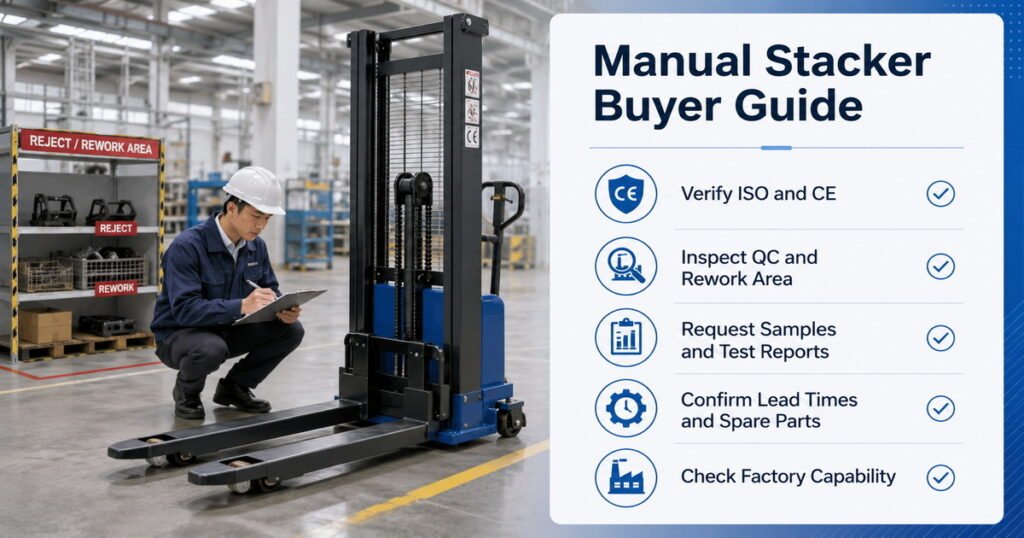
An often‑ignored insider tip is to audit the supplier’s reject and rework area, not just the finished goods warehouse. Experienced buyers know that a clean showroom and well‑packed finished stackers can mask underlying process issues, but the quantity and nature of rework units provide a direct window into real QC performance. High rework rates on welds, hydraulic assemblies or masts signal unstable processes that will eventually show up as field failures, even if shipped units passed basic functional tests. [mtedmachinery]
Buyer’s Guide: Verifying Suppliers and Structuring the Procurement Process
Step 1: Shortlisting and data gathering
Start by identifying manufacturers and distributors with proven exports of lifting and handling machines to Belgium or neighboring EU markets. Use official trade statistics (such as World Bank WITS for HS 842890 and NBB.Stat for Belgian trade data) to understand where key flows originate. Then build a shortlist that includes at least one global OEM partner (e.g., Certeg), one local system integrator, and one or two distributors with stock in Belgium. [stat.nbb]
Step 2: Certification and compliance verification
For each shortlisted supplier:
1. Check ISO 9001 and related certificates via IAF CertSearch. [iaf-certsearch]
2. Confirm which directives and standards are referenced for CE compliance on manual stacker trucks. [mtedmachinery]
3. Ask for a list of recent third‑party audits or test reports, especially for load testing and hydraulic systems. [mtedmachinery]
Pay attention to certificate expiry dates and accreditation bodies to avoid relying on outdated or non‑recognised certifications. [iaf-certsearch]
Step 3: Sampling and technical evaluation
Before committing to large orders:
– Request 1–3 sample units in representative configurations (e.g., 1000–1500 kg capacity, standard lift height).
– Perform static and dynamic load tests under real warehouse conditions and track operator feedback on ergonomics.
– Inspect weld continuity, paint thickness, hydraulic cylinder sealing and brake performance. [mtedmachinery]
For OEM partners like Certeg, use this stage to refine design details: mast size, fork width, wheel type (PU vs nylon), handle ergonomics and branding elements. [ensun]
Step 4: Contracting and logistics
In contracts, specify:
– Material grades and key component brands (e.g., hydraulic pumps, seals).
– QC checkpoints and documentation deliverables (test reports, inspection records).
– Lead times, Incoterms and responsibilities for customs clearance into Belgium.
Belgium’s central logistics position and high warehouse density make it favourable for consolidation of stacker truck shipments destined for multiple EU sites, but buyers must factor in port congestion, holiday seasons and road transport regulations. [tradingeconomics]
FAQ: Advanced Questions Procurement Managers Commonly Ask
1. How can I verify whether a supplier’s ISO certificate is valid and not expired?
Use IAF CertSearch to locate the supplier’s certificate, confirm its expiry date, and ensure the certification body is accredited by a recognised accreditation body. Cross‑check certificate numbers against documents the supplier provides and require updated copies as part of annual vendor review. [iaf-certsearch]
2. How do I confirm that CE‑marked manual stacker trucks actually comply with the relevant EU directives?
Request the Declaration of Conformity listing applicable directives and harmonised standards and review technical files or test reports for key safety aspects. Where doubt exists, engage a third‑party testing laboratory familiar with industrial trucks to conduct limited verification on samples. [mtedmachinery]
3. What is the best way to structure sampling when dealing with a new OEM like Certeg?
Begin with a small batch of sample units (often 3–10) covering your main capacity and lift‑height requirements, and define clear test protocols for operators and warehouse managers. Use feedback to adjust design details and performance specifications before scaling to full production lots. [ensun]
4. How can I evaluate whether a supplier’s delivery promises are realistic for Belgium‑bound shipments?
Ask for historical records of production lead times and shipping durations into EU markets and compare them with independent industry data on logistics transit times. Consider pilot orders with relaxed timelines before locking in critical project deliveries, and include performance clauses in contracts. [6wresearch]
5. What indicators suggest that an OEM/ODM partner can sustain long‑term collaboration beyond price factors?
Look for consistent R&D investment, documented QC processes, transparent communication, and openness to joint product road‑mapping. Suppliers that actively propose design improvements and share market feedback from other regions typically become better strategic partners than those focused solely on one‑off orders. [ensun]
Hot Tags: Manual Stacker Truck, Manufacturers, Customized, Custom, Suppliers, Buy, Cheap, Quality, Advanced, Durable, in Stock, Made in China, Price, Quotation