
Skid Steer and Track Loader Market Watch: Expert Insights for Equipment Buyers in 2026
Content Menu
● Track Loaders vs Wheeled Skid Steers
● Technology Integration and Smart Features
>> Operator Comfort and Safety Innovations
>> Hydraulic and Attachment Advancements
>> Telematics and Fleet Management
● Vertical Lift vs Radial Lift Configurations
● Emissions Compliance and Engine Technology
>> Emission Control Technologies
>> Sustainability and Alternative Power
● Strategic Buying Considerations for 2026
>> Rental vs Purchase Analysis
● Application-Specific Recommendations
>> Construction and Urban Development
>> Landscaping and Grounds Maintenance
>> Q1: Should I choose a compact track loader or wheeled skid steer in 2026?
>> Q2: What rated operating capacity (ROC) should I target for general construction work?
>> Q3: Are electric skid steer loaders practical for full-time construction use in 2026?
>> Q4: What’s the price difference between Tier 4 Final diesel engines and older technology?
>> Q5: How important are telematics and digital features for small contractors?
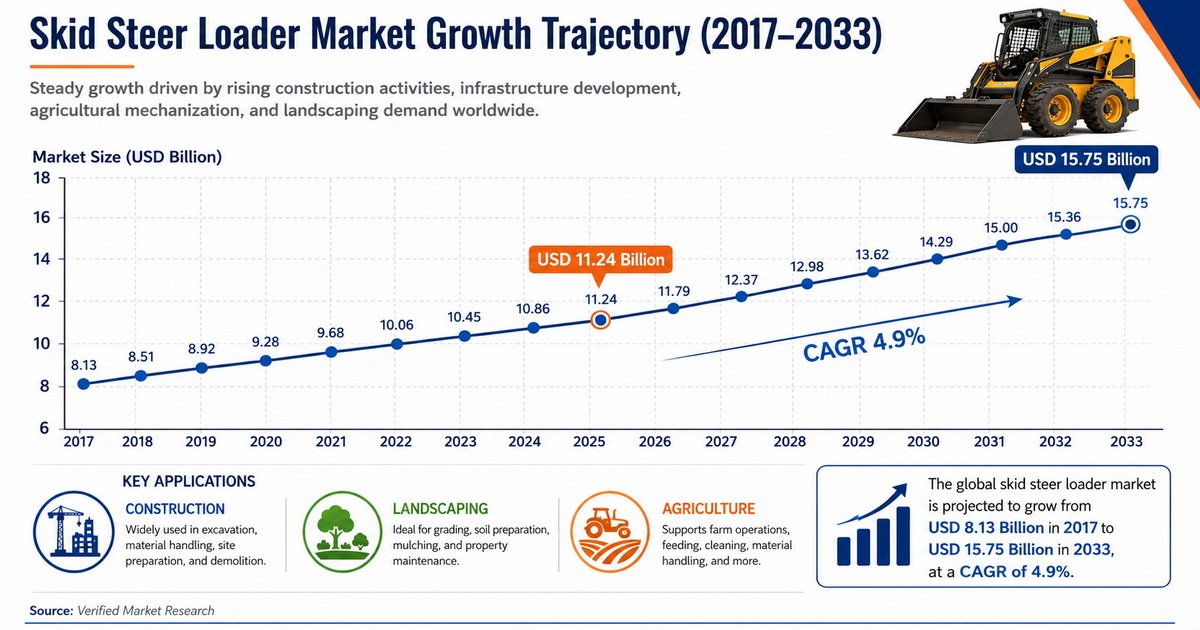
The skid steer loader and compact track loader market has evolved dramatically since 2017, transforming from straightforward earthmoving equipment into technologically advanced, intelligent machines. As a construction equipment specialist with over a decade of experience working with manufacturers like Certeg, I’ve witnessed firsthand how compact loader technology has reshaped construction, landscaping, and agricultural operations worldwide. The global skid steer loader market reached USD 11.24 billion in 2025 and is projected to hit USD 15.75 billion by 2033, growing at a 4.9% CAGR. [datamintelligence]
This comprehensive guide analyzes current market trends, technological innovations, and strategic buying considerations to help contractors, fleet managers, and construction professionals make informed equipment investments.
Market Evolution Since 2017
The compact loader landscape has undergone significant transformation over the past decade. In 2015-2016, compact track loader sales surged approximately 17% year-over-year, surpassing traditional wheeled skid steer sales for the first time. This trend has accelerated through 2026, with compact track loaders now commanding 35.45% of the compact construction equipment market share. [compactequip]
Key market shifts include:
– Capacity preferences: The 1,750-2,200 lbs rated operating capacity range still represents over 42% of skid steer sales, maintaining consistency since 2017 [compactequip]
– Power segment dominance: Machines under 100 HP lead with 52% of the power output segment, while diesel-powered equipment maintains 68% market share [futuremarketinsights]
– Regional growth: Emerging economies are driving expansion through accelerating residential, commercial, and infrastructure construction [factmr]
– Electrification momentum: Electric and hybrid skid steer loader portfolios expanded significantly in March 2026, supporting low-emission construction initiatives [openpr]
The construction industry’s recovery from 2017 onward has been sustained by robust residential and commercial development. While agricultural and energy sectors experienced volatility, urban construction projects—where skid steers and track loaders excel in confined spaces—have flourished. [compactequip]
Track Loaders vs Wheeled Skid Steers
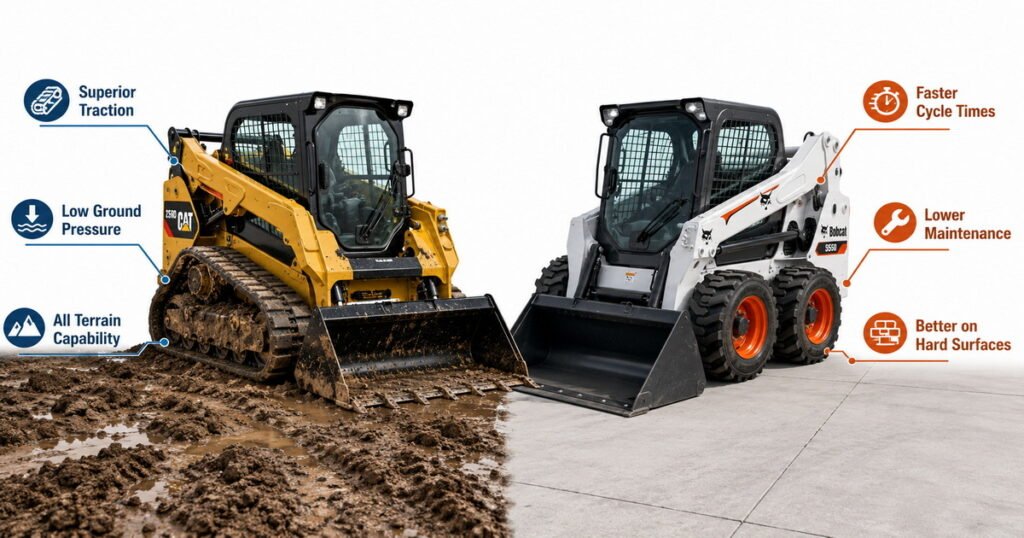
The compact track loader advantage has become increasingly evident through real-world applications. These rubber-tracked machines, also called multi-terrain loaders, deliver superior flotation, traction, and lower ground pressure compared to wheeled counterparts. [compactequip]
Track loader benefits:
– Enhanced traction: Dedicated undercarriages distribute weight across multiple contact points, providing exceptional power for dozing operations [compactequip]
– Reduced ground disturbance: Lower ground pressure minimizes soil compaction and turf damage, critical for landscaping and sensitive site work [fortunebusinessinsights]
– Weather adaptability: Superior flotation allows operations during wet conditions when wheeled units would struggle [compactequip]
– Application expansion: Track loaders have penetrated traditionally skid-steer-dominated sectors including agriculture [compactequip]
In 2015, compact track loader sales reached approximately 37,000 units, jumping to 45,000 units in 2016. By comparison, wheeled skid steers sold around 31,000 units in 2015 and 33,000 units in 2016. This market shift reflects contractors recognizing that track loaders’ versatility justifies the higher initial investment. [compactequip]
However, wheeled skid steers maintain advantages in specific applications: [compactequip]
– Hard surface operations: Superior cycle times on paved surfaces and concrete
– Lower ownership costs: Reduced maintenance expenses and longer service intervals
– Transport efficiency: Easier and more cost-effective to move between jobsites
The pricing gap between wheeled and tracked models has narrowed as technologies mature, making track loaders more accessible to small and medium contractors. [compactequip]
Technology Integration and Smart Features
April 2026 marked a watershed moment when manufacturers introduced next-generation skid steer loaders featuring enhanced hydraulic systems, improved fuel efficiency, and advanced telematics for real-time equipment monitoring and predictive maintenance. At CES 2026, Bobcat showcased compact equipment incorporating AI, autonomy, electrification, and connectivity, demonstrating the industry’s commitment to pushing technological frontiers. [datamintelligence]
Operator Comfort and Safety Innovations
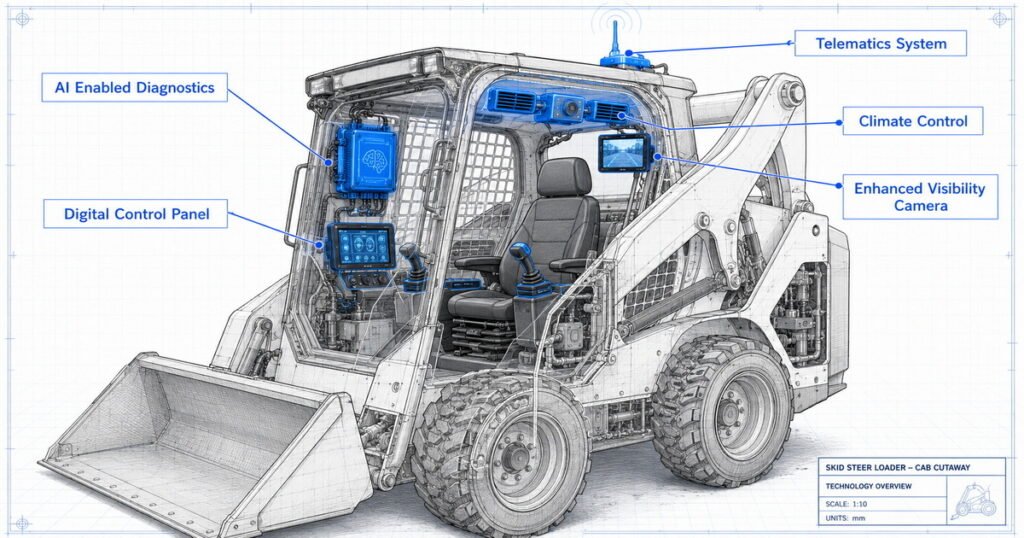
Modern skid steer and track loader cabs have evolved into all-day mobile offices with features that dramatically improve productivity: [fortunebusinessinsights]
– Ergonomic control systems: Low-effort electro-hydraulic (EH) controls with ISO, H-pattern, and foot control options
– Climate control: Pressurized cabins with air conditioning, heating, and air-ride heated/ventilated seats [equipmentworld]
– Enhanced visibility: Larger windows and backup cameras for improved situational awareness [equipmentworld]
– Digital monitoring: Sophisticated control panels enabling attachment automation and machine customization [compactequip]
– Collision warning systems: AI-enabled safety features to prevent accidents on busy construction sites [datamintelligence]
Hydraulic and Attachment Advancements
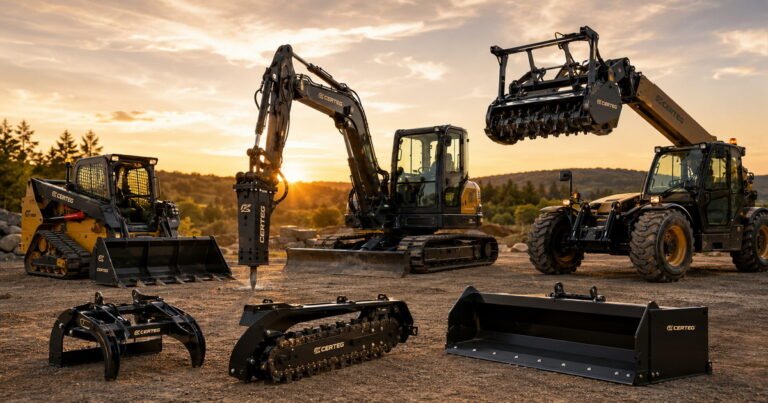
The versatility of skid steers and track loaders stems from their ability to operate hundreds of hydraulic and non-hydraulic attachments. Recent innovations have expanded this capability: [compactequip]
– High-flow hydraulic systems: Increased pressure ratings enabling operation of demanding attachments like cold planers and forestry mulchers [fortunebusinessinsights]
– Multi-attachment compatibility: Universal quick-attach systems (introduced 2023-2025) allowing seamless switching between tools [fortunebusinessinsights]
– Smart attachment integration: Systems like JCB’s MyChoice allow operators to customize machine responsiveness based on specific attachment requirements [compactequip]
– Power quick-hitches: Tool-free attachment changes reducing downtime and improving efficiency [compactequip]
Telematics and Fleet Management
Telematics integration has become standard on mid-to-high-tier models, allowing fleet owners to monitor usage, maintenance schedules, and productivity remotely. In January 2026, OEMs focused heavily on integrating smart control systems, joystick automation, and AI-enabled diagnostics to improve operator efficiency and reduce downtime. [openpr]
Benefits include:
– Predictive maintenance: Early warning systems preventing catastrophic failures
– Usage optimization: Data-driven insights identifying underutilized equipment
– Security features: Geofencing capabilities preventing theft and unauthorized use [compactequip]
– Performance tracking: Operator behavior analysis for training and productivity improvements [compactequip]
Vertical Lift vs Radial Lift Configurations
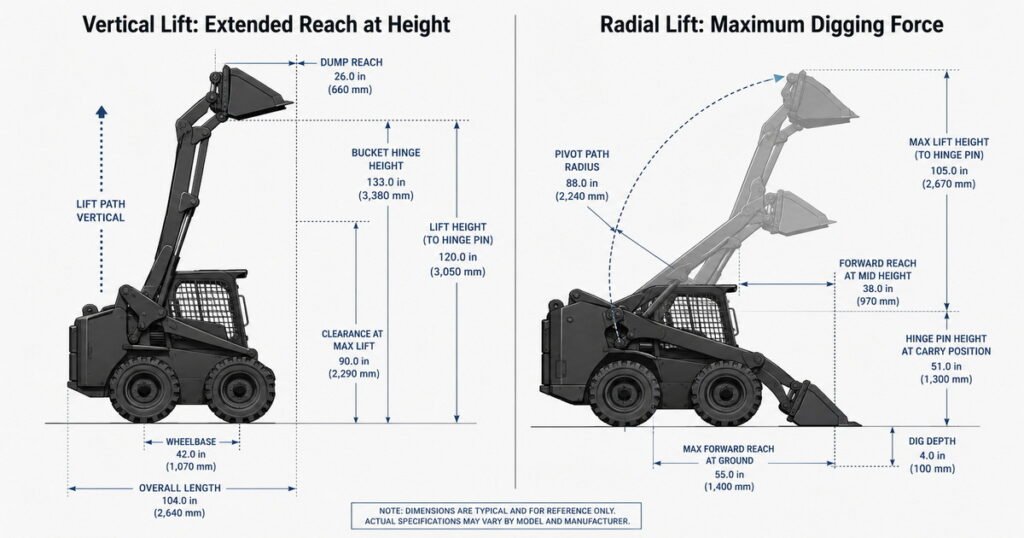
Understanding lift patterns is crucial for matching equipment to application. Vertical-lift designs now dominate approximately two-thirds of all models, reflecting strong demand for lifting and loading applications. [compactequip]
Vertical Lift Advantages
Invented by New Holland in 1972 with the L35 skid steer loader, vertical-lift linkage uses two pivot points allowing the boom to raise the bucket straight upward. This configuration excels in: [compactequip]
– High-reach applications: Extended reach at full height for truck loading from center positions
– Material handling: Superior stability when transporting heavy loads
– Container loading: Optimal for feeding high-side trucks, feed carts, and elevated containers [compactequip]
Modern vertical-lift track loaders like the Takeuchi model released in recent years represent the largest capacity in the industry. Cat’s 262D delivers extended reach of 50.9 inches and lift height of 124.9 inches with a 2,700 lbs rated operating capacity. [equipmentwatch]
Radial Lift Applications
The original skid steer design features a single pivot point, creating an arcing lift path. Radial-lift machines remain popular for: [compactequip]
– Grading and excavation: Superior digging force at ground level
– Backfilling operations: Natural scooping motion ideal for moving material
– Cost-conscious buyers: More economical pricing for basic applications [compactequip]
– Prying and dragging: Enhanced leverage for demanding groundwork [compactequip]
Emissions Compliance and Engine Technology
Tier 4 Final regulations, which hit most small diesel engine power ranges in 2015-2016, continue shaping the compact loader market. These stringent EPA standards increased unit costs by $2,000-$5,000 but delivered significant benefits: [compactequip]
– Fuel efficiency: Advanced engine designs consuming less diesel per operating hour
– Reduced emissions: Cleaner operation meeting environmental regulations
– Enhanced performance: More sophisticated power delivery and responsiveness [compactequip]
Emission Control Technologies
Manufacturers employ two primary approaches to Tier 4 Final compliance: [compactequip]
1. Diesel Particulate Filters (DPF):
– Exhaust filters requiring periodic regeneration (cleaning) every 6-8 hours
– Automatic regeneration processes burning off accumulated carbon/soot
– Buyer consideration: Some operators prefer DPF-free designs to eliminate regeneration requirements [compactequip]
2. Selective Catalytic Reduction (SCR):
– Introduced by Case Construction Equipment on the SR270 skid steer in 2015
– Requires Diesel Exhaust Fluid (DEF) at approximately one-third the fuel consumption ratio
– Consideration: Total fluid consumption includes both fuel and DEF when calculating operating costs [compactequip]
Sustainability and Alternative Power
The March 2026 expansion of electric and hybrid skid steer loader portfolios signals a major industry shift toward sustainability. Battery-electric adoption is accelerating due to: [openpr]
– Urban emission regulations: Restrictions on diesel equipment in cities
– Operating cost reductions: Lower energy costs compared to diesel fuel
– Noise reduction: Electric models enabling operation in noise-sensitive environments
– Zero-emission requirements: Municipal and infrastructure projects mandating clean equipment [mordorintelligence]
Strategic Buying Considerations for 2026
Capacity Selection
Despite manufacturer emphasis on larger models, the mid-capacity range (1,750-2,200 lbs ROC) represents 42% of the market. This “sweet spot” balances: [compactequip]
– Versatility: Handles most construction, landscaping, and agricultural tasks
– Maneuverability: Compact enough for confined urban jobsites
– Transport logistics: Fits standard trailers without special permits
– Attachment compatibility: Supports widest range of hydraulic tools
Larger capacity units (like Case’s largest skid steer released in 2016) serve specialized applications requiring maximum lifting power but command premium prices. [compactequip]
Feature Prioritization
Contractors are increasingly specifying high-specification units with productivity-enhancing features: [compactequip]
– Climate-controlled cabs: Heat and AC for year-round operator comfort
– Two-speed travel: Increased transport speed between work areas
– Parallel lift systems: Automatic bucket and attachment leveling
– Smooth ride systems: Suspension technology reducing material spillage and operator fatigue [compactequip]
Traditional hand and foot controls still represent 25% of the market, appealing to operators preferring mechanical simplicity. [compactequip]
Rental vs Purchase Analysis
February 2026 saw rental service providers significantly expanding compact skid steer loader fleets to meet growing demand from small and medium contractors. Rental considerations include: [openpr]
Rental advantages:
– Lower upfront capital investment
– Access to latest technology without long-term commitment
– Maintenance and service included in rental agreements
– Flexibility to match equipment to specific project requirements
Purchase advantages:
– Long-term cost efficiency for high-utilization operations
– Customization with company branding and specialized attachments
– Tax benefits through depreciation and Section 179 deductions
– Immediate availability without rental scheduling constraints
Manufacturer Landscape
Fifteen major brands compete in the North American skid steer and track loader market: ASV, Bobcat, Case, Cat, Gehl, JCB, IHIMER, John Deere, Kubota, Mustang, New Holland, Takeuchi, Volvo, Wacker Neuson, and Yanmar. [compactequip]
Market leaders include: [compactequip]
– Bobcat: Industry pioneer with 15 skid steer models covering diverse price and performance points
– Caterpillar: Premium positioning with advanced technology integration
– John Deere: Strong construction and agricultural market presence
– CNH (Case/New Holland): Differentiated product lines under two brands
Notable developments:
– Terex exited the compact equipment market in 2016, selling assets to Yanmar [compactequip]
– Kubota achieved successful market penetration since releasing first skid steers in 2015 [compactequip]
– JCB custom manufactures Volvo’s skid steers through supply agreement [compactequip]
– Gehl and Mustang share similar designs under Manitou ownership [compactequip]
Application-Specific Recommendations
Construction and Urban Development
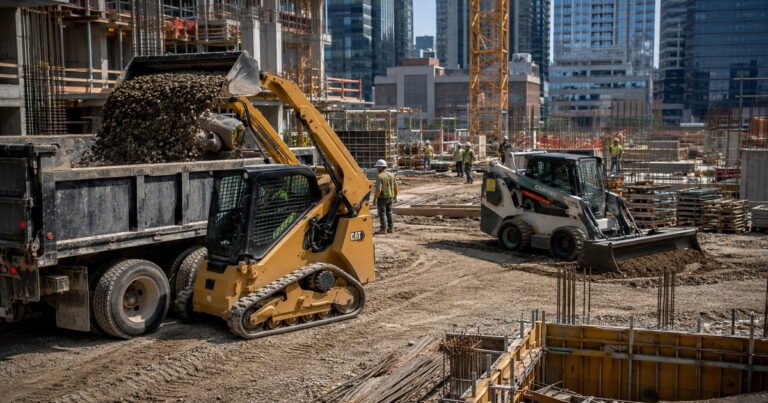
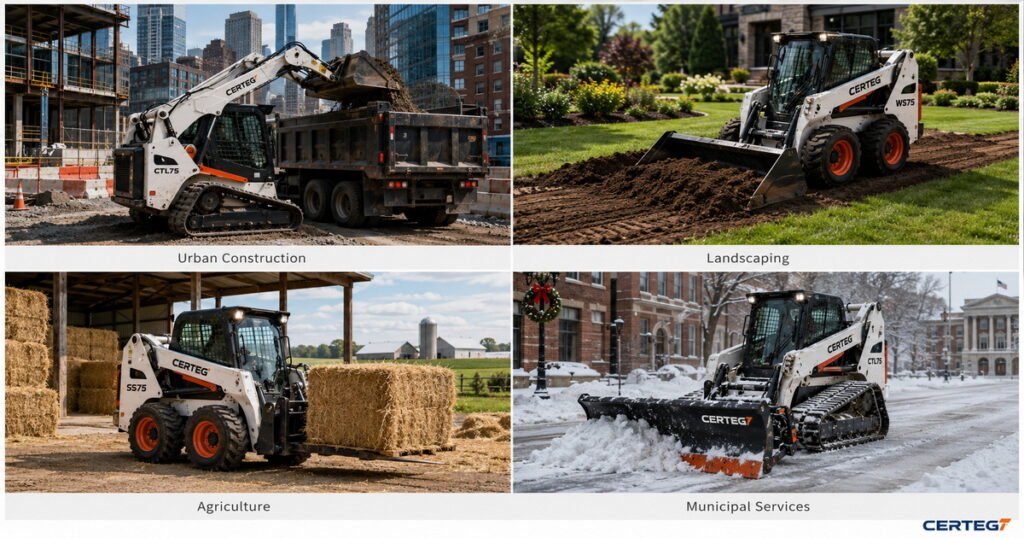
Urban infill projects favor machines under 13 tons, with the 2-5 ton class accounting for 47.96% of market share in 2024. December 2025 demand strengthened in urban construction and municipal applications, particularly for road maintenance, snow removal, and landscaping. [mordorintelligence]
Optimal specifications:
– Compact track loaders for mixed terrain and weather conditions
– Vertical-lift configuration for material loading
– High-flow hydraulics for breaker and planer attachments
– Telematics for urban fleet management
Landscaping and Grounds Maintenance
Landscape operations continue driving compact track loader growth. Specialized requirements include: [compactequip]
– Low ground pressure for turf protection
– Quick-attach systems for frequent tool changes (mowers, augers, graders)
– Parallel lift for precise grading work
– Operator comfort features for extended daily use
Agricultural Operations
While agriculture experienced commodity price-driven declines from 2016-2017, the sector has shown renewed interest in compact track loaders. Agricultural applications demand: [compactequip]
– High tractive effort for manure handling and feed distribution
– Radial-lift configurations for bucket work
– Simplified maintenance for operator servicing
– Attachment versatility for seasonal task variation
Future Market Outlook
The skid steer loader industry is projected to maintain steady growth through 2033-2036, with different market research firms forecasting values between USD 10.9-15.75 billion by the mid-2030s. Key drivers include: [factmr]
– Infrastructure investment: Government spending on roads, bridges, and public works
– Residential construction: Housing production targeting 1.5 million annual units [compactequip]
– Commercial development: Office and lodging market expansion [compactequip]
– Technology adoption: AI, autonomy, and electrification attracting new buyers [datamintelligence]
– Attachment innovation: Expanding application possibilities in forestry, recycling, and specialty construction [compactequip]
Emerging trends to watch:
– Autonomous assistance: Semi-autonomous features for repetitive tasks
– Electrification expansion: Battery technology improvements extending runtime
– Connectivity integration: IoT sensors enabling predictive analytics
– Operator assistance: AI-powered systems optimizing fuel consumption and productivity [datamintelligence]
The sub-2-ton category is set to advance at a 7.59% CAGR through 2030, indicating strong demand for ultra-compact units. Meanwhile, compact excavators are projected to grow at 10.48% CAGR, suggesting potential market share competition. [mordorintelligence]
Conclusion
The skid steer and track loader market has matured significantly since 2017, with compact track loaders establishing dominance in versatility-demanding applications while wheeled skid steers maintain value in specific use cases. Technology integration—from advanced hydraulics to AI-enabled diagnostics—has transformed these machines into sophisticated productivity platforms. [openpr]
For equipment buyers in 2026, success depends on matching capacity, lift configuration, and feature packages to specific operational requirements while considering long-term technology trends. The mid-capacity range (1,750-2,200 lbs ROC) continues offering the best balance of versatility and value for most applications. Whether purchasing or renting, prioritizing operator comfort, attachment compatibility, and telematics capabilities will maximize productivity and return on investment. [compactequip]
As Certeg and other manufacturers continue innovating in both wheeled and tracked configurations, buyers benefit from competitive pricing, expanded feature sets, and improved reliability. The future of compact loaders lies in intelligent, sustainable, operator-centric machines that adapt to diverse applications—a promising evolution that serves the construction industry well.
Frequently Asked Questions
Q1: Should I choose a compact track loader or wheeled skid steer in 2026?
Choose a compact track loader if your operations involve soft terrain, wet conditions, landscaping, or applications requiring low ground pressure and maximum traction. Select a wheeled skid steer for primarily hard-surface work, cost-conscious budgets, or applications where faster cycle times and easier transport are priorities. Track loaders now represent the majority of compact loader sales due to their versatility. [compactequip]
Q2: What rated operating capacity (ROC) should I target for general construction work?
The 1,750-2,200 lbs ROC range represents the industry sweet spot, accounting for over 42% of skid steer sales. This capacity handles most construction, landscaping, and light agricultural tasks while maintaining excellent maneuverability in confined spaces. Larger capacities serve specialized heavy-lifting applications but come with higher costs and reduced agility. [compactequip]
Q3: Are electric skid steer loaders practical for full-time construction use in 2026?
Electric and hybrid models have expanded significantly, with major manufacturers launching new portfolios in March 2026. They’re practical for urban construction, municipal maintenance, and noise-sensitive environments but currently face limitations in runtime and charging infrastructure for remote jobsites. Diesel-powered equipment still dominates with 68% market share, though battery technology improvements are accelerating adoption. [futuremarketinsights]
Q4: What’s the price difference between Tier 4 Final diesel engines and older technology?
Tier 4 Final compliance adds approximately $2,000-$5,000 to equipment costs. However, these engines deliver improved fuel efficiency, reduced emissions, and enhanced performance that can offset the initial investment through lower operating costs. Buyers should calculate total fluid consumption (fuel plus DEF for SCR systems) when comparing ownership costs. [compactequip]
Q5: How important are telematics and digital features for small contractors?
Telematics has become standard on mid-to-high-tier models, offering significant value even for small fleets. Benefits include predictive maintenance (preventing costly breakdowns), theft prevention through geofencing, and usage optimization identifying underutilized equipment. For single-machine operators, basic digital control panels that customize attachment settings and automate routine tasks provide immediate productivity gains without monthly subscription costs. [fortunebusinessinsights]
References
1. Compact Equipment. “Planning on Buying a Skid Steer or Track Loader? Check Out Our 2017 Loader Market Watch.” https://compactequip.com/skid-steers/2017-skid-steertrack-loader-market-watch/
2. EquipmentWatch. “2017 Caterpillar 262 Loaders, Skid Steer, Large.” February 15, 2017. https://equipmentwatch.com/2017-highest-retained-value-awards/2017-caterpillar-262-loaders-skid-steer-large/
3. Fortune Business Insights. “Skid Steer Loader Market Size, Industry Share | Forecast 2026-2034.” April 19, 2026. https://www.fortunebusinessinsights.com/skid-steer-loader-market-104089
4. Fact.MR. “Skid Steer Loader Market Share and Statistics 2025-2035.” January 31, 2025. https://www.factmr.com/report/389/skid-steer-loader-market
5. DataM Intelligence. “Skid Steer Loader Market Size, Trends & Forecast 2033.” April 12, 2026. https://www.datamintelligence.com/research-report/skid-steer-loader-market
6. OpenPR. “Future of Skid Steer Loader Market (2026-2033) | Infrastructure.” April 17, 2026. https://www.openpr.com/news/4477676/future-of-skid-steer-loader-market-2026-2033-infrastructure
7. Mordor Intelligence. “Compact Construction Equipment Market Size & Share Analysis.” September 23, 2025. https://www.mordorintelligence.com/industry-reports/compact-construction-equipment-market
8. Equipment World. “Skid Steer Buyer’s Guide 2026.” March 17, 2026. https://www.equipmentworld.com/construction-equipment/compact-equipment/skid-steer-loaders/article/15819941/skid-steer-buyers-guide-2026
9. Markets and Markets. “Compact Construction Equipment Market Report 2025.” https://www.marketsandmarkets.com/Market-Reports/compact-construction-equipment-market-89115103.html
10. Future Market Insights. “Compact Construction Equipment Market Size, Share & Forecast.” May 7, 2026. https://www.futuremarketinsights.com/reports/global-compact-construction-equipment-market
Hot Tags: Skid Steer Loader, Manufacturers, Customized, Custom, Suppliers, Buy, Cheap, Quality, Advanced, Durable, in Stock, Made in China, Price, Quotation