
Skid Steer Loaders Evolved: What Manitou’s V‑Series and VT‑Series Teach Us About Next‑Gen Compact Equipment
Content Menu
● Understanding Today’s Skid Steer and CTL Market
● Manitou’s Two‑Brand Strategy: Lessons for Global Manufacturers
● Inside the V‑Series Skid Steers and VT‑Series Track Loaders
● New Lift Arm Design: Visibility, Cleanliness, and Speed
● Performance Upgrades: Hydraulics, Breakout Force, and Productivity
● Serviceability: Why Technicians and Fleet Managers Care
● Cab Redesign: Visibility, Protection, and Operator Comfort
● Doors, Controls, and Safety: Human‑Centered Design Details
● Radial vs Vertical Lift: Where the 1950 RT Fits
● How Certeg Applies These Lessons in OEM/ODM Skid Steer Design
● What to Look For When Evaluating Modern Skid Steers and CTLs
● Skid Steer and CTL Feature Snapshot
● How Certeg Can Support Your Next Skid Steer Program
● Frequently Asked Questions (FAQ)
>> 1. What is the main difference between vertical lift and radial lift skid steers?
>> 2. Why does serviceability matter so much for skid steers and CTLs?
>> 3. How do cab visibility improvements impact safety on the jobsite?
>> 4. Are larger fuel tanks always better on compact loaders?
>> 5. How can I apply these design lessons when choosing or specifying machines from Certeg?
As someone who has spent years walking construction sites, talking with operators, and helping manufacturers like Certeg optimize their machines for real‑world conditions, I see Manitou’s new V‑Series skid steers and VT‑Series compact track loaders (CTLs) as a blueprint for where the compact equipment market is heading. These loaders are not just incremental updates; they reflect deeper shifts in how contractors buy, operate, and maintain high‑value compact machines worldwide. [lovellmediagroup]
Understanding Today’s Skid Steer and CTL Market
Over the last decade, demand for compact equipment in the U.S. has stayed consistently strong and continues to grow. Roughly 260,000 compact machines were sold around 2022, with analysts projecting a 5–7% compound annual growth rate in the coming years. Much of that growth comes from rental, tight labor markets, and contractors favoring versatile, multi‑task machines over large, single‑purpose iron. [raddinteractive]
From my perspective working with global buyers, three trends stand out:
– Lifecycle cost is king – Buyers scrutinize fuel burn, uptime, serviceability, and resale value more than ever. [qrolic]
– Application fit beats brand loyalty – Contractors compare lift paths, undercarriage options, auxiliary hydraulics, and cab features by job type: residential pads, roadwork, livestock operations, plant maintenance, and more. [salesfunnelprofessor]
– Rental‑first mindset – Many small and mid‑sized contractors “try before they buy,” meaning machine design must satisfy both owner‑operators and rental fleets. [raddinteractive]
This is the competitive backdrop against which Manitou redesigned its skid steers and CTLs—and it’s the same environment in which a manufacturer like Certeg must position its own wheeled and track skid steer loaders.
Manitou’s Two‑Brand Strategy: Lessons for Global Manufacturers
Manitou’s story is also a story about branding and market positioning. Founded in 1957 in France, the company has grown into one of Europe’s top equipment makers and now sells one in four telehandlers globally. To build a stronger foothold in North America, Manitou acquired Gehl in 2008—a bold move during the housing crash but one that paid off as the compact segment rebounded.
Today, Manitou operates with a dual‑brand strategy:
– Gehl – Deep roots in North American agriculture, long‑term brand trust, machines that many farmers have run for 15–20 years.
– Manitou – Broader global identity, complementary product lines, and machines that fill gaps in the Gehl lineup.
From an OEM/ODM perspective, there are several takeaways:
– Different segments, different stories – Agricultural customers, urban contractors, and rental companies respond to different narratives and spec priorities. [lovellmediagroup]
– Dealer networks matter – Manitou leverages both Gehl and Manitou dealers, allowing each to sell and service both brands and expand coverage without duplicating infrastructure. [salesfunnelprofessor]
– Local manufacturing builds trust – Celebrating 50 years of skid steer production in the U.S. and expanding the Madison, South Dakota plant signals long‑term commitment to North American customers.
Manufacturers like Certeg can mirror this approach by offering co‑branded or private‑label machines for different regions while maintaining a common engineering platform underneath.
Inside the V‑Series Skid Steers and VT‑Series Track Loaders
The V‑Series skid steers and VT‑Series compact track loaders represent Manitou and Gehl’s first full clean‑sheet redesign of their skid steer/CTL platform since around 2009. After extensive feedback from dealers and end users, Manitou focused on five critical areas: serviceability, safety, simpler operation, higher productivity, and better operator comfort.
Key platform characteristics include:
– Mid‑size frames with rated operating capacities from 2,100 lb to 2,750 lb at 35% of tipping load.
– Vertical lift architecture across both skid steer and CTL lines, which improves reach at full lift height for loading trucks and hoppers.
– Weight‑optimized chassis to maintain lift capacity while improving ground speed and cycle times.
Manitou used the well‑liked 1650 RT radial‑lift CTL—a machine praised by dealers and operators for its driving and maneuvering characteristics—as the handling benchmark for the new platform. By basing the V‑/VT‑Series geometry on that proven layout, Manitou ensured the new models feel nimble and confidence‑inspiring on tight jobsites.
For buyers comparing options across brands, this kind of platform continuity is critical: operators don’t have time to “relearn” controls and balance on every machine.
New Lift Arm Design: Visibility, Cleanliness, and Speed
One of the most distinctive engineering changes on the new V‑ and VT‑Series machines is the fully redesigned lift arm. Instead of a flat, debris‑catching profile, the new arm slopes down and away from the operator.
This design delivers several practical benefits:
– Less material buildup – Hay, silage, dirt, and stone slide off rather than accumulating on top of the arms.
– Better ground visibility – The shape provides roughly an extra inch to 1.25 inches of downward sightline, translating into 2–3 feet of additional visibility along the machine’s sides at ground level.
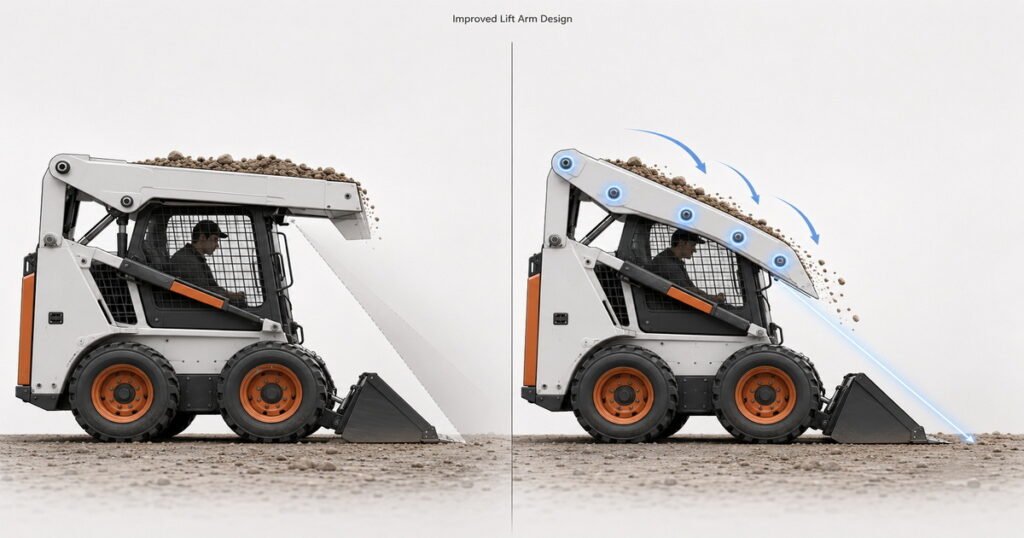
– Faster daily greasing – Grease‑able pins are aligned along the side of the arms so an operator can walk the machine and grease all points efficiently, cutting greasing time roughly in half.
– Improved lighting – LED work lights mounted under each arm illuminate the working area when loading trucks or working at night.
From an engineering standpoint, this is a good example of multi‑functional design: a single structural change enhances cleanliness, safety, ergonomics, and service time. Manufacturers like Certeg can apply similar thinking to boom geometry and service points on their own skid steer and CTL platforms.
Performance Upgrades: Hydraulics, Breakout Force, and Productivity
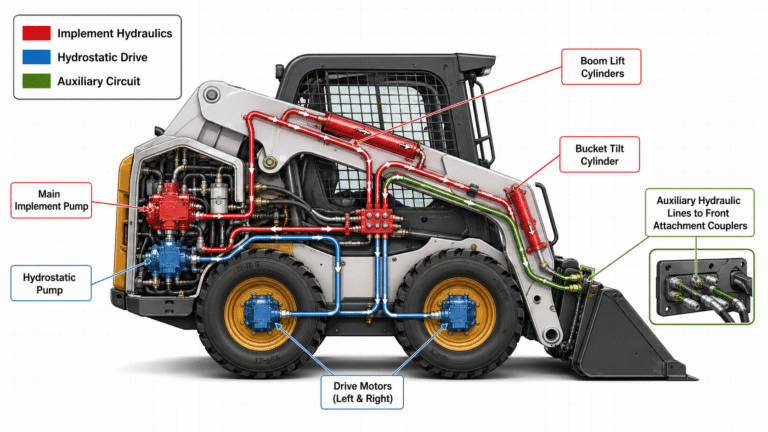
Beyond chassis and arm geometry, Manitou invested heavily in hydraulic performance and structural optimization. The new skid steers and CTLs feature:
– Higher hydraulic pressure and flow, improving attachment performance and lift speeds.
– Larger lift cylinder bores and repositioned lift and tilt cylinders for better leverage.
– Average breakout force gains of about 12% across the range.
– A fuel tank approximately 14% larger, extending working intervals between refuels.
When I talk to fleet owners, they consistently connect these improvements directly to profitability:
– Higher breakout forces mean faster bucket fill in tough materials.
– Increased hydraulic power unlocks more demanding attachments—planers, mulchers, high‑flow brooms—which in turn expands revenue‑generating applications.
– Larger fuel capacity and faster cycle times reduce non‑productive downtime over the course of a shift.
This is the same mindset Certeg applies when designing compact equipment for global OEM/ODM partners: not just looking at headline horsepower, but optimizing throughput per engine hour.
Serviceability: Why Technicians and Fleet Managers Care
In my experience, serviceability is often the deciding factor for large fleets—and Manitou clearly treated it as a core design pillar. The new machines introduce several maintenance‑friendly features:
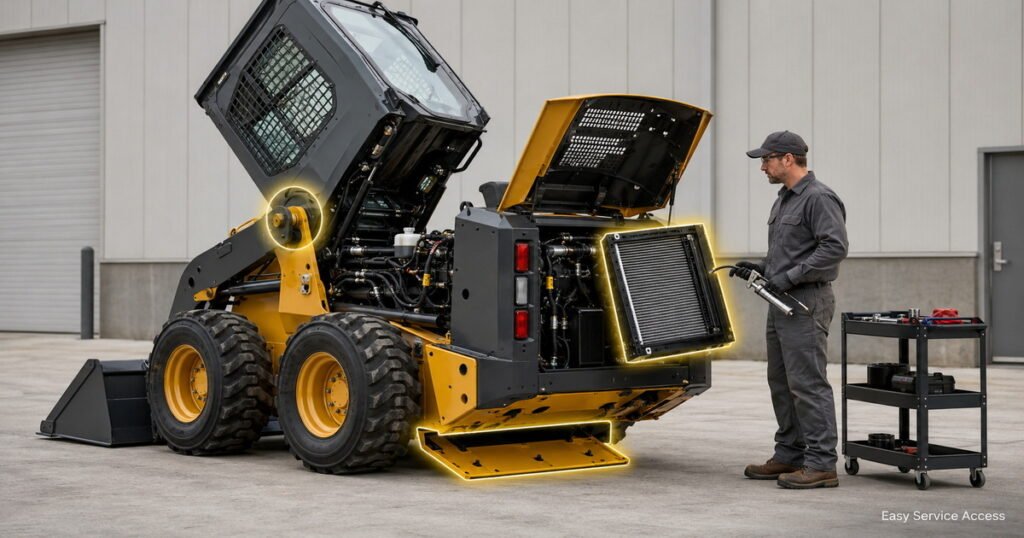
– Lift‑up cab design tilts the entire cab assembly up to about 62 degrees, giving direct access to the hydraulic and electrical components beneath.
– Unlike many competitors, the cab can tilt with the lift arms either raised or lowered, adding flexibility in the yard or workshop.
– The cooler assembly tilts up about 28 degrees and includes a removable panel for easy wash‑out, crucial for dusty, silty, or agricultural environments.
– Bottom access panels can be removed and reinstalled by one person, enabling technicians to reach anything not accessible from the front, sides, or rear.
For global buyers and rental fleets, features like these translate into:
1. Shorter service windows – Less time spent disassembling components just to reach filters, hoses, or valves.
2. Lower labor cost – One technician can safely handle more tasks without extra support or specialized tooling.
3. Higher uptime – Faster turnarounds when faults occur in the field.
When Certeg engineers its own wheeled and track skid steer loaders, we treat this kind of maintenance access planning as a non‑negotiable, especially for export markets where skilled technicians may be limited.
Cab Redesign: Visibility, Protection, and Operator Comfort
Operator comfort and safety have moved from “nice to have” to must‑have in competitive bids. Manitou’s new cab architecture on the V‑ and VT‑Series is a clear acknowledgement of that reality.
Major changes include:
– 23% larger cab compared to previous designs, giving operators more space to move and less fatigue over long shifts.
– A reworked footwell with drain plug, allowing operators to wash out mud and debris and keep the cab cleaner.
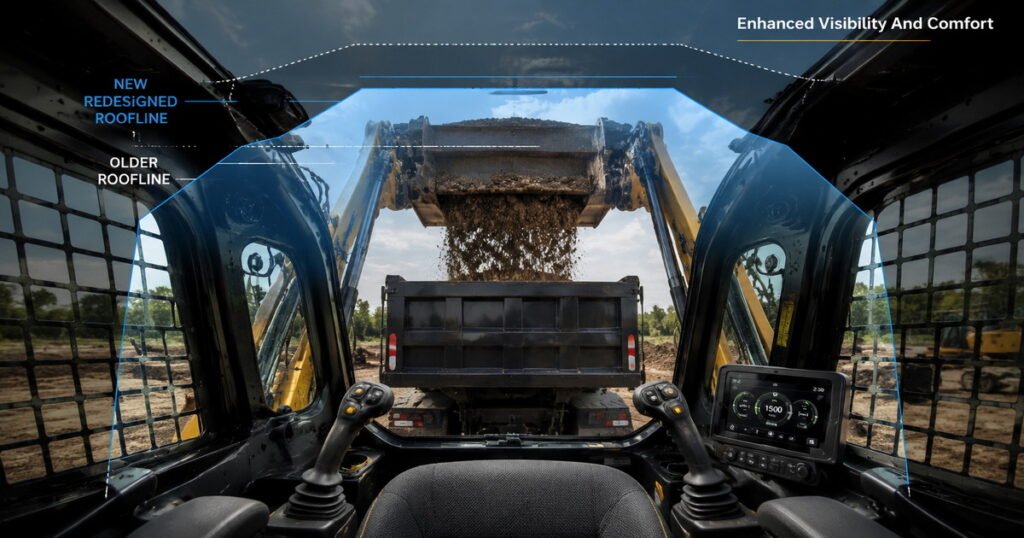
– An estimated 20% increase in visibility, thanks to structural changes and roof redesign.
Historically, Manitou and Gehl provided FOPS Level 2 protection as standard—a higher level than many competitors. After speaking with customers, they concluded that Level 2 as standard was over‑spec’d for most use cases; those working in mulching, demolition, or extreme conditions often require more than just roof protection anyway.
So, on the new machines, Manitou:
– Returned to FOPS Level 1 as standard while still offering higher protection options where needed.
– Used thinner but structurally appropriate materials to reshape the roofline.
The redesigned roof slopes forward between the work lights and has become the subject of a patent application. This change significantly reduces the blind spot at full lift: where a typical machine might have a 2–3 inch blind zone at the top of the operator’s view, Manitou claims to cut this down to about 1.25 inches.
From an operator’s standpoint, that means:
– Better visibility into trucks and hoppers during tipping.
– Reduced neck strain from repeated repositioning to see past the roof edge.
– Faster, more confident loading cycles, especially in high‑volume operations.
Doors, Controls, and Safety: Human‑Centered Design Details
Inside the cab, Manitou has paid particular attention to how operators actually enter, exit, and control the machine. These are subtle details that experienced users notice immediately.
Highlights include:
– Fold‑up door on skid steers – Previously popular on CTLs, the fold‑up polycarbonate door is now available on skid steers as well. It folds along a crease so the door stows above the operator—but not directly overhead—balancing visibility and headroom.
– Narrowed steel frame around the two‑piece door improves sightlines, and the crease is positioned so that work tools remain below the operator’s line of sight.
– 7‑inch color display with a simplified interface, keyless start, and intuitive configuration menus.
– Improved pilot controls that move with the seat like electro‑hydraulic controls, maintaining the tactile feedback operators prefer while boosting ergonomics.
From a safety and access standpoint, Manitou also:
– Lowered the cab opening by about 3 inches to reduce tripping risk when entering or exiting.
– Added egress lighting and additional tie‑down points for better transport and emergency safety.
– Integrated a machine lockout switch that keeps the workgroup (lift/bucket) locked while releasing the parking brake, letting operators reposition the machine without worrying about unintended boom movement.
These kinds of features often don’t show up in spec sheets, but they strongly influence operator satisfaction, training time, and safety records—key differentiators when fleets choose between brands.
Radial vs Vertical Lift: Where the 1950 RT Fits
While the V‑ and VT‑Series are Manitou and Gehl’s flagship medium‑frame vertical‑lift machines, the company also builds on the success of its 1650 RT CTL foundation. The new 1950 RT is a simplified, nimble radial‑lift compact track loader that deliberately omits some of the “bells and whistles” of the flagship series.
This matters for buyers who:
– Prefer radial lift for better digging and grading performance at mid‑range heights.
– Need a lower acquisition cost without sacrificing core power and maneuverability.
– Want a rugged, straightforward CTL suitable for rental fleets or harsh environments.
By offering both radial and vertical lift designs within the same overall platform, Manitou—and manufacturers like Certeg—can tailor machines to specific job profiles instead of forcing a one‑size‑fits‑all compromise.
How Certeg Applies These Lessons in OEM/ODM Skid Steer Design
From an industry practitioner’s standpoint, Manitou’s redesign validates several principles we already follow in Certeg’s own skid steer loader and compact track loader development.
When we engineer machines for global construction and agriculture markets, we:
– Prioritize application‑driven specs: lift path, undercarriage type (wheeled vs track), auxiliary hydraulics, and attachment compatibility tailored to regional tasks.
– Design for easy service access, including large rear doors, side panels, and—where required—tilting cabs and swing‑out coolers.
– Balance cab comfort and safety with clear visibility, ergonomic controls, and optional protection packages for high‑risk applications.
– Offer flexible branding and configuration for OEM and private‑label partners who need differentiated machines based on geography, dealer strategy, or price positioning. [lovellmediagroup]
If you are specifying or sourcing skid steers and CTLs for your own fleet or as a dealer, the Manitou V‑/VT‑Series can serve as a helpful benchmark for what a modern, globally competitive compact loader should look like in 2026 and beyond.
What to Look For When Evaluating Modern Skid Steers and CTLs
When I walk a yard with fleet managers or procurement teams, we usually evaluate machines using a simple but structured checklist. Here is a condensed version you can apply when comparing Manitou, Certeg, and other brands:
1. Lift path and capacity
– Vertical vs radial lift based on your applications.
– Rated operating capacity and tipping load at typical working positions.
2. Hydraulic system
– Standard and optional flow/pressure.
– Compatibility with key attachments you use today and plan to use in the future.
3. Undercarriage and traction
– Track vs wheeled configuration for your soil types and climates.
– Track design, sprocket layout, and ground pressure for CTLs.
4. Service and maintenance access
– Access to filters, batteries, hoses, and valves.
– Tilt‑cab features, cooler clean‑out access, and diagnostic ports.
5. Cab environment and safety
– Visibility to attachment, sides, and overhead dump height.
– FOPS/ROPS levels, door design, lighting, and egress options.
6. Total cost of ownership
– Fuel consumption, service intervals, parts availability, and resale value.
Using a framework like this helps you move beyond marketing language and focus on what actually impacts your operating margin.
Skid Steer and CTL Feature Snapshot
| Feature Focus | Manitou V‑/VT‑Series Highlight | What Buyers Should Look For |
|---|---|---|
| Lift path & capacity | Vertical lift, ~2,100–2,750 lb ROC at 35% of tipping | Match lift path to truck loading vs grading tasks |
| Visibility | Sloped arms, patented sloped roof, reduced blind spot | Clear view of attachment edges and dump height |
| Hydraulics | Higher pressure/flow, larger cylinder bores | Enough power for core and future attachments |
| Serviceability | 62° tilt cab, tilting cooler, bottom panels | 1‑tech service access, easy cooler clean‑out |
| Cab comfort | 23% larger cab, better footwell, more visibility | Space, ergonomics, climate control, noise level |
| Safety & controls | FOPS Level 1 std, fold‑up door, lockout switch | Appropriate FOPS/ROPS, intuitive entry/exit |
| Fuel & productivity | ~14% larger fuel tank, 12% higher breakout force | Fuel interval vs shift length, real‑world cycle times |
How Certeg Can Support Your Next Skid Steer Program
If you are planning your next skid steer or compact track loader purchase—or developing a private‑label compact machine program—now is the time to benchmark against platforms like Manitou’s V‑Series and VT‑Series. [lovellmediagroup]
As a global manufacturer of wheeled and track skid steer loaders, Certeg can work with you to:
– Define application‑specific specs for your region or customer base.
– Customize cab, hydraulic, and undercarriage options to meet your market requirements.
– Deliver OEM/ODM solutions that align with your dealer strategy and brand positioning.
Reach out to our team to discuss your project requirements, request technical data, or explore how a tailored skid steer or CTL lineup can strengthen your competitive position in construction, agriculture, and industrial applications.
Frequently Asked Questions (FAQ)
1. What is the main difference between vertical lift and radial lift skid steers?
Vertical lift machines like Manitou’s V‑Series are optimized for higher reach and more consistent lift capacity through the lift arc, making them ideal for loading trucks and hoppers. Radial lift machines, such as the 1950 RT, typically offer better mid‑range reach and digging performance, which suits grading, backfilling, and general earthmoving.
2. Why does serviceability matter so much for skid steers and CTLs?
Compact machines often work in harsh, confined environments that accelerate wear, so easy access to filters, coolers, hoses, and electrical components is essential to keeping uptime high. Features like tilting cabs, tilting coolers, and removable lower panels reduce labor time and complexity, which directly lowers maintenance cost and downtime. [lovellmediagroup]
3. How do cab visibility improvements impact safety on the jobsite?
Better visibility reduces the risk of striking obstacles, personnel, or structures when maneuvering in tight areas or loading trucks. Design changes such as sloped lift arms, narrower door frames, and sloped roofs reduce blind spots and help operators maintain a clear view of their attachment and surroundings.
4. Are larger fuel tanks always better on compact loaders?
Larger tanks, like the roughly 14% capacity increase on Manitou’s new machines, extend run time between refueling, which can be valuable on remote sites or multi‑shift operations. However, fuel tank size should be considered alongside engine efficiency, idle time practices, and typical shift length to avoid carrying unnecessary weight.
5. How can I apply these design lessons when choosing or specifying machines from Certeg?
Use the Manitou V‑/VT‑Series as a reference point for key categories like lift path, hydraulic performance, service access, and cab design, then map those requirements to Certeg’s skid steer and CTL options. Discuss your jobs, terrain, and attachment plans with our engineering and sales teams so they can recommend the most suitable platform and configuration. [lovellmediagroup]
References
1. Compact Equipment – “Machine Heads Video: Exploring Manitou’s New V‑Series Skid Steers and VT‑Series Track Loaders” (2024). [Link]
2. Lovell Media Group – “SEO for Heavy Equipment Manufacturing.” [Link] [lovellmediagroup]
3. Radd Interactive – “Construction Heavy Equipment Marketing & Advertising.” [Link] [raddinteractive]
4. SEO.com – “SEO for Heavy Equipment Companies: 7 Pro Tips.” [Link] [seo]
5. Qrolic – “Heavy Machinery Manufacturer Website SEO: Rank on Google’s First Page.” [Link] [qrolic]
6. Gushwork – “Digital Marketing for Construction Equipment.” [Link] [gushwork]
Hot Tags: Skid Steer Loader, Manufacturers, Customized, Custom, Suppliers, Buy, Cheap, Quality, Advanced, Durable, in Stock, Made in China, Price, Quotation