
Skid Steer Loader Preventive Maintenance: 5 Expert Tips to Reduce Downtime and Extend Machine Life
Content Menu
● Why Preventive Maintenance Matters
● 1. Start With a Daily Walkaround
● 2. Protect the Powertrain With Fluid and Filter Care
>> Focus areas for fluid service
● 3. Maintain Tires or Tracks for the Right Ground Conditions
>> Best practices for undercarriage care
>> Wheel vs. track maintenance
● 4. Keep Attachments, Pins, and Couplers in Top Shape
>> Attachment maintenance routine
● 5. Log Service Intervals and Train Operators
● How to Build a Smart Maintenance Schedule
>> Practical maintenance rhythm
● Jobsite Conditions Change the Rules
● How Certeg Supports Product Reliability
● FAQ
>> 1. How often should I service a skid steer loader?
>> 2. What fluids should I check every day?
>> 3. Are tracks harder to maintain than tires?
>> 4. Why is the daily walkaround so important?
>> 5. Can telematics help with skid steer maintenance?
>> 6. Should I use oil analysis on skid steer loaders?
A skid steer loader works hard in tight spaces, on rough ground, and often under nonstop pressure. That is exactly why preventive maintenance matters so much: it helps reduce downtime, protect key components, and keep your machine productive across demanding jobsite conditions. [conexpoconagg]
For manufacturers, fleet owners, and contractors, maintenance is not only about avoiding breakdowns. It is also about protecting resale value, improving operator confidence, and making sure every machine delivers consistent performance over time. [empire-cat]
Why Preventive Maintenance Matters
Skid steer loaders are exposed to dust, mud, vibration, shock loads, and frequent direction changes. Over time, those conditions can accelerate wear on fluids, filters, tires or tracks, hoses, attachment points, and cooling systems. [wheelercat]
A structured maintenance routine helps you catch small issues before they become expensive failures. It also supports better fuel efficiency, safer operation, and more predictable service planning, especially when machines are used in high-hour or mixed-condition work. [theutilityexpo]
1. Start With a Daily Walkaround
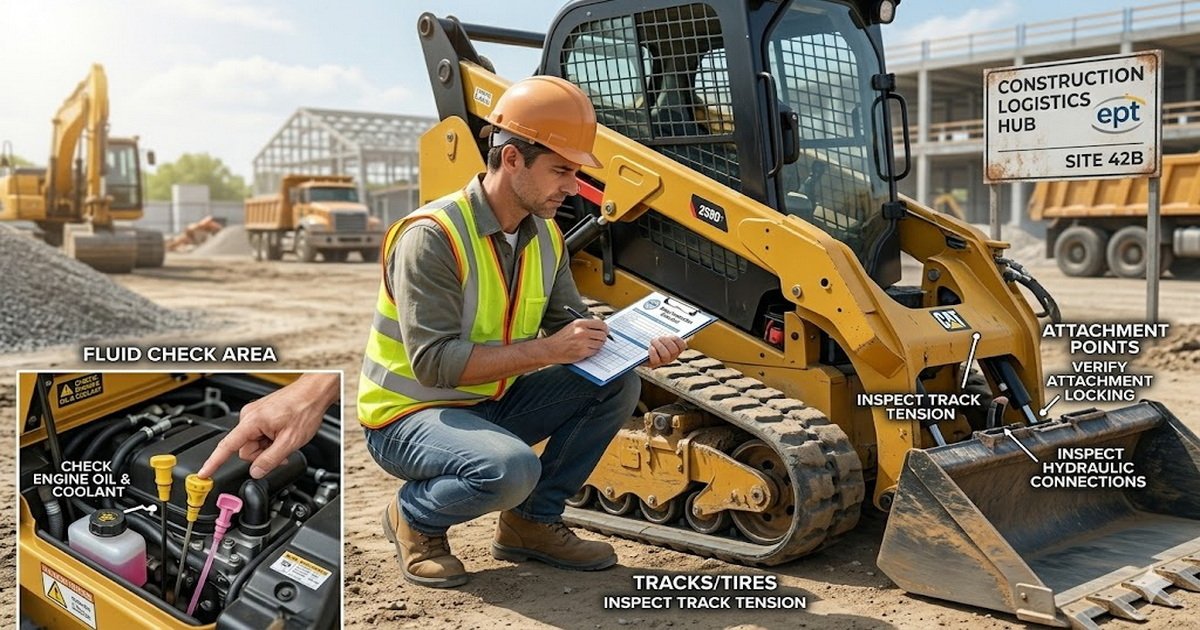
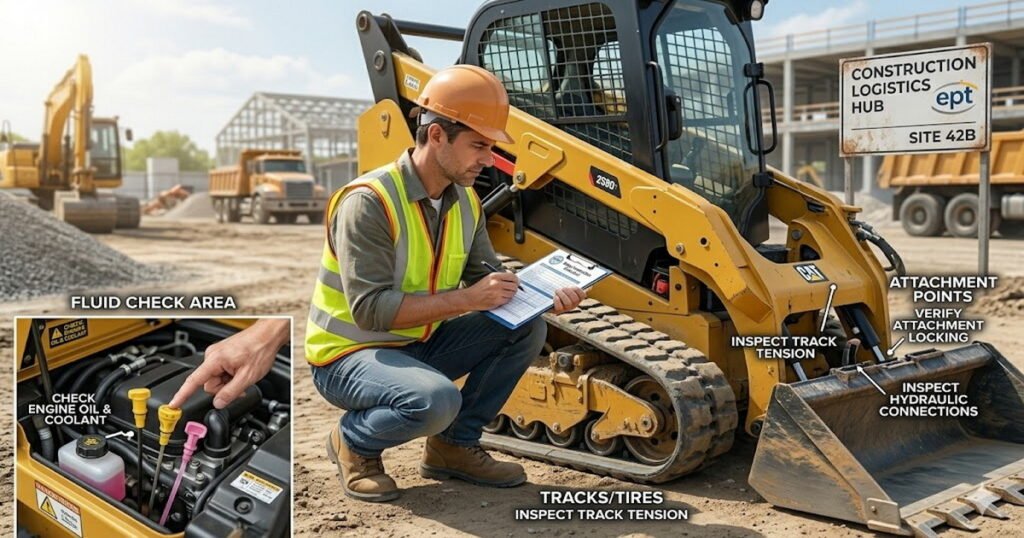
The most effective skid steer maintenance habit is also the simplest: inspect the machine before each shift. Daily walkarounds help operators catch leaks, loose parts, damage, low fluids, and safety issues before the machine enters service. [tractorpartsasap]
During the walkaround, check fluid levels, including engine oil, coolant, hydraulic fluid, and fuel. Inspect hoses, fittings, guards, lights, tires or tracks, and the fuel-water separator; also remove mud, debris, and material buildup from around the engine compartment and undercarriage. [conexpoconagg]
Daily inspection checklist
– Check engine oil, coolant, hydraulic fluid, and fuel levels.
– Look for fresh leaks or wet spots under the machine.
– Inspect hoses, belts, and guards for wear or damage.
– Clean debris from the radiator, engine area, and undercarriage.
– Confirm safety systems, lights, seat belt, and alarms work properly.
– Review tire pressure or track condition before operating. [wheelercat]
2. Protect the Powertrain With Fluid and Filter Care
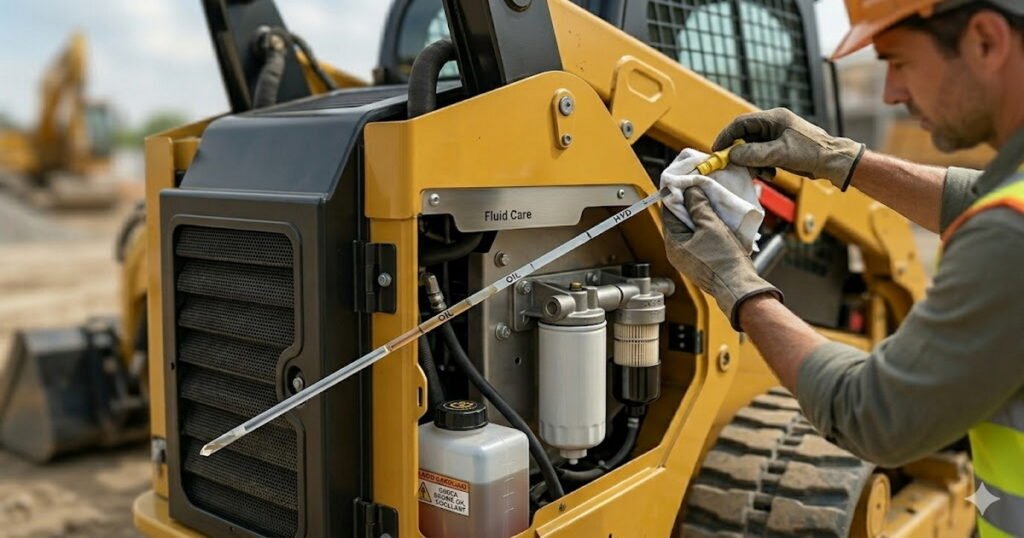
Hydraulic systems and engines depend on clean fluids and clean filters. If contamination builds up, wear increases quickly, and component life shortens. That is why fluid condition should never be treated as an afterthought. [takeuchi-us]
Follow the owner’s manual for service intervals, and do not stretch them just to save time. Industry guidance commonly emphasizes regular oil and filter changes, plus sampling or testing at interval-based service points to identify early wear patterns. [southeasternequip]
Focus areas for fluid service
– Engine oil and oil filter.
– Hydraulic oil and hydraulic filters.
– Fuel filter and water separator.
– Air filter and cab filter.
– Coolant condition and level. [takeuchi-us]
Pro tip: If your machine works in dusty demolition, forestry, or waste-handling environments, filters may need attention sooner than the standard schedule. Real-world jobsite severity should always influence service frequency. [southeasternequip]
3. Maintain Tires or Tracks for the Right Ground Conditions
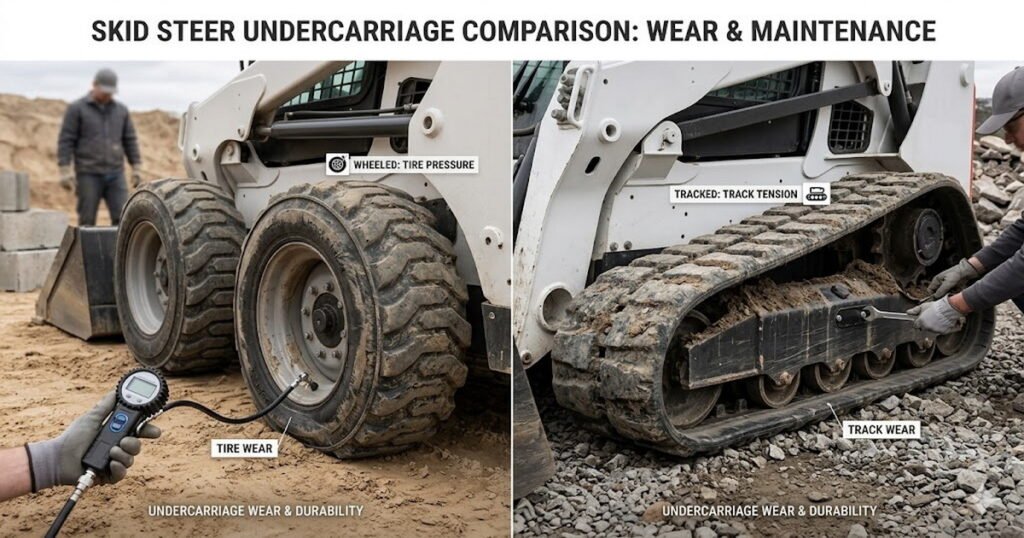
Undercarriage wear is one of the biggest hidden cost drivers in compact equipment. For wheeled skid steers, tire pressure and tread wear affect traction, fuel use, stability, and ride quality. For tracked machines, track tension, debris removal, and tread damage are critical to long-term performance. [fivestarequipment]
Check tires or tracks every day and adjust them according to OEM recommendations. Underinflated tires, over-tensioned tracks, spinning in place, and aggressive turning can all shorten service life. [tirereview]
Best practices for undercarriage care
– Keep tire pressure at the recommended level.
– Check for cuts, punctures, sidewall damage, or uneven wear.
– Remove rocks, mud, wire, and debris from tracks and tread.
– Avoid unnecessary spinning and harsh pivot turns.
– Match the tire or track setup to the terrain and job type. [kelbebros]
Wheel vs. track maintenance
| Machine type | Main risk | What to check | Why it matters |
|---|---|---|---|
| Wheeled skid steer | Pressure loss and tire wear | PSI, tread depth, cuts, embedded debris tirereview | Affects traction, stability, and replacement cost |
| Tracked skid steer | Tension and debris damage | Track tension, rollers, idlers, tears, debris fivestarequipment | Prevents premature wear and slippage |
4. Keep Attachments, Pins, and Couplers in Top Shape
Many skid steer failures begin at the attachment interface. Loose couplers, damaged hoses, worn pins, and contaminated pivot points can reduce productivity and create safety risks. Every attachment should be inspected before use, not only when something feels wrong. [tractorpartsasap]
Clean debris from the lift arms, coupler plate, and attachment contact points. Check hydraulic connections, cylinders, teeth, bushings, and mounting hardware for looseness, cracks, or abnormal wear. Grease pivot points and moving joints according to the manufacturer’s instructions to reduce friction and extend component life. [wheelercat]
Attachment maintenance routine
1. Disconnect and inspect the attachment on level ground.
2. Clean dirt and material from couplers and contact areas.
3. Check hydraulic hoses and quick couplers for leaks.
4. Inspect pins, bushings, teeth, and wear edges.
5. Grease all required points before returning to work. [tractorpartsasap]
This step is especially important for fleets that use one carrier machine with multiple attachments. A weak attachment routine can damage a machine even when the base unit is otherwise well maintained.
5. Log Service Intervals and Train Operators
Maintenance becomes much easier when there is a record. Service logs help track running hours, identify repeat problems, and schedule the next interval before a failure interrupts work. They also support resale value, compliance, and better communication between operators, mechanics, and managers. [warrencat]
Operator training matters just as much. The person in the cab often notices the first warning signs: unusual noise, sluggish response, overheating, vibration, smoke, or smell. If operators know what to look for, they can report small issues before they become large repairs. [sttc]
What to record
– Date, hour meter reading, and machine ID.
– Inspection results and fluid checks.
– Repairs, replaced parts, and filter changes.
– Tire or track adjustments.
– Operator-reported symptoms or alerts. [empire-cat]
How to Build a Smart Maintenance Schedule
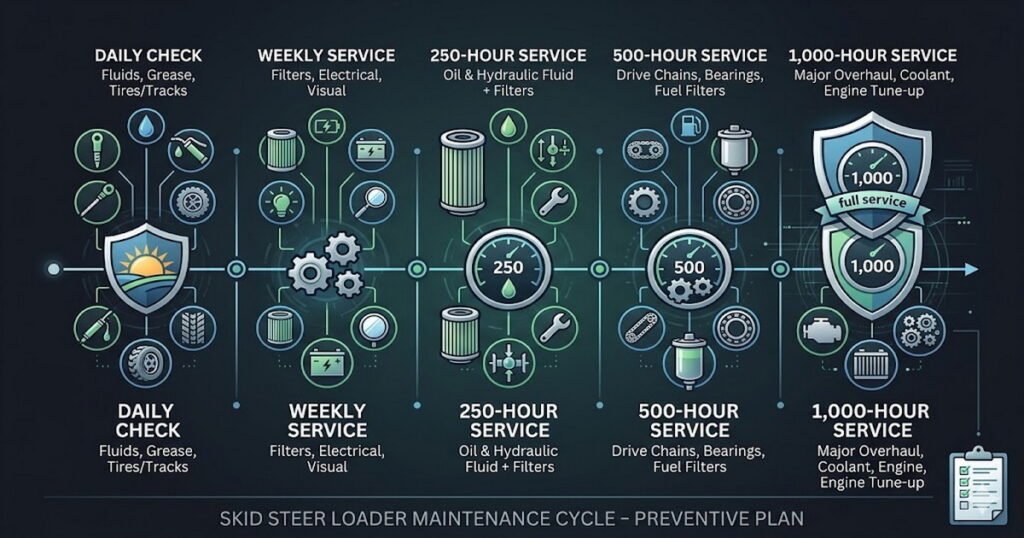
One gap in many maintenance articles is that they list tasks, but do not show how to turn them into a working system. A better approach is to combine daily checks, hour-based service, and jobsite-specific adjustments into one maintenance plan. [southeasternequip]
Practical maintenance rhythm
– Daily: Walkaround inspection, fluids, leaks, tires/tracks, attachments. [conexpoconagg]
– Weekly: Deeper cleaning, grease points, air filter review, undercarriage check. [wheelercat]
– 250–500 hours: Filters, oils, service checks, and oil analysis where appropriate. [conexpoconagg]
– 1,000 hours and beyond: Coolant service, hydraulic system review, drivetrain inspection, and deeper wear analysis. [takeuchi-us]
This kind of layered schedule is especially useful for global buyers operating in different climates and duty cycles. A machine used in dry aggregate work does not wear the same way as one used in mud, snow, or demolition.
Jobsite Conditions Change the Rules
Another major information gap in generic maintenance content is that it often assumes all machines work under the same conditions. In reality, maintenance requirements change based on terrain, temperature, dust, moisture, and operator behavior. [theutilityexpo]
For example, a hot and dusty site may demand more frequent cooling-system cleaning and air-filter checks. A muddy or snowy site may require more undercarriage cleaning and corrosion control. Heavy stop-and-go duty may also justify shorter service intervals than the manual’s baseline recommendation. [southeasternequip]
Adjust your plan for:
– Dusty construction sites.
– Wet, muddy, or frozen ground.
– High-hour rental fleets.
– Multiple-shift operations.
– Severe-duty attachment work. [kelbebros]
This is where manufacturers can add real value to their content. Buyers do not only need maintenance tips; they need maintenance logic they can apply to their own operating conditions.
How Certeg Supports Product Reliability
For manufacturers like Certeg, maintenance education is part of product value. When a skid steer loader is designed for different power needs and work conditions, the user still needs a clear maintenance routine to protect performance over the machine’s life cycle.
That is why Certeg’s product messaging can be stronger when it connects design quality with practical ownership guidance. If your machines are engineered for durability, this article should make that durability visible through real maintenance outcomes: lower downtime, longer component life, safer operation, and better total cost of ownership.
Recommended CTA
Need skid steer loaders built for demanding construction conditions? Contact Certeg to discuss OEM, performance, and application-specific solutions for your market.
FAQ
1. How often should I service a skid steer loader?
You should follow the OEM service schedule and use daily inspections, plus hour-based service intervals such as 250, 500, and 1,000 hours where applicable. [takeuchi-us]
2. What fluids should I check every day?
Check engine oil, coolant, hydraulic fluid, and fuel before operating the machine. [conexpoconagg]
3. Are tracks harder to maintain than tires?
Tracks and tires fail in different ways. Tracks need tension control and debris removal, while tires need pressure checks and tread inspection. [tirereview]
4. Why is the daily walkaround so important?
A daily walkaround catches leaks, wear, loose parts, and safety issues before they cause downtime or damage. [theutilityexpo]
5. Can telematics help with skid steer maintenance?
Yes. Telematics can help track hours, detect faults, and improve scheduling, especially for mixed-fleet or high-utilization operations. [simplyfleet]
6. Should I use oil analysis on skid steer loaders?
Yes, for many fleets oil analysis is a useful early-warning tool, especially at interval-based service points. [southeasternequip]
References
1. Google Search Central. Search Engine Optimization (SEO) Starter Guide. https://developers.google.com/search/docs/fundamentals/seo-starter-guide [developers.google]
2. Google Search Central. SEO Starter Guide (Chinese version). https://developers.google.com/search/docs/fundamentals/seo-starter-guide?hl=zh-cn [developers.google]
3. CONEXPO-CON/AGG. Five Preventative Maintenance Tips for Skid Steer Loaders. https://www.conexpoconagg.com/news/five-preventative-maintenance-tips-for-skid-steer [conexpoconagg]
4. The Utility Expo. Preventative Maintenance Tips for Compact Equipment. https://www.theutilityexpo.com/news/preventative-maintenance-tips-for-compact-equipmen [theutilityexpo]
5. Wheeler CAT. Guide to Skid Steer Maintenance. https://wheelercat.com/blog/guide-to-skid-steer-maintenance/ [wheelercat]
6. DOZR. Top 5 Skid Steer Maintenance Tips. https://dozr.com/blog/skid-steer-maintenance-tips [dozr]
7. Empire Cat. Maintenance Tips for Compact and Small Heavy Equipment. https://www.empire-cat.com/company/news/six-easy-tips-to-maintain-compact-and-small-heavy-equipment [empire-cat]
8. Warren CAT. 6 Equipment Preventive Maintenance Tips. https://www.warrencat.com/knowledge-center/articles/6-equipment-preventive-maintenance-tips/ [warrencat]
9. Tire Review. Skid Steer Tire/Track Maintenance Tips. https://www.tirereview.com/skid-steer-tire-track-maintenance-tips/ [tirereview]
Hot Tags: Skid Steer Loader, Manufacturers, Customized, Custom, Suppliers, Buy, Cheap, Quality, Advanced, Durable, in Stock, Made in China, Price, Quotation