
Skid Steer Loader Buyer’s Guide 2026: Expert Insights, Real-World Specs and How Certeg Machines Fit Your Jobs
Content Menu
● Skid Steer Loaders in 2026 – How to Choose the Right Machine for Real Jobs
● Skid Steer Loader Basics – Radial vs Vertical Lift, Wheels vs Tracks
>> Radial vs Vertical Lift – Which One Fits Your Work?
>> Wheels vs Tracks – Compact Track Loader or Wheeled Skid Steer?
● What Case Skid Steer Specs Tell Us About Modern Buyer Priorities
>> Power, Hydraulics and Breakout Force
>> Operator Station, Visibility and Controls
● Emissions, Telematics and Lifecycle Cost – What to Look For
>> Tier 4 / Stage V and Maintenance‑Friendly Design
>> Telematics and Data‑Driven Fleet Management
● Skid Steer Loader Buying Checklist From Industry Experts
>> Step‑by‑Step Skid Steer Selection Process
● Where Certeg Skid Steer Loaders Fit in a Global Fleet
>> Configurations Optimized for Different Regions and Jobs
>> Customer‑Driven Design and Attachments
● Case B Series vs Typical Certeg Skid Steer Configuration
>> Skid Steer Loader Feature Snapshot
● CTA – Talk to a Specialist Before You Lock In Specs
● FAQs: Skid Steer Loader Buying Questions
>> Q1. What is the most important spec when choosing a skid steer loader?
>> Q2. How do I decide between a wheeled skid steer and a compact track loader?
>> Q3. Do I really need high‑flow hydraulics?
>> Q4. Are emissions and telematics worth paying extra for on a skid steer loader?
>> Q5. How does Certeg compare to established brands like Case?
If you are evaluating a skid steer loader in 2026, you are likely balancing power, hydraulic performance, comfort, and lifetime operating cost across brands like Case, Bobcat, Cat and new-generation manufacturers such as Certeg. From my experience working with construction OEMs and fleet managers, the machines that win long term are those that match lift type, hydraulic flow and uptime strategy precisely to the work you do most often. [compactequip]
Skid Steer Loaders in 2026 – How to Choose the Right Machine for Real Jobs
A modern skid steer loader is no longer just a compact tool carrier; it is a high‑productivity platform where electronics, telematics and hydraulics now matter as much as raw horsepower. Case’s evolution from the Alpha Series to the B Series shows how operators now expect powerful hydraulics, spacious cabs and simple pattern switching between ISO and H modes as standard. At the same time, global manufacturers like Certeg are bringing track and wheel skid steers tailored for international markets where mixed jobsite conditions and varied fuel quality are daily realities. [openpr]
Skid Steer Loader Basics – Radial vs Vertical Lift, Wheels vs Tracks
Before comparing brands and models, you need to understand how lift path and undercarriage type change the machine’s strengths on your site. [equipmentworld]
Radial vs Vertical Lift – Which One Fits Your Work?
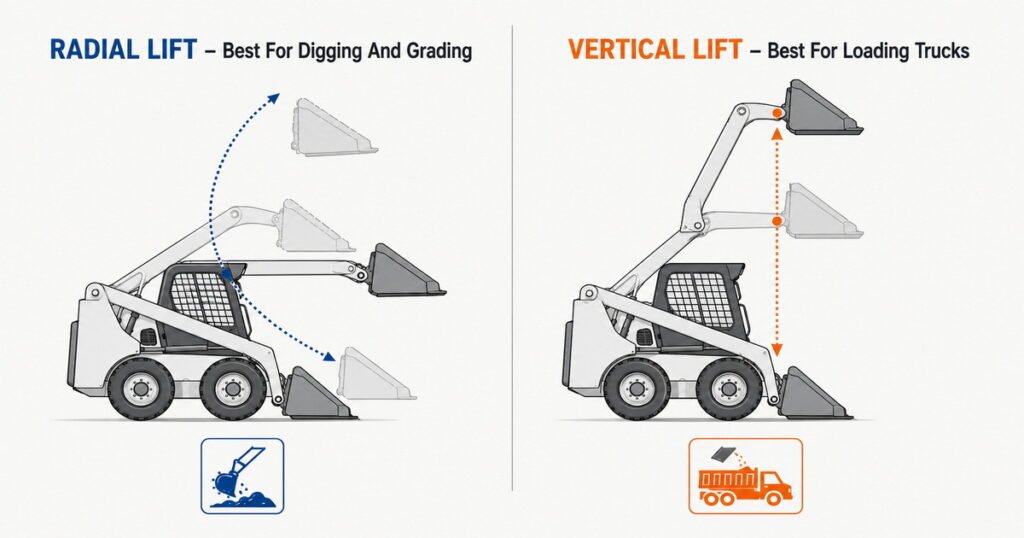
Case’s lineup is a good illustration of the two lift concepts, with radial‑lift models like the SR160B and SR210B and vertical‑lift models such as the SV280B and SV340B. [openpr]
– Radial‑lift skid steer loader
– Strong mid‑height reach and excellent digging and grading performance. [compactequip]
– Typically preferred for ground‑engaging work: trench backfilling, grading, light demolition, loading low‑sided trucks. [equipmentworld]
– Vertical‑lift skid steer loader
– Offers more vertical reach and stability at full height, ideal for loading high‑sided trucks, hoppers and mixers. [openpr]
– Often chosen for material‑handling and pallet work, especially with heavy pallets of block, brick, bagged material or pipe. [skidpro]
Industry experts consistently recommend that buyers look first at rated operating capacity (ROC), lift path and primary attachments rather than just peak horsepower, because these three factors directly control what you can safely lift and how high you can place it. [compactequip]
Wheels vs Tracks – Compact Track Loader or Wheeled Skid Steer?
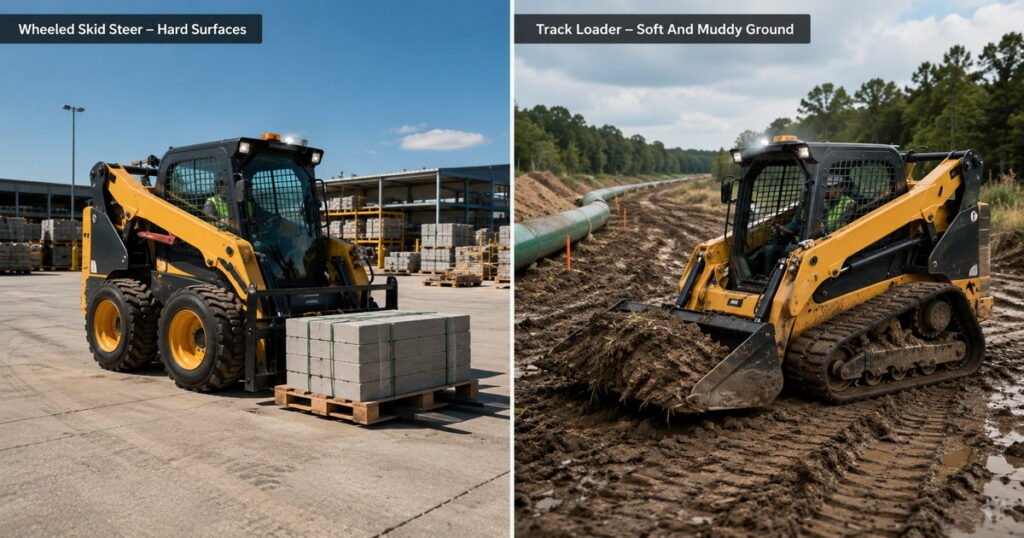
Case and other major brands offer both wheeled skid steers and compact track loaders, and manufacturers like Certeg follow a similar split to match different ground conditions worldwide. [equipmentworld]
– Wheeled skid steer loader
– Better on firm, improved surfaces such as concrete, asphalt and compacted gravel. [equipmentworld]
– Generally lower purchase price and lower undercarriage maintenance cost if you mainly work on hard, abrasive sites. [skidpro]
– Compact track skid steer loader (rubber tracks)
– Delivers lower ground pressure and better flotation on mud, soft ground and snow. [equipmentworld]
– Often chosen for landscaping, utility jobs, and year‑round municipal work where traction and minimal ground disturbance matter. [equipmentworld]
From a buyer’s point of view, the undercarriage decision has a bigger lifetime cost impact than a small difference in horsepower, because tracks and tires wear at different rates and prices depending on how aggressive your jobsites are. [openpr]
What Case Skid Steer Specs Tell Us About Modern Buyer Priorities
The Case skid steer portfolio, summarized in spec guides from 2014 through the B Series in 2022, provides a useful benchmark for what a well‑engineered machine should offer today. [compactequip]
Power, Hydraulics and Breakout Force
Even earlier models like the Case SR210 were designed to deliver strong torque and hydraulic performance for demanding attachments. [compactequip]
Key highlights:
– The SR210 weighed about 6,970 lb with standard 24.2 gpm auxiliary flow and optional high‑flow 33.2 gpm, which made it suitable for high‑demand tools such as cold planers and heavy sweepers. [compactequip]
– With 74 gross hp and 7,270 lb bucket breakout force, it targeted one of the most popular size classes for general construction and rental fleets. [compactequip]
The newer B Series pushed these numbers even higher. The SV340B, Case’s most powerful skid steer to date, offers:
– Rated operating capacity of 3,400 lb, aligning with heavier material‑handling and attachment work. [openpr]
– Bucket breakout force of 9,531 lb, which is significant for tough digging and demolition tasks. [openpr]
– Optional high‑flow (38.7 gpm at 3,450 psi) and enhanced high‑flow (35 gpm at 4,000 psi) to drive heavy hydraulic attachments. [openpr]
From an expert perspective, any modern skid steer loader you consider—whether from Case, Cat or Certeg—should clearly publish:
– Rated operating capacity at 50% of tipping load
– Standard and high‑flow hydraulic specs (gpm and psi)
– Bucket breakout force
– Engine horsepower and torque curve
These numbers allow you to estimate whether the machine will handle your current and future attachment plans without being under‑spec’d. [equipmentworld]
Operator Station, Visibility and Controls
Case’s B Series machines show how much emphasis the industry now places on operator experience and visibility. [openpr]
Notable improvements include:
– A redesigned operator interface with simple ignition, push‑button start and intuitive switches for core machine functions. [openpr]
– Options for standard mechanical controls, mechanical hand‑and‑foot or electro‑hydraulic controls, allowing fleet managers to match machines to operator preferences. [openpr]
– An 8‑inch LCD multi‑function display with backup camera available on all electro‑hydraulic models and optionally on mechanical versions. [openpr]
– Cab‑forward design, ultra‑narrow side screens, large rear window and wide cab doors to enhance comfort and 360‑degree situational awareness. [compactequip]
From a UX and safety standpoint, these features are not just “nice to have”; they directly influence fatigue, productivity and incident rates on busy jobsites. [equipmentworld]
Emissions, Telematics and Lifecycle Cost – What to Look For
Skid steer loader buyers are increasingly judged on total cost of ownership, not only purchase price. Case and other major OEMs have responded with more efficient engines, emissions systems and telematics. [compactequip]
Tier 4 / Stage V and Maintenance‑Friendly Design
The Case SR210 illustrates a maintenance‑friendly approach to Tier 4 Final emissions standards:
– It uses a CEGR engine with a particulate matter catalyst that combines a diesel oxidation catalyst (DOC) and high‑efficiency flow‑through filter. [compactequip]
– This solution does not require filter replacement or extra fluids, which reduces downtime and consumable costs compared with some after‑treatment systems. [compactequip]
– The DOC converts emissions into neutral gases and remaining particulates are burned off in the flow‑through filter, which Case reports improves engine power by about 10%. [compactequip]
For global buyers, systems like this matter because they reduce the complexity of managing emissions across multiple markets while preserving engine performance. [openpr]
Telematics and Data‑Driven Fleet Management
Electronic control modules and telematics are now standard on many premium skid steer loaders. Case’s SiteWatch‑compatible machines, for example, can: [compactequip]
– Log operating data, fuel use and work patterns through a CAN‑bus network. [compactequip]
– Alert managers to maintenance intervals, fault codes and security issues. [openpr]
In practice, this allows contractors and rental houses to optimize maintenance schedules, verify utilization and reduce idle time, which directly lowers operating cost per hour. [equipmentworld]
Certeg’s telematics‑ready loaders follow the same philosophy: giving international fleet owners a clear picture of machine health and performance, even when machines are deployed across multiple regions and rental partners. [gushwork]
Skid Steer Loader Buying Checklist From Industry Experts
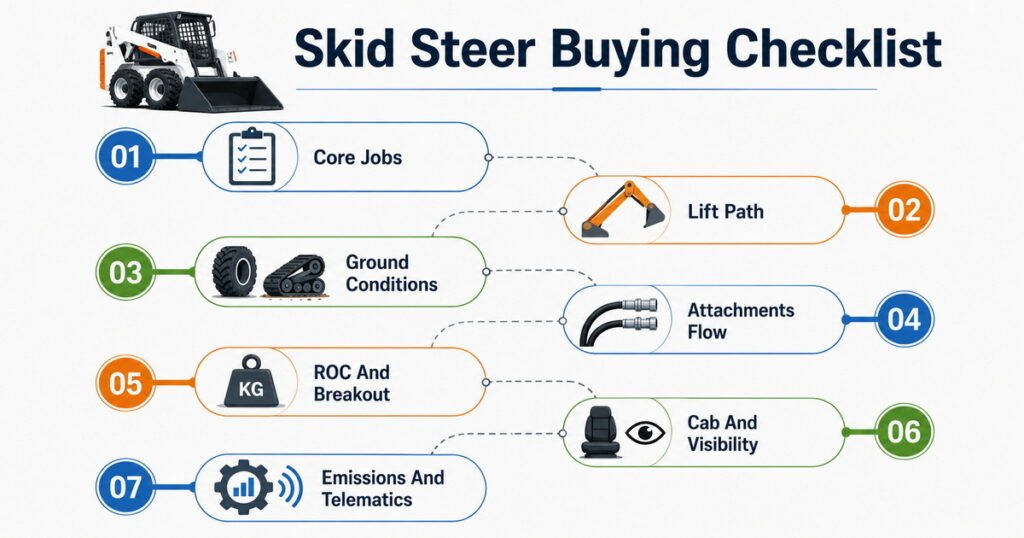
Case experts regularly emphasize that buyers should prioritize rated operating capacity, horsepower, torque and hydraulic flow to avoid under‑specifying a machine. Based on OEM guidance and current market data, here is a practical checklist you can use when evaluating any brand, including Certeg. [skidpro]
Step‑by‑Step Skid Steer Selection Process
1. Define your core jobs
List your top 3–5 applications: loading trucks, grading, pallet handling, snow removal, demolition, etc. [equipmentworld]
2. Map tasks to lift path
– Choose radial‑lift if you focus on digging, grading and low to mid‑height loading.
– Choose vertical‑lift if most of your work involves loading trucks, hoppers or high‑sided bins. [equipmentworld]
3. Match ground conditions to wheels or tracks
– Mostly hard surfaces and yards → wheeled skid steer loader.
– Mixed or soft ground, snow, landscaping → compact track loader. [skidpro]
4. Check hydraulic requirements of attachments
– Make a list of existing and planned attachments (planer, mulcher, breaker, broom, snow blower).
– Compare required gpm and psi to the machine’s standard and high‑flow specs. [equipmentworld]
5. Right‑size ROC and breakout force
– Ensure rated operating capacity covers your heaviest regular loads with a safety margin.
– Confirm breakout force is sufficient for your digging and demolition expectations. [equipmentworld]
6. Evaluate cab comfort and visibility
Look for wide doors, low thresholds, sealed and pressurized cabs, good lighting and camera options to reduce fatigue and improve safety. [openpr]
7. Consider emissions, fuel and telematics
Check how the engine meets emissions rules in your region, what consumables it needs, and whether telematics is included or easily added. [compactequip]
Where Certeg Skid Steer Loaders Fit in a Global Fleet
As a manufacturer focused on skid steer loaders (both compact track and wheeled) for global construction markets, Certeg designs machines to handle widely varying power demands and working conditions. [gushwork]
Configurations Optimized for Different Regions and Jobs
While established OEMs like Case build primarily for North American and European standards, Certeg emphasizes:
– Configurable engine options to meet different emission regulations and fuel qualities in diverse markets.
– Both radial‑lift and vertical‑lift models to align with regional preferences and typical project types.
– Track and wheel variants tuned for everything from soft, rainy climates to hot and abrasive quarry conditions. [gushwork]
This flexibility is particularly valuable for distributors and rental companies who must serve contractors in multiple sectors—from urban construction to infrastructure and agriculture—without over‑complicating their fleets. [gushwork]
Customer‑Driven Design and Attachments
End‑user feedback on skid steer loaders often focuses on three things: attachment performance, cab comfort and dealer support. Certeg responds by: [skidpro]
– Matching hydraulic options to the attachment mix common in each export market (e.g., cold planers and breakers in roadwork, augers and trenchers in utilities).
– Prioritizing spacious cabs with ergonomic controls and clear sightlines, taking cues from best‑in‑class designs like Case’s wide, cab‑forward layouts and backup camera integration. [openpr]
– Working with local partners to stock high‑wear parts such as tires, tracks, filters and cutting edges to keep downtime low. [gushwork]
For buyers, this means you can use a Case spec guide as a benchmark and then compare Certeg’s loaders model‑by‑model on ROC, hydraulic flow and comfort features, ensuring that whichever brand you choose meets or exceeds the performance metrics you rely on. [equipmentworld]
Case B Series vs Typical Certeg Skid Steer Configuration
The table below uses the Case SV340B as a reference point and outlines how a typical high‑capacity Certeg vertical‑lift skid steer loader is positioned conceptually for similar applications. [gushwork]
Skid Steer Loader Feature Snapshot
| Feature / Focus | Case SV340B Skid Steer Loader | Typical Certeg Vertical‑Lift Skid Steer Loader |
|---|---|---|
| Primary application focus | Heavy material handling and high‑demand attachments openpr | Construction, infrastructure and rental fleets in varied conditions gushwork |
| Rated operating capacity | 3,400 lb ROC openpr | Configurable to competitive ROC classes for export markets gushwork |
| Engine power | About 90 hp class openpr | Multiple engine options to meet different regional regulations gushwork |
| Hydraulic options | Standard, high‑flow 38.7 gpm at 3,450 psi; enhanced 35 gpm at 4,000 psi openpr | Standard and optional high‑flow packages aligned with common attachment mixes gushwork |
| Cab and visibility | Wide cab, low entry threshold, cab‑forward design, ultra‑narrow wire side screens openpr | Emphasis on wide‑view cab and ergonomic controls inspired by industry best practice gushwork |
| Controls | Mechanical or electro‑hydraulic; ISO/H pattern switch via button openpr | Region‑specific control packages; simplified pattern switching for operator familiarity gushwork |
| Telematics readiness | Electronic control module, CAN‑bus, compatible with Case SiteWatch compactequip | Designed for integration with OEM or third‑party telematics solutions gushwork |
| Emissions and after‑treatment | Tier 4 Final with DOC and high‑efficiency flow‑through filter, no filter replacement or extra fluids compactequip | Engine configurations tuned for local fuel quality and regulatory frameworks openpr |
This kind of structured comparison helps procurement teams and fleet managers quickly shortlist machines that match their duty cycles and ownership strategies. [skidpro]
CTA – Talk to a Specialist Before You Lock In Specs
Selecting the wrong skid steer loader can lock you into higher fuel use, attachment limitations and operator frustration for the entire life of the machine. Before you finalize a purchase, it is worth walking through your applications, preferred lift path, attachment list and emissions requirements with an equipment specialist. [skidpro]
If you are evaluating a mixed fleet or planning to introduce Certeg skid steer loaders into your operation, consider requesting:
– A quick application review based on your actual job mix
– A model‑by‑model ROC and hydraulic comparison against your current machines
– Guidance on wheel vs track configuration for your typical ground conditions
A short conversation at this stage can prevent costly mis‑matches and ensure your next skid steer loader delivers the productivity, comfort and lifecycle cost you expect.
FAQs: Skid Steer Loader Buying Questions
Q1. What is the most important spec when choosing a skid steer loader?
The most critical spec for most buyers is rated operating capacity (ROC), because it defines how much you can safely lift and carry in daily work. Once ROC is aligned with your heaviest tasks, hydraulic flow, breakout force and engine power complete the performance picture. [equipmentworld]
Q2. How do I decide between a wheeled skid steer and a compact track loader?
If most of your work is on hard, improved surfaces like concrete and asphalt, a wheeled skid steer loader usually delivers lower owning and operating costs. If you work frequently in mud, snow, soft soils or sensitive turf, a compact track loader with rubber tracks provides better traction and lower ground disturbance. [skidpro]
Q3. Do I really need high‑flow hydraulics?
You only need high‑flow if your attachments require it, such as cold planers, heavy mulchers, some snow blowers and certain brooms. For buckets, forks, light brooms and basic augers, standard flow is usually sufficient, which can save money and complexity. [compactequip]
Q4. Are emissions and telematics worth paying extra for on a skid steer loader?
Modern emissions systems and telematics help you stay compliant, reduce downtime and monitor utilization across multiple jobsites. Over the life of the machine, better maintenance planning and reduced idle time typically outweigh the initial cost of these technologies. [openpr]
Q5. How does Certeg compare to established brands like Case?
Established brands like Case set strong benchmarks for ROC, breakout force, cab comfort and hydraulic options in their B Series skid steers. Certeg positions its skid steer loaders to meet or exceed those benchmarks in targeted export markets, with flexible engine and configuration options for different duty cycles and regulations. [gushwork]
References
1. Compact Equipment – “Case Skid Steers — 2014 Spec Guide” (Case Alpha Series overview, SR210 specifications, emissions and telematics features). [compactequip]
2. Compact Equipment – “Case Skid Steers Summarized — 2022 Spec Guide” (Case B Series lineup, SV340B specs, cab and control upgrades, buyer advice). [openpr]
3. Equipment World – “Skid Steer Buyer’s Guide 2026” (market overview, major brand models, application guidance and spec considerations). [equipmentworld]
4. SkidPro Attachments – “Best Skid Steer Brands of 2026: Which One Should You Buy?” (brand comparison and buyer priorities in the current market). [skidpro]
5. Fact.MR / OpenPR – “Next-Generation Skid Steer Loader Market Trends 2026–2036” (trends in fuel efficiency, electrification, smart controls and safety in compact equipment). [openpr]
6. Gushwork – “SEO Strategy for Heavy Equipment Sales” (best practices for keyword targeting, on-page structure, technical SEO and content strategies for heavy equipment manufacturers). [gushwork]
7. Valve+Meter – “Top 20 Heavy Equipment Digital Marketing Strategies” (role of content, visuals and multi‑channel marketing in selling heavy machinery). [valveandmeter]
Hot Tags: Skid Steer Loader, Manufacturers, Customized, Custom, Suppliers, Buy, Cheap, Quality, Advanced, Durable, in Stock, Made in China, Price, Quotation