
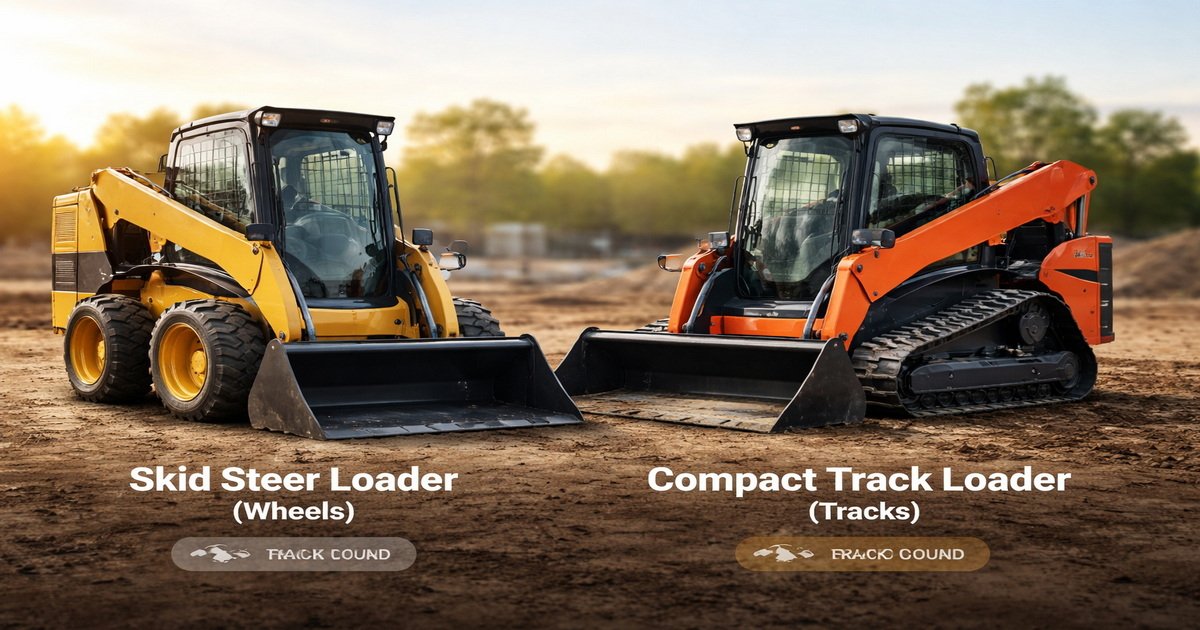
Skid Steer and Track Loader Technology: A Practical Expert Guide for Modern Contractors
Content Menu
● What Is a Skid Steer or Compact Track Loader?
● Skid Steer vs Compact Track Loader
● Attachment Coupling System: Your Multi‑Tool Interface
● Auxiliary Hydraulic System: The Real Power Behind Attachments
● Modern Control Systems: EH, Pilot, and Mechanical
● Dual Self‑Leveling: Keeping Loads Under Control
● Creep Mode: Precision Speed for High‑Demand Attachments
● Engine Technology and Emissions Compliance
● Grade Control and Machine Control: 2D vs 3D
● Operator Station: Comfort, Retention, and Productivity
● Radial vs Vertical Lift Arms
● Rated Operating Capacity (ROC) and Tipping Load
● Remote Control Operation and Safety
● Automation Features: Return to Dig and Work Tool Positioner
● Lighting, Reversing Camera, and Reversing Fan
● Suspension Undercarriage: Comfort vs Cost
● Ride Control: Smoother Travel and Less Spillage
● Telematics and Fleet Management
● Proper Track Tension and Alignment (Pro Tip for CTLs)
● Call to Action: Choose the Right Certeg Loader for Your Job
● Frequently Asked Questions (FAQ)
>> 1. What is the main difference between a skid steer and a compact track loader?
>> 2. Do I really need high‑flow hydraulics on my loader?
>> 3. Is grade control worth the investment for small contractors?
>> 4. How often should I check track tension on a compact track loader?
>> 5. Which cab options make the biggest difference for operator retention?
As someone who has spent years helping contractors and fleet managers choose and operate skid steer loaders and compact track loaders, I see one recurring challenge: the machines are getting smarter and more capable, but the terminology keeps getting harder to follow. This guide breaks down key skid steer and track loader technology in plain language, with real-world examples and purchase tips you can actually use on site. [vitaldesign]
What Is a Skid Steer or Compact Track Loader?
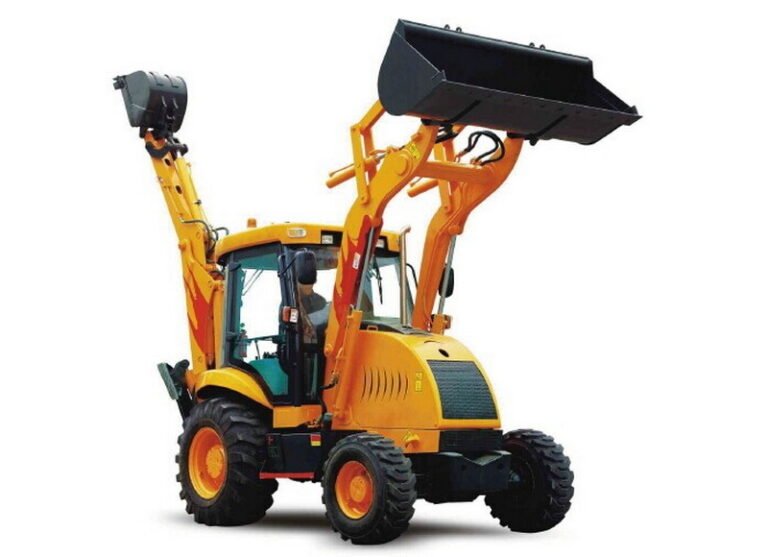
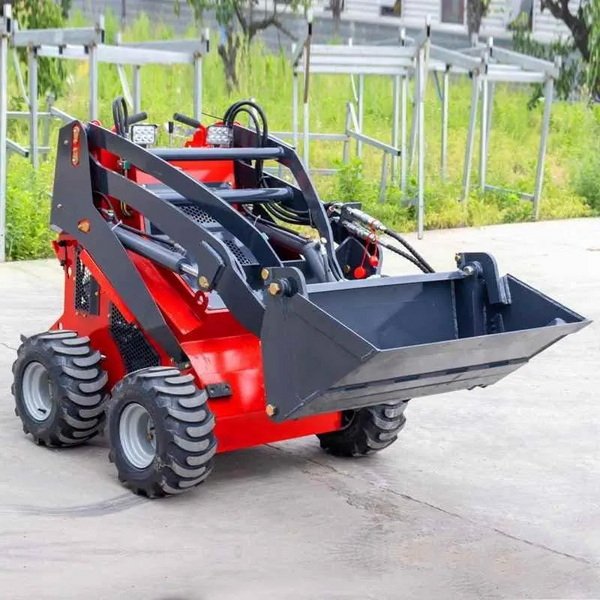
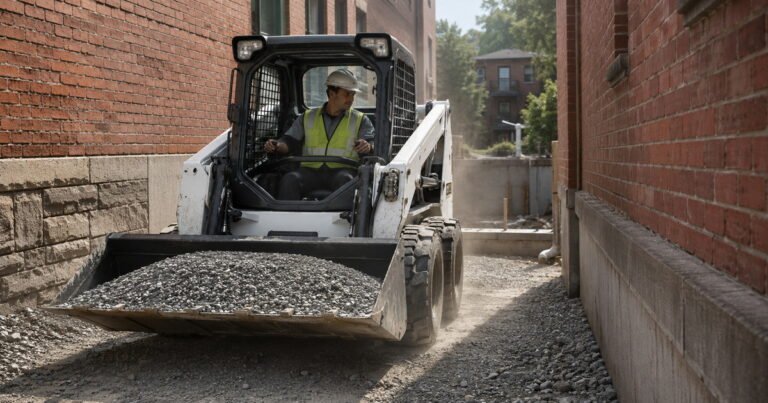
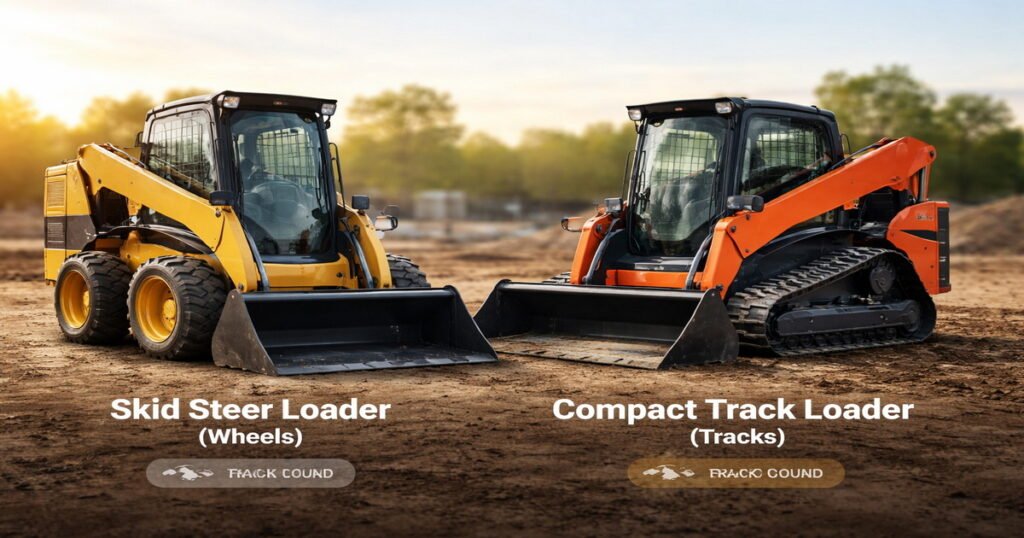
Skid steer loaders use wheels, while compact track loaders (CTLs) use rubber tracks, but both are compact, zero‑turn loaders designed to run a wide variety of attachments. A modern skid steer or CTL is no longer just “a small loader” – it is a multi‑tool carrier powered by advanced hydraulics, electronics, telematics, and operator‑assist features. [ideahills]
For a manufacturer like Certeg, this means designing both wheel skid steers and tracked loaders that can handle very different jobsite conditions – from muddy residential backyards to hard‑surface urban demolition – using one core platform and different undercarriage, power, and control packages. [webfx]
Skid Steer vs Compact Track Loader
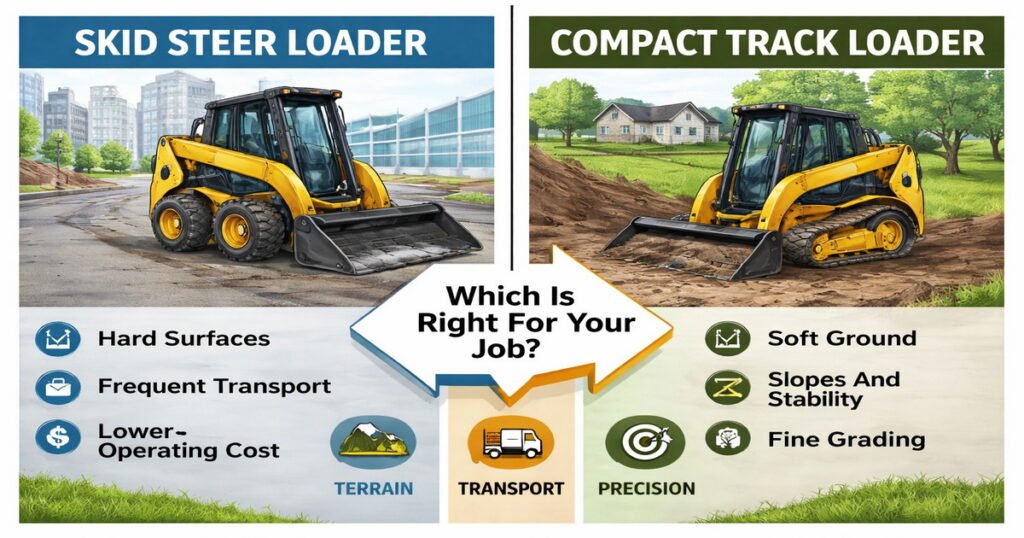
Before diving into the tech dictionary, it helps to decide whether you need wheels or tracks first. [rippa]
| Use case / condition | Better choice | Why it matters |
|---|---|---|
| Hard, paved or concrete surfaces | Skid steer loader | Lower tire cost, less track wear on abrasive ground. rippa |
| Soft, muddy, or sandy ground | Compact track loader | Better flotation, less ground disturbance, higher stability on slopes. rippa |
| Frequent transport between jobs | Skid steer loader | Easier trailering, lighter weight, lower total cost. rippa |
| Finish grading and landscaping | Compact track loader | Smoother ride, higher traction, better fine‑grade control. vitaldesign |
If your projects mix mud, slopes, and precision grading, a CTT (compact track loader) from a manufacturer like Certeg is often the best long‑term value, even if the initial price is higher. [ideahills]
Attachment Coupling System: Your Multi‑Tool Interface
The attachment coupling system is the universal plate and wedge pin setup that lets you swap tools like buckets, forks, trenchers, and brooms in minutes. These pins can be engaged manually (you step out of the cab) or through a powered coupler from the seat. [vitaldesign]
When you spec a machine from a brand such as Certeg, pay attention to:
– Coupler type: manual vs powered, and whether it follows the common universal pattern. [vitaldesign]
– Attachment size and weight: match to the rated operating capacity and machine width. [vitaldesign]
– Hydraulic requirements: some attachments need standard flow, others require high‑flow (see next section). [vitaldesign]
For most mixed fleets, choosing a universal quick‑attach style ensures you can share attachments between different skid steers and CTLs, even across brands. [vitaldesign]
Auxiliary Hydraulic System: The Real Power Behind Attachments
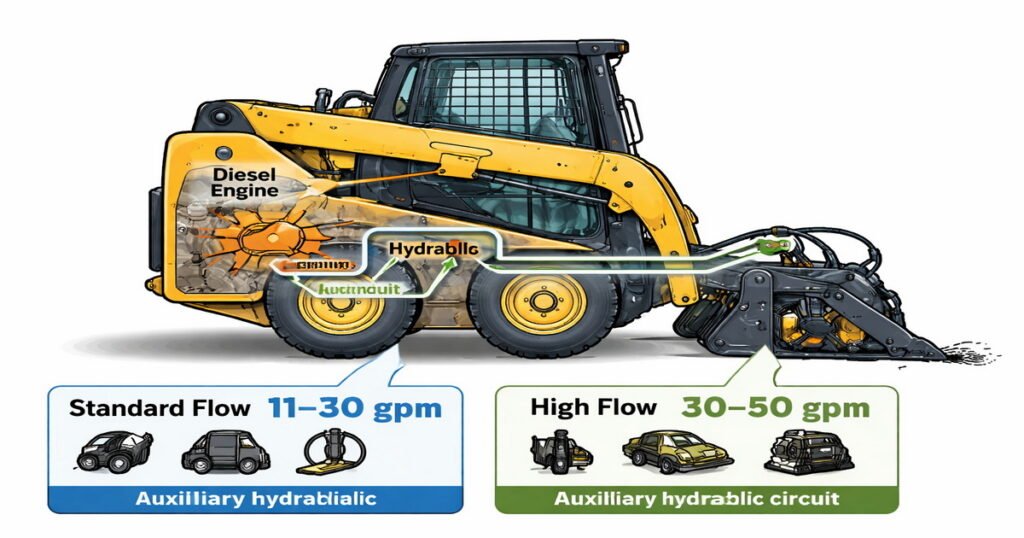
The auxiliary hydraulic system is the pressurized oil circuit that drives your powered attachments such as cold planers, mulchers, and brush cutters. Typical specs you will see include pressure (psi) and flow (gpm), with machines offered in standard‑flow and high‑flow options. [vitaldesign]
Typical ranges:
– Standard‑flow: about 11–30 gpm at 3,000–3,500 psi. [vitaldesign]
– High‑flow: about 30–50 gpm at 4,000–5,000 psi, plus “super” or enhanced flow packages on some models. [vitaldesign]
When choosing a Certeg skid steer or track loader, always:
1. Start with the attachment (e.g., planer, mulcher, wheel saw).
2. Check the required minimum gpm and psi.
3. Make sure your machine’s auxiliary package meets or exceeds those numbers, with some safety margin. [vitaldesign]
This is where many buyers under‑spec; they buy the right loader size but the wrong hydraulic package, and then discover their premium attachment bogs down under load. [webfx]
Modern Control Systems: EH, Pilot, and Mechanical
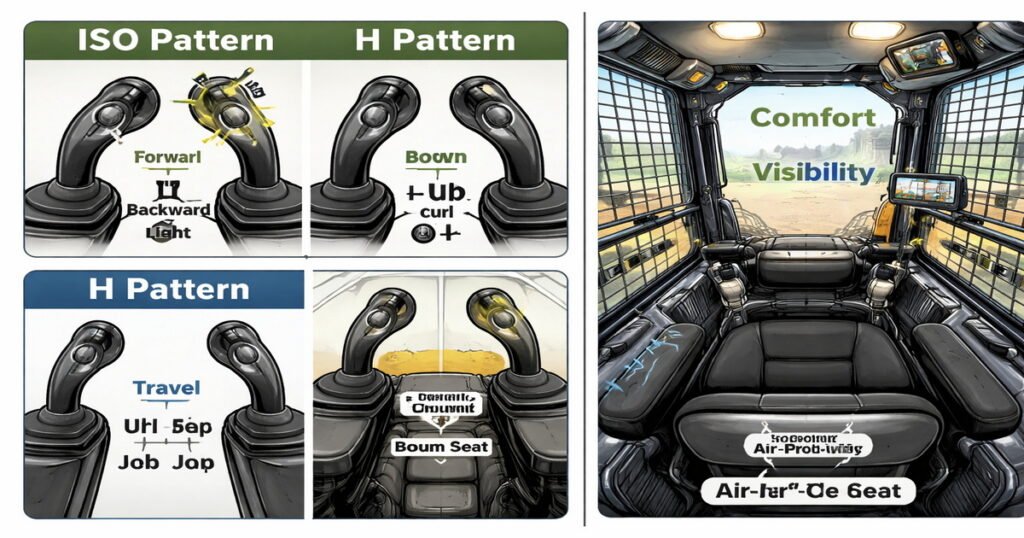
Today’s machines offer several control types: electro‑hydraulic (EH), pilot‑hydraulic, and mechanical hand/foot controls, each often available in H‑pattern or ISO pattern. [vitaldesign]
– Mechanical controls: direct linkage, lower cost, more physical effort, fading in popularity. [vitaldesign]
– Pilot‑hydraulic controls: low‑pressure hydraulics move the main valve spools, providing load feedback and simpler troubleshooting. [vitaldesign]
– Electro‑hydraulic controls: joysticks send electronic signals to valves, enabling pattern switching and customizable response rates. [vitaldesign]
With ISO pattern, the left joystick drives the machine, and the right joystick operates boom and bucket, which many newer operators find more intuitive. For fleets that hire frequently or rely on rental operators, investing in EH controls with adjustable response can shorten training time and improve productivity. [vitaldesign]
Dual Self‑Leveling: Keeping Loads Under Control
Dual self‑leveling systems use electronic sensors to keep your attachment level as you raise or lower the loader arms. This helps retain material in buckets and keep pallet loads stable when loading trucks or handling fragile products. [vitaldesign]
For a contractor, dual self‑leveling means:
– Less spilled material and rework.
– Faster truck loading cycles.
– Less stress for newer operators trying to multitask boom, tilt, and travel. [vitaldesign]
When you configure a Certeg loader, this is a high‑ROI feature if you perform regular loading or pallet work.
Creep Mode: Precision Speed for High‑Demand Attachments
Creep mode allows the machine to move at a very slow, consistent speed, regardless of how far you push the travel joystick. This is critical for operations such as trenching, cold planing, or saw cutting, where attachment productivity depends on steady ground speed. [vitaldesign]
Instead of “feathering” the joystick all day, the operator sets a target creep speed and focuses on attachment performance and job quality. For contractors running high‑value attachments on Certeg CTLs, this mode directly supports better surface finish and longer tool life. [vitaldesign]
Engine Technology and Emissions Compliance
The diesel engine is the heart of your skid steer or CTL, powering the hydraulic system and providing the torque needed for heavy attachments. Modern units use Tier 4 Final compliant engines with aftertreatment systems like EGR, SCR, DPF, and DEF, depending on power class and market. [ideahills]
Typical rules of thumb:
– Under 25 hp: usually no aftertreatment required. [vitaldesign]
– Under 75 hp: often no DEF, simpler aftertreatment. [vitaldesign]
– 75+ hp: more complex systems including DEF dosing for emissions control. [vitaldesign]
If you export or operate across borders, a manufacturer such as Certeg must offer different emissions packages by region, while still delivering strong torque, fuel efficiency, and electronic engine control for telematics and automation integration. [ideahills]
Grade Control and Machine Control: 2D vs 3D
Grade control (or machine control) technology uses electronics to automatically adjust a dozer blade or box blade to meet a desired grade more accurately than manual operation. Systems may use lasers, sonic sensors, GPS, or robotic total stations, and they are often easier to integrate on CTLs than on wheeled skid steers for fine grading. [vitaldesign]
Two main levels:
– 2D grade control: creates flat or single‑/dual‑slope planes, ideal for pads, parking lots, or basic drainage. [vitaldesign]
– 3D grade control: uses GPS or total station plus 3D design files for complex surfaces like roads or large commercial sites. [vitaldesign]
For contractors upgrading their Certeg CTL fleet, starting with 2D laser‑based control is often the most cost‑effective path, with an upgrade to 3D as project complexity grows. [webfx]
Operator Station: Comfort, Retention, and Productivity
The operator station has evolved into a genuine command center, and it is a major factor in operator retention in today’s labor‑tight market. Buyers can choose from open ROPS to fully enclosed cabs with heat, A/C, different door types, and a wide range of tech features. [uxplanet]
Modern comfort and productivity options include:
– LCD touchscreen displays for machine settings, maintenance data, security, and language selection. [vitaldesign]
– Integrated backup cameras for safer reversing and reduced blind spots. [vitaldesign]
– Heated, air‑ride seats for long days and cold climates. [vitaldesign]
For a brand like Certeg, investing in high‑comfort cabs with strong visibility and intuitive controls is one of the best ways to keep operators in your machines and not your competitors’.
Radial vs Vertical Lift Arms
Skid steers and CTLs are typically offered in radial lift or vertical lift arm configurations. [vitaldesign]
– Radial lift: simpler curved path, ideal for excavating, grading, and digging, with fewer pivot points and often better durability. [vitaldesign]
– Vertical lift: more vertical path that reaches higher to load trucks or handle pallets, ideal when most work involves lifting above cab height. [vitaldesign]
Neither design is “better” overall; it depends on your most frequent task. Certeg can offer radial lift for earthwork‑focused crews and vertical lift for material‑handling‑heavy operations like supply yards or building supply delivery. [vitaldesign]
Rated Operating Capacity (ROC) and Tipping Load
Rated Operating Capacity (ROC) is the load your machine can safely lift and operate with, without tipping or nose‑diving. It is related to, but not the same as, tipping load, which is the weight at which the loader will tip forward on level ground with arms fully extended. [vitaldesign]
Key points:
– ROC is often around 50% of tipping load, depending on standards and test conditions. [vitaldesign]
– Long attachments (such as long forks) move the center of gravity forward and reduce real‑world ROC. [vitaldesign]
For fleet buyers, this is where mis‑sizing shows up quickly: choose a Certeg machine with enough ROC margin for your heaviest, most awkward loads, not just your average bucket work.
Remote Control Operation and Safety
Some manufacturers now offer remote control packages for skid steers and CTLs, supporting both line‑of‑sight and non‑line‑of‑sight operation from a remote station or even a smartphone app. These systems plug into the machine’s CAN bus and allow safer operation in hazardous environments like stevedoring, demolition, or industrial cleaning. [vitaldesign]
For Certeg‑type machines, remote control is an emerging area where safety and uptime drive investment:
– Operators can stay out of dust, debris, or fall zones.
– One operator can control multiple machines sequentially from a centralized station. [webfx]
Automation Features: Return to Dig and Work Tool Positioner
Return to Dig automates the cycle of lowering the loader arms and returning the bucket to a preset angle when you back away from a truck to reload. Work Tool Positioner lets operators store and recall a preferred attachment tilt angle at the touch of a button. [vitaldesign]
These features:
– Reduce operator workload during repetitive cycles.
– Improve consistency of cut depth, trench quality, or pallet handling.
– Support higher productivity, especially for newer operators. [vitaldesign]
For any contractor loading trucks all day with a Certeg skid steer, specifying Return to Dig is one of the simplest ways to gain more cycles per hour.
Lighting, Reversing Camera, and Reversing Fan
Jobsite visibility and cooling are essential for safety and reliability. [vitaldesign]
– Lighting: interior cab lights, rear work lights, and front boom‑mounted lights increase visibility for night work and low‑light conditions. [vitaldesign]
– Reversing camera: an external camera and in‑cab display greatly improve rear visibility, reducing collision risks when operating in tight spaces. [vitaldesign]
– Reversing hydraulic fan: periodic automatic or manual reversal clears debris from the cooling pack, helps maintain lower engine compartment temperatures, and can reduce fuel consumption compared to fixed mechanical fans. [vitaldesign]
For dusty or debris‑heavy work, a reversing fan is a high‑value protection feature that supports uptime and prevents overheating.
Suspension Undercarriage: Comfort vs Cost
On many compact track loaders, you can choose between rigid‑mounted and suspension undercarriage systems. [vitaldesign]
– Rigid‑mounted: simple, fewer moving parts, lower upfront cost, but more vibration transmitted to the machine and operator. [vitaldesign]
– Single‑level suspension: torsion axles and bogie wheels providing base‑level cushioning. [vitaldesign]
– Dual‑level suspension: independent torsion axles plus flexible bogie wheels, absorbing more vibration and allowing higher travel speeds over rough terrain. [vitaldesign]
In my experience, contractors running Certeg CTLs on rough or uneven jobsites gain more productivity and less operator fatigue by investing in suspension systems, particularly when combined with ride control and high‑comfort seats.
Ride Control: Smoother Travel and Less Spillage
Ride control manages how the machine responds when traveling with a load, especially at higher speeds. When active, it helps keep rear wheels or undercarriage more stable, reducing spillage and improving ride comfort. [vitaldesign]
Some systems offer automatic ride control that activates based on arm pressure or travel speed. The result is: [vitaldesign]
– Fewer lost loads.
– Higher travel speeds between pile and truck.
– Less physical strain on the operator. [vitaldesign]
Telematics and Fleet Management
Telematics systems collect and transmit machine data such as operating hours, maintenance alerts, and fault codes, providing on‑demand reports for fleet managers. This allows proactive maintenance scheduling, utilization tracking, and rapid response to critical alerts. [ideahills]
For a global manufacturer like Certeg, integrating telematics enables:
– Remote diagnostics and faster dealer support.
– Better understanding of real‑world duty cycles and failure modes.
– Data‑driven improvements in future models. [webfx]
Proper Track Tension and Alignment (Pro Tip for CTLs)
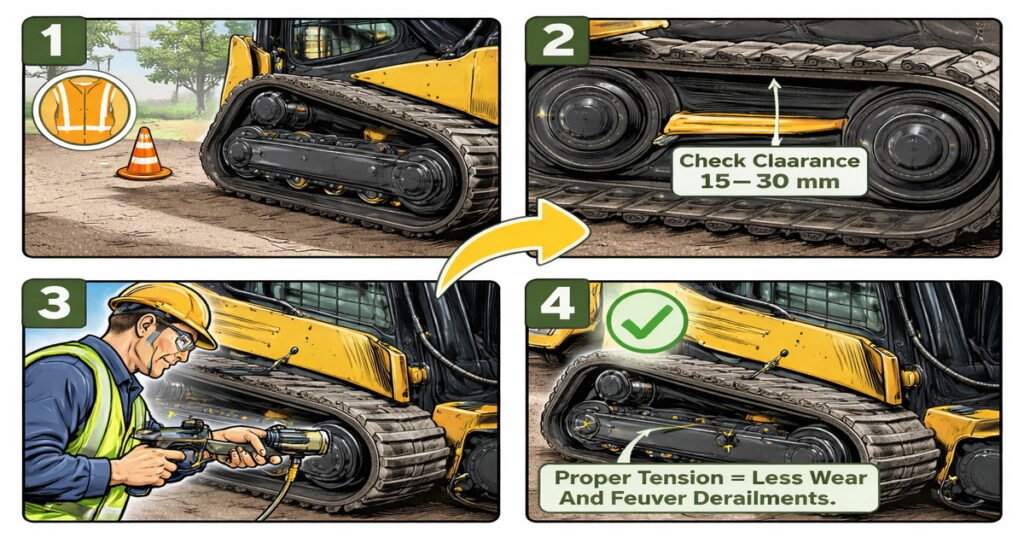
Correct track tension is crucial for compact track loaders. Operators should regularly check the clearance between the middle track roller and the track surface, typically targeting about 15–30 mm, and adjust tension using a grease‑filled tensioning cylinder and discharge valve according to manufacturer specs. [vitaldesign]
If tension is too tight, track wear and required drive effort increase, potentially reducing service life of sprockets and idlers. If tension is too loose, the track can derail and cause damage or stretching beyond normal limits. Building this simple check into your Certeg CTL daily routine will save significant downtime and undercarriage cost over the life of the machine. [vitaldesign]
Call to Action: Choose the Right Certeg Loader for Your Job
If you are planning your next skid steer or compact track loader purchase, the smartest move is to match power, hydraulics, and undercarriage to the work you do most often, and then layer on the right comfort and automation features. Certeg’s wheel and track loaders can be configured with the hydraulic packages, control systems, grade control, and telematics required for demanding construction, landscaping, agricultural, and industrial jobs around the world. [webfx]
Ready to spec your ideal skid steer or compact track loader? Get in touch with Certeg’s application specialists to review your attachments, jobsite conditions, and budget, and build a machine package optimized for real‑world productivity and lifecycle cost.
Frequently Asked Questions (FAQ)
1. What is the main difference between a skid steer and a compact track loader?
A skid steer uses wheels and typically performs best on hard, stable surfaces, while a compact track loader runs on rubber tracks, offering better flotation and traction on soft or muddy ground. [rippa]
2. Do I really need high‑flow hydraulics on my loader?
You only need high‑flow if you plan to run demanding attachments such as cold planers, heavy mulchers, or large sweepers that specify higher gpm and psi than standard‑flow systems can provide. [vitaldesign]
3. Is grade control worth the investment for small contractors?
For contractors doing frequent pads, driveways, or parking lots, even basic 2D grade control can reduce rework and increase finish quality enough to pay for itself quickly. [webfx]
4. How often should I check track tension on a compact track loader?
You should visually inspect tracks daily and measure tension regularly, aiming for the manufacturer‑recommended clearance (often around 15–30 mm at the middle roller) and adjusting via the grease tensioning system as needed. [vitaldesign]
5. Which cab options make the biggest difference for operator retention?
Enclosed cabs with heat, A/C, air‑ride seats, adjustable electro‑hydraulic controls, and good visibility (plus features like backup cameras) tend to have the strongest impact on operator comfort, fatigue, and retention. [uxplanet]
References
1.Compact Equipment – “Tech Dictionary: Learn About Skid Steer and Track Loader Technology One Word at a Time” (attachment coupling, hydraulics, controls, engines, grade control, cab, ROC, remote control, automation, lighting, reversing fan, suspension, telematics, track tension). [vitaldesign]
2.Idea Hills – “SEO & GEO for the Heavy Machinery Industry” (E‑E‑A‑T and authority guidance for heavy equipment content). [ideahills]
3.UX Planet – “Top Industrial Machinery Manufacturing Websites – UX Design Best Practices” (UX and visual design best practices for industrial machinery sites). [uxplanet]
4.Rippa – “Skid Steer vs. Compact Track Loader: Which Is Right for Your Job?” and “Skid Steer Loader vs. Compact Loader: A Complete Buyer’s Guide” (use cases and selection guidance for skid steers vs CTLs). [rippa]
5.WebFX – “SEO for Machinery Manufacturers: 5 Proven Lead Strategies” and “Building Authority in the Age of AI: Thompson Tractor’s OmniSEO Advantage” (SEO and authority building practices for machinery and equipment content). [webfx]
6.Tiecas – “A Guide to Writing Industrial Blogs | Tips for Manufacturing Content Marketing” (industrial blog and SEO writing strategy, search intent and UX guidance). [tiecas]
Hot Tags: Skid Steer Loader, Manufacturers, Customized, Custom, Suppliers, Buy, Cheap, Quality, Advanced, Durable, in Stock, Made in China, Price, Quotation