
Takeuchi Compact Track Loaders vs. Modern Jobsite Demands – An Expert-Level 2026 Buyer’s Guide
Content Menu
● Why Compact Track Loaders Still Dominate Tough Jobsites
● Inside the Takeuchi Compact Track Loader Lineup
>> Five Purpose‑Built Track Loaders
>> Undercarriage and Frame – Where Durability Really Lives
>> Operator Environment and Controls
● What the 2022 Spec Guide Missed – Real‑World Buying Criteria
>> Application Fit – Radial vs. Vertical Lift in Practice
>> Attachment Strategy and Hydraulic Flow
>> Telematics and Fleet Management
● New Expert Sections – How to Choose the Right CTL in 2026
>> A Step‑by‑Step CTL Selection Checklist
>> Comparing Takeuchi CTLs with Modern Certeg Skid Steer Loaders
>> Industry Expert Insight – Where CTLs Create the Highest ROI
● Real‑World Attachment Advice for Buyers
>> Core Attachments Every CTL Fleet Should Own
● Clear Calls to Action for CTL Buyers
● Frequently Asked Questions (FAQ)
>> 1. Are Takeuchi compact track loaders still competitive in 2026?
>> 2. When should I choose a track loader instead of a wheeled skid steer?
>> 3. How important is high‑flow hydraulics for CTLs?
>> 4. What does Takeuchi Fleet Management (TFM) actually do?
>> 5. How does Certeg position its skid steer and track loaders in this market?
If you run earthmoving, rental, or landscaping projects in 2026, choosing the right compact track loader (CTL) is no longer just about horsepower – it’s about productivity per hour, attachment versatility, operator comfort, and lifecycle cost. In this long-form expert guide, I’ll break down how Takeuchi compact track loaders stack up today, what their 2022 spec guide missed, and how they compare to new-generation machines from manufacturers like Certeg for both track and skid steer loaders. [compactequip]
Why Compact Track Loaders Still Dominate Tough Jobsites
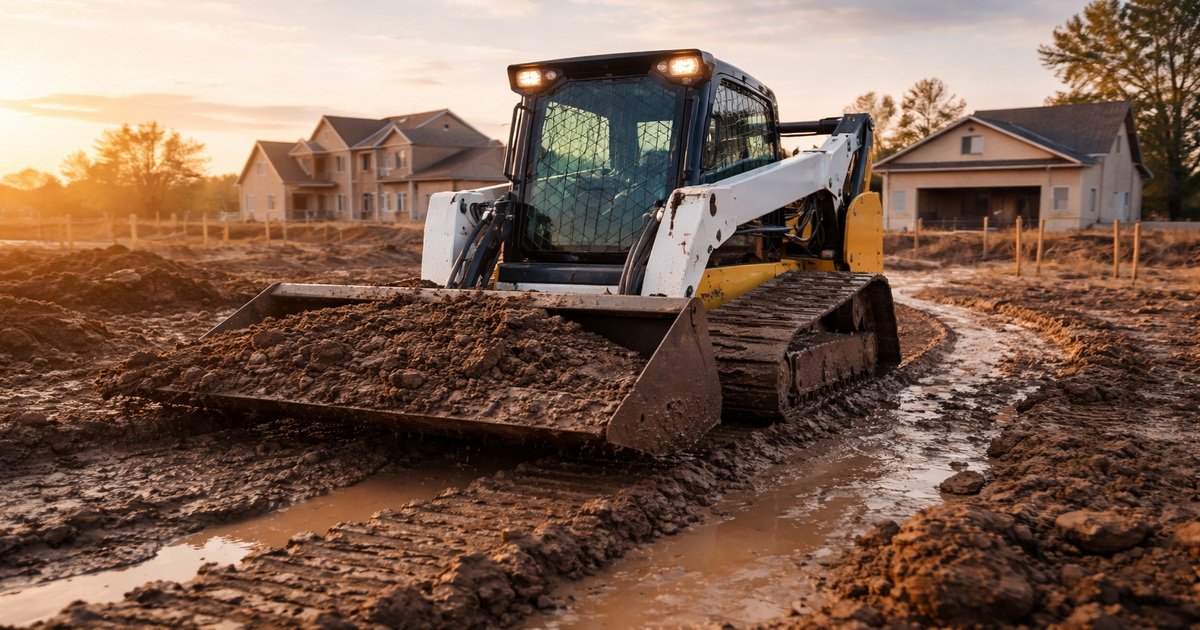
From muddy subdivision sites to tight urban infill projects, compact track loaders have become the go‑to machine where traction and flotation matter more than speed. Compared with wheeled skid steers, CTLs deliver lower ground pressure, better stability on slopes, and less turf damage, which directly reduces rework and surface restoration costs. [dozr]
On mixed fleets, contractors increasingly pair CTLs with wheeled skid steers and mini excavators, using CTLs for high‑traction work (grading, land clearing, heavy lifting) and wheeled machines for hard‑surface travel and high‑cycle material handling. That’s exactly the use case where Certeg’s track and wheel skid loaders position themselves: track models for soft or sensitive ground, wheel models for fast loading and yard work. [equipmentworld]
Inside the Takeuchi Compact Track Loader Lineup
Five Purpose‑Built Track Loaders
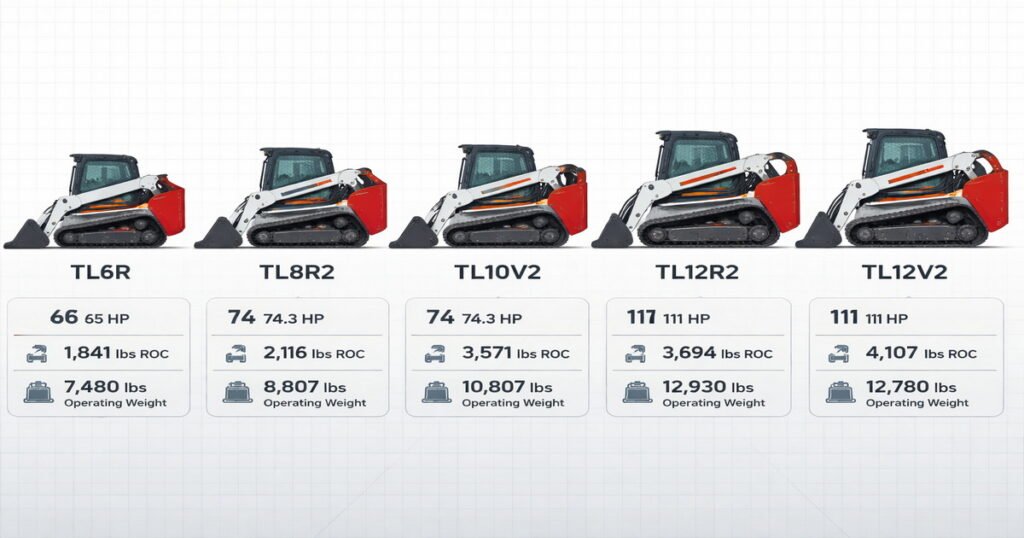
Takeuchi’s CTL range is built around five core models, each with a specific operating weight and capacity band. [compactequip]
| Model | Net engine hp | Rated operating capacity (35%) | Operating weight (approx.) | Lift pattern |
|---|---|---|---|---|
| TL6R | 65.2 hp | 1,841 lb | 7,780 lb (4.9 psi) | Radial lift |
| TL8R2 | 74.3 hp | 2,116 lb | 9,182 lb (4.5 psi) | Radial lift |
| TL10V2 | 74.3 hp | 2,522 lb | 10,270 lb (4.9 psi) | Vertical lift |
| TL12R2 | 111.3 hp | 2,975 lb | 12,590 lb (4.7 psi) | Radial lift |
| TL12V2 | 111.3 hp | 4,107 lb | 13,190 lb (4.8 psi) | Vertical lift |
This spread lets a buyer move from compact residential work (TL6R, TL8R2) through medium commercial jobs (TL10V2) all the way to high‑production grading and land‑clearing (TL12R2/TL12V2). For many contractors, the TL8R2 hits the sweet spot where transport weight, power, and attachment flow intersect. [takeuchi-us]
Undercarriage and Frame – Where Durability Really Lives
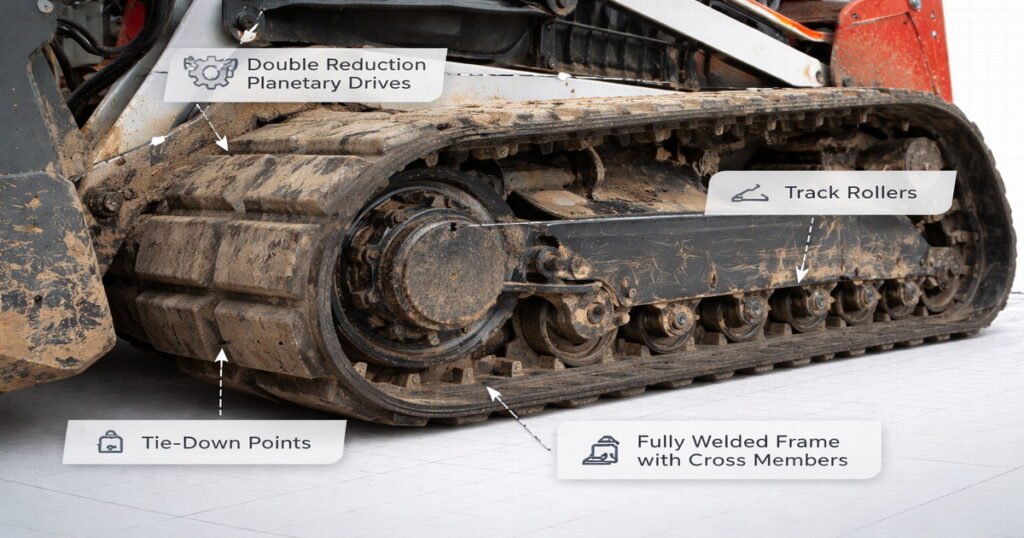
Takeuchi emphasizes a unique undercarriage design with model‑specific components matched to each platform. Tracks run on a fully welded frame with multiple cross members, and double‑reduction planetary drives are used to deliver torque in demanding applications. [compactequip]
In practice, what this means on the jobsite is:
– Less frame flex when running heavy attachments like mulchers or brush cutters. [compactequip]
– Better track alignment under side‑loading (pushing sideways against a curb or pile). [compactequip]
– Fewer derailments and longer track life when operators work on uneven terrain or slopes. [takeuchi]
As a fleet manager, I pay a lot of attention to undercarriage because it is one of the highest lifetime cost items on any CTL; Takeuchi’s design is clearly aimed at minimizing premature wear in abusive conditions. [takeuchi]
Operator Environment and Controls
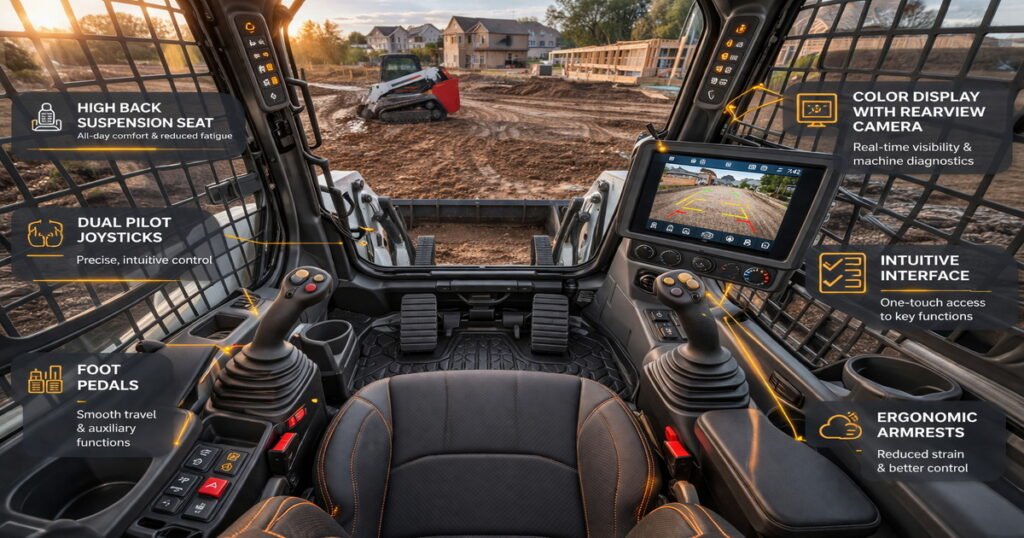
All current‑generation Takeuchi CTLs come with a spacious cab, a deluxe high‑back suspension seat and pilot‑operated joystick controls for all loader and travel functions. The company also standardized a 5.7‑inch color monitor with a rearview camera across new models, improving rear visibility and jobsite awareness.
From an operator‑experience perspective, that translates to:
– Reduced fatigue on long days due to low‑effort pilot controls and better seating.
– Faster attachment changes and safer backing thanks to the camera view.
– Easier training of new operators, as the control scheme is consistent across models. [compactequip]
What the 2022 Spec Guide Missed – Real‑World Buying Criteria
The original 2022 Takeuchi spec summary focused heavily on history, undercarriage, and a basic model lineup, but it left several critical buyer questions underdeveloped. In 2026, buyers expect more clarity in at least four areas: application fit, attachment strategy, telematics/remote management, and cost of ownership. [dozr]
Application Fit – Radial vs. Vertical Lift in Practice
The spec guide mentions both radial and vertical lift but doesn’t explain how to choose between them. From a contractor’s point of view: [compactequip]
– Radial‑lift models (TL6R, TL8R2, TL12R2) excel at digging, grading, and working close to the machine thanks to a simpler linkage and strong breakout forces. [takeuchi]
– Vertical‑lift models (TL10V2, TL12V2) are ideal for truck loading and pallet handling because they maintain lift capacity higher in the lift arc and offer greater hinge‑pin height. [compactequip]
If your work is 70%+ truck loading or material handling, you should prioritize vertical‑lift; if you’re primarily doing residential grading and ground engagement, radial‑lift will often be more cost‑effective. [dozr]
Attachment Strategy and Hydraulic Flow
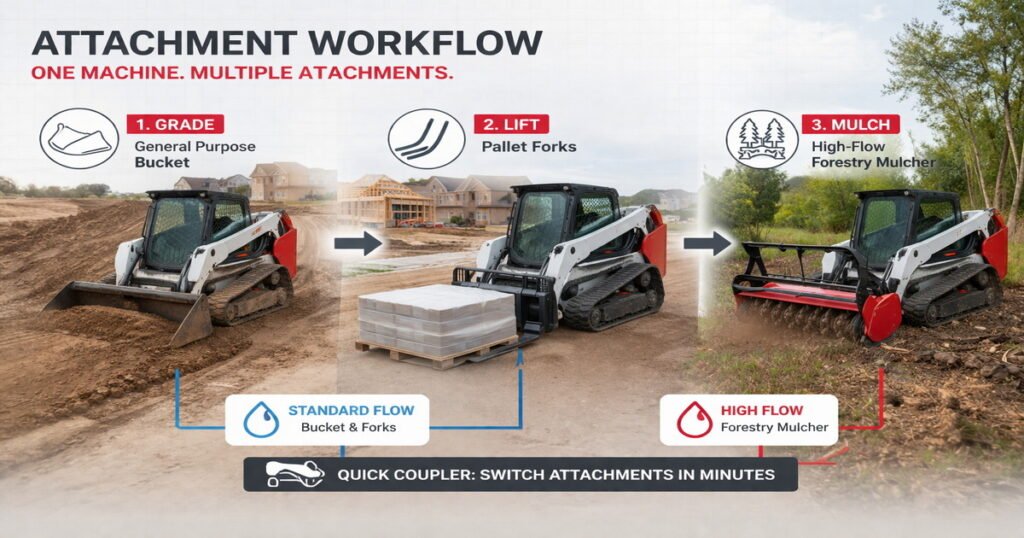
Takeuchi started offering a full line of attachments in 2021, including multi‑purpose buckets, 4‑in‑1 buckets, dozer blades, grapples, mulchers, brush cutters, rock crushers, stump grinders, and snow blowers. High‑flow hydraulics are available on several models, such as the TL8R2 and TL12V2, with flows above 30 gpm at pressures around 3,045–3,481 psi. [takeuchi-us]
As an equipment advisor, my rule of thumb is:
1. List your “must‑run” attachments (for example, forestry mulcher, high‑capacity snow blower, cold planer).
2. Check each attachment’s required flow and pressure against the CTL’s standard and high‑flow specs. [takeuchi-us]
3. Choose the smallest CTL that comfortably runs your heaviest hydraulic attachment. [dozr]
This approach protects you from under‑spec’ing a machine that struggles in real work, which is a pain point I still see in rental fleets that match attachments and loaders loosely.
Telematics and Fleet Management
The spec guide mentions Takeuchi Fleet Management (TFM) but doesn’t spell out what it actually delivers to owners. In practice, TFM provides remote access to machine health, service alerts, and usage data, helping you prevent unplanned downtime and schedule maintenance more intelligently. [compactequip]
For medium and large fleets, telematics also supports:
– Geo‑fencing, so you know if a machine leaves a defined jobsite. [compactequip]
– Utilization tracking, allowing you to right‑size your fleet and push under‑used units into revenue‑generating jobs. [equipmentworld]
– Service interval compliance across multiple brands and models. [compactequip]
New Expert Sections – How to Choose the Right CTL in 2026
A Step‑by‑Step CTL Selection Checklist
Based on current 2026 jobsite demands, here is a practical selection workflow you can use, whether you are evaluating Takeuchi, Certeg or any other brand:
1. Clarify your primary applications.
– Grading and earthmoving, truck loading, land clearing/forestry, snow, demolition, or material handling.
2. Define surface and climate conditions.
– Soft soils, rock, pavement, steep slopes, freeze‑thaw cycles, or high‑dust environments.
3. Set capacity targets.
– Minimum rated operating capacity (ROC), required lift height for truck bodies, and acceptable ground pressure range.
4. Map attachment requirements.
– Identify any high‑flow attachments (mulchers, planers, large snow blowers) and match them to hydraulic specs. [takeuchi-us]
5. Decide on track vs. wheel loader.
– Track for traction and low ground pressure, wheel for speed and lower owning cost on hard surfaces. [takeuchi]
6. Evaluate operator productivity.
– Cab comfort, visibility, intuitive controls, and safety technology such as rear cameras and better lighting. [compactequip]
7. Estimate lifecycle cost.
– Fuel burn, undercarriage wear, service access, warranty terms, and telematics support. [compactequip]
Using this checklist, a contractor focusing on residential grading and light commercial work might shortlist a Takeuchi TL8R2, a Certeg mid‑frame track loader, and a comparable model from one other OEM, then compare ROC, fuel burn, and undercarriage design side by side. [takeuchi-us]
Comparing Takeuchi CTLs with Modern Certeg Skid Steer Loaders
As a manufacturer, Certeg positions its skid steer and track loaders to cover similar power and application ranges but with a different design philosophy focused on global construction markets and varying power‑emission standards.
| Aspect | Takeuchi CTLs (2022–2025) | Certeg track & skid loaders (positioning) |
|---|---|---|
| Core focus | Compact track loaders with unique undercarriage | Track and wheel skid loaders for global jobsite demands |
| Lift patterns | Radial and vertical lift across 5 CTL models | Radial/vertical options depending on model family |
| Warranty | 2‑year / 2,000‑hour full‑machine warranty | Competitive warranty terms for export markets |
| Attachments | Branded buckets, blades, grapples, mulchers, etc. | Broad compatibility with global standard attachments |
| Fleet connectivity | Takeuchi Fleet Management (TFM) telematics | Telematics packages adaptable to different regions |
[takeuchi]
For buyers comparing brands, the key is less about logo and more about total productivity: uptime, cycle times, fuel usage, and operator confidence. Both Takeuchi and Certeg aim to meet demanding duty cycles, but Certeg’s product strategy emphasizes matching engine, hydraulics, and cooling to specific regional regulations and fuel qualities.
Industry Expert Insight – Where CTLs Create the Highest ROI
Across fleets I’ve worked with, CTLs deliver outsized ROI in three scenarios:
– All‑weather residential and commercial grading. You can keep working in muddy shoulder seasons when wheel loaders and skid steers need to stand down. [dozr]
– Forestry and land clearing. High‑flow CTLs paired with mulchers and brush cutters can replace multiple dedicated machines on smaller projects. [compactequip]
– Urban infill and utility work. Compact machines with low ground pressure can maneuver in tight spaces while minimizing damage to finished surfaces. [dozr]
In these scenarios, investing in a properly spec’d CTL – from Takeuchi, Certeg, or another reputable brand – usually pays off within the first two to three seasons through reduced downtime and rework. [dozr]
Real‑World Attachment Advice for Buyers
The original Takeuchi article includes a short “Advice to Buyers” quote emphasizing attachments such as buckets and forks. From an expert standpoint, this is absolutely correct but incomplete for 2026.
Core Attachments Every CTL Fleet Should Own
At minimum, I recommend every CTL owner starts with:
– General‑purpose bucket. Essential for earthmoving, trench backfill, and stockpile work; most CTLs, including Takeuchi, ship with this by default.
– 4‑in‑1 or multi‑purpose bucket. For grading, grabbing, back‑dragging, and limited demolition without swapping tools.
– Pallet forks. For moving pallets, lumber, pipe, and jobsite materials; increases a CTL’s value on mixed construction sites.
From there, consider:
– Brush cutter or forestry mulcher (ensure high‑flow compatibility). [compactequip]
– Snow blade or blower if you’re in cold climates.
– Auger for fencing and utility work. [dozr]
The buyers who extract the most value from their CTLs treat the machine not as a single‑function loader, but as a hydraulic power platform for a rotating attachment fleet. [dozr]
Clear Calls to Action for CTL Buyers
In a 2026‑optimized CTL article, your CTAs should be specific and aligned with buyer intent:
– For early‑stage readers:
– “Download our Compact Track Loader Spec Checklist to compare Takeuchi, Certeg and other brands side by side before you buy.”
– For mid‑funnel, spec‑driven visitors:
– “Request a personalized CTL sizing consultation – send us your typical jobs, attachments and budget, and our experts will recommend 2–3 best‑fit models.”
– For bottom‑funnel, high‑intent buyers:
– “Get a quote on a Certeg skid steer or track loader matched to your operating conditions, power requirements and preferred attachments.”
Frequently Asked Questions (FAQ)
1. Are Takeuchi compact track loaders still competitive in 2026?
Yes. With purpose‑built undercarriages, a five‑model lineup and integrated telematics, Takeuchi CTLs remain competitive in power, durability and operator comfort. However, buyers should compare them against newer machines, including Certeg track and skid loaders, to ensure the best fit for their applications and regional requirements. [compactequip]
2. When should I choose a track loader instead of a wheeled skid steer?
Choose a track loader when you work frequently on soft, muddy, or uneven ground, or when surface damage must be minimized. If most of your work is on concrete or asphalt yards with frequent travel between sites, a wheeled skid steer may offer lower owning and operating costs. [takeuchi]
3. How important is high‑flow hydraulics for CTLs?
High‑flow hydraulics are critical if you plan to run power‑hungry attachments such as forestry mulchers, large cold planers, or big snow blowers. For basic buckets, forks, and light brush cutters, standard‑flow often suffices, so buyers should match their flow spec directly to attachment requirements. [takeuchi-us]
4. What does Takeuchi Fleet Management (TFM) actually do?
TFM is Takeuchi’s telematics platform that lets you remotely monitor machine location, utilization, and health, and receive service alerts. This supports better maintenance planning, theft deterrence and fleet optimization across multiple jobsites. [compactequip]
5. How does Certeg position its skid steer and track loaders in this market?
Certeg designs both track and wheel skid loaders to serve global construction customers needing flexible power ranges and robust performance in varied jobsite conditions. Their machines focus on matching powertrains, hydraulics and cooling to different regions and duty cycles, competing directly with established CTL brands in productivity and lifecycle cost.
References
1. Compact Equipment – “Takeuchi Track Loaders Summarized — 2022 Spec Guide.”
2. Compact Equipment – “Takeuchi Compact Track Loader Specs and Product Line Summary.” [compactequip]
3. Takeuchi US – “TL8 Compact Track Loader – Specifications and Features.” [takeuchi-us]
4. Takeuchi Global – “Track Loaders – Product Overview.”[takeuchi]
5. DOZR – “The Ultimate Compact Track Loader Specifications and Dimensions Guide.” [dozr]
6. Boom & Bucket – “Used Takeuchi TL8 Specs & Features.” [boomandbucket]
7. Takeuchi US – “TL6R, TL8, TL10V2, TL12R2, TL12V2 Track Loaders – Trifold Brochure.” [takeuchi-us]
8. Compact Equipment / Equipment industry overviews – compact track loader market trends and multi‑brand summaries (including Takeuchi). [equipmentworld]
Hot Tags: Skid Steer Loader, Manufacturers, Customized, Custom, Suppliers, Buy, Cheap, Quality, Advanced, Durable, in Stock, Made in China, Price, Quotation