
What Kind of Skid Steer / Compact Track Loader Owner Are You? A Complete Certeg Buyer’s Guide
Content Menu
● Skid Steer vs Compact Track Loader Basics
● Radial vs Vertical Lift: How You Work Matters
>> Radial Lift: Ground Engaging Specialist
>> Vertical Lift: Material Handling Powerhouse
● Tires vs Tracks: Choosing the Right Platform
>> Skid Steer with Tires: Speed and Agility
>> Compact Track Loader: Traction and Flotation
● Matching Operating Capacity, Horsepower, and Torque
>> Rated Operating Capacity: Plan for Your Heaviest Day
>> Horsepower: Faster Cycles and Multifunction
>> Torque: Keeping Work Moving in Tough Conditions
● Auxiliary Hydraulics: Powering Modern Attachments
>> High Flow and Enhanced High Flow
● Controls and Operator Comfort: Mechanical vs Electro Hydraulic
● Emissions, Compliance, and Routine Maintenance
● Practical Five Step Loader Selection Framework
>> Step 1: Define Dominant Terrain and Climate
>> Step 2: List Heaviest and Most Frequent Loads
>> Step 3: Map Attachments Over the Next Three to Five Years
>> Step 4: Match Lift Geometry to Your Workflow
>> Step 5: Align Controls and Comfort With Operator Profile
● Ownership Costs, Productivity, and Uptime
● Skid Steer and CTL Selection Overview Table
● Plan Your Next Loader With a Specialist
● FAQ
>> FAQ 1: Is a Skid Steer or Compact Track Loader Better for Snow?
>> FAQ 2: How Much Extra Operating Capacity Should Be Selected?
>> FAQ 3: Is High Flow Hydraulics Always Necessary?
>> FAQ 4: Are Tracks Always Better Than Tires?
>> FAQ 5: Which Control Pattern Is Best for a Mixed Operator Team?
Choosing between a skid steer loader and a compact track loader is one of the most important equipment decisions a contractor can make when planning for growth, profitability, and long term ownership costs. This enhanced guide explains lift types, undercarriage options, hydraulics, power, controls, and ownership factors so you can confidently select the machine that fits your business today and in the future.[1][2][3]
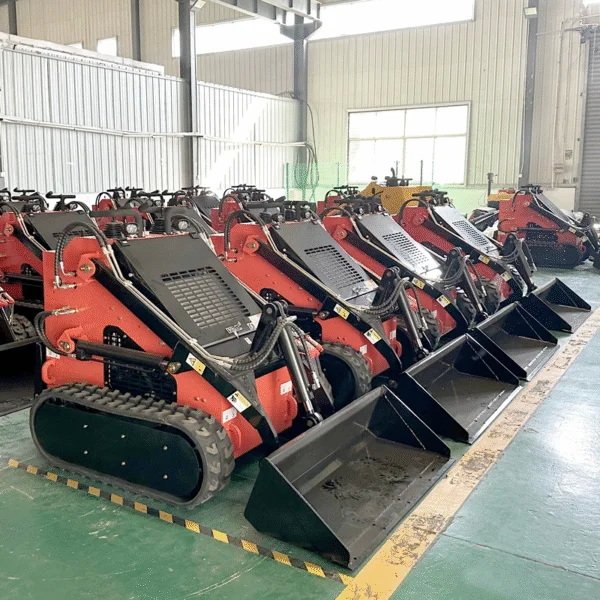
Skid Steer vs Compact Track Loader Basics
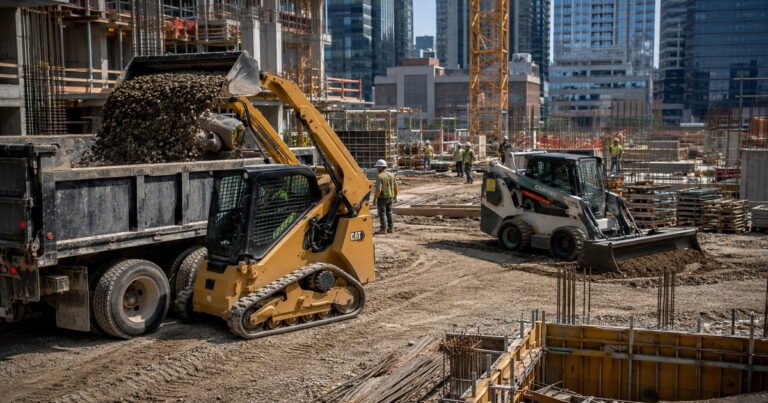
Skid steers and compact track loaders share a compact body, front attachment interface, and tight turning radius, but they behave very differently on the ground.[3][4]
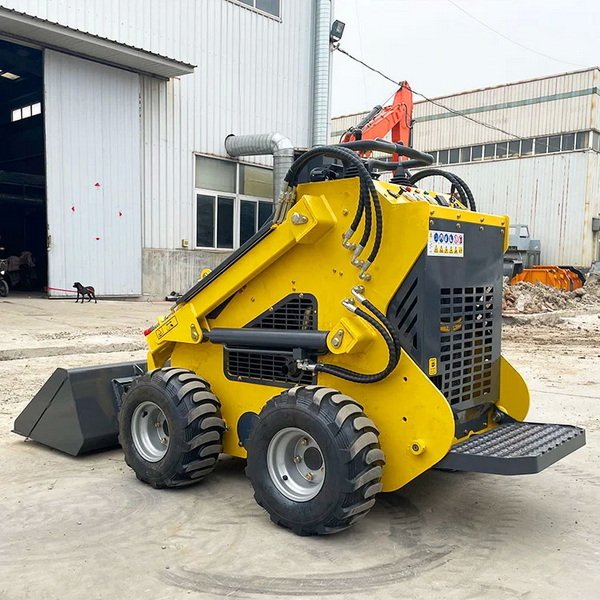
– Skid steer loaders use four wheels and are lighter, faster, and highly maneuverable on firm, paved, or prepared surfaces.[4][5]
– Compact track loaders use rubber or steel tracks, delivering lower ground pressure, better traction, and greater stability on soft, wet, or uneven terrain.[5][4]
Skid steer loaders are typically the better choice for hard surfaces and tight urban jobs, while compact track loaders excel in landscaping, earthmoving, and rough terrain work.[2][4]
Suggested visuals: place a side by side image of a wheeled skid steer and a compact track loader on different terrain (asphalt vs muddy site) and consider embedding a short video explaining the key differences.[6]
Radial vs Vertical Lift: How You Work Matters
Lift arm geometry determines how the loader lifts, reaches, and dumps, which directly affects productivity on everyday tasks.[7][1]
Radial Lift: Ground Engaging Specialist
Radial lift machines move the bucket in an arc shaped path and provide strong performance in ground engaging work.[1][7]
– Strong breakout, digging, and prying forces for aggressive loading from stockpiles.[7][1]
– Excellent reach at mid height, ideal for loading pickup trucks, small trailers, and bins.[1]
– Often simpler structure and slightly better side visibility around the arms.[1]
Radial lift is ideal when most of the day involves site preparation, landscaping, general earthmoving, and low height loading.[7][1]
Vertical Lift: Material Handling Powerhouse
Vertical lift machines keep the load closer to the machine and lift more straight up, delivering better reach at full height.[7][1]
– Higher maximum lift height for loading high sided dump trucks and hoppers.[2][1]
– Generally higher rated operating capacity for the same size class.[1]
– More stable material handling with palletized loads such as pavers, bricks, and blocks.[2][1]
Vertical lift is the better choice for yards, distribution centers, precast plants, and any operation that relies on pallet forks and truck loading.[2][1]
Suggested visuals: add a simple diagram that compares the lift paths of radial and vertical arms, showing typical loading heights and reach zones.
Tires vs Tracks: Choosing the Right Platform
The choice between wheels and tracks affects traction, ground disturbance, upkeep, and transport logistics.[4][1]
Skid Steer with Tires: Speed and Agility
Tired machines offer a quick, responsive, and cost effective platform for many contractors.[5][1]
– Higher travel speeds and excellent maneuverability in tight spaces.[5][1]
– Best on concrete, asphalt, compacted gravel, and other firm surfaces.[4][5]
– Lower initial price and simpler, cheaper undercarriage service compared to tracked machines.[3][1]
Skid steers are ideal when work happens mostly on paved or stable ground, travel distance on site is important, and transport needs to remain simple and efficient.[3][4]
Compact Track Loader: Traction and Flotation
Tracked loaders distribute weight over a larger area and deliver much lower ground pressure than wheeled machines.[2][1]
– Superior traction and stability in mud, snow, sand, and uneven ground.[5][1]
– Reduced rutting and ground disturbance, protecting lawns, landscaping, and soft subgrades.[5][2]
– Smoother ride and more stable platform for grading and precision attachments, especially with suspension and bogie systems that keep the track in contact with the ground.[8][1]
Compact track loaders are best for wet seasons, soft soils, steep terrain, and any work where surface protection is critical.[2][5]
Suggested visuals: include a photo pair or infographic showing turf damage after several passes with a skid steer versus a compact track loader.
Matching Operating Capacity, Horsepower, and Torque
Choosing the right machine requires balancing rated operating capacity, horsepower, and torque rather than focusing on a single number.[3][1]
Rated Operating Capacity: Plan for Your Heaviest Day
Rated operating capacity (ROC) is commonly defined as 50 percent of the tipping load and reports how much weight the machine can safely handle.[9][1]
– Start from the heaviest pallet or bucket load handled regularly and add a safety margin.[1]
– For a heaviest pallet of around 2,000 pounds, it is wise to look at machines with about 2,100 to 2,500 pounds ROC to avoid working at the limit.[1]
– Hardscape, masonry, quarry, and precast operations often use pallets from 1,000 to beyond 3,000 pounds, which may require a larger frame or vertical lift configuration.[2][1]
Horsepower: Faster Cycles and Multifunction
Two machines with the same ROC can deliver very different performance depending on horsepower.[10][1]
– Higher horsepower allows faster cycle times, quicker recovery, and more confident charging into piles.[1]
– The ROC does not increase with horsepower; lift capacity is set by tipping load and design.[1]
– More horsepower helps maintain performance when driving, lifting, and running attachments simultaneously.[10][1]
Torque: Keeping Work Moving in Tough Conditions
Torque describes the ability to push through resistance and keep the machine working in difficult material.[3][1]
– Higher torque helps maintain ground drive in deep mud, snow, or dense material.[2][1]
– It also supports high drag tools such as mulchers, large augers, and cold planers that demand continuous power.[10][1]
Suggested visuals: integrate a simple infographic that states “Capacity: what you lift, Horsepower: how fast you work, Torque: how hard you push” to visually connect the concepts.
Auxiliary Hydraulics: Powering Modern Attachments
Attachments turn compact equipment into multi tool platforms, and hydraulic specification determines which tools are realistic.[3][1]
Standard Flow Hydraulics
Standard flow is included on nearly all modern skid steers and compact track loaders.[11][1]
– Typical flow rates are roughly 17.5 to 24.2 gallons per minute at around 3,000 psi, depending on model.[11][1]
– Suitable for four in one buckets, grapples, augers, trenchers, smaller hydraulic hammers, and many snow plows.[3][1]
Standard flow is usually a good fit when the focus is on basic earthmoving, light to medium attachments, and controlled purchase cost.[3][1]
High Flow and Enhanced High Flow
High flow systems support attachments that require more hydraulic oil per minute than a standard circuit can provide.[10][1]
– Typical high flow ranges from about 30.7 to 41.6 gallons per minute at similar pressure levels.[11][1]
– This option powers more demanding tools such as cold planers, larger snow blowers, many mulchers, rock saws, and chipper shredders.[10][1]
Enhanced high flow combines similar flow levels with significantly higher pressure for extremely demanding attachments.[10][1]
– In some systems, pressure can rise to around 4,100 psi, unlocking more power at the tool.[10][1]
– Larger forestry mulchers, big rock saws, and high production cold planers may require this configuration.[10][1]
A secondary auxiliary circuit can be valuable for attachments that need multiple hydraulic motions, such as side shift, chute rotation, or stabilizer deployment.[1]
Suggested visuals: add a table styled graphic that maps common attachments to standard flow, high flow, or enhanced high flow requirements for fast reference.

Controls and Operator Comfort: Mechanical vs Electro Hydraulic
Control technology influences operator fatigue, precision, and training time, especially on long shifts.[8][1]
Mechanical Controls
Mechanical systems use direct linkages between levers and valves.[1]
– Familiar to many experienced operators who learned on older machines and prefer a traditional feel.[1]
– Demand more arm and upper body movement, which may increase fatigue during extended operation.[1]
– Some manufacturers add servo assistance to reduce effort while retaining the mechanical character.[1]
Mechanical controls remain relevant where crews include long time operators who prefer that feel, where simplicity is important, and where jobs are shorter or less precise.[1]
Electro Hydraulic Controls
Electro hydraulic (EH) controls use electronic signals to manage hydraulic valves and machine response.[8][1]
– Enable multiple preset sensitivity levels so operators can fine tune joystick feel to their comfort and skill level.[8][1]
– Allow quick switching between ISO and H patterns via a rocker switch, simplifying training and fleet flexibility.[8][1]
– Reduce lever travel and rely more on wrist movement, which can lower fatigue and improve fine grading or material placement.[1]
Advanced EH handles often add extra feel points to improve feathering precision, which is especially helpful with grading blades, planers, and other sensitive attachments.[1]
Suggested visuals: consider showing a close up photo of an EH joystick and in cab display, highlighting pattern selection and responsiveness settings.
Emissions, Compliance, and Routine Maintenance
Modern compact equipment must comply with stringent emission standards, influencing engine design, fluids, and service routines.[12][1]
– Many machines at or below about 74 horsepower use maintenance free solutions that require no regeneration, no additional fluids, and no periodic filter replacement.[1]
– Larger engines around 90 horsepower may require diesel exhaust fluid (DEF), but the main daily task is simply monitoring and topping off the DEF tank during regular walkaround checks.[12][1]
Across different regions, choosing the proper emissions configuration for each market is essential to avoid compliance issues, registration delays, or limitations on where the equipment can be used.[9][12]
Suggested visuals: integrate a compact infographic explaining the basic difference between maintenance free emissions systems and DEF based systems, and where each is most commonly used.
Practical Five Step Loader Selection Framework
A structured decision process helps connect technical specifications with real jobsite performance and business priorities.[2][1]
Step 1: Define Dominant Terrain and Climate
Clarify where the loader works most of the time rather than focusing on rare extremes.[4][2]
– Mostly concrete, asphalt, and stable, compacted surfaces suggest a wheeled skid steer.[4][5]
– Frequent soft soils, mud, snow, or steep grades point toward a compact track loader.[5][2]
Step 2: List Heaviest and Most Frequent Loads
Identify typical pallets, bucket loads, and attachment forces to understand capacity needs.[9][1]
– Record the heaviest pallet weight, plus any occasional oversize load that recurs during the season.[1]
– Select a rated operating capacity that offers at least a 10 to 20 percent buffer above everyday workloads.[9][1]
Step 3: Map Attachments Over the Next Three to Five Years
Consider planned attachments rather than only current tools.[3][1]
– Buckets, forks, grapples, small augers, and trenchers usually function well with standard flow.[3][1]
– Cold planers, large snow blowers, mulchers, and rock saws typically require high flow or enhanced high flow to reach productive performance levels.[10][1]
Step 4: Match Lift Geometry to Your Workflow
Connect lift type to the dominant type of task and load type.[7][1]
– Jobs focused on digging, grading, and low height loading favor radial lift.[7][1]
– Operations centered on pallet handling and high truck loading benefit more from vertical lift.[2][1]
Step 5: Align Controls and Comfort With Operator Profile
Consider shift length, operator experience, and workforce turnover.[8][1]
– Electro hydraulic controls support long shifts, diverse operator skill levels, and training flexibility.[8][1]
– Mechanical or servo assisted mechanical controls suit operations that prioritize simplicity and already rely on operators comfortable with that layout.[1]
Ownership Costs, Productivity, and Uptime
Looking beyond purchase price helps prevent hidden costs during the machine’s life cycle.[2][3]
– Tracks generally cost more to replace than tires and can require closer attention to tension and undercarriage wear, but they often enable productivity on sites where a wheeled machine would struggle or cause excessive damage.[2][1]
– Greater horsepower and high flow hydraulics increase performance but may also raise fuel usage and DEF consumption, so the total productivity gain should justify the added operating cost.[12][1]
– Consistent daily inspections, clean coolers, correct track tension, and timely filter changes are essential to avoid unplanned downtime and maintain residual value.[3][1]
Standardizing on similar control patterns, emissions technologies, and common components across multiple machines can streamline training, parts stocking, and technical support.[12][9]
Skid Steer and CTL Selection Overview Table
Plan Your Next Loader With a Specialist
The choice of skid steer or compact track loader, lift geometry, undercarriage, hydraulics, and controls is a strategic decision that shapes project productivity, operator comfort, and long term profitability. To turn these specifications into a configuration that matches real loads, terrain, climate, and attachment plans, contact a dedicated application specialist and request a detailed working profile analysis, then use that insight to select the machine package that best supports your business growth over the coming years.[9][3][2][1]
FAQ
FAQ 1: Is a Skid Steer or Compact Track Loader Better for Snow?
In deep or uneven snow, compact track loaders generally provide better traction and stability, especially on slopes or unprepared surfaces. On cleared and firm pavement, a skid steer with the correct snow blade or blower can still deliver strong productivity and simple transport.[4][5][3][2]
FAQ 2: How Much Extra Operating Capacity Should Be Selected?
A practical approach is to choose a rated operating capacity that is roughly 10 to 20 percent higher than the heaviest regular pallet or bucket load. This buffer helps avoid running at the limit, improves stability, and provides flexibility for future material changes or heavier attachments.[9][1]
FAQ 3: Is High Flow Hydraulics Always Necessary?
High flow is not mandatory for every owner; many operations function effectively using only standard flow. High flow becomes important when using demanding attachments such as large cold planers, heavy mulchers, big snow blowers, and rock saws that require higher oil volume to perform as designed.[10][3][1]
FAQ 4: Are Tracks Always Better Than Tires?
Tracks offer clear advantages on soft, wet, or uneven ground and where surface damage must be minimized, but they typically cost more to replace and may travel more slowly. Tires are usually the better choice where surfaces are firm and travel speed, maneuverability, and lower undercarriage cost are highest priorities.[5][2][1]
FAQ 5: Which Control Pattern Is Best for a Mixed Operator Team?
Electro hydraulic control systems with selectable ISO and H patterns are usually the best choice for fleets with operators of different backgrounds and experience levels. These systems let each operator select a familiar pattern and sensitivity level, helping reduce training time and improve safety and productivity.[8][1]
Citations:
[1] https://www.casece.com/en-us/northamerica/inside-case/articles/2023/what-kind-of-skid-steer-compact-track-loader-owner-are-you
[2] https://www.mccoycf.com/skid-steers-vs-compact-track-loader
[3] https://dozr.com/blog/skid-steer
[4] https://www.equipmentshare.com/articles/track-loader-vs-skid-steer
[5] https://www.farmmachinerysales.com.au/editorial/details/how-to-choose-compact-tracked-loader-vs-skid-steer-loader-110955/
[6] https://www.youtube.com/watch?v=cqlnb-79vmY
[7] https://www.bigrentz.com/blog/radial-lift-vs-vertical-lift-skid-steer
[8] https://www.casece.com/en/europe/products/b-series-compact-track-loaders
[9] https://www.bobcat.com/na/en/buying-resources/loaders/compact-track-loader-skid-steer-loader-buyers-guide/sizes-types-specifications
[10] https://www.equipmentworld.com/construction-equipment/compact-equipment/compact-track-loaders/article/15541743/compact-track-loaders-on-the-market-in-2023
[11] https://www.key-tec.be/upload/attach-document/sr150200tr270-1.pdf
[12] https://www.cat.com/en_US/products/new/equipment/skid-steer-and-compact-track-loaders.html
Hot Tags:Vertical Lift Skid Steer, Skid Steer Vertical Lift vs Radial Lift,Skid Steer Vertical Lift, Vertical vs Radial Lift Skid Steer,Skid Steer Ownership Types, Compact Track Loader Applications, Compact Track Loader Uses, Skid Steer Equipment Guide, Compact Track Loader Comparison, Skid Steer Machine Types