
How Skid Steer & Track Loader Hydraulics Work: Standard, High‑Flow and Enhanced High‑Flow Systems Explained
Content Menu
● How a Skid Steer Hydraulic System Works
● From Engine to Oil Flow: Pumps and Power
● Auxiliary Hydraulics: Where Attachments Come to Life
● Standard vs High‑Flow vs Enhanced High‑Flow
>> Typical Flow and Pressure Ranges
● Which Attachments Need Which Flow?
● Inside the Hydrostatic Drive and Controls
● Cooling: Protecting the “Lifeblood” of the Machine
● Maintenance: Habits That Extend Hydraulic Life
● How Certeg Designs for Global Work Conditions
● Skid Steer Hydraulic Options at a Glance
● Actionable Checklist Before You Spec or Buy
● Call to Action: Talk to a Hydraulic Specialist Before You Commit
● FAQs: Skid Steer and Track Loader Hydraulics
>> 1. What is the difference between standard and high‑flow hydraulics?
>> 2. Can I add high‑flow hydraulics later?
>> 3. How do I know if my attachment is compatible with my skid steer?
>> 4. Why does my skid steer overheat when running a mulcher?
>> 5. What hydraulic oil should I use in my skid steer?
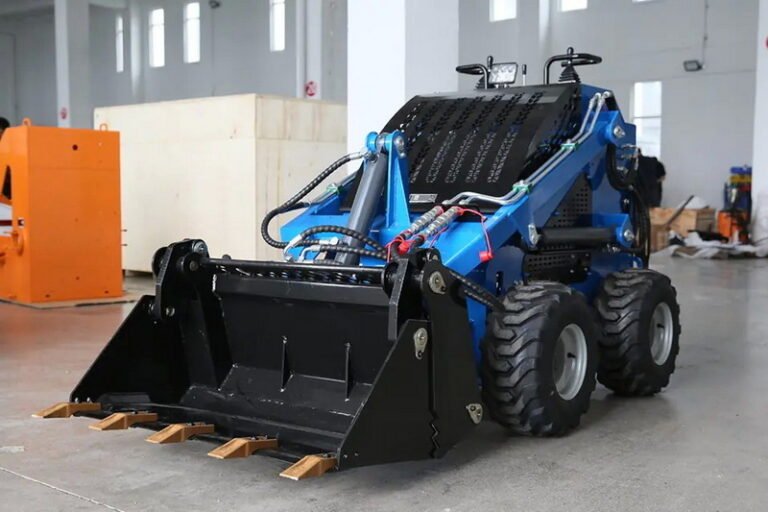
A skid steer or compact track loader only feels as “smart” and productive as its hydraulic system allows — and as a manufacturer at Certeg, I see this every day on our own wheel and track loaders in the field. When you understand how that hydraulic system works, and how to spec the right flow options, you unlock more uptime, safer operations, and better ROI from every attachment you bolt on. [casece]
How a Skid Steer Hydraulic System Works
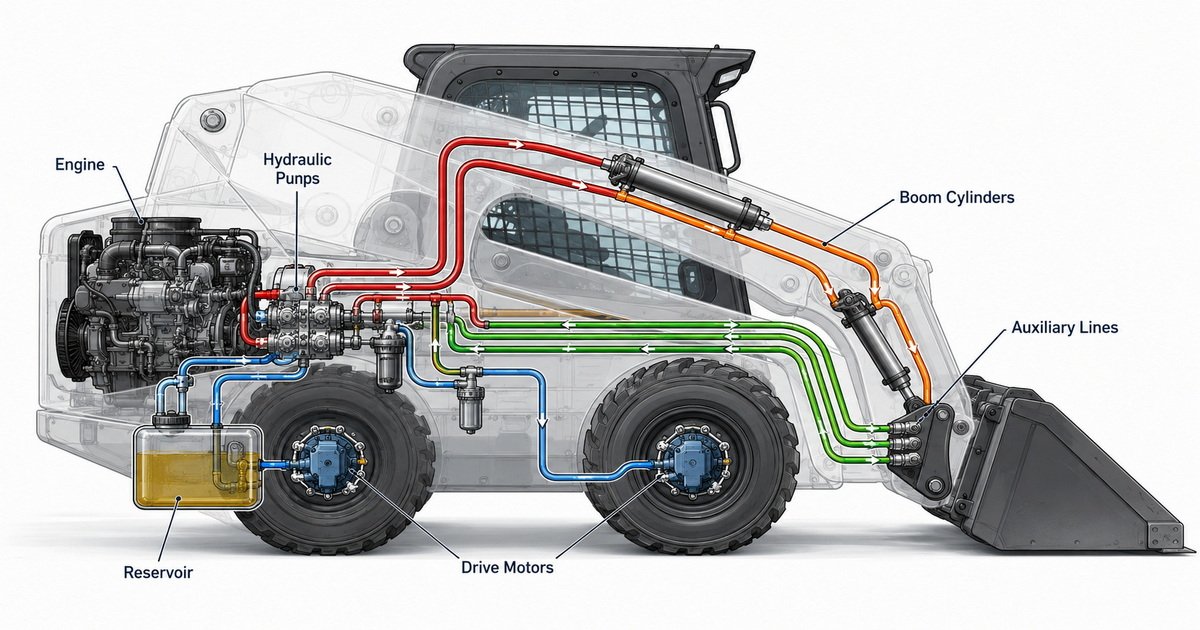
At its core, a skid steer or compact track loader converts diesel engine power into pressurized oil flow, then routes that oil through pumps, valves, cylinders, and motors to move the machine and its attachments. Instead of a traditional mechanical transmission, most modern units use hydrostatic drive, meaning hydraulic pumps directly power the wheel or track motors. [info.texasfinaldrive]
From an engineer’s perspective, you can think of the system as three intertwined circuits: [scribd]
– Drive / hydrostatic circuit – powers wheel or track motors, giving you forward, reverse, and steering.
– Implement circuit – raises/lowers the boom and tilts the bucket with hydraulic cylinders.
– Auxiliary circuit – sends power to external attachments like augers, breakers, or mulchers.
All three circuits typically share a common hydraulic reservoir, filtered return lines, and often multiple pumps—some fixed displacement, some variable—to balance flow and pressure where it’s needed most. [scribd]
From Engine to Oil Flow: Pumps and Power
Every hydraulic operation starts at the engine crankshaft, where one or more hydraulic pumps are mounted. Many modern loaders use load‑sensing, variable‑displacement pumps that adjust output based on demand, improving efficiency and control. [highways]
Typical layout on a mid‑size skid steer / CTL: [scribd]
– Two hydrostatic drive pumps – one for the left side, one for the right, feeding individual drive motors for zero‑turn steering. [info.texasfinaldrive]
– One implement/auxiliary pump – supplies oil to boom lift, bucket tilt, and auxiliary attachment circuits. [scribd]
– Optional electrohydraulic controls and pilot lines – allow fine tuning of joystick response and pattern selection (ISO / H).
From an operator’s seat, you don’t see any of this complexity—you feel it as smooth power delivery, infinite speed control, and the ability to micro‑adjust arms or attachments in tight spaces. [construction.casenamibia]
Auxiliary Hydraulics: Where Attachments Come to Life
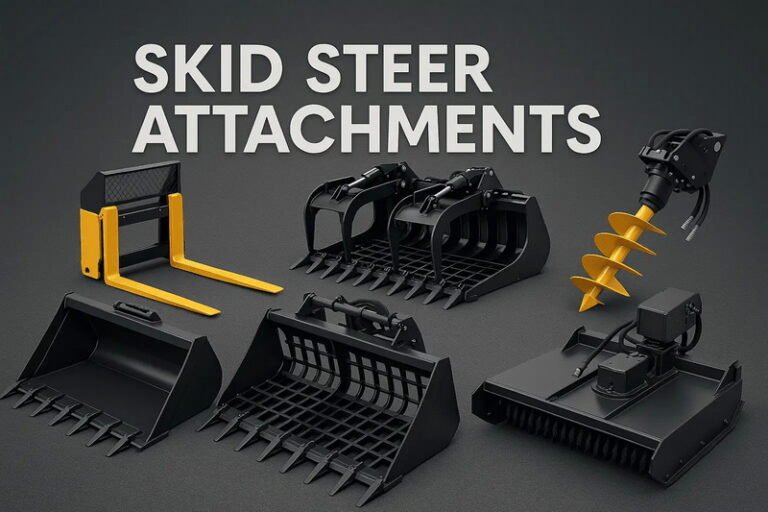
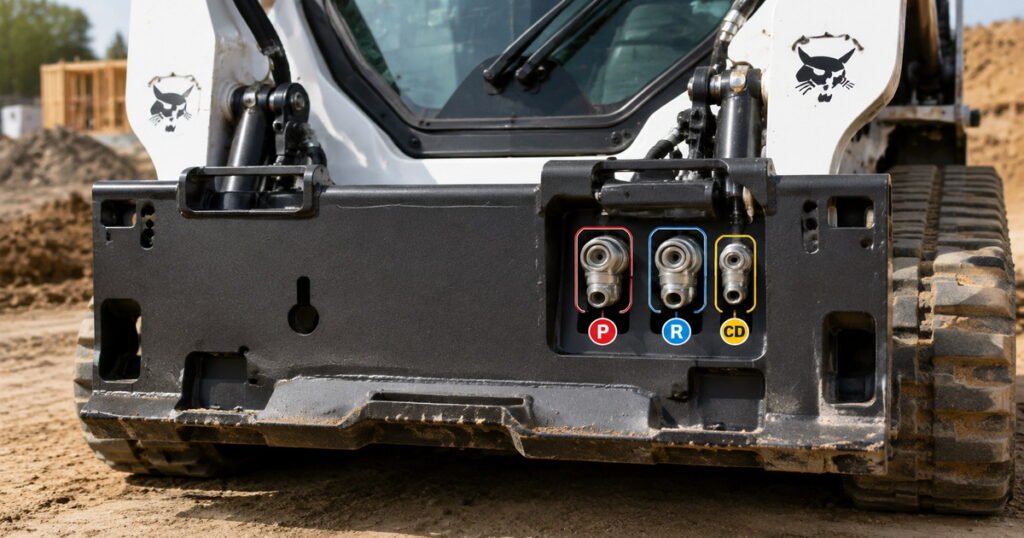
Auxiliary hydraulics are the lifeline for attachments, connecting your skid steer to tools like trenchers, cold planers, brush cutters, and snow blowers. Pressurized oil flows from the main system through quick‑coupler ports at the front of the machine, into the attachment’s motor or cylinders, and back to the reservoir. [reddit]
Key characteristics of auxiliary circuits: [casece]
– Flow rate (GPM or L/min) – how much oil moves per minute; directly affects attachment speed.
– Pressure (psi or bar) – how hard that oil pushes; directly affects torque and cutting force.
– Hydraulic horsepower – the combination of flow and pressure, calculated as:
Hydraulic HP=psi×gpm/1714
This metric helps you compare machines and attachments on a consistent basis. [heavyequipmentguide]
As a manufacturer, we pay close attention to how these specs translate into real‑world productivity—for example, ensuring our Certeg wheel and track loaders can maintain stable flow to mulchers or breakers without overheating or bogging down. [deretteloader]
Standard vs High‑Flow vs Enhanced High‑Flow
Most modern skid steers and compact track loaders are offered with several auxiliary hydraulic options. Understanding the differences is critical before you spec your machine. [compactequip]
Typical Flow and Pressure Ranges
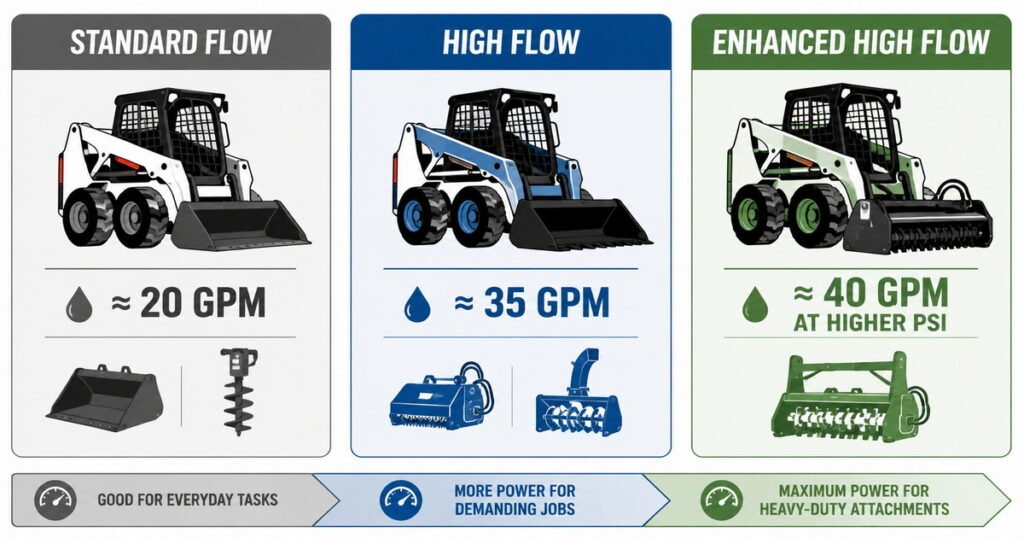
Industry ranges vary by brand, but broadly you’ll see: [casece]
– Standard flow
– ~17–24 gpm (about 65–90 L/min) on many mid‑range machines. [runtxmachinery]
– Pressure typically around 3,000–3,500 psi.
– Included from the factory on all units.
– High flow
– ~30–42 gpm on many models; some forestry CTLs go up to 50 gpm. [compactequip]
– Pressure usually similar to main system, around 3,000–3,500 psi, though some packages push to ~4,000 psi. [casece]
– Enhanced / super high‑flow
– Flow often comparable to high flow, but at higher pressures up to ~4,100 psi for demanding attachments. [heavyequipmentguide]
Manufacturers market these differently—”High‑Flow XPS”, “XHP”, “enhanced high‑flow”, etc.—but the underlying logic is the same: more hydraulic horsepower to the front of the machine. [compactequip]
Which Attachments Need Which Flow?
From an operator’s and fleet manager’s perspective, the question isn’t “standard vs high‑flow?”—it’s “What do my jobs require?” [forconstructionpros]
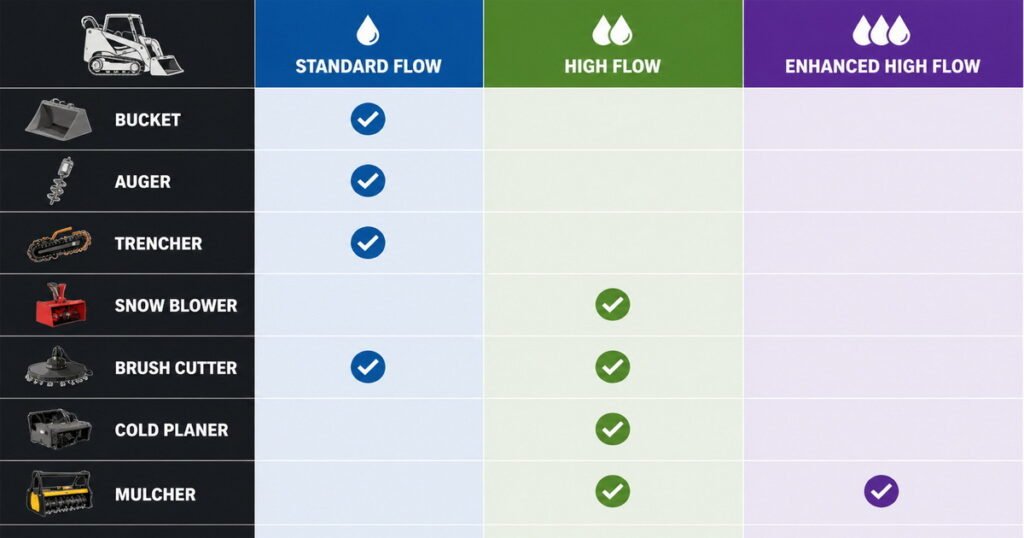
Typical attachment needs: [casece]
– Standard flow is usually enough for:
– 4‑in‑1 and general‑purpose buckets
– Pallet forks and grapples
– Basic augers and trenchers
– Hydraulic breakers for light to medium work
– High‑flow strongly recommended for:
– Brush cutters and flail mowers
– Cold planers and rock saws
– Snow blowers
– Small to medium mulchers
– Enhanced high‑flow (or heavy forestry packages) for:
– Large mulchers and heavy rock saws
– Big cold planers and high‑duty industrial tools
In our own customer base, we see compact track loader buyers opting for high‑flow far more often than wheel skid steer buyers, largely because CTLs are frequently used with forestry heads, planers, and continuous‑duty attachments. For wheeled units focused on material handling and dirt work, standard flow often hits the sweet spot of performance and cost. [heavyequipmentguide]
Inside the Hydrostatic Drive and Controls
Hydrostatic drive is what gives skid steers their signature zero‑turn maneuverability. Each side of the machine has its own hydraulic pump and motor; by varying flow and direction, the loader can spin in place or crab in tight spaces. [info.texasfinaldrive]
Modern machines typically offer two control philosophies:
– Pilot hydraulics – low‑pressure pilot lines physically shift valve spools; they give operators strong “feel” and direct feedback.
– Electrohydraulic controls – electronic sensors and actuators manage valves, allowing adjustable response curves, pattern switching, and even programmable boom/bucket functions. [equipmentworld]
From a UX standpoint, electrohydraulic controls give us, as manufacturers, the ability to tune joystick behavior to different regions, operator preferences, or applications, and to add features like hydraulics‑on‑demand where the operator can set specific flow for each attachment. [youtube]
Cooling: Protecting the “Lifeblood” of the Machine
Hydraulic oil is often described as the lifeblood of a skid steer—and like blood, its temperature must be managed carefully. Continuous high‑flow work (mulching, planing, heavy brush cutting) can quickly drive oil temperatures up, especially in hot climates. [highways]
Key cooling strategies used across the industry: [compactequip]
– Larger line sizes and coolers to slow flow through the radiator and improve heat transfer.
– Hydraulically driven cooling fans that can run independently of engine rpm, maintaining airflow even at low throttle.
– Reversible fans to clear dust and debris from coolers, critical in forestry and demolition work.
Some brands and third‑party providers even offer add‑on hydraulic coolers mounted on the machine for extreme applications like forestry mulching. As a manufacturer, we design our Certeg loaders with these thermal realities in mind, balancing compact packaging with sufficient cooling capacity for real‑world duty cycles. [youtube]
Maintenance: Habits That Extend Hydraulic Life
Even the best‑engineered hydraulic system lives or dies based on maintenance discipline. As someone who regularly reviews failure reports, I can tell you that many major issues trace back to basic tasks that were skipped. [compactequip]
Best practices recommended by OEMs and hydraulic specialists: [compactequip]
– Daily checks
– Inspect hoses and fittings for leaks or abrasion.
– Check hydraulic oil levels and top up with the manufacturer‑approved grade.
– Scheduled service
– Sample hydraulic oil every 500–1,000 operating hours, depending on OEM guidance.
– Replace filters and breather elements on schedule to control contamination.
– Fully drain and refill hydraulic oil at intervals recommended by your manufacturer—some OEMs allow up to ~6,000 hours with proper sampling. [compactequip]
– Attachment hygiene
– Always wipe quick‑coupler faces before connecting, to prevent dirt from entering the circuit. [compactequip]
– If an attachment includes a case drain, connect it first and disconnect it last to protect seals and motors.
– Oil selection
– Use the viscosity grade (e.g., ISO 32, 46, 68) recommended for your climate and duty cycle.
These habits not only cut downtime; they also protect pumps, motors, and cylinders that are some of the most expensive components on the machine. [forconstructionpros]
Matching Flow to a Planer
Imagine a contractor choosing a skid steer for asphalt milling with a cold planer. [compactequip]
1. The planer’s spec sheet calls for 30–40 gpm at 3,000+ psi.
2. A standard‑flow machine at 20 gpm will technically run it, but the drum speed will be low and prone to stalling under load. [casece]
3. A high‑flow machine at ~36 gpm and 3,500 psi delivers significantly more hydraulic horsepower, allowing faster travel speeds and deeper cuts per pass. [compactequip]
In our factory visits with customers, we often run side‑by‑side demonstrations to show how correctly matching flow and pressure can mean finishing a job in one shift instead of two—an important story when you’re justifying the premium for a high‑flow package. [youtube]
How Certeg Designs for Global Work Conditions
As a manufacturer supplying wheel and track skid steer loaders to customers from North America to emerging markets, we design our hydraulic systems around three core principles: compatibility, durability, and serviceability. [deretteloader]
– Compatibility – We target flow and pressure ranges that align with mainstream attachments, so our machines can work with global brands and regional suppliers alike.
– Durability – We test under heavy duty cycles, including high‑dust, high‑heat environments, to ensure pumps, motors, and hoses stand up over time.
– Serviceability – We prioritize accessible filters, tilting cabs, and clear hose routing so local technicians can maintain systems without specialized OEM tools. [construction.casenamibia]
For many buyers—especially rental fleets and export dealers—this balance matters more than chasing headline numbers on flow or horsepower.
Skid Steer Hydraulic Options at a Glance
| Hydraulic option | Typical flow & pressure | Best‑fit attachments | Pros | Considerations |
|---|---|---|---|---|
| Standard‑flow | ~17–24 gpm, 3,000–3,500 psi casece | Buckets, forks, grapples, light augers | Lower cost, included on all machines casece | Limited for high‑demand tools |
| High‑flow | ~30–42 gpm, ~3,000–3,500 psi compactequip | Cold planers, snow blowers, small mulchers | Higher productivity, more attachment options | Higher machine cost and more heat to manage |
| Enhanced / super high | Similar gpm, up to ~4,100 psi heavyequipmentguide | Large mulchers, big rock saws, heavy planers | Maximum hydraulic horsepower for extreme tasks | Requires carefully matched attachments |
Actionable Checklist Before You Spec or Buy
If you’re evaluating skid steer or compact track loader options (including Certeg machines), use this quick checklist:
1. List your top 5–7 attachments and gather their required flow and pressure specs. [skidsteerattachments]
2. Compare those specs to machine options (standard, high‑flow, enhanced high‑flow) and calculate hydraulic horsepower where possible. [heavyequipmentguide]
3. Check the machine’s cooling capacity (fan type, cooler size, reversible fan) against your climate and duty cycles. [compactequip]
4. Confirm quick‑coupler type and size (flat‑face, 1/2‑in vs 3/4‑in) and any 14‑pin electrical requirements. [akjia]
5. Review the maintenance schedule and ensure your team or dealer network can support oil sampling, filter changes, and diagnostics. [compactequip]
When in doubt, work with the OEM or dealer to model your most demanding use case—such as a forestry mulcher on a track loader—and spec hydraulics from that top‑end requirement down.
Call to Action: Talk to a Hydraulic Specialist Before You Commit
Hydraulic specs are more than just numbers on a brochure—they directly influence what jobs your skid steer can take on, how fast you complete them, and how reliably your machine runs over the long term. Before you finalize a purchase, upgrade, or fleet standard, sit down with your OEM or dealer and walk through your attachments, duty cycles, and growth plans so they can recommend the right combination of standard, high‑flow, or enhanced high‑flow hydraulics for your business. [casece]
If you’re considering Certeg skid steer loaders or compact track loaders, our team can provide spec‑by‑spec guidance based on your region, application mix, and preferred attachment brands, helping you build a machine package that works hard from day one. [deretteloader]
FAQs: Skid Steer and Track Loader Hydraulics
1. What is the difference between standard and high‑flow hydraulics?
Standard‑flow systems typically deliver around 17–24 gpm at 3,000–3,500 psi, enough for most common attachments. High‑flow systems boost flow into the 30–42 gpm range, providing more hydraulic horsepower for power‑hungry tools like planers and mulchers. [compactequip]
2. Can I add high‑flow hydraulics later?
On many machines, high‑flow is available as a factory option or a dealer‑installed kit, but retrofitting after purchase can be costly and may not be supported on all models. It’s usually more economical to decide on high‑flow at the initial purchase stage. [casece]
3. How do I know if my attachment is compatible with my skid steer?
Check the attachment’s spec plate or manual for required gpm and psi, then compare to your machine’s auxiliary specs and coupler type. If the attachment requires more flow or pressure than your machine can deliver, you risk poor performance or damage to both tool and carrier. [forconstructionpros]
4. Why does my skid steer overheat when running a mulcher?
Mulchers and similar continuous‑duty tools push the hydraulic system near its thermal limits, especially at high ambient temperatures. If cooling capacity, fan control, or oil condition aren’t adequate, oil temperature rises, triggering derating or shutdown. [compactequip]
5. What hydraulic oil should I use in my skid steer?
Follow the manufacturer’s manual, which typically recommends specific viscosity grades (such as ISO 32, 46, or 68) based on climate and application. Using the wrong oil can affect efficiency, wear rate, and cold‑weather performance. [casece]
References
1. Keith Gribbins, “How Does a Skid Steer/Track Loader’s Hydraulic System Work? We Explain (Options Too),” Compact Equipment, 2023. [Continue reading]
2. “Go With the Flow: Skid Steer Hydraulics,” CASE Construction Equipment.
https://www.casece.com/en-us/northamerica/inside-case/articles/2016/go-with-the-flow-skid-steer-hydraulics [casece]
3. “CTL and SSL Auxiliary Hydraulics Demystified,” CASE Construction Equipment.
https://www.heavyequipmentguide.ca/article/40070/what-to-consider-when-selecting-a-hydraulic-flow-option-for-your-skid-steer-or-compact-track-loader [heavyequipmentguide]
4. “High-Flow Auxiliary Hydraulics Will Upgrade Your Skid Steer and CTL,” Compact Equipment.
https://compactequip.com/skid-steers/tapping-into-high-flow-potential/ [compactequip]
5. “Hydraulic Health: A Maintenance Guide to Maximize a Skid Steer/Track Loader’s Hydraulic System,” Compact Equipment.
https://compactequip.com/skid-steers/hydraulic-health-a-maintenance-guide-to-maximize-a-skid-steertrack-loaders-hydraulic-system/ [compactequip]
6. “Skid Steer Motion and Hydraulic Motors,” Shop Talk Blog, Texas Final Drive.
https://info.texasfinaldrive.com/shop-talk-blog/skid-steer-motion-and-hydraulic-motors [info.texasfinaldrive]
7. “Skid Steer Hydraulic Flow Guide — Standard vs High Flow,” SkidSteerAttachments.ca.
https://skidsteerattachments.ca/guides/hydraulics/hydraulic-flow-guide/ [skidsteerattachments]
8. “High-Tech Loaders: Tracking the Latest Advancements in Skid Steers and Track Loaders,” Compact Equipment.
https://compactequip.com/skid-steers/high-tech-loaders-tracking-the-latest-advancements-in-skid-steers-and-track-loaders/ [compactequip]
9. Komatsu next-gen skid steer and CTL hydraulic system overview, Highways Today.
https://highways.today/2025/03/04/komatsu-loaders-bauma/ [highways]
10. Certeg skid steer loader factory overview video.
https://www.youtube.com/watch?v=Q–2n9JfrYM [youtube]
Hot Tags: Skid Steer Loader, Manufacturers, Customized, Custom, Suppliers, Buy, Cheap, Quality, Advanced, Durable, in Stock, Made in China, Price, Quotation