
How Machine Control Systems For Compact Track Loaders Elevate Earthworks
Content Menu
● What Is Machine Control On Compact Track Loaders?
● Why Compact Track Loaders Are Ideal For Precision Earthworks
● Core Types Of Machine Control: Indicate, 2D, And 3D
● Key Components Of CTL Machine Control Systems
● Portable Machine Control And Fleet Flexibility
● Performance Benefits For Earthworks Operations
>> Productivity And Cost Savings
>> Accuracy And Finish Quality
>> Safety And Jobsite Efficiency
● CTLs With Machine Control Compared To Skid Steers And Dozers
>> Application Comparison Table
● Selecting The Appropriate Machine Control Level
● Integration: Machine Compatibility And Attachments
>> Machine Control Compatibility
>> Attachment Setup And Calibration
● Common Earthworks Tasks Enhanced By CTL Machine Control
● New Trends: Accessible, App‑Driven Machine Control
● Practical Implementation Steps For Contractors
● Recommended Visuals For Better User Experience
● How Certeg Supports Machine Control‑Ready Compact Equipment
● FAQs About Machine Control Systems For Compact Track Loaders
>> FAQ 1: Is machine control on a compact track loader worth the investment for small contractors?
>> FAQ 2: Do I need 3D machine control, or is 2D enough?
>> FAQ 3: Can one machine control kit be shared across multiple compact track loaders?
>> FAQ 4: How difficult is it for operators to learn machine control?
>> FAQ 5: What do I need to prepare on the jobsite before using machine control?
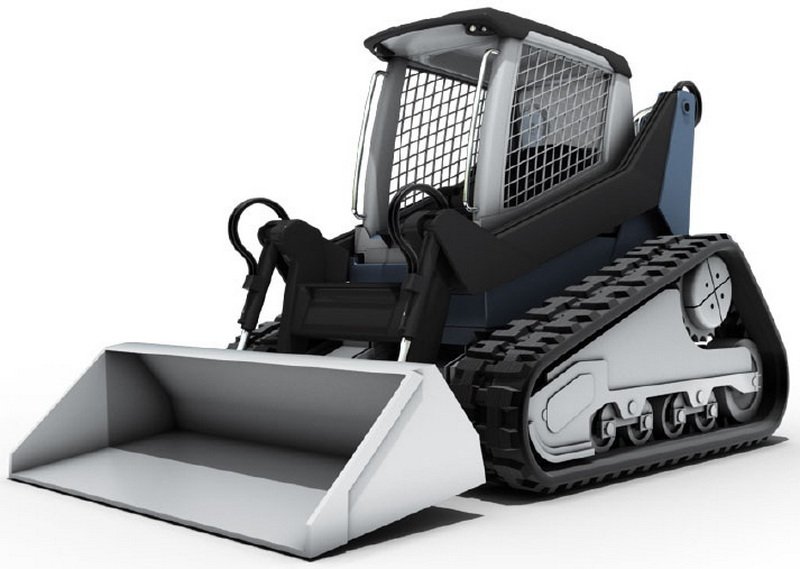
Machine control systems for compact track loaders have transformed how contractors handle earthworks, bringing survey‑grade accuracy, faster production, and lower rework costs to smaller jobsites. When combined with the right grading attachments, these systems turn a compact track loader (CTL) into a precision earthmoving platform that can compete with full‑size dozers and graders on many tasks.[1][2][3]
What Is Machine Control On Compact Track Loaders?
Machine control for compact track loaders is a technology package that uses sensors, lasers, GPS/GNSS, and onboard computers to guide or automate the grading attachment so the operator can hit target grade faster and more accurately.[4][1]
– Sensors measure blade or box‑blade position, slope, and height in real time.[1][4]
– A control unit compares this to a design surface or laser reference and calculates cut/fill.[5][1]
– The system either shows guidance or automatically adjusts the attachment.[4][1]
On compact machines, these systems are packaged to be smaller, lighter, more portable, and easier to install than traditional systems used on large dozers and motor graders.[6][4]
Why Compact Track Loaders Are Ideal For Precision Earthworks
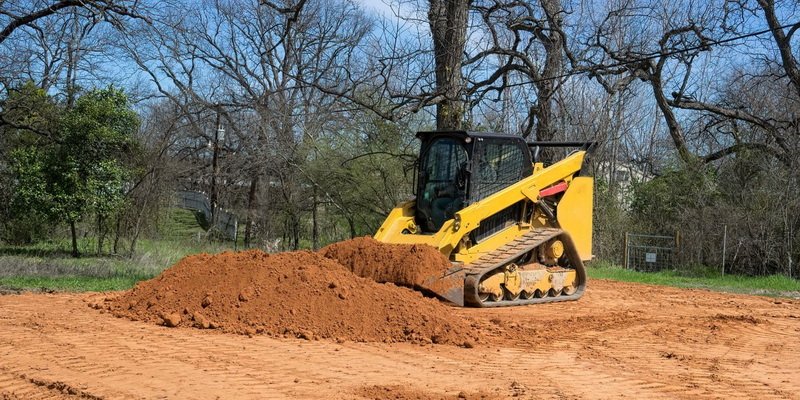
Compact track loaders are often the first machines to adopt machine control in small to mid‑size earthworks because of their high tractive effort and excellent stability.[3][1]
– The rubber track undercarriage spreads machine weight, reducing ground pressure and improving traction on soft or uneven ground.[7][3]
– The rigid frame and low center of gravity make CTLs more stable than wheeled skid steers when pushing heavy blades or box scrapers at precise grades.[3][7]
Compared with skid steers, CTLs can maintain more consistent blade engagement and finish quality, especially when paired with automatic grade control. This allows contractors to handle many fine‑grading tasks that previously required a larger dozer or grader.[8][1][3]
Core Types Of Machine Control: Indicate, 2D, And 3D
Indicate Systems
Indicate systems show the operator where the blade is relative to design grade, but do not move the attachment automatically.[9][1]
– A display in the cab shows cut/fill in real time.[9][1]
– The operator manually adjusts the controls to stay on grade.[5][1]
– This option suits contractors who want improved accuracy while keeping full manual control.[5][9]
Indicate systems are typically the lowest cost entry point and can later be upgraded to automatic control on many platforms.[1][4]
2D Grade Control
2D systems manage elevation and single‑plane slopes using lasers or sonic sensors as reference.[9][1]
– A rotating laser or laser receiver defines a reference plane.[10][1]
– The system maintains a target height and slope for flat pads, roads, or sports fields.[3][1]
– Common tasks include driveways, parking lots, shed pads, sidewalks, and simple drainage grades.[10][1]
Solutions like Topcon 2D‑MC mount directly to grading attachments on compact track loaders and skid steers, offering automatic blade control with laser‑based accuracy. Many contractors start with 2D because it provides fast ROI on everyday grading work without the complexity of 3D.[4][10][1]
3D Grade Control
3D systems use GNSS/GPS, robotic total stations, and digital terrain models to guide the CTL and attachment over complex surfaces with multiple slopes and contours.[1][9]
– RTK‑corrected positioning delivers centimeter‑level accuracy in three dimensions.[2][1]
– The CTL carries antennas, IMUs, and sometimes prisms for total station tracking.[11][1]
– The system reads a 3D design file and continuously adjusts blade position to match the model.[5][9]
3D grade control is ideal for large developments, golf courses, sports complexes, subdivisions, and complex drainage projects, where multiple elevations and transitions must be built without constant staking.[12][9]
Key Components Of CTL Machine Control Systems
Machine control platforms for compact track loaders share several common components.[4][1]
– Control display: Rugged display mounted in the cab showing grade, cut/fill, and system status.[10][1]
– Sensors: IMUs and position sensors on the blade or box scraper to track pitch, roll, and elevation.[1][4]
– Receivers: Laser receivers for 2D or GNSS antennas/prisms for 3D systems.[10][1]
– Controllers: Electronic control units that calculate corrections and send commands to the hydraulic valves.[4][1]
– Hydraulic interface: Integration to the CTL’s electrohydraulic system or pilot controls.[10][1]
Some systems, such as portable Earthworks‑style solutions, emphasize portability, using magnet‑mount receivers and compact control modules so kits can be moved between multiple machines in minutes.[13][1]
Portable Machine Control And Fleet Flexibility
For small and mid‑sized contractors, portable systems create a flexible way to spread investment across a fleet.[6][1]
– Core components can be moved from one CTL to another as jobs progress.[6][1]
– Attachment‑centric 2D solutions mount on the grading blade or box blade, making it easy to swap between carriers.[1][10]
– Quick‑mount designs minimize setup time when moving between machines on the same site.[4][1]
This approach works well for fleets that include compact track loaders, skid steers, and mini excavators, but only require machine control on selected machines at a time.[11][6]
Performance Benefits For Earthworks Operations
Productivity And Cost Savings
Machine control enables compact track loaders to complete grading tasks faster with fewer passes and less rework.[2][5]
– Operators reach finished grade with fewer cuts, reducing fuel consumption and machine hours.[2][5]
– Staking labor and survey revisits are reduced, because design information is available in the cab.[12][2]
– Contractors can handle more projects in a season and reduce schedule risk due to rework.[8][2]
Industry guidance shows that modern grade control can significantly reduce over‑excavation and material waste, especially on high‑volume flat work.[2][5]
Accuracy And Finish Quality
Automatic control allows CTLs to regularly achieve centimeter‑level accuracy, depending on the reference and configuration.[5][1]
– Finished surfaces for pads, roads, and fields are smoother and closer to design from the start.[3][1]
– High spots and low spots are reduced, which is critical ahead of concrete or asphalt.[8][3]
– Consistency improves across multiple operators and shifts.[12][2]
This quality provides a strong justification for equipping compact track loaders with machine control, even on smaller projects.[3][1]
Safety And Jobsite Efficiency
Machine control also contributes to safer and more efficient jobsites.[12][2]
– Fewer workers are needed in the grading zone holding grade rods or checking stakes.[2][12]
– Operators can pay more attention to people, utilities, and traffic around the machine.[2][3]
– Less survey staking reduces clutter and trip hazards.[8][2]
These safety and efficiency gains are especially valuable on dense urban sites where compact track loaders frequently operate.[7][2]
CTLs With Machine Control Compared To Skid Steers And Dozers
Application Comparison Table
Selecting The Appropriate Machine Control Level
Contractors can match machine control level to their project mix using a simple framework.[9][1]
– Flat work and simple slopes: 2D laser‑based systems are usually sufficient and cost‑effective.[10][1]
– Complex multi‑slope work: 3D GNSS or total station systems are better suited to large developments and drainage networks.[9][12]
– Initial adoption: Indicate systems provide guidance without automation and can be upgraded later.[1][4]
– Mixed fleet: Portable, attachment‑centric systems allow sharing across CTLs, skid steers, and compact excavators.[6][1]
Aligning control level with project types helps avoid under‑ or over‑investing in technology.[5][2]
Integration: Machine Compatibility And Attachments
Machine Control Compatibility
Not every compact track loader integrates with machine control in the same way.[10][1]
– Many systems work best with electrohydraulic control machines using CAN bus.[4][1]
– Pilot‑controlled machines may require additional hardware, and capabilities can differ by brand.[1][10]
– Dealers and integrators usually verify compatibility between the CTL, attachments, and control platform before installation.[10][1]
Considering machine control readiness during CTL procurement helps future‑proof fleets for precision earthworks.[7][4]
Attachment Setup And Calibration
Machine control systems for CTLs are often centered on specific grading attachments.[1][10]
– Box blades, dozer blades, and grading beams are commonly used because they maintain stable ground engagement.[3][1]
– Some setups use dual laser receivers or combinations of receivers and tilt sensors.[4][10]
– Correct mounting of sensors and receivers is essential to maintain accuracy across the working width.[10][1]
Routine calibration, including zeroing elevation and verifying slopes, should be part of site startup to maintain performance.[9][1]
Common Earthworks Tasks Enhanced By CTL Machine Control
Machine control raises CTL performance on many recurring tasks.[3][1]
– Residential building pads and foundations.[7][1]
– Parking lots, access roads, and industrial yards.[3][1]
– Sports fields, courts, and recreation areas requiring controlled drainage.[9][10]
– Landscaping projects including berms, swales, and finished yards.[7][8]
These tasks benefit from more predictable outcomes, helping contractors maintain schedules and quality standards.[2][5]
New Trends: Accessible, App‑Driven Machine Control
Recent developments have made machine control more accessible to smaller fleets.[6][1]
– Smartphone‑based interfaces and wireless connectivity simplify training and operation.[13][1]
– Portable kits bundle measurement and control tools for compact machines.[14][6]
– Systems can often be upgraded from basic 2D to full 3D as needs grow.[11][1]
These innovations align with broader moves toward semi‑autonomous and autonomous earthmoving systems to improve productivity and reduce dependence on highly specialized operators.[15][16]
Practical Implementation Steps For Contractors
A phased path helps contractors adopt machine control efficiently.[2][1]
– Assess typical grading tasks and problem areas such as rework or high material waste.[8][2]
– Select one CTL and a well‑matched grading attachment as the initial platform.[1][10]
– Begin with simpler work using 2D or indicate systems to build operator confidence.[10][1]
– Provide focused training for operators and foremen on system setup and daily use.[12][2]
– Upgrade to 3D when handling larger or more complex sites where digital designs are standard.[5][9]
– Track savings in time, fuel, and material, then extend systems to additional CTLs as ROI is demonstrated.[5][2]
Recommended Visuals For Better User Experience
Targeted visuals make the topic clearer and more engaging for readers.[9][2]
– A labeled diagram of a CTL with sensors, receivers, and display to show component locations.[4][1]
– A comparative illustration of CTL tracks versus skid steer wheels on soft ground.[7][3]
– A flowchart of the adoption path from manual grading to 3D control.[2][5]
– A short demonstration video of a CTL automatically maintaining grade on a small commercial pad.[17][9]
Placing these visuals near sections on components, control levels, and implementation improves comprehension.[9][2]
How Certeg Supports Machine Control‑Ready Compact Equipment
Certeg manufactures compact construction equipment such as compact track loaders, skid steer loaders, excavators, road rollers, forklifts, tractors, and tracked transporters for global markets.
– CTLs can be specified with electrohydraulic controls, auxiliary hydraulics, and attachment interfaces suitable for grade control integration.[4][1]
– Matching machines with compatible grading attachments simplifies deployment of 2D and 3D systems from leading providers.[1][10]
– Global buyers can configure fleets of Certeg machines that support precise pads, roads, and landscaping work using modern control technology.[8][3]
Aligning machine selection, attachment choice, and control requirements from the start helps maximize long‑term value.[5][2]
Focused Call To Action
Contractors planning to upgrade their earthworks operations with compact track loaders and modern control systems can move sooner rather than later to capture productivity gains.[8][2]
Reach out to Certeg’s application and sales team to discuss:
– Machine configurations that are best suited for your preferred 2D or 3D control platforms.[4][1]
– Grading attachments that match your primary projects, from residential pads to commercial parking lots and sports fields.[3][1]
– A step‑by‑step rollout plan that integrates new CTLs, attachments, and control kits across your fleet while staying within budget and schedule goals.[2][1]
Working with Certeg gives you a clear path to more accurate, efficient, and profitable earthworks using compact track loaders equipped for advanced machine control.[3][1]
FAQs About Machine Control Systems For Compact Track Loaders
FAQ 1: Is machine control on a compact track loader worth the investment for small contractors?
Yes, especially for teams that frequently handle pads, parking lots, and sports fields that demand consistent grade and smooth finishes. Entry‑level 2D systems and portable kits can reduce staking, rework, and fuel use enough to recover costs over a series of well‑planned projects.[2][3][1]
FAQ 2: Do I need 3D machine control, or is 2D enough?
For flat work and simple slopes, a 2D laser‑based system generally provides sufficient accuracy and is more economical. Contractors who manage large subdivisions, complex drainage works, or multi‑slope surfaces benefit from 3D GNSS or total station solutions that follow digital design models.[5][9][10][1]
FAQ 3: Can one machine control kit be shared across multiple compact track loaders?
Many current systems are designed to be portable, so core components like displays and receivers can be moved between machines and attachments. Attachment‑centric mounting and quick‑release hardware make it practical to use one kit across several CTLs, skid steers, and compact excavators in the same fleet.[13][6][1]
FAQ 4: How difficult is it for operators to learn machine control?
Most platforms use clear, color‑coded displays with simple menus, so operators who already run CTLs can learn the basics quickly. A combination of short training sessions and supervised practice on early projects usually builds enough confidence to rely on automated grade control.[12][2][4]
FAQ 5: What do I need to prepare on the jobsite before using machine control?
For 2D systems, a properly set up rotating laser or reference plane and a calibrated attachment are essential. For 3D systems, contractors should prepare a validated digital design model, reliable corrections (base station or VRS), and suitable control points to ensure accurate positioning and grading.[5][10][1][2]
Citations:
[1] https://compactequip.com/attachments/how-machine-control-systems-for-compact-track-loaders-can-elevate-earthworks/
[2] https://www.aem.org/news/how-machine-control-help-construction-professionals-regain-control-of-project-accuracy-and-waste
[3] https://www.forconstructionpros.com/equipment/earthmoving-compact/track-loaders/article/22890715/compact-track-loaders-benefits-challenges
[4] https://www.topconpositioning.com/us/en/solutions/technology/infrastructure-products/2d-mc
[5] https://benchmarksupply.com/blogs/bmblogs/2d-vs-3d-machine-grade-control-which-one-is-better-for-your-construction-project
[6] https://www.heavyequipmentguide.ca/article/39328/3-machine-control-solutions-for-compact-equipment-that-speed-up-work-and-improve-precision
[7] https://www.inland-group.ca/news-resources/skid-steer-compact-track-loader-right-for-you/)
[8] https://highways.today/2023/06/29/compact-track-loaders/
[9] https://compactequip.com/attachments/video-unlocking-the-full-potential-of-compact-track-loaders-with-advanced-grade-control-systems/
[10] https://highways.today/2023/01/18/topcon-2dmc-track-loaders/
[11] https://sitechsolutions.com.au/our-services-2/trimble-earthworks-compact-machines/
[12] https://na.develon-ce.com/en/news-stories/the-cutting-edge/master-the-grade-what-to-know-about-2d–3d-grading-systems
[13] https://sitechcs.com/trimble-earthworks-for-compact-machines/
[14] https://www.topconpositioning.com/articles/media-coverage-exploring-grade-control-solutions-for-compact-track-loaders
[15] https://www.sciencedirect.com/science/article/pii/S0926580516300899
[16] https://www.cambridge.org/core/journals/robotica/article/robotic-autonomous-systems-for-earthmoving-equipment-operating-in-volatile-conditions-and-teaming-capacity-a-survey/2CCA41BB39D8094D1D71679FAEB4CA8D
[17] https://www.youtube.com/watch?v=4luR7rlWhi8
Hot Tags:Compact Track Loaders, Machine Control Systems, Earthworks Technology, Construction Machine Control, Grading Control Systems, Compact Equipment Technology, Precision Earthmoving, GPS Machine Control, Smart Construction Equipment, Advanced Earthworks Solutions