
Expert Skid Steer Loader Guide 2026: How to Choose the Right Machine for Real Jobsite Conditions
Content Menu
● What Is a Skid Steer Loader and Where Does It Fit?
● Skid Steer vs. Compact Track Loader: Which Should You Deploy?
● Key Skid Steer Specifications That Actually Matter On Site
>> Rated Operating Capacity (ROC)
>> Lift Height and Lift Path (Radial vs. Vertical)
>> Dimensions: Length, Width, and Height
● Comparing Popular Skid Steer Product Lines
>> High‑Level Brand Positioning
● How an Expert Actually Chooses a Skid Steer
>> Step 1 – Define Core Tasks and Attachments
>> Step 2 – Map Tasks to ROC and Frame Size
>> Step 3 – Check Access, Transport, and Ground Conditions
>> Step 4 – Compare Brand Ecosystem and Service
● Matching Skid Steers to Real‑World Scenarios
● Where Certeg Fits in a Crowded Global Skid Steer Market
● CTAs
● FAQ: Skid Steer Loaders and Buying Decisions
>> Q1. What is the most important skid steer spec for safety?
>> Q2. How do I decide between radial and vertical lift?
>> Q3. Are high‑flow hydraulics always necessary?
>> Q4. How often should a skid steer spec page be updated for SEO and E‑E‑A‑T?
>> Q5. What type of content helps a skid steer manufacturer rank better in 2026?
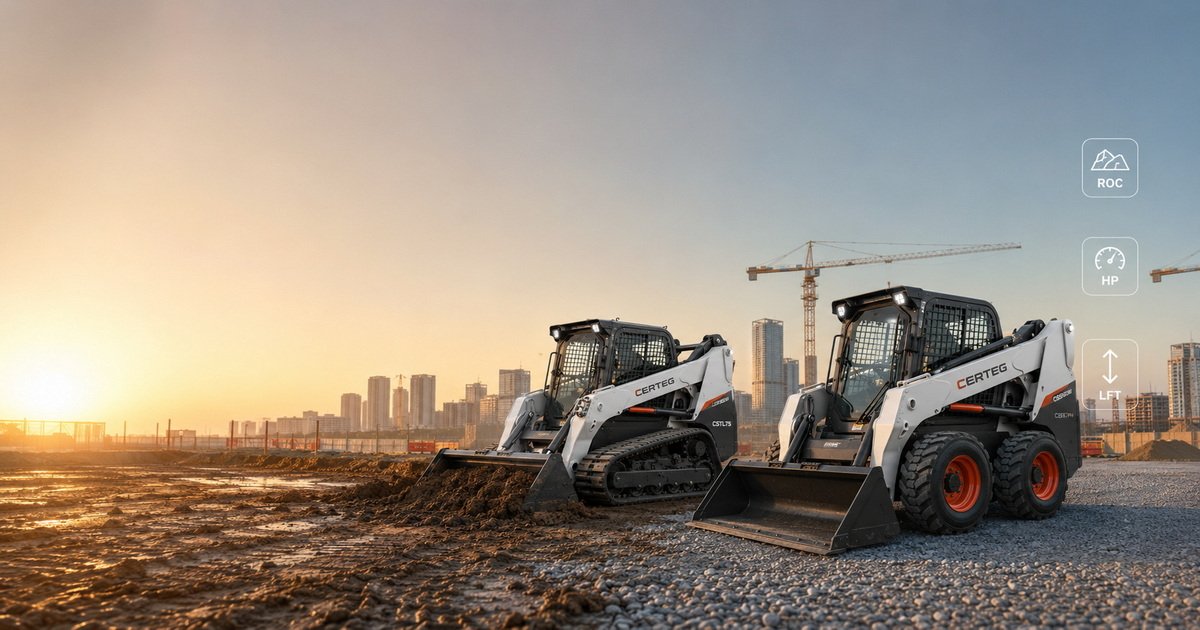
When you are standing on a muddy site at 6:30 a.m., staring at a tight access lane and a schedule that is already behind, skid steer loader specs suddenly become very real business decisions. As a manufacturer working with contractors around the world, Certeg sees the same pattern again and again: the projects that go smoothly are usually the ones where the skid steer was chosen with clear specs, real jobsite constraints, and attachment strategy in mind. [vitaldesign]
What Is a Skid Steer Loader and Where Does It Fit?
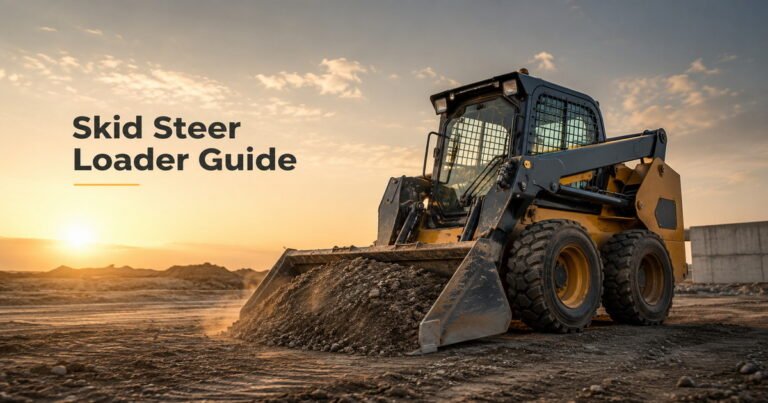
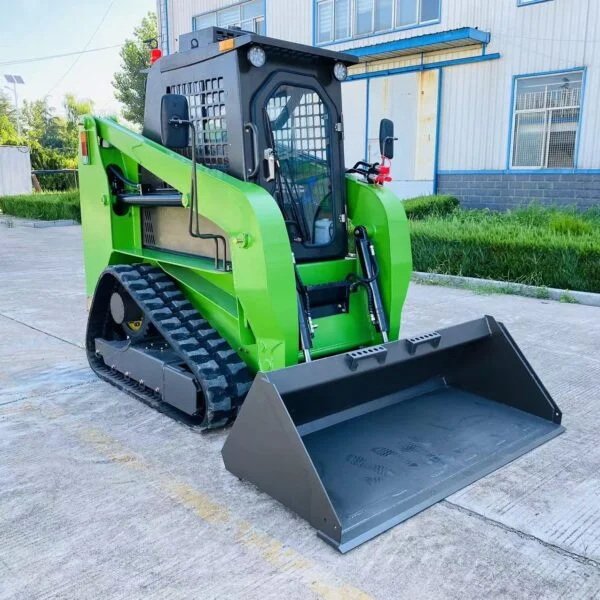
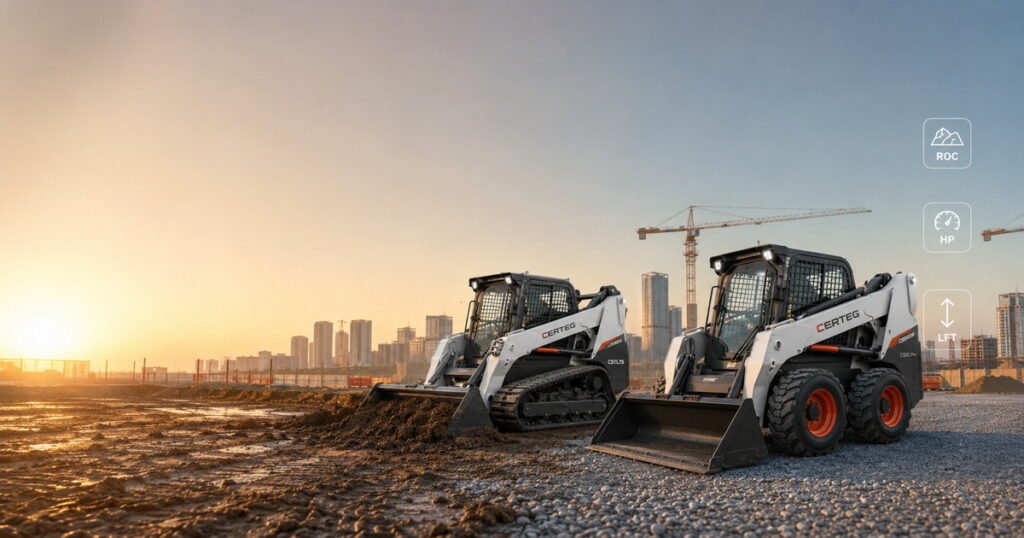
Skid steer loaders are compact, highly maneuverable machines designed to lift, load, dig, grade, and run hydraulic attachments in confined spaces. Wheeled skid steers use four tires, while compact track loaders use rubber tracks for lower ground pressure and better traction on soft or uneven ground. [bobcatoffortwayne]
Across brands like Bobcat, CAT, CASE, John Deere, Kubota, New Holland, GEHL, Manitou, and newer entrants such as XCMG, skid steers are now offered in small‑, medium‑ and large‑frame sizes with a wide power range and hundreds of compatible attachments. Global demand remains strong: the skid steer market is projected to reach over USD 15 billion by 2034, driven by infrastructure, rental fleets, and urban construction. [fortunebusinessinsights]
Typical applications include:
– Residential and commercial construction
– Roadwork, snow removal, and municipal maintenance
– Landscaping, material handling, and small‑scale demolition
– Agriculture, recycling yards, and port/stevedoring operations [bobcatoffortwayne]
From a buyer’s perspective, the skid steer is no longer just “the small loader”; it is a hydraulic tool carrier that must be spec’d around the attachments and the environment, not just the sticker price. [dozr]
Skid Steer vs. Compact Track Loader: Which Should You Deploy?
On paper, a wheeled skid steer and a compact track loader (CTL) with similar horsepower can look interchangeable, but they behave very differently in the field. [holtca]
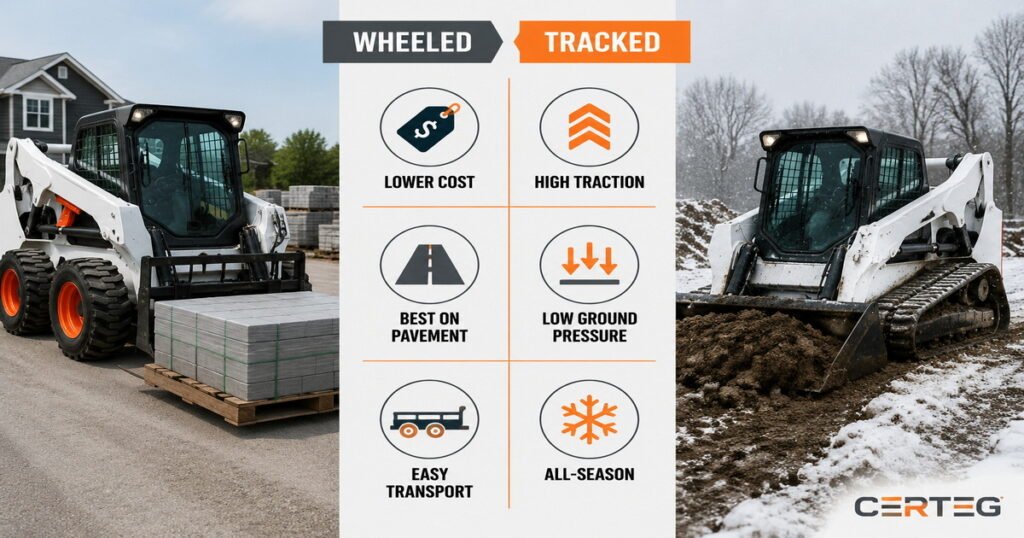
Wheeled skid steers:
– Better suited to firm, paved, or compacted surfaces
– Generally lower purchase cost and cheaper to maintain (tires vs. tracks)
– Turn quickly with less drivetrain drag on hard ground
– Ideal for yard work, indoor demolition, and sites with concrete/asphalt [holtca]
Tracked loaders (CTLs):
– Spread weight over a larger area for lower ground pressure
– Maintain traction on mud, snow, sand, and loose aggregate
– Often preferred on slopes, soft soils, and all‑season outdoor work
– Typically command a higher rental rate or capex, but can save money when wheeled units bog down. [dozr]
From a Certeg manufacturing and consulting perspective, many customers now standardize on a mixed fleet: a mid‑frame wheeled skid steer for hard‑surface work and a similar‑ROC track loader for wet seasons or new subdivision sites with poor base preparation. [fortunebusinessinsights]
Key Skid Steer Specifications That Actually Matter On Site
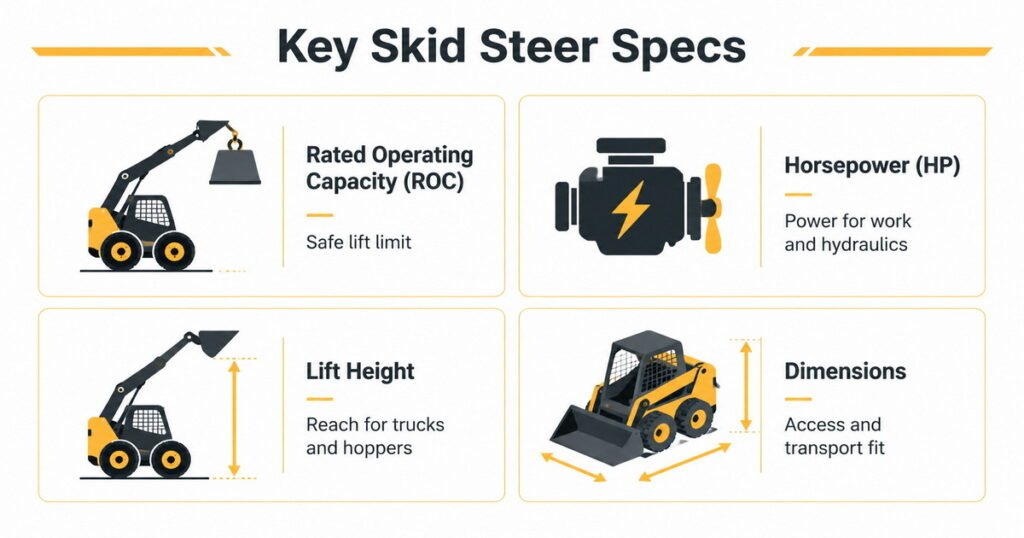
Most spec sheets list dozens of data points, but experienced buyers usually start with six core specs before looking at options. [bobcatoffortwayne]
Rated Operating Capacity (ROC)
Rated Operating Capacity (ROC) is the maximum load the machine is designed to lift and move safely, usually expressed as a percentage of its tipping load (commonly 30–50 percent). A Bobcat S70, for example, has an ROC of about 760 lb, while large units like the GEHL V420 or Manitou 4200V can exceed 4,200 lb. [bobcatoffortwayne]
If your pallet of pavers weighs 2,800 lb wet, running a 2,000 lb ROC machine is not good practice; you are operating on razor‑thin safety and stability margins. [dozr]
Operating Weight
Operating weight influences:
– Transport costs (trailer size, permits, tow vehicle class)
– Ground pressure and site damage
– Stability when handling heavy loads or high‑reach attachments [bobcatoffortwayne]
Light machines such as compact Bobcat or Kato models are easier to haul and ideal for interior work, while 11,000+ lb large‑frame skid steers are closer to small loaders in behavior. [dozr]
Engine Power (Horsepower)
Horsepower is directly linked to:
– Hydraulic performance (especially with high‑flow attachments)
– Ability to maintain ground speed under load
– Productivity in demanding cycles like cold‑planing, mulching, or heavy digging [holtca]
Entry‑level models may sit around 20–40 hp, whereas top‑end machines from CAT, John Deere, and GEHL push above 100 hp. [dozr]
Lift Height and Lift Path (Radial vs. Vertical)
Lift height at the hinge pin determines whether you can reliably load high‑side trucks or hoppers. [bobcatoffortwayne]
– Radial‑lift machines follow an arc that favors digging, grading, and ground‑level work, offering excellent breakout forces.
– Vertical‑lift models maintain load closer to the machine and reach higher, making them ideal for loading trucks and handling pallets. [bobcatoffortwayne]
For most mixed‑use contractors (grading plus loading), the decision often comes down to which task generates more revenue.
Dimensions: Length, Width, and Height
In practice, width is often the first hard constraint because it determines whether the unit can pass through gates, between existing structures, or inside industrial buildings. Compact machines like the Bobcat S70 or Kato AS12 are under 50 in wide and dominate tight‑access interior demolition and retrofit work. [dozr]
Length (usually measured with bucket) and height (ROPS clearance) drive transport and storage decisions and affect turning radius on congested sites. [bobcatoffortwayne]
Comparing Popular Skid Steer Product Lines
The original spec guides from 2022–2024 do an excellent job of listing models by ROC, weight, and dimensions across major brands, but they often lack decision‑oriented commentary from people who have to live with these fleets. The table below summarizes how key brands tend to position their skid steer lines. [dozr]
High‑Level Brand Positioning
| Brand / Line | Typical Focus & Strengths | Example ROC Range (approx.) | Notable Differentiators |
|---|---|---|---|
| Bobcat | Very broad range from micro to large; strong dealer network and attachment ecosystem dozr | ~760–3,950 lb dozr | Smallest mainstream model (S70), multiple series tuned for comfort vs. power dozr |
| CAT (D3 series) | High hydraulic performance, strong telematics, premium cab and controls dozr | ~1,550–3,700 lb dozr | XE high‑output hydraulics, strong vertical‑lift loaders for production loading |
| CASE (B series) | Workhorse machines for general construction and landscaping dozr | ~1,600–3,400 lb dozr | Clear radial vs. vertical naming (SR vs. SV), balanced spec packages |
| John Deere | Wide ROC range, strong presence in civil and infrastructure work dozr | ~1,750–4,000 lb dozr | New P‑Tier models with higher power and refined hydraulics |
| Kubota (SSV) | Limited models, but very popular in construction; strong diesel engines dozr | ~1,950–2,690 lb dozr | Simple, durable designs; strong brand trust in compact equipment |
| GEHL / Manitou | Massive ROC range including some of the largest loaders in the marketdozr | ~1,049–4,200 lb dozr | V420/4200V are among the heaviest and highest‑capacity skid steers dozr |
| New Holland | 300 series covers all frame sizes; good fuel efficiency and versatility dozr | ~1,600–3,400 lb dozr | Strong in agriculture and landscaping segments |
| XCMG | Single mid‑frame model, increasingly visible in global sourcing projects dozr | ~2,992 lb dozr | Competitive specs vs. price; vertical lift and global distribution expansion |
From field feedback, one of the biggest gaps in standard spec guides is discussion of dealer coverage, parts availability, and the role of emerging global brands—a critical factor for fleets operating outside North America or Europe. [fortunebusinessinsights]
How an Expert Actually Chooses a Skid Steer
Most articles list specs but do not show a practical selection workflow. The following decision path is used in many real procurement and rental scenarios.
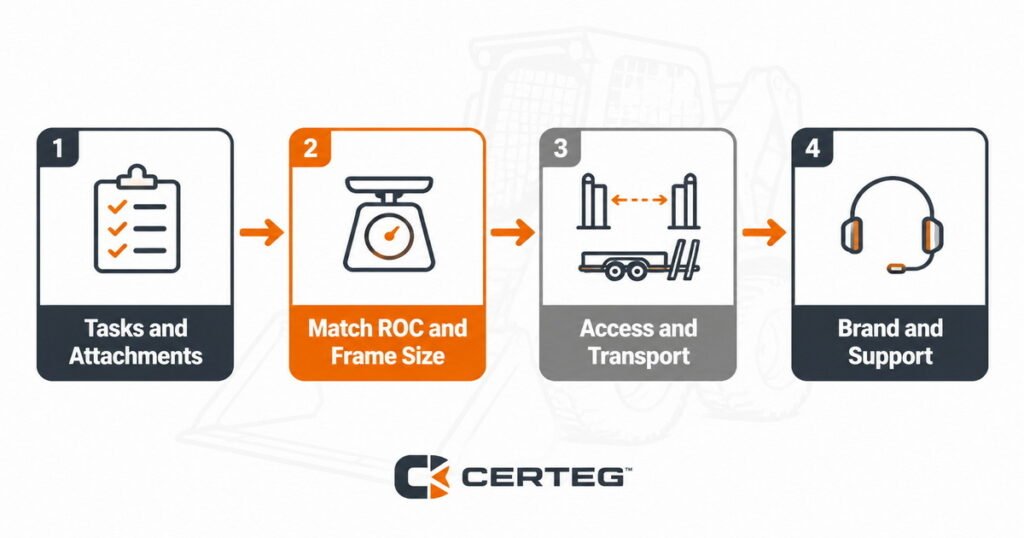
Step 1 – Define Core Tasks and Attachments
Start by writing down:
1. Primary tasks (e.g., “load 10‑wheelers with recycled concrete,” “finish grade residential lots,” “snow removal in tight parking lots”).
2. Required attachments (e.g., cold planer, mulcher, pallet forks, 6‑way dozer blade, auger).
3. Duty cycle and environment (hours/day, slope, soil conditions, climate). [bobcatoffortwayne]
High‑flow attachments, like planers and mulchers, will immediately push you toward higher horsepower and high‑flow hydraulics on mid‑ to large‑frame machines. [dozr]
Step 2 – Map Tasks to ROC and Frame Size
Using recent multi‑brand spec charts, group candidate machines by ROC band:
– Under 1,750 lb: small‑frame – interior work, landscaping, light material handling
– 1,750–2,200 lb: medium‑frame – general construction, typical rental fleet sweet spot
– Above 2,200 lb: large‑frame – heavy material handling, high‑flow attachments, production loading [dozr]
For safety, experienced buyers often use actual load × 1.25 as a target ROC to leave some margin. [bobcatoffortwayne]
Step 3 – Check Access, Transport, and Ground Conditions
– Gate clearances, doorway widths, and mezzanine heights
– Trailer capacity and tow vehicle class
– Soil and weather: if more than 30–40 percent of annual work is on soft or muddy ground, a track loader or more aggressive tire spec becomes hard to ignore. [holtca]
This is where many end users in reviews and forums complain: the machine specs were fine, but the unit couldn’t physically reach or operate efficiently in the work area. [facebook]
Step 4 – Compare Brand Ecosystem and Service
Beyond raw specs:
– Dealer distance and service response time
– Availability and pricing of wear parts
– Attachment compatibility and quick‑coupler standards
– Telematics and remote diagnostics for larger fleets [vitaldesign]
Skid steers spend a high proportion of their life in tough conditions; downtime often costs more than the monthly finance difference between models. [webfx]
Matching Skid Steers to Real‑World Scenarios
Below are three simplified scenarios that reflect common user questions and align with the spec patterns visible across the major brands. [holtca]
1. Urban landscaping and light construction
– Constraints: narrow gates, fragile turf, occasional pallet handling
– Recommended: small‑ to mid‑frame wheeled skid steer with ROC in the 1,600–2,100 lb range, radial lift, and a focus on maneuverability and transport ease. [dozr]
2. Roadwork and rental fleet applications
– Constraints: heavy attachments (cold planers), high hours, varied operators
– Recommended: mid‑ to large‑frame units with 70+ hp, high‑flow hydraulics, vertical lift, strong cooling package, and robust dealer support. [holtca]
3. Site development with poor soils and long duty cycles
– Constraints: slopes, mud, high cycle counts, mixed attachments
– Recommended: compact track loaders or heavy large‑frame skid steers with aggressive tires, higher horsepower, and large fuel and DEF capacities. [fortunebusinessinsights]
The strategic advantage for a manufacturer like Certeg is the ability to offer both wheeled and tracked platforms across multiple ROC bands, simplifying fleet standardization for global customers.
Where Certeg Fits in a Crowded Global Skid Steer Market
As global sourcing has expanded, buyers now compare established North American and European brands against high‑spec machines from Asia and emerging markets. Buyers typically look for: [fortunebusinessinsights]
– Competitive ROC and horsepower in the core 1,700–3,000 lb band
– Durability and parts support suitable for export regions with less dealer density
– Flexible emission packages for different regulatory zones
– Track and wheel options tuned to regional soil and climate conditions [fortunebusinessinsights]
By focusing on wheeled and tracked skid steer loaders engineered around attachment performance, export logistics, and reliable support, Certeg can serve contractors who need global‑grade reliability without sacrificing price competitiveness or spec transparency.
CTAs
– “Download full ROC and hydraulic spec sheet (PDF) for wheeled and tracked models”
– “Talk to an engineer about matching skid steer specs to your attachments”
– “Compare Certeg skid steer loaders to your current fleet in a 15‑minute review call”
– “Request a global shipping and lead‑time quote for your region”
FAQ: Skid Steer Loaders and Buying Decisions
Q1. What is the most important skid steer spec for safety?
The most critical spec is usually Rated Operating Capacity (ROC), because it directly affects stability and the risk of tipping when handling loads at height or on uneven ground. Operators should avoid treating ROC as a target to exceed; it is a limit to stay comfortably under. [bobcatoffortwayne]
Q2. How do I decide between radial and vertical lift?
If your primary work is digging, grading, and working close to the ground, radial lift often provides better breakout force and visibility into the bucket. If you primarily load trucks, feed hoppers, or handle pallets, vertical lift is usually the better choice because it offers higher reach and keeps the load closer to the machine at full height. [dozr]
Q3. Are high‑flow hydraulics always necessary?
No. High‑flow hydraulics are mainly required for energy‑intensive attachments such as cold planers, large mulchers, some sweepers, and heavy snow blowers. For buckets, forks, blades, and basic augers, standard‑flow hydraulics are usually sufficient, and they reduce purchase and maintenance costs. [bobcatoffortwayne]
Q4. How often should a skid steer spec page be updated for SEO and E‑E‑A‑T?
In fast‑moving markets where model updates occur every 1–3 years, updating spec pages at least annually or whenever a major model revision occurs is recommended. Each update should clearly note the date, reference current manufacturer data, and correct any outdated references to older series. [roirevolution]
Q5. What type of content helps a skid steer manufacturer rank better in 2026?
Helpful content now blends accurate spec tables, real field experience, and clear how‑to guidance (selection steps, checklists, and case studies) with transparent sourcing. Pages that show genuine expertise, link to primary data, and answer common buyer questions in depth tend to perform better than thin spec sheets or purely promotional copy. [webfx]
References
1. DOZR – *The Ultimate Skid Steer Specifications, Weight, and Dimensions Guide* (updated 2024). <https://dozr.com/blog/the-ultimate-skid-steer-spec-guide> [dozr]
2. Compact Equipment – *Summaries and Specs for 11 Different Skid Steer Product Lines (2022 Spec Guide)*. <https://compactequip.com/skid-steers/here-are-summaries-and-specs-for-11-different-skid-steer-product-lines-courtesy-of-the-2022-spec-guide/> [vitaldesign]
3. Fortune Business Insights – *Skid Steer Loader Market Size and Forecast*. <https://www.fortunebusinessinsights.com/skid-steer-loader-market-104089> [fortunebusinessinsights]
4. Bobcat of Fort Wayne – *Comprehensive Buying Guide for Skid Steer Loaders*. <https://www.bobcatoffortwayne.net/blog/a-comprehensive-buying-guide-for-skid-steer-loaders–88396> [bobcatoffortwayne]
5. Holt CAT – *Guide to Skid Steer Loaders*. <https://holtca.com/company/news/guide-to-skid-steer-loaders/> [holtca]
6. TopRank Marketing – *E‑E‑A‑T and SEO: Optimizing for Google’s Guidelines*. <https://www.toprankmarketing.com/blog/eeat-seo-google-guidelines-experience-expertise-authority-trust/> [toprankmarketing]
7. ROI Revolution – *Optimizing Your Site for Google E‑E‑A‑T*. <https://roirevolution.com/blog/google-e-e-a-t-how-to-optimize-your-site-to-align-with-the-search-quality-rater-guidelines/> [roirevolution]
8. Cybercurate – *Optimizing Product Pages for AI Visibility*. <https://cybercurate.com/optimising-product-pages-for-ai-visibility/> [cybercurate]
9. WebFX – *Digital Marketing for Skid Steer Attachment Companies*. <https://www.webfx.com/industries/heavy-equipment/heavy-equipment/digital-marketing-for-skid-steer-attachment-companies/> [webfx]
10. Vital Design – *Manufacturer Marketing Growth Study: Bobcat*. <https://vitaldesign.com/manufacturer-marketing-bobcat/> [vitaldesign]
Hot Tags: Skid Steer Loader, Manufacturers, Customized, Custom, Suppliers, Buy, Cheap, Quality, Advanced, Durable, in Stock, Made in China, Price, Quotation