
Compact Track Loader Specs and Product Line Strategy: An Expert Guide to Wacker Neuson ST‑Series and Certeg Skid Steer Loaders
Content Menu
● What This Guide Covers (And Who It’s For)
● Compact Track Loader Specs & Real Jobsite Performance
● Understanding Compact Track Loaders vs Skid Steer Loaders
● Wacker Neuson Compact Track Loader Product Line at a Glance
● Key Specifications: ST27, ST31, ST37 Compact Track Loaders
>> Wacker Neuson ST‑Series CTL Specs Overview
● ST27: Tow‑Friendly Compact Track Loader With Serious Reach
● ST31: Vertical‑Lift All‑Rounder for Heavy Work
● ST37 and the Move Toward Heavier CTLs
● Operator Experience: Cab, Controls, and Visibility
● Real‑World CTL Applications and Attachment Choices
● How to Choose the Right Compact Track Loader for Your Fleet
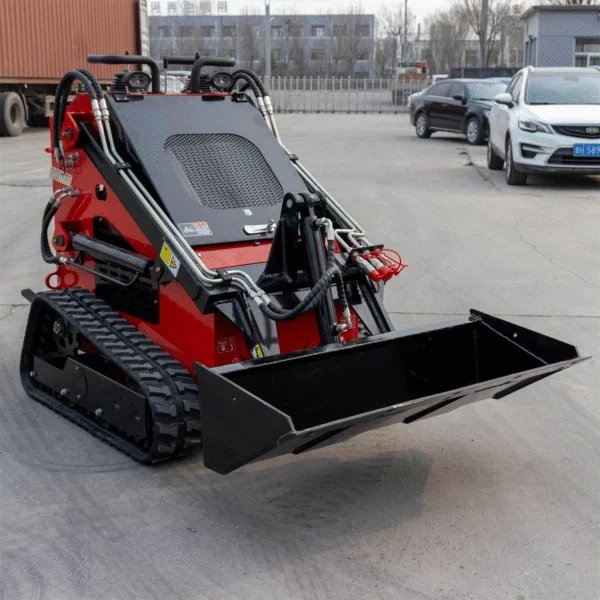
● Track vs Wheel Loaders: How Certeg Engineers the Difference
● FAQs: Compact Track Loaders, Specs, and Selection
>> Q1. What is the rated operating capacity (ROC) and why does 35% matter?
>> Q2. How do I decide between ST27, ST31, and ST37?
>> Q3. When should I consider a 100‑hp compact track loader instead of a 74‑hp unit?
>> Q4. Are compact track loaders always better than skid steers?
>> Q5. How does cab design affect productivity and safety?
A compact track loader buyer’s guide is only useful if it reflects what actually happens on muddy, uneven jobsites — not just what’s printed on a spec sheet. In this expert breakdown, I’ll walk through the Wacker Neuson compact track loader (CTL) lineup from a hands‑on contractor’s perspective, then explain how we as a manufacturer (Certeg) think about power, lift, and undercarriage design when you’re choosing between track and wheel loaders for real projects. [compactequip]
What This Guide Covers (And Who It’s For)
If you run compact equipment on site prep, utilities, landscaping, or rental fleets, this guide is written for you as a practical selection playbook, not a brochure. It combines published technical data on Wacker Neuson CTLs with current industry usage patterns to help you specify machines by application, not guesswork. [dozr]
You’ll find clear specs in context (how lift height, ROC and ground pressure change what you can safely do), real‑world scenarios for ST‑series CTLs, and a framework you can reuse when comparing any compact track loader or skid steer — including Certeg’s own tracked and wheeled loaders for global markets. [rentalex]
Compact Track Loader Specs & Real Jobsite Performance
From an SEO standpoint, the key phrase for this article is “compact track loader specs and product line summary”, supported by long‑tail phrases such as “Wacker Neuson compact track loader,” “ST27 CTL specs,” “ST31 vertical lift compact track loader,” and “how to choose a compact track loader for construction.” [compactequip]
Throughout this guide, those phrases appear naturally in headings and body text so search engines can clearly understand that this page is an in‑depth, experience‑based guide to compact track loader specifications, applications, and product selection strategy. [theatomlab.co]
Understanding Compact Track Loaders vs Skid Steer Loaders
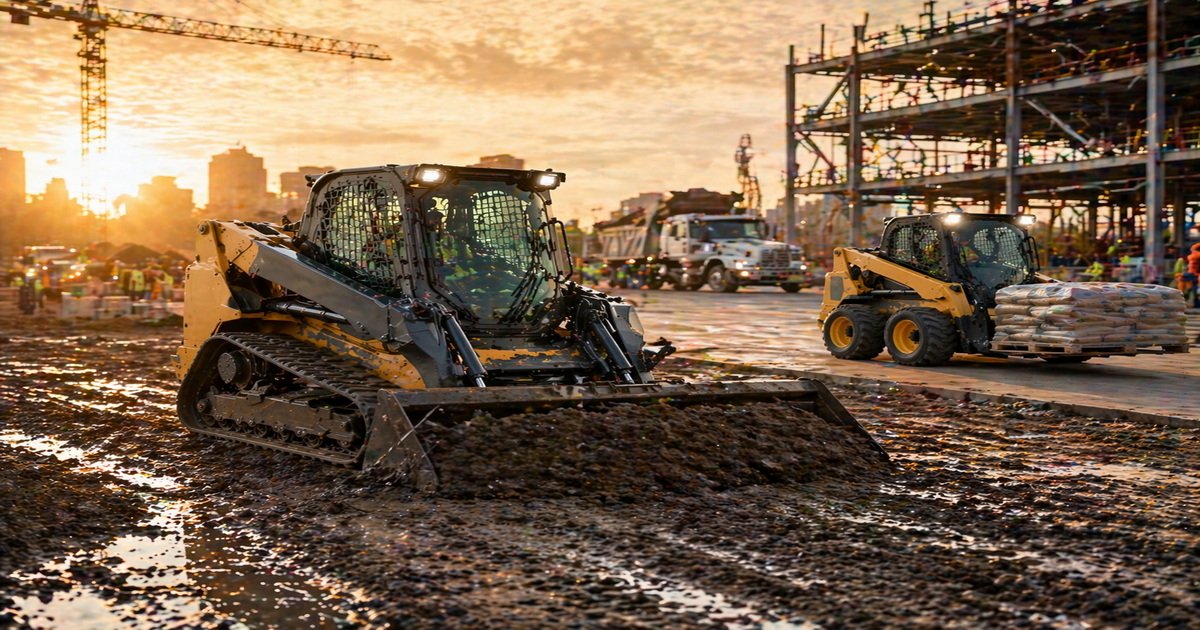
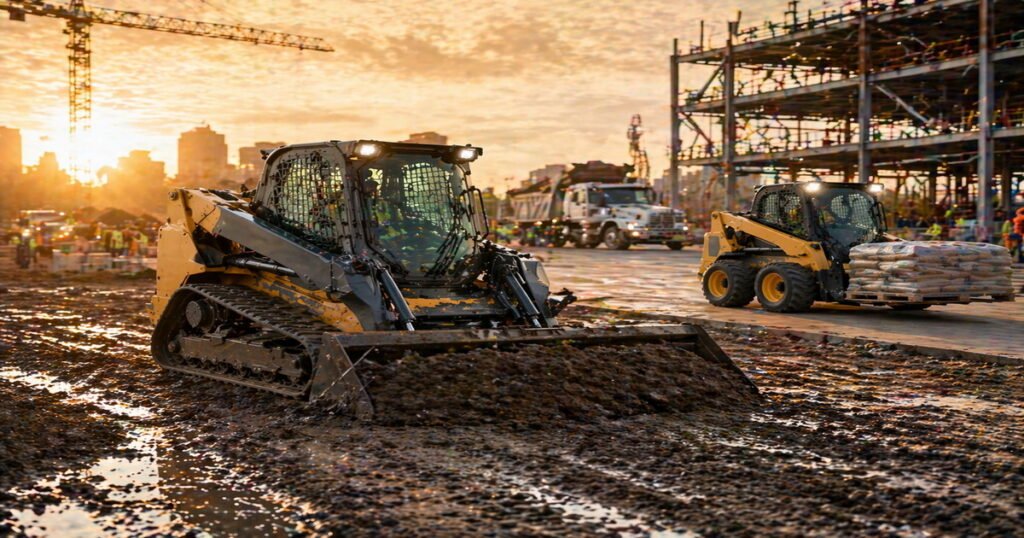
Before diving into individual models, it is worth revisiting why contractors increasingly specify compact track loaders over wheeled skid steers in many conditions. [gregorypoole]
– Traction and flotation: Rubber tracks spread the machine’s weight over a larger area, reducing ground pressure and delivering far better traction in mud, snow, and loose soil than tires. [sniperrentals]
– Surface protection: Tracks are more forgiving on turf and finished surfaces compared with aggressive skid steer tires, cutting down on rework in landscaping and site restoration. [gregorypoole]
– Stability and lifting confidence: Lower ground pressure and a longer track frame can translate into steadier lifting and grading performance, especially on slopes or rough pads. [rentalex]
– Cost and maintenance trade‑offs: Skid steer loaders still win on purchase price, tire replacement cost, and high‑speed travel on hard surfaces; track loaders pay off where underfoot conditions are variable or soft. [gregorypoole]
From a manufacturer’s standpoint, we design both tracked and wheeled loaders because the “best” machine is the one that matches your duty cycle, underfoot conditions, and attachment mix — not a one‑size‑fits‑all answer. [sniperrentals]
Wacker Neuson Compact Track Loader Product Line at a Glance
Wacker Neuson’s compact track loader lineup is built around the ST‑series, which targets the compact‑to‑medium frame class with emphasis on visibility, operator comfort, and high auxiliary hydraulic performance. [wackerneuson]
The core models in the current spec guides and field usage are ST27, ST31, ST37 and larger 100‑hp CTLs like ST40 and ST50, introduced to handle heavy‑duty attachments. These models are designed to cover everything from tow‑friendly machines for small crews to high‑flow workhorses for forestry mulchers and cold planers. [equipmentjournal]
Key Specifications: ST27, ST31, ST37 Compact Track Loaders
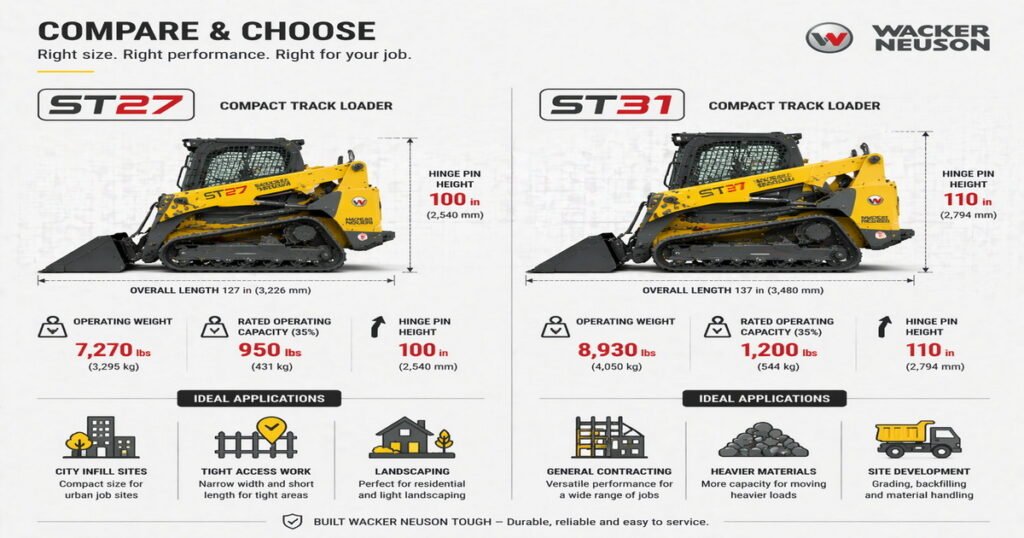
The table below summarizes headline specs for three cornerstone Wacker Neuson compact track loaders as reported in recent spec guides and manufacturer data. [dozr]
Wacker Neuson ST‑Series CTL Specs Overview
| Model | Engine power | Rated operating capacity (35%) | Operating weight | Ground pressure | Lift path / hinge‑pin height | Standard aux hydraulic | High‑flow hydraulic |
|---|---|---|---|---|---|---|---|
| ST27 | 74 hp diesel compactequip | 1,890 lb compactequip | 7,350 lb compactequip | Around 5.5 psi compactequip | Vertical; ~120 in to hinge pin compactequip | ~19–20 gpm at 3,500 psi compactequip | ~29 gpm at 3,500 psi compactequip |
| ST31 | 74 hp diesel compactequip | 2,170 lb (approx. 2,169) compactequip | 8,095 lb wackerneuson | Around 5.7 psi compactequip | Vertical; ~129 in to hinge pin compactequip | ~20 gpm at 3,500 psi compactequip | ~30 gpm at 3,500 psi compactequip |
| ST37 | 74 hp diesel dozr | 2,590 lb dozr | 9,014 lb dozr | Approx. similar low ground pressure (compact frame class) wackerneuson | Vertical; ~129 in class‑leading height dozr | Comparable standard flow in 20 gpm range dozr | High‑flow package available on many units compactequip |
These compact track loader specs put all three models firmly in the high‑performance 74 hp category with excellent lift height for truck loading and enough hydraulic flow to run most high‑demand attachments when optioned with high‑flow. [equipmentjournal]
ST27: Tow‑Friendly Compact Track Loader With Serious Reach
The ST27 is Wacker Neuson’s smallest CTL, but its design focuses on ease of transport and best‑in‑class dump reach rather than cutting corners on capability. [wackerneuson]
– Weighs only about 7,350 lb, making it easily towable behind a properly equipped pickup and tag trailer in many regions. [wackerneuson]
– Rated operating capacity of 1,890 lb at 35% of tip load gives it surprising material handling ability for its size. [compactequip]
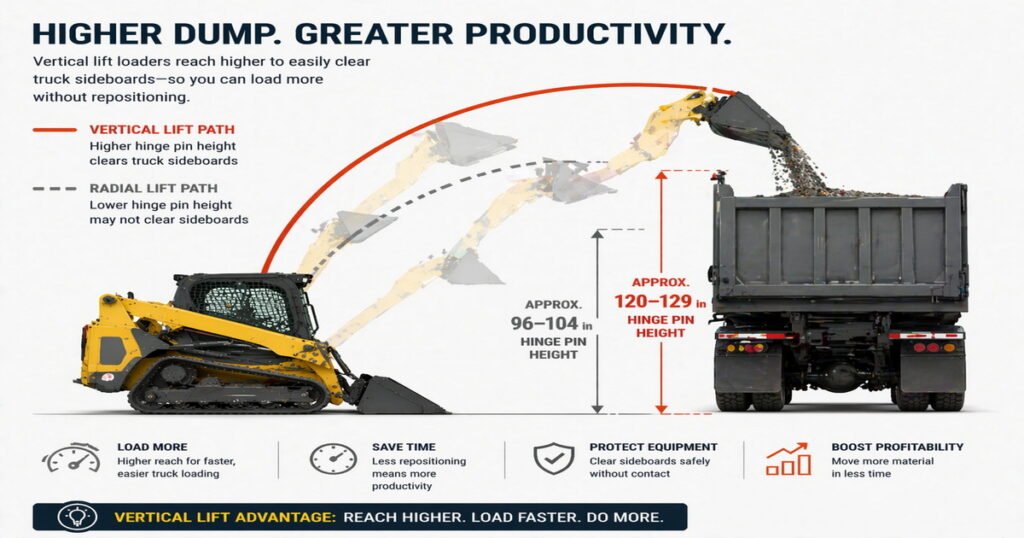
– Vertical lift design delivers around 120 in hinge‑pin height with extra reach at dump, so you can clear the sideboards and hit the center of the truck bed instead of spilling on the far side. [dozr]
– A two‑speed travel drive on recent models offers up to about 9.1 mph, improving cycle times when you are shuttling material across the site. [wackerneuson]
From an operator’s perspective, this machine shines in urban infill sites, small commercial projects, or rental fleets that need a compact track loader that fits tight access but still loads tri‑axles efficiently. [compactequip]
ST31: Vertical‑Lift All‑Rounder for Heavy Work
If I had to pick one model from the line as a “default” compact track loader for general contractors, it would likely be the ST31. [wackerneuson]
– Same 74 hp engine class as the ST27 but with a higher 2,170 lb rated operating capacity. [dozr]
– Operating weight around 8,095 lb gives it a more planted feel when running heavier attachments or handling wet soil and aggregate. [wackerneuson]
– Vertical lift path with roughly 129 in hinge‑pin height makes it a strong performer for loading high‑sided trucks or hoppers. [wackerneuson]
– Standard auxiliary hydraulic flow in the low‑20 gpm range with optional high‑flow around 30 gpm at 3,500 psi supports cold planers, trenchers, and other hydraulic‑intensive tools. [equipmentjournal]
On‑site, this is the kind of CTL you assign to your most experienced operator and leave there: from rough grading to pallet handling, it is a stable, predictable platform. As manufacturers, we think of this segment as the “fleet backbone” class — the model around which you design attachment packages and maintenance logistics. [equipmentjournal]
ST37 and the Move Toward Heavier CTLs
The ST37 pushes deeper into the medium‑frame class with more ROC and operating weight while staying in the 74 hp power band. [wackerneuson]
– Rated operating capacity increases to about 2,590 lb, which matters when you are handling dense materials like crushed stone or wet clay. [dozr]
– Operating weight rises to roughly 9,014 lb, improving stability on uneven ground but also demanding more from trailers and transport planning. [wackerneuson]
– Lift height remains in the same 129 in neighborhood but with more stability at full height, which operators notice when loading heavy material over the side of trucks. [gregorypoole]
In the wider Wacker Neuson family, the introduction of 100‑hp models such as the ST40 and ST50 highlights an industry trend: contractors increasingly want compact track loaders that can serve as small dozers or dedicated attachment platforms for forestry, milling, and reclamation work. [rentalex]
Operator Experience: Cab, Controls, and Visibility
Specifications tell you what a compact track loader can do; cab design determines how long operators can deliver that performance safely. [youtube]
Recent Wacker Neuson compact track loader cabs feature a spacious layout with good visibility and come standard with a color display (around 5.7 in) and control options that can be configured to match operator preferences. [youtube]
– Large entry and exit points help reduce slips and trips, especially when operators are entering with muddy boots or in low‑light conditions. [compactequip]
– Modern HVAC and sealed cabs matter if you are running dust‑producing attachments like planers or mulchers. [gregorypoole]
– Intuitive joysticks and selectable control patterns shorten the learning curve for operators coming from other brands or from skid steers. [youtube]
From an E‑E‑A‑T perspective, we always advise equipment buyers to prioritize cab comfort and visibility alongside specs, because operator fatigue and line‑of‑sight issues show up quickly in real‑world productivity and incident reports. [coseoco]
Real‑World CTL Applications and Attachment Choices
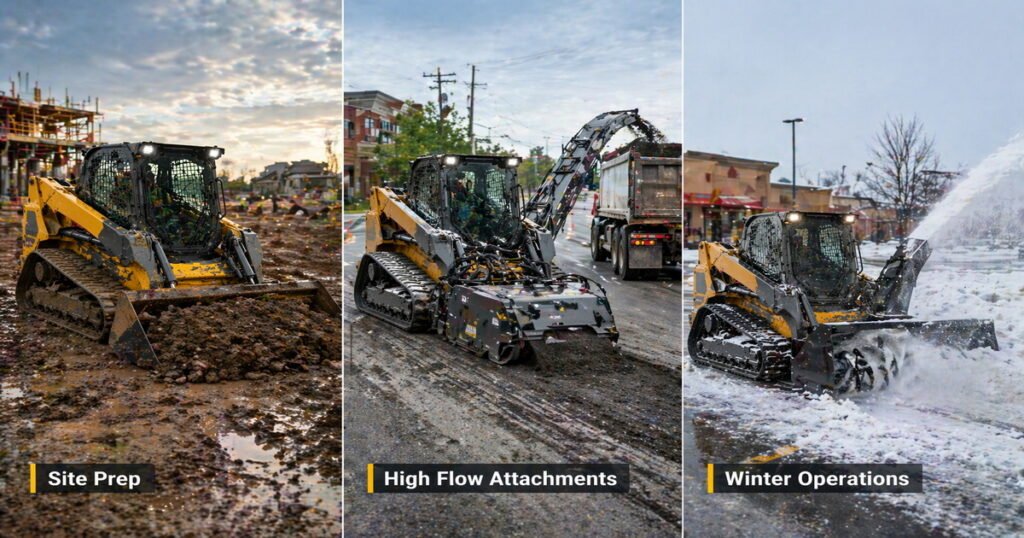
Compact track loaders earn their keep by how many tasks they can handle across a project’s lifecycle. In practice, contractors use CTLs for: [sniperrentals]
– Site preparation: stripping topsoil, rough grading pads, and backfilling trenches. [rentalex]
– Materials handling: transporting pallets, moving aggregates, and cycling spoil to trucks. [rentalex]
– Fine grading and landscaping: working on turf, pathways, and finished surfaces where low ground pressure matters. [sniperrentals]
– Winter work: snow removal on sensitive surfaces that cannot tolerate chains or aggressive tires. [sniperrentals]
– Heavy‑duty attachments: high‑flow machines like ST40/50 drive planers, mulchers, and power rakes at full efficiency. [equipmentjournal]
Manufacturers such as Certeg design both track and wheel loaders to support this life‑cycle approach, working backward from the attachment set you intend to run and the hours per year those tools will see. [coseoco]
How to Choose the Right Compact Track Loader for Your Fleet
When you evaluate compact track loader specs, treat them as a decision matrix rather than isolated numbers. Here’s a simple framework we use when advising fleet managers and export customers: [dozr]
1. Start with underfoot conditions
– If you are regularly working on mud, loose soil, snow, or steep grades, a compact track loader is usually the safer and more productive choice. [gregorypoole]
– For mostly paved or hardpack yards with long travel distances, consider pairing track loaders with skid steers rather than replacing them outright. [rentalex]
2. Match ROC to your heaviest realistic load
– Identify your densest routine material (for example wet clay, crusher run) and the bucket or attachment volume you typically move. [dozr]
– Aim for a rated operating capacity that keeps you well below tip load at full height, not just at half‑height. [gregorypoole]
3. Check lift height vs truck and hopper dimensions
– If you load high‑sided trucks daily, prioritize vertical‑lift models like ST27 or ST31 with hinge‑pin heights in the 120–129 in range. [wackerneuson]
– For lower bins, ramp height and approach angle may matter more than maximum pin height. [gregorypoole]
4. Plan your hydraulic attachments
– List the attachments you own or plan to purchase and note their minimum hydraulic flow and pressure. [equipmentjournal]
– Select machines whose standard or high‑flow packages meet or exceed those requirements so you are not under‑driving tools. [compactequip]
5. Balance transport and fleet logistics
– Confirm that operating weight plus trailer weight stays within your region’s towing regulations. [wackerneuson]
– Standardizing on one or two frame classes simplifies parts stocking and technician training. [coseoco]
Using this framework, an urban contractor might land on ST27 units for tight city jobs and a larger ST37 or 100‑hp CTL for heavy off‑road work — while a rural sitework firm might build a fleet around ST31s with a few high‑flow units for specialized attachments. [compactequip]
Track vs Wheel Loaders: How Certeg Engineers the Difference
As a manufacturer like Certeg that builds both skid steer loaders (wheeled) and compact track loaders (tracked), we see the same questions from buyers in North America, Europe, and emerging markets: where does each platform win over the full machine life? [coseoco]
– Tracked loaders (CTLs)
– Designed for low ground pressure, traction, and stability in variable terrain, mirroring what you see in the Wacker Neuson ST‑series. [wackerneuson]
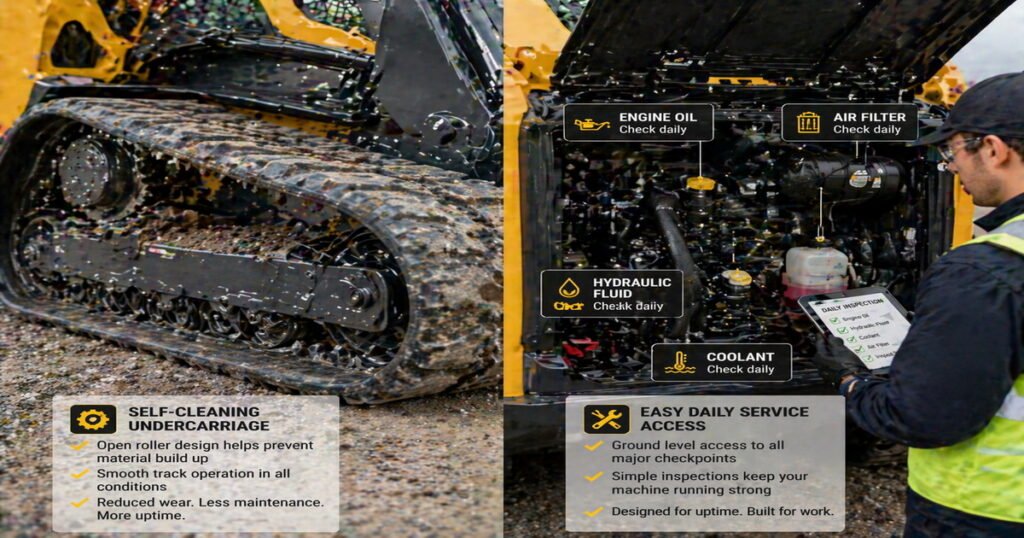
– Typically specified with undercarriages that emphasize debris shedding and track durability, because downtime from packed rollers or derails is costly. [wackerneuson]
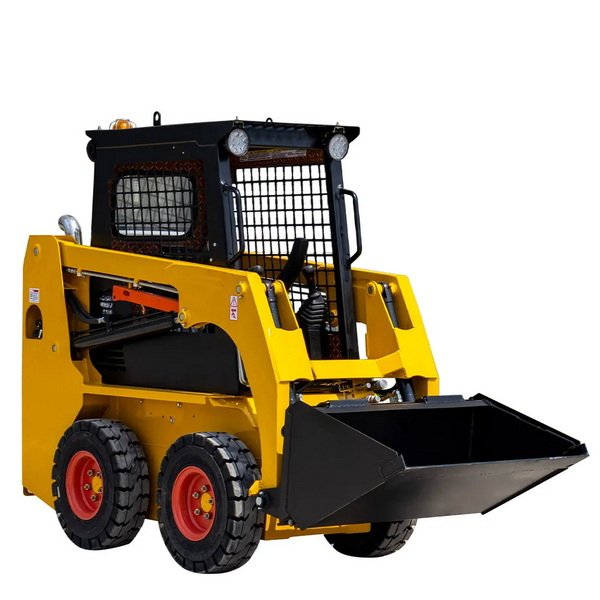
– Wheeled loaders / skid steers
– Optimized around hard‑surface productivity and faster roading speeds. [rentalex]
– Tire selection becomes a major tuning parameter (solid vs pneumatic, tread pattern) for balancing ride quality with puncture resistance. [rentalex]
In export projects, we often recommend a hybrid fleet: compact track loaders for primary production work and skid steers as flexible support units for yards, material depots, and paved sections of the job. [coseoco]
FAQs: Compact Track Loaders, Specs, and Selection
Q1. What is the rated operating capacity (ROC) and why does 35% matter?
ROC is the maximum safe load a compact track loader can lift and carry at a given percentage of its tipping load; 35% is a common standard used in North American spec sheets to define conservative, stable operation. [dozr]
Q2. How do I decide between ST27, ST31, and ST37?
Start with your heaviest regular material and required lift height, then select the smallest model whose ROC and hinge‑pin height comfortably exceed those needs, factoring in transport limits and available trailers. [compactequip]
Q3. When should I consider a 100‑hp compact track loader instead of a 74‑hp unit?
If you rely on high‑demand hydraulic attachments like forestry mulchers, cold planers, or large snow blowers for many hours per year, a 100‑hp CTL with high‑flow hydraulics will usually deliver better productivity and tool life. [equipmentjournal]
Q4. Are compact track loaders always better than skid steers?
No; track loaders dominate in soft, uneven, or sensitive ground conditions, while skid steers typically win on hard surfaces, longer roading distances, and tire maintenance costs. [sniperrentals]
Q5. How does cab design affect productivity and safety?
Spacious cabs with good visibility, modern controls, and effective HVAC reduce operator fatigue and help prevent incidents, especially when running high‑duty cycles with heavy attachments or in dusty environments. [youtube]
References
1. Wacker Neuson, “Compact Track Loaders – Product Overview and Specs.” [wackerneuson]
2. Compact Equipment, “Wacker Neuson Compact Track Loader Specs and Product Line Summary.” [compactequip]
3. Wacker Neuson, “ST31 Compact Track Loader.” [wackerneuson]
4. DOZR, “The Ultimate Compact Track Loader Specifications and Dimensions Guide.” [dozr]
5. Gregory Poole, “The Benefits of Compact Track Loaders.” [gregorypoole]
6. Rentalex, “Maximize Efficiency – Compact Track Loader Applications.” [rentalex]
7. Sniper Rentals, “The Advantages of Compact Track Loaders in Construction.” [sniperrentals]
8. Equipment Journal, “Wacker Neuson Introduces 100‑hp Skid Steer and CTLs.” [equipmentjournal]
9. Wacker Neuson, “New Compact Track Loader Promotes Exceptional Visibility and Productivity (ST27).” [wackerneuson]
10. Polar Industrial Services, “Wacker Neuson Compact Track Loader/Skid Steer Walk Through.” [youtube]
11. The Atom Lab, “EEAT Checklist for Construction Websites [2025 Guide].” [theatomlab.co]
12. CoSEO, “EEAT for Contractors: Building Trust with Google and Clients.” [coseoco]
13. HubSpot, “Is Your Website EEAT-compliant? What Developers Should Keep In Mind.” [blog.hubspot]
Hot Tags: Skid Steer Loader, Manufacturers, Customized, Custom, Suppliers, Buy, Cheap, Quality, Advanced, Durable, in Stock, Made in China, Price, Quotation