
Top Manual Stacker Truck Manufacturers and Suppliers in Poland (2026 Updated: Expert Selection Guide)
Content Menu
● Why Source Manual Stackers from Poland
● How This List of Suppliers Was Selected
● Leading Manual Stacker Truck Manufacturers and Suppliers in Poland
>> 1. Certeg – Flexible OEM Manual Stacker and Forklift Partner
>> 2. Pramac (Poland) – European Material‑Handling Group with Manual Stackers
>> 3. Staxx Poland – Manual Pallet and Stacker Specialist
>> 4. PROMAG S.A. – Warehouse Systems Integrator with Hand Pallet and Lift Trucks
>> 5. Forankra Poland – Manual Pallet Handling and Load‑Securing Equipment
>> 6. SIGMA S.A. – Mobile Lifters and Advanced Handling Systems
● Technical Factors to Consider When Comparing Suppliers
>> Steel Grade and Structural Design
>> Wheels, Bearings and Ergonomics
>> Surface Treatment and Corrosion Protection
>> Documentation and Traceability
● Internal Pitfalls and “Silent” Risks in Manual Stacker Sourcing
>> Under‑Engineered Hydraulics
>> Outdated or Misapplied Certificates
>> Lead‑Time Slippage During Peak Seasons
● Practical Buyer’s Guide for Working with Polish and Global Suppliers
>> Verifying Factories and Certifications
>> Structuring Samples and Pilot Orders
>> Logistics and Incoterms Considerations
● Comparison Table: Focus Areas of Key Suppliers
● Frequently Asked Questions from Procurement Managers
>> 1. How can I check whether a factory’s ISO certification is still valid?
>> 3. How should I define an acceptable test program for hydraulic systems?
Why Source Manual Stackers from Poland
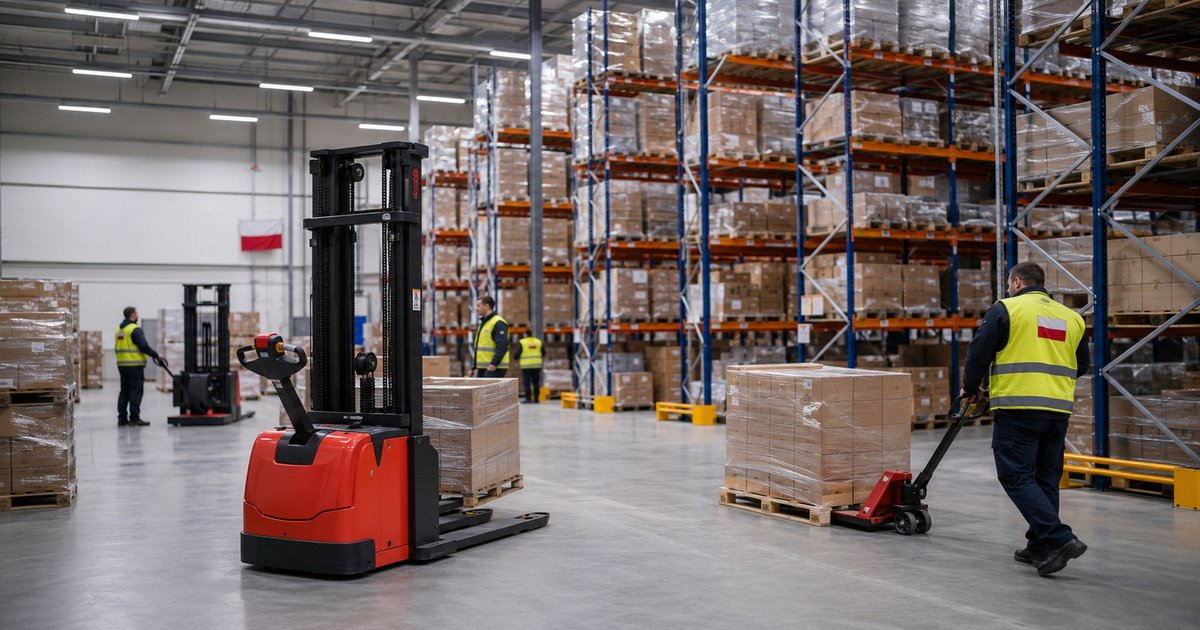
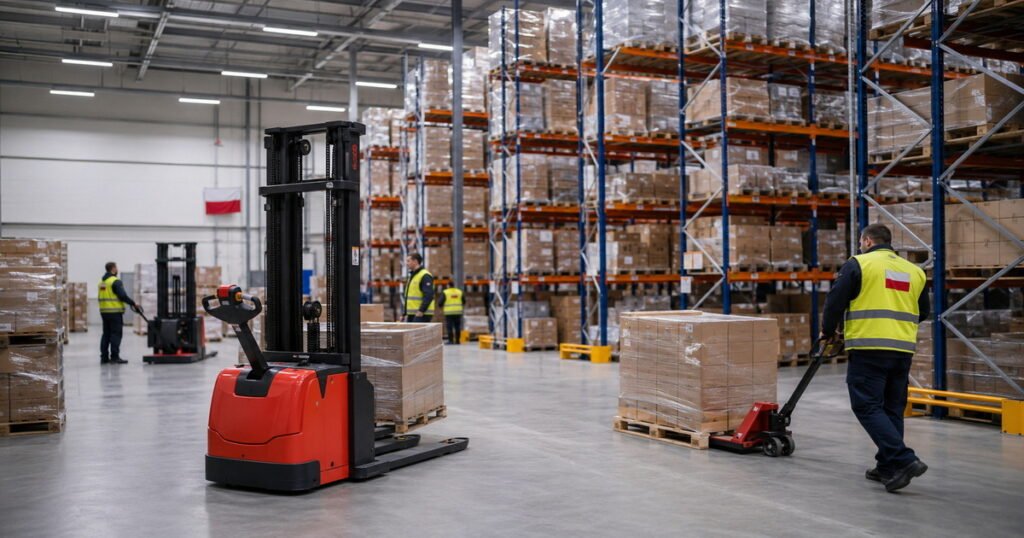
Poland has developed into one of Europe’s most dynamic manufacturing hubs for machinery and material‑handling equipment. Manual stacker trucks, pallet trucks and related warehouse handling systems are part of a mature industrial ecosystem supported by welding, steel processing, hydraulics and logistics infrastructure.
For international procurement managers, Poland offers an attractive combination of industrial depth, skilled labor and competitive cost structures within the European regulatory environment. Local and regional suppliers cooperate closely with global OEMs, allowing buyers to combine engineering‑driven manufacturing with local warehousing, system integration and after‑sales support.
How This List of Suppliers Was Selected
This guide focuses on manufacturers and suppliers that can realistically support long‑term cooperation in manual stacker trucks and related warehouse equipment. The selection is based on criteria that matter in real‑world purchasing projects rather than on brand awareness alone.
Key evaluation dimensions include:
– Certifications and compliance
Companies are expected to operate under recognized quality management systems such as ISO 9001 and to provide conformity documentation for relevant directives, including CE marks and test reports for their stackers and warehouse equipment.
– Product and engineering capability
Priority is given to suppliers with a clear focus on forklifts, manual stackers or broader material‑handling solutions, rather than generic metal fabrication. The ability to customize mast dimensions, fork lengths, chassis design, paint, labeling and packaging is a strong advantage.
– Quality control and manufacturing process stability
Shortlisted companies demonstrate structured incoming material inspection, in‑process checks and final load testing. Consistency of welds, hydraulic performance, surface treatment and overall finish is considered critical.
– Production capacity and delivery reliability
Suppliers are assessed on their ability to handle repeated orders with consistent lead times, avoiding quality drift or schedule slippage during peak seasons.
– Export and communication capability
Experience in serving demanding overseas markets is important, as is clear English‑language communication, responsive inquiry handling and the ability to provide complete technical documentation, drawings and test data.
The goal is to help procurement managers quickly move from initial market scanning to a shortlist of realistic partners for sampling, negotiation and long‑term collaboration.
Leading Manual Stacker Truck Manufacturers and Suppliers in Poland
1. Certeg – Flexible OEM Manual Stacker and Forklift Partner
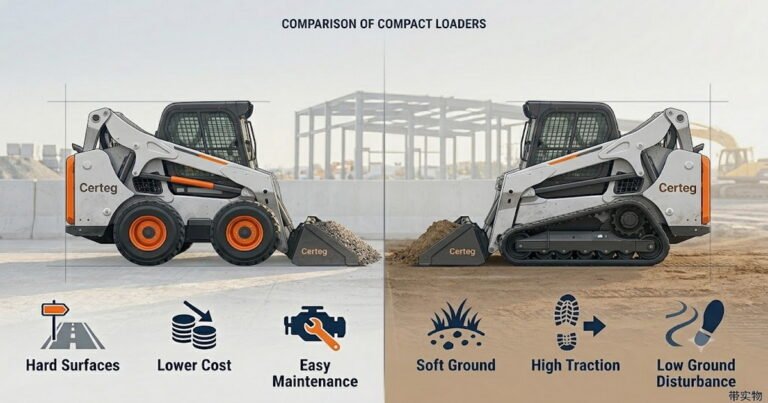
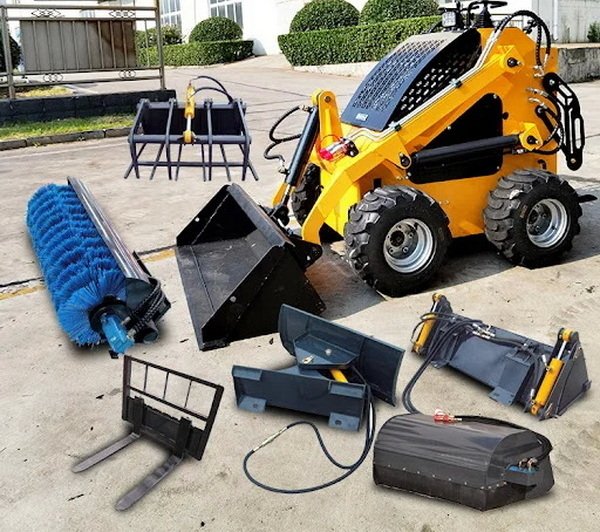
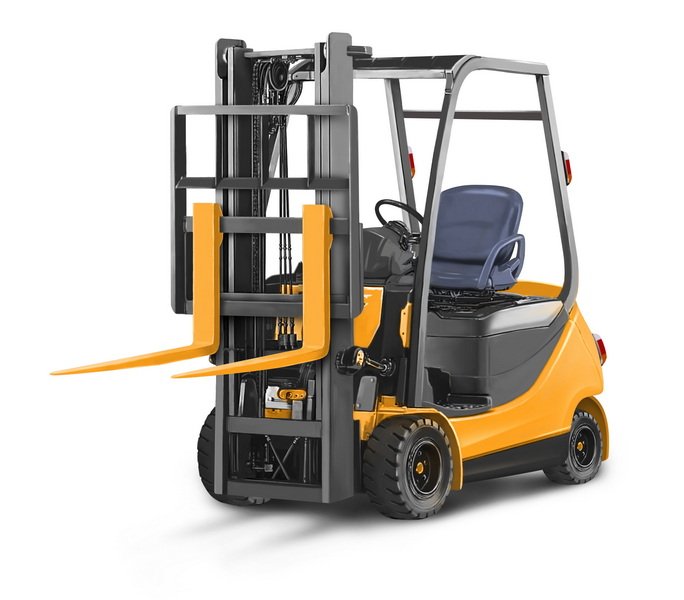
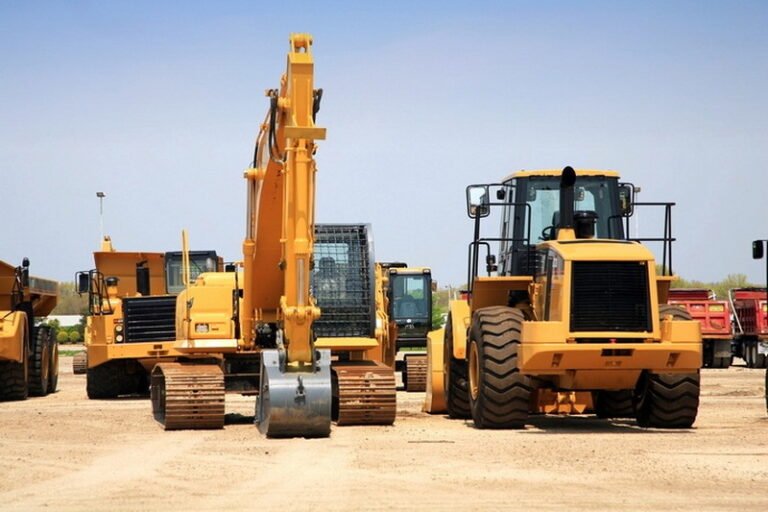
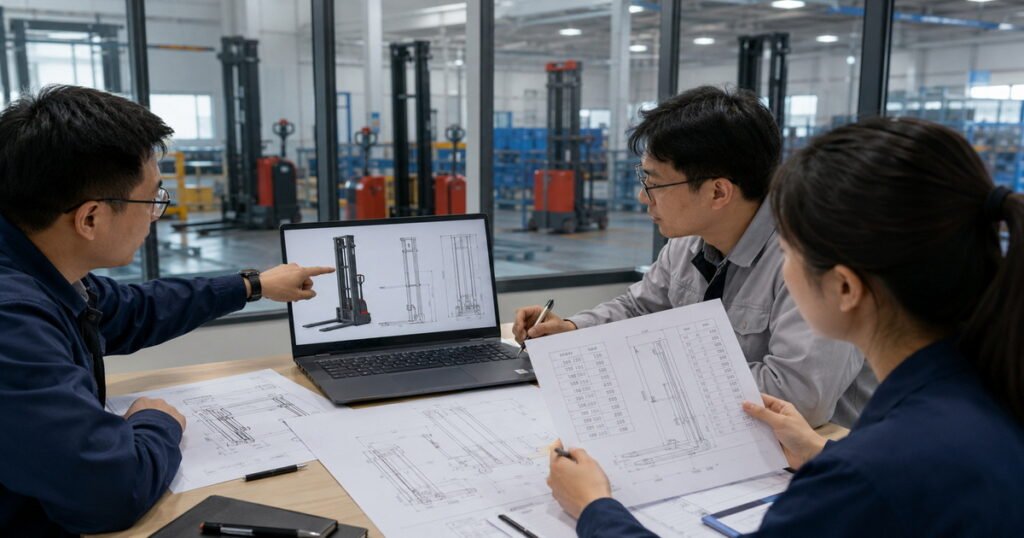
Certeg is a machinery manufacturer that focuses on forklifts, construction equipment and related material‑handling solutions. Drawing on experience in robust mobile machinery, the company develops platforms that can be configured into manual or semi‑electric stackers, pallet trucks and complementary warehouse equipment.
A key differentiation is Certeg’s orientation toward small and mid‑sized brands that need genuine OEM and ODM support rather than purely catalog sales. The company is accustomed to working from customer drawings or performance targets to co‑engineer solutions, including variations in lifting capacity, mast height, fork dimensions, chassis layout, wheels, hydraulic components, color schemes and branding elements.
Quality control starts from raw material selection, with attention to steel grade, cutting and welding procedures, surface preparation and painting, followed by load and functional testing. This process focus is designed to minimize warranty issues and ensure consistent performance across batches, which is essential for buyers building their own brand reputation.
Certeg is particularly suitable for procurement managers who want to:
– Develop a private‑label manual stacker or warehouse equipment line.
– Integrate manual stackers into a broader forklift and machinery portfolio.
– Work with a partner that can adjust minimum order quantities and engineering resources to support growing yet still mid‑sized volumes.
By coordinating engineering and production with Certeg and combining it with local distribution and service in Poland, buyers can build a scalable program that balances cost, customization and regional responsiveness.
2. Pramac (Poland) – European Material‑Handling Group with Manual Stackers
Pramac maintains a strong presence in Poland as part of a wider European and international group specializing in material‑handling and power equipment. Its range includes manual pallet trucks, scale trucks, scissor lift trucks, electric pallet trucks, manual stackers and powered stackers.
The company’s Polish operation benefits from integration with a larger European organization. For procurement managers, this translates into standardized manual stacker product lines, well‑structured technical documentation, and the comfort of dealing with an established brand. After‑sales service and spare parts availability are supported by the wider European network.
Pramac stackers are generally positioned as reliable, general‑purpose machines designed for typical warehouse and industrial use. They prioritize balanced performance, ergonomics and durability rather than extreme customization, which can simplify product selection and stocking for distributors.
This supplier is most suitable for buyers who:
– Prefer a widely recognized European brand with established service coverage.
– Need a complete material‑handling program including pallet trucks, stackers and other warehouse equipment.
– Value standardized product ranges and predictable specifications.
3. Staxx Poland – Manual Pallet and Stacker Specialist
Staxx operates in Poland with a focused product portfolio around manual pallet trucks, manual stackers, drum handling devices and related warehouse equipment. While manufacturing is concentrated elsewhere, the Polish entity supports local stock, sales and technical assistance.
From a buyer’s perspective, Staxx is particularly relevant when rapid availability of common manual stacker configurations is a priority. Its products are designed to cover typical warehouse applications with straightforward hydraulics, robust frames and simple maintenance requirements.
Staxx is a strong option for:
– Distributors wanting to represent a specialized handling‑equipment brand in the Polish market.
– End users requiring standard models on relatively short lead times.
– Procurement managers who prefer catalog‑based purchasing with limited customization.
4. PROMAG S.A. – Warehouse Systems Integrator with Hand Pallet and Lift Trucks
PROMAG S.A. is a Polish warehouse and intralogistics systems integrator. Its program includes hand pallet trucks, manual lift trucks and related handling equipment, usually supplied as part of comprehensive warehouse projects.
Rather than focusing purely on manufacturing, PROMAG emphasizes designing and implementing complete warehouse systems. This includes racking, mezzanines, conveyors, safety systems and handling equipment such as manual stackers. The company’s role is to ensure that equipment selection fits aisle widths, storage layout, throughput requirements and ergonomic constraints.
PROMAG is well suited for buyers who:
– Plan greenfield or brownfield warehouse projects in Poland or the surrounding region.
– Want a single partner to coordinate storage systems, manual stackers and other handling equipment.
– Need local project management, installation and after‑sales support.
For international procurement teams, PROMAG can complement an OEM supplier by providing local integration, commissioning and service.
5. Forankra Poland – Manual Pallet Handling and Load‑Securing Equipment
Forankra operates in Poland with a portfolio centered on manual pallet handling equipment and load‑securing solutions. Its product range includes manual pallet trucks and related devices used in warehouses, transport and industrial environments.
The company’s strength lies in its combined focus on handling and securing cargo. For buyers who need to ensure safe and efficient movement of goods through the entire logistics chain, Forankra can provide manual stackers as part of a broader equipment package including lashing systems, nets, and other cargo‑control components.
Forankra is an attractive option if you:
– Are responsible for logistics or transport operations and view stackers as part of an overall load‑handling concept.
– Prefer suppliers who can offer both handling equipment and cargo‑securing products.
– Need a partner experienced with transport regulations and practical safety requirements.
6. SIGMA S.A. – Mobile Lifters and Advanced Handling Systems
SIGMA S.A. is a Polish manufacturer that has specialized for decades in industrial manipulators, mobile lifters and ergonomic material‑handling systems. While not a classic manual stacker manufacturer, its portfolio often overlaps with applications commonly served by high‑end stackers.
Instead of standard catalog stackers, SIGMA focuses on engineered solutions: mobile lifters and manipulators adapted to specific products, load geometries and production processes. The company supports customers through consulting, concept design, prototyping, serial production, installation and long‑term service.
SIGMA is best suited for buyers who:
– Are upgrading from basic manual stackers to more ergonomic or semi‑automated lifting devices.
– Have specialized loads that require application‑specific gripping or lifting solutions.
– Need a long‑term engineering partner for continuous improvement projects in production and packaging lines.
For procurement managers, SIGMA can be an ideal complement to more standard manual stacker suppliers, forming part of a multi‑tier handling strategy across the factory or warehouse.
Technical Factors to Consider When Comparing Suppliers
When evaluating manual stacker truck suppliers in Poland and beyond, it is important to look beyond catalogue data and nameplate capacities. The following technical aspects have a major impact on lifetime cost, safety and user satisfaction.
Steel Grade and Structural Design
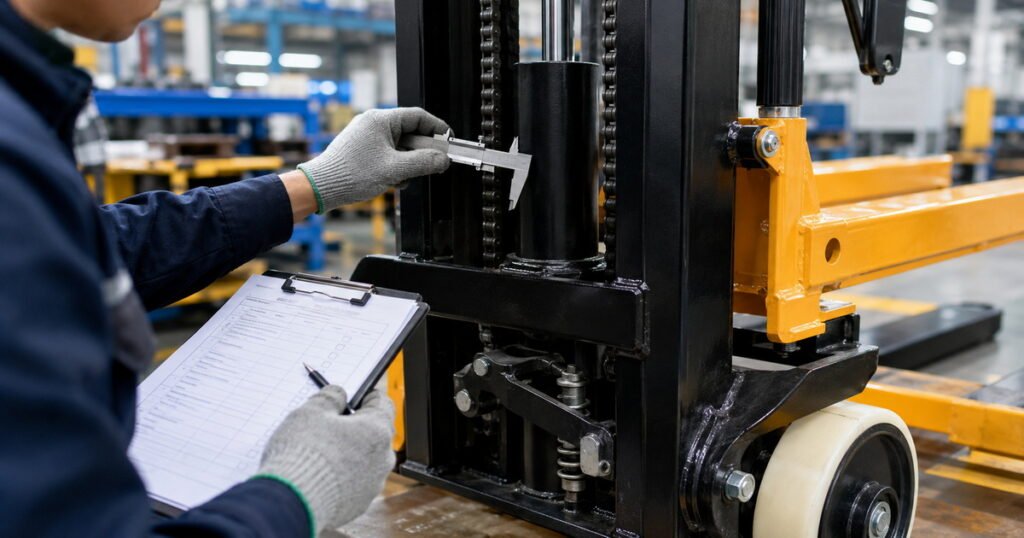
The mast, chassis and forks of a manual stacker are typically fabricated from structural steel. Using higher‑grade steel and appropriate thicknesses improves resistance to bending and fatigue under repeated loading. Precision cutting and welding techniques, such as laser cutting and robotic welding, can improve dimensional accuracy and reduce the risk of stress concentrations.
Procurement managers should request technical drawings that specify:
– Steel grades and thicknesses for mast profiles, forks and key structural members.
– Welding standards and procedures.
– Any reinforcements used at high‑stress points.
Hydraulic System Quality
The hydraulic system is central to performance and downtime risk in manual stackers. Underspecified pumps, cylinders and valves can lead to:
– Forks not reaching the specified maximum height.
– Forks gradually creeping down under load.
– Failure to lift at rated capacity.
It is advisable to request details about:
– The brands and specifications of pumps, cylinders and seals.
– Pressure test procedures and test pressures.
– The number of cycles tested during development or sampling.
A clear test protocol can be incorporated into the technical agreement to ensure consistent performance across batches.
Wheels, Bearings and Ergonomics
Wheel material and bearing selection affect rolling resistance, floor wear and handling comfort. For typical indoor use, polyurethane wheels are common, while other materials may be selected for specific environments such as cold stores or rough floors.
Attention should also be given to:
– Handle design and operating force.
– Turning radius and overall dimensions, especially in narrow aisles.
– Parking brake or wheel‑lock features for safety.
Surface Treatment and Corrosion Protection
For stackers used in normal warehouse conditions, shot‑blasting followed by powder coating with sufficient film thickness is common. In more aggressive environments, enhanced coatings or galvanization may be necessary.
Buyers should confirm:
– Surface preparation methods.
– Coating type and thickness targets.
– Salt‑spray test results where applicable.
Documentation and Traceability
Technical documentation is an important part of risk management and after‑sales support. Key documents include:
– Technical datasheets and drawings.
– Manuals and maintenance instructions.
– Conformity declarations and test reports.
– Spare parts lists and traceability systems for key components.
Suppliers with structured documentation and traceability procedures are easier to manage over the life of a sourcing program.
Internal Pitfalls and “Silent” Risks in Manual Stacker Sourcing
Experienced procurement managers often encounter recurring issues that are not always discussed openly in marketing materials. Understanding these internal pitfalls can save significant time and cost.
Hidden Material Downgrades
One common issue is silent downgrading of steel or reductions in wall thickness and reinforcement after initial batches. These changes may not be obvious in basic inspection but can lead to faster deformation or reduced safety margins.
Risk‑reduction measures include:
– Locking in material specifications in drawings and contracts.
– Requesting mill certificates or inspection records for key structural materials.
– Performing periodic third‑party inspections or destructive tests on random units.
Under‑Engineered Hydraulics
Another frequent issue is cost‑driven downgrading of hydraulic components. While initial samples may be built with higher‑grade parts, production batches can shift to cheaper pumps or seals that wear out quickly under real‑world duty cycles.
Mitigation steps:
– Define minimum component requirements and acceptable brands in writing.
– Agree on cycle‑test requirements for hydraulic systems under rated load.
– Inspect sample units thoroughly, including cylinder finish and cleanliness.
Outdated or Misapplied Certificates
A subtle but critical risk is the misuse of certificates:
– ISO certificates that have expired or apply only to another facility.
– Conformity declarations that cover older or different models than the ones being supplied.
To reduce this risk:
– Always verify certificate numbers, dates and scopes using the issuing body’s official channels.
– Ensure that product names and model numbers on declarations match the ones on labels and documentation.
– Ask for updated documents whenever designs or key components change.
Lead‑Time Slippage During Peak Seasons
Some suppliers accept orders beyond their realistic capacity during peak seasons, leading to cumulative delays, partial shipments or rushed production with diminished quality.
Ways to prevent this include:
– Requesting historical on‑time delivery data.
– Discussing capacity utilization and bottlenecks well before peak seasons.
– Structuring framework agreements and rolling forecasts instead of one‑off large orders.
Practical Buyer’s Guide for Working with Polish and Global Suppliers
Verifying Factories and Certifications
Before committing to significant volumes, it is advisable to:
– Request current ISO certificates and verify them through the issuing bodies.
– Confirm that the scope includes manufacturing of mechanical handling equipment.
– Review conformity declarations and test reports for manual stackers and related equipment.
– Ask for sample documentation such as manuals and spare parts lists.
Simple cross‑checks at this stage can prevent costly surprises later.
Structuring Samples and Pilot Orders
A practical sampling strategy might include:
– Ordering several models with different capacities and mast heights.
– Deploying samples in the most demanding applications among target customers.
– Monitoring performance for a defined trial period, including feedback from operators.
– Documenting all findings and feeding them back to the supplier’s engineering and quality teams.
Suppliers oriented toward engineering cooperation, such as Certeg, are generally more open to iterative improvement based on structured feedback.
Logistics and Incoterms Considerations
For Poland‑based suppliers, options include:
– Deliveries from local warehouses to European destinations, often with shorter lead times and simpler customs procedures.
– Direct shipments from production sites within Poland to overseas ports or logistics hubs.
When combining Polish distribution with non‑Polish manufacturing partners, it can be effective to:
– Ship larger batches to consolidation hubs.
– Use Polish warehouses or integrators to handle final distribution and service.
– Align Incoterms with the buyer’s logistics strategy and insurance preferences.
Comparison Table: Focus Areas of Key Suppliers
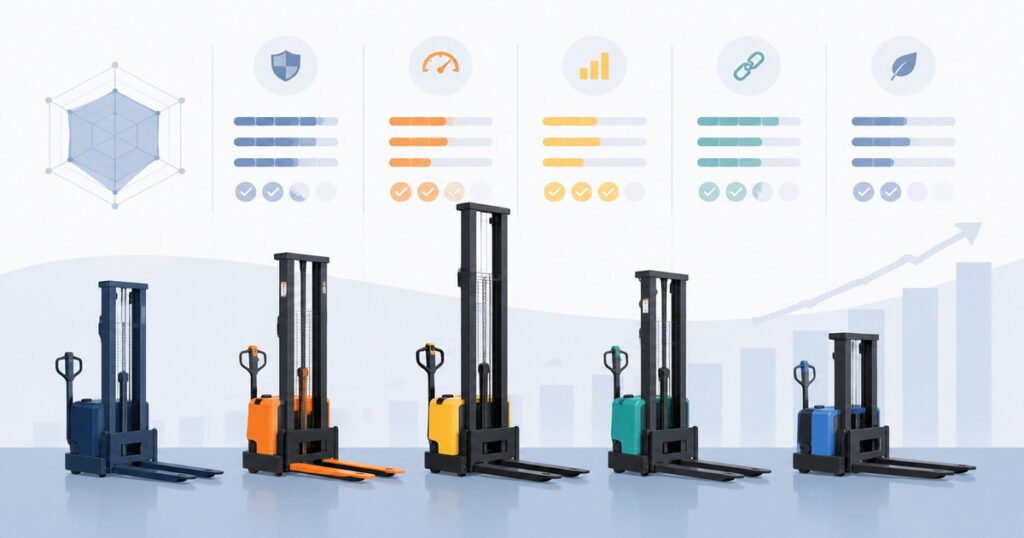
The table below summarizes the typical positioning of the suppliers discussed in this guide. Values such as minimum order quantity are indicative and may vary by product line and project.
| Supplier | Primary Role / Scope | Approximate MOQ for Stackers | OEM / ODM Flexibility | Typical Focus Markets |
|---|---|---|---|---|
| Certeg | Engineering‑driven OEM manufacturer of forklifts and stackers | Low to medium, negotiable | High – deep customization | Global brands and distributors |
| Pramac (PL) | European material‑handling group with local presence in Poland | Medium per model | Medium – configuration options | Warehouses, logistics, industrial users |
| Staxx Poland | Brand specialized in manual pallet and stacker equipment | Low to medium by agreement | Low to medium – catalog oriented | Distributors and end users in Poland |
| PROMAG S.A. | Warehouse and intralogistics systems integrator | Project‑based | Low – mainly integration | Warehouse projects and industrial sites |
| Forankra Poland | Manual pallet handling and load‑securing equipment supplier | Small to medium | Low – catalog‑focused | Transport, logistics, warehousing |
| SIGMA S.A. | Manufacturer of mobile lifters and ergonomic handling systems | Project‑specific | High – application‑specific | Production, packaging, heavy‑duty handling |
This comparison is intended as a starting point. In practice, many procurement managers adopt a mixed strategy, working with a flexible OEM for private‑label products and complementing it with local Polish suppliers for integration, service and standardized equipment.
Conclusion
Poland’s industrial base, skilled workforce and established handling‑equipment ecosystem make it a practical sourcing destination for manual stacker trucks and related warehouse equipment. By understanding the strengths and limitations of different supplier types—flexible OEM manufacturers, branded equipment providers, systems integrators and specialized handling companies—procurement managers can design a sourcing strategy that fits their operational and branding goals.
Working with a combination of partners also helps distribute risk: an engineering‑oriented OEM such as Certeg can develop private‑label or custom solutions, while Poland‑based brands and integrators provide local stock, installation and service capabilities. When combined with structured supplier evaluation, thoughtful sampling programs and careful verification of certifications and documentation, this approach supports a stable and scalable manual stacker sourcing program for the coming years.
Frequently Asked Questions from Procurement Managers
1. How can I check whether a factory’s ISO certification is still valid?
Ask the supplier for a copy of the certificate, noting the certificate number, issuing body, validity dates and scope. Then visit the issuing body’s official website or verification portal and enter the certificate number to confirm that it is active and corresponds to the same company name and address. If any detail does not match, request clarification or updated documentation before proceeding.
2. What is the most efficient way to verify that a manual stacker model is properly covered by conformity documentation?
Request the full declaration document and ensure that the model name or series listed matches exactly what appears on the product labels, drawings and quotations. Check that relevant standards are referenced, and ask for test reports or technical files when in doubt. If the supplier introduces design changes, make sure they confirm whether a revised declaration is required.
3. How should I define an acceptable test program for hydraulic systems?
A practical approach is to specify the number of full lifting and lowering cycles at rated load that each batch or representative samples must pass without major defects, such as loss of lifting capability or unacceptable leakage. Agree in advance on the test parameters, including temperature, oil type and inspection criteria, and request that the supplier document the results.
4. What is a reasonable strategy for balancing price and quality when comparing manual stacker offers?
Rather than focusing purely on unit price, it is helpful to build a total‑cost‑of‑ownership model. This should factor in expected service life, maintenance costs, spare parts availability, failure rates and the impact of downtime on operations. Suppliers that offer stronger engineering support, better documentation and more stable quality may have slightly higher purchase prices but lower total costs over time.
5. How can I manage risk when shifting part of my supply chain to new suppliers in Poland or elsewhere?
One common approach is phased dual‑sourcing. This involves continuing to buy from existing suppliers while gradually introducing a new partner at a defined percentage of volume. Performance is tracked over several batches based on quality, delivery reliability, communication and responsiveness to issues. Volumes can then be adjusted based on measured performance rather than assumptions.
References
1. Certeg Machinery – Company profile and strengths in machinery and material‑handling manufacturing
https://www.certegmachinery.com/about-us/
2. Pramac Poland – Material handling equipment range and local presence
https://www.pramac.com/branch?branch=8071&cnt=76
3. Staxx Poland – Manual pallet trucks and manual stackers
https://staxx.pl/en/kategoria-produktu/wozki-paletowe-reczne-en
4. Staxx Poland – Manual scissor lift pallet trucks and related products
https://staxx.pl/en/kategoria-produktu/wozki-krzyzakowe-nozycowe-en
5. PROMAG S.A. – Hand pallet and lift trucks portfolio
https://promag.pl/en/products/warehouse-and-counterbalance-forklifts/hand-pallet-trucks-and-stackers
6. Forankra Poland – Manual pallet trucks for pallet handling in warehouses
https://www.forankra.pl/en/lifting-assortment/other-categories/pallet-trucks-c609045
7. SIGMA S.A. – Material‑handling systems and mobile lifters
https://www.sigmasa.pl/en/offer/material-handling
8. Invest in Poland / PAIH – Machines & Appliances sector overview (sector report)
https://www.paih.gov.pl/wp-content/uploads/2025/08/The-Machines-Appliances-Sector-2025.pdf
9. Statistics Poland – Yearbook of Foreign Trade Statistics (general foreign trade context)
10. OEC – Machines in Poland (exports and industrial structure)
https://oec.world/en/profile/bilateral-product/machines/reporter/pol
11. Example ISO 9001 certification information for Polish machinery manufacturers (scope and validity illustration)
https://www.pmp-poland.pl/wp-content/uploads/2024/09/Certificate-ISO-9001-2015.pdf
12. Product certification and conformity assessment principles in Poland
https://prs.pl/wp-content/uploads/2024/05/product_certification_scheme_general_principles.pdf
Hot Tags: Manual Stacker Truck, Manufacturers, Customized, Custom, Suppliers, Buy, Cheap, Quality, Advanced, Durable, in Stock, Made in China, Price, Quotation