
Expert Guide to Choosing the Right Skid Steer Loader in 2026
Content Menu
● Why Skid Steers Still Matter on Today’s Jobsite
● Skid Steer Basics: What Really Drives Performance
● Wheel vs Track: Matching Undercarriage to Ground Conditions
● Radial vs Vertical Lift: Choosing the Right Geometry
● Modern Buying Criteria: Spec Sheet vs Real Job Requirements
● Example Spec Ranges: What to Expect by Size Class
● Practical 7‑Step Process for Selecting Your Next Skid Steer
● Field Insights from Global Contractors
● How Certeg Skid Steers Fit into a Multi‑Brand Fleet
● Talk to a Skid Steer Specialist
● Frequently Asked Questions (FAQ)
>> 1. Should I choose a tracked skid steer or a wheeled one for mixed urban projects?
>> 2. How important is hydraulic flow when buying a skid steer?
>> 3. Does vertical lift always outperform radial lift?
>> 4. How can I improve skid steer uptime on dusty jobsites?
>> 5. What is the single most common mistake first‑time skid steer buyers make?
Why Skid Steers Still Matter on Today’s Jobsite
After more than a decade working around earthmoving fleets and now helping global buyers specify skid steer loaders, one pattern is crystal clear: the contractors who make money with their machines are the ones who match the right loader to the right job profile – not just the right brand name. [dozr]
real-world selection advice, lifecycle cost thinking, and comparisons across wheel and track options for different ground conditions and attachments. This guide builds on that foundation and adds a manufacturer’s perspective (Certeg) to help you choose and configure your next skid steer with confidence. [toprankmarketing]
Skid Steer Basics: What Really Drives Performance
When evaluating any brand of skid steer loader, focus less on marketing names and more on a few core specs that actually show up in productivity: [dozr]
– Rated Operating Capacity (ROC) – How much the machine can lift safely and repeatedly.
– Operating Weight – Impacts transport, ground disturbance and stability.
– Engine Power and Torque – Determines how well you can run demanding attachments.
– Hydraulic Flow and Pressure – Critical for cold planers, mulchers, augers, brooms and more.
– Lift Path (Radial vs Vertical) – Shapes how the loader behaves in loading vs grading tasks.
As a manufacturer, Certeg designs both wheeled and tracked skid steers specifically around these variables, then tunes each model to work in a clear use case (landscaping, construction, agriculture, municipal, etc.). [nine]
Wheel vs Track: Matching Undercarriage to Ground Conditions
From on-site visits and warranty data, undercarriage choice is one of the most common sources of regret for first-time buyers. [deskera]
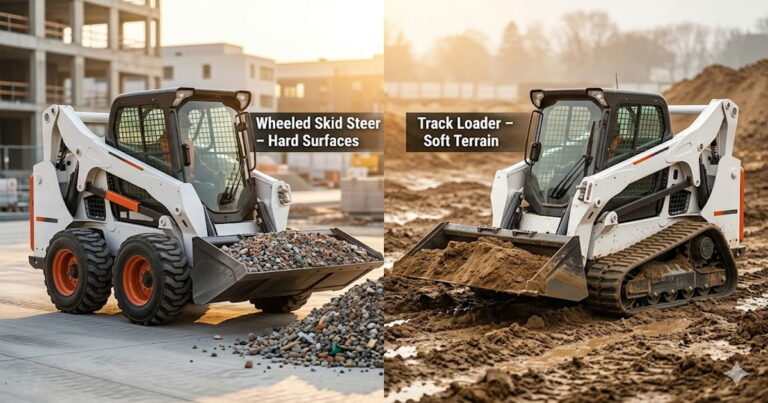
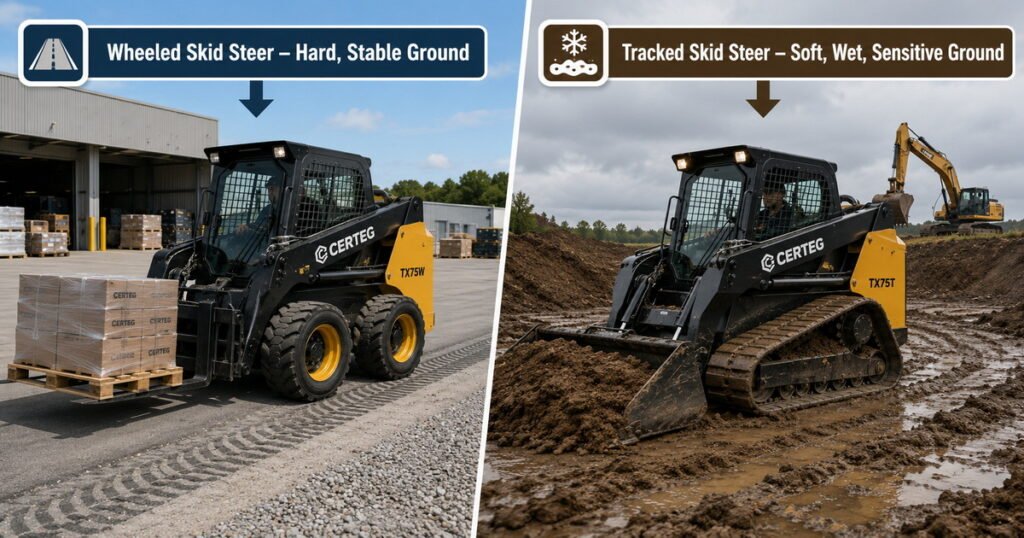
Wheeled skid steer loaders are typically the better choice if you:
– Work mostly on paved yards, compacted gravel, concrete or asphalt
– Need higher travel speeds between work areas
– Want lower initial purchase cost and simpler maintenance
– Change tires strategically to handle different surfaces
Tracked skid steer loaders (compact track loaders) make more sense if you:
– Operate on muddy, soft, sandy or snowy ground
– Need maximum traction and flotation with less rutting
– Work on finished landscaping or turf where surface damage is a concern
– Accept higher undercarriage costs in exchange for more usable working days per year
In our own Certeg fleet analysis, contractors switching from wheels to tracks on wet or soft jobs reported more effective working days per season and fewer stoppages due to weather or ground conditions. [gushwork]
Radial vs Vertical Lift: Choosing the Right Geometry
Most buyers see “radial” and “vertical” on spec sheets and skip the nuance. Based on jobsite feedback, that is a mistake. [dozr]
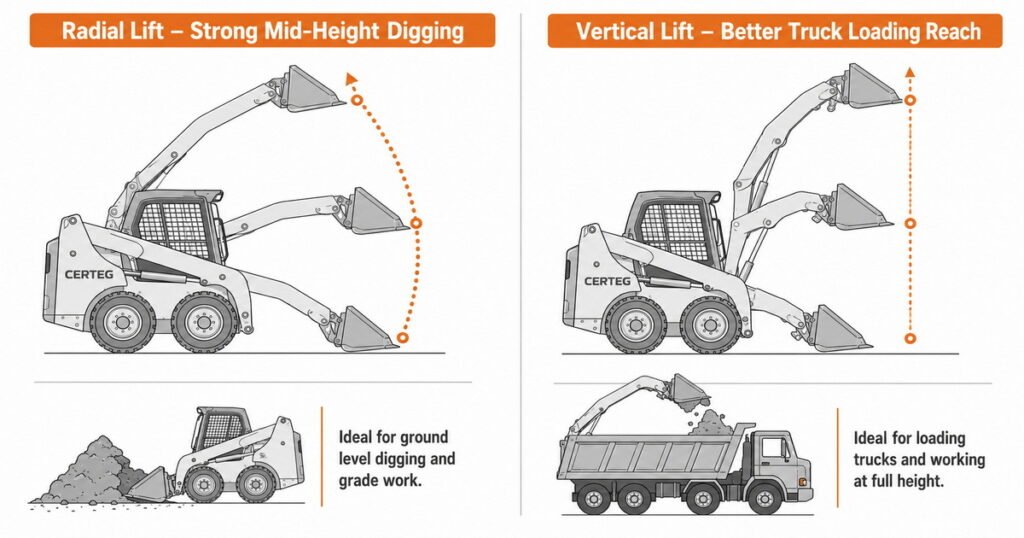
– Radial lift
– Simple, durable linkage
– Strong mid-height digging and breakout force
– Ideal for grading, trench backfilling, site cleanup, agriculture
– Vertical lift
– More complex linkage optimized for higher reach and more stable lift path
– Better for loading trucks, feed mixers, high-sided bins
– Often favored in rental and construction fleets focused on loading operations
Bobcat’s historic lineup and today’s competitors, including Certeg, commonly offer both lift paths in different frame sizes so you can choose the geometry that fits your dominant use case instead of forcing a “one size fits all” decision. [bobcat]
Modern Buying Criteria: Spec Sheet vs Real Job Requirements
In many RFQs and international tenders, buyers still lead with engine horsepower and price. From an OEM perspective, that is only part of the story. [5k]
When specifying a skid steer today, prioritize:
1. Primary Application Mix
– % of time in loading, grading, fork work, attachment use, snow, demolition, ag.
– This drives whether you want vertical or radial lift, wheel or track, and what size frame makes sense. [dozr]
2. Attachment Strategy
– Identify must‑have attachments now and in the next 3–5 years (auger, breaker, mulcher, planer, brush cutter, snow blower, pallet forks, etc.).
– Make sure the loader’s standard and optional auxiliary hydraulic flows support your heaviest attachment. [dozr]
3. Ground Conditions and Climate
– Soft soil, extreme heat, heavy dust, or winter conditions should influence undercarriage, cooling capacity, sealing, and cab options. [gushwork]
4. Operator Skill and Safety
– Consider visibility, control layout, ride control, lighting, access steps and handholds.
– Better ergonomics translate into fewer mistakes and higher daily output. [toprankmarketing]
This “application‑first” approach consistently delivers better lifetime ROI than simply chasing the highest horsepower at the lowest price. [deskera]
Example Spec Ranges: What to Expect by Size Class
The exact numbers vary by brand, but modern skid steers tend to fall into comparable ranges based on frame size. [dozr]
| Loader class | Typical ROC range* | Typical operating weight* | Typical engine power* | Common use cases |
|---|---|---|---|---|
| Small frame | ~700–1,500 kg | ~2,600–3,500 kg | ~35–55 kW | Landscaping, small construction sites, agriculture chores, warehouse/fork work |
| Medium frame | ~1,500–2,000 kg | ~3,500–4,500 kg | ~55–70 kW | General construction, batching plants, rental fleets, municipal maintenance |
| Large frame | ~2,000–2,700 kg | ~4,500–5,800 kg | ~70–90+ kW | Heavy construction, roadwork with planers, forestry mulching, quarries |
Certeg configures both wheel and track loaders in each of these bands to cover global customer needs from compact urban projects to large infrastructure contracts. [nine]
Practical 7‑Step Process for Selecting Your Next Skid Steer
To turn research into a confident purchasing decision, use a simple but rigorous process drawn from real buyer workshops and fleet audits. [macraes]
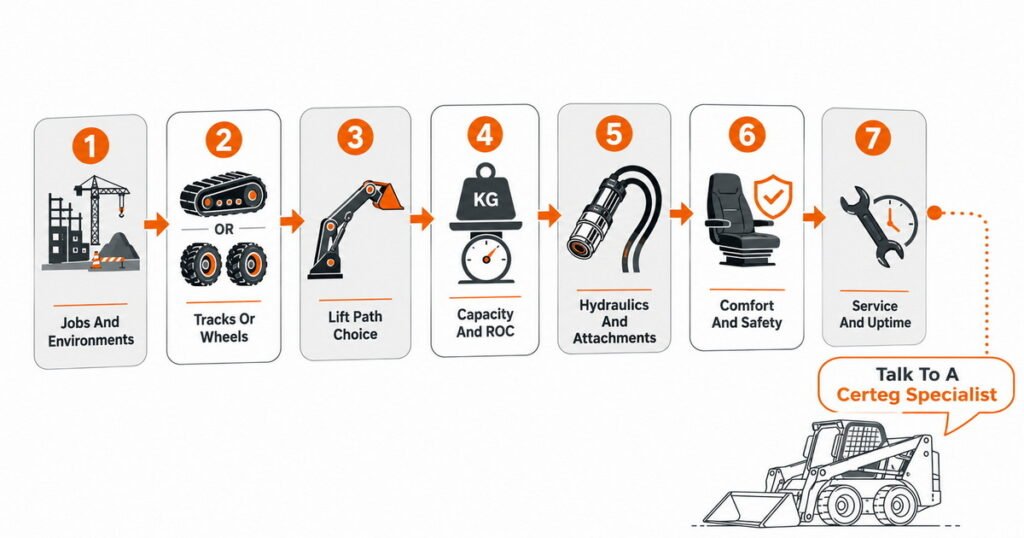
1. Define jobs and environments
– List the top 3–5 task types and the typical surfaces you work on in a normal month.
2. Pick track or wheel
– If you frequently work in mud, soft soil or snow, favor tracks.
– If you mostly operate on pavement or compacted yards, favor wheels.
3. Choose lift path
– If loading trucks or hoppers dominates, choose vertical lift.
– If you mainly grade, trench or handle bulk material near ground level, radial lift is often enough.
4. Size the ROC and frame
– Work backward from your heaviest pallets, buckets or attachments.
– Add a realistic safety margin to specify your minimum ROC.
5. Check hydraulic needs
– For power‑hungry attachments, confirm both flow (L/min) and pressure (bar) match the attachment manufacturer’s recommendations. [dozr]
6. Validate comfort and safety
– Test cab access, seat quality, visibility, lighting and controls.
– Look for features like ride control and reversing fans on dusty or long‑haul jobs. [bobcat]
7. Plan service and uptime
– Evaluate dealer or OEM support, parts availability, and filters/intervals.
– Ask about telematics or maintenance alerts if your fleet is distributed. [macraes]
Walking through these steps with your team or dealer rarely takes more than an hour, but it dramatically focuses your shortlist and aligns stakeholders on what “fit for purpose” really means.
Field Insights from Global Contractors
Talking with fleet managers and operators across construction, agriculture and municipal fleets reveals consistent patterns in what makes a skid steer a profit center instead of a cost center. [deskera]
Common observations:
– Over‑spec’d machines can hurt ROI
– Buying the largest possible loader for “future proofing” often increases transport costs, fuel burn and tire or track wear without a matching revenue gain.
– Under‑spec’d hydraulics limit attachment strategy
– Contractors who tried to save on purchase price but ignored hydraulic flow later found themselves unable to run high‑value attachments like cold planers or mulchers efficiently. [dozr]
– Operators reward comfortable machines with better productivity
– Cab comfort, heating/cooling, adjustable controls and good visibility reduced operator fatigue and rework, especially in hot or long‑shift environments. [toprankmarketing]
– Preventive maintenance beats downtime every time
– Cooling system cleaning (helped by reversing fans), daily walk‑around checks and clear access to filters are strongly correlated with fewer breakdowns and longer component life. [gushwork]
Certeg integrates these lessons into design reviews and field testing, focusing not just on meeting a spec sheet, but on how the loader feels and performs after thousands of operating hours.
How Certeg Skid Steers Fit into a Multi‑Brand Fleet
Many professional buyers run mixed fleets where Bobcat, Certeg and other international brands work side by side. In that reality, compatibility and fleet strategy matter as much as any single model choice. [5k]
From a manufacturer’s perspective, Certeg designs skid steers to:
– Integrate smoothly with existing attachment ecosystems, using widely accepted quick‑coupler standards and hydraulic connections.
– Offer both wheel and track variants tuned for different regions, from soft soil in Southeast Asia to harsher ground in North America. [nine]
– Provide clear, transparent specs (ROC, hydraulic flow, pressure, breakout force) so fleet managers can make apples‑to‑apples comparisons with their existing machines. [dozr]
– Support global buyers with export documentation, parts logistics and technical support, which is crucial for cross‑border projects. [gushwork]
If you already operate Bobcat or other brands, the practical goal is less about replacing everything and more about filling gaps in capacity, ground conditions or attachment power.
Talk to a Skid Steer Specialist
If you are evaluating skid steers for your next project or tender, the most effective next step is to translate this guide into a project‑specific short list.
– Define your core applications, surfaces and attachment needs.
– Shortlist 2–3 capacity bands (small, medium, large frame).
– Then consult with a manufacturer or dealer who can map those needs to specific models and options.
As an OEM focused on skid steer loaders and other construction machinery, Certeg works with global buyers to configure wheel or track machines that match regional ground conditions, attachment strategies and service capabilities. When you are ready, share your typical job profiles, attachment plans and preferred undercarriage type, and a specialist can recommend a focused set of models instead of generic “one size fits all” proposals. [nine]
Frequently Asked Questions (FAQ)
1. Should I choose a tracked skid steer or a wheeled one for mixed urban projects?
For urban projects that mix paved surfaces with occasional soft ground, many fleets start with wheeled skid steers for lower cost and tire flexibility, then add tracked loaders if downtime due to mud or weather becomes a recurring issue. [deskera]
2. How important is hydraulic flow when buying a skid steer?
Hydraulic flow and pressure directly control which attachments you can run and how productively you can use them, especially for planers, mulchers and high‑flow brooms, so they should be treated as core specs rather than optional extras. [dozr]
3. Does vertical lift always outperform radial lift?
No. Vertical lift offers advantages for truck loading and higher dump heights, while radial lift machines are often simpler, slightly lighter in equivalent classes, and very strong in mid‑range digging and grading applications. [dozr]
4. How can I improve skid steer uptime on dusty jobsites?
Features like reversing fans, good access to cooling cores and filters, plus a disciplined daily inspection routine are proven to reduce unplanned downtime on dusty or abrasive sites. [gushwork]
5. What is the single most common mistake first‑time skid steer buyers make?
The most common mistake is treating horsepower and purchase price as primary decision drivers instead of starting from real job requirements, attachment plans and ground conditions. [5k]
References
1. – Heavy equipment and construction equipment marketing best practices – Nine.is, “The Complete Guide To Heavy Equipment Marketing.” [nine]
2. – Construction equipment marketing and buyer behavior – 5K, “How to Market Construction Equipment.” [5k]
3. – Digital marketing and buyer journey for construction equipment – Gushwork, “Effective Digital Marketing Strategies for Construction Equipment.” [gushwork]
4. – Skid steer specification and dimension patterns – DOZR, “The Ultimate Skid Steer Specifications, Weight, and Dimensions Guide.” [dozr]
5. – Google E‑E‑A‑T guidance – TopRank Marketing, “E‑E‑A‑T and SEO: Optimizing for Google’s Guidelines.” [toprankmarketing]
6. – Google EEAT compliance practices – Innovation Visual, “Google’s EEAT Guidelines – How To Remain Compliant.” [innovationvisual]
7. – Example skid steer product specs and features – Bobcat Company, “Classic S650 Skid Steer Loader (Specs, Pricing & More).” [bobcat]
8. – Historical and marketing information for skid steer loaders – Doosan Bobcat China, “Skid-Steer Loaders.” [bobcat]
9. – SEO guidance for heavy equipment companies – MacRAE’s, “SEO for Heavy Equipment Companies.” [macraes]
10. – UX and SEO tips for construction companies – YouTube, “SEO for Construction Companies: Boosting Visibility and …” [youtube]
Hot Tags: Skid Steer Loader, Manufacturers, Customized, Custom, Suppliers, Buy, Cheap, Quality, Advanced, Durable, in Stock, Made in China, Price, Quotation