
The Biggest Skid Steers on the Market – And When a Certeg Skid Steer or Compact Track Loader Is the Smarter Choice
Content Menu
● What Makes a “Biggest” Skid Steer in 2026?
● Key Big‑Frame Skid Steer Models Featured
>> Flagship Skid Steer Highlights
● Skid Steer vs Compact Track Loader – How I Advise Customers
>> Step‑by‑Step Selection Framework
● How Certeg Positions Its Skid Steer and Compact Track Loaders
>> Powertrain and Undercarriage Options
● When the Biggest Flagship Isn’t the Best Choice
● Practical Buyer Checklist – Choosing Your Next Skid Steer or CTL
● Call to Action – Configure a Certeg Loader for Your Jobsite
>> FAQ 1 – What is considered a “big” skid steer in today’s market?
>> FAQ 2 – When should I choose a compact track loader instead of a wheel skid steer?
>> FAQ 3 – Do I need high‑flow hydraulics on my skid steer?
>> FAQ 4 – How does Certeg support international customers for skid steer and CTL purchases?
>> FAQ 5 – How can I make my skid steer or CTL investment future‑proof?
Certeg’s skid steer and compact track loaders give contractors a practical alternative to the “biggest on the market” machines, combining high productivity with tailored power, undercarriage, and attachment solutions for real‑world jobsites. As an equipment strategist working with fleets worldwide, I’ve seen that spec sheets only tell part of the story—what really matters is matching the right loader to the right application, operator, and ownership cost profile. [gushwork]
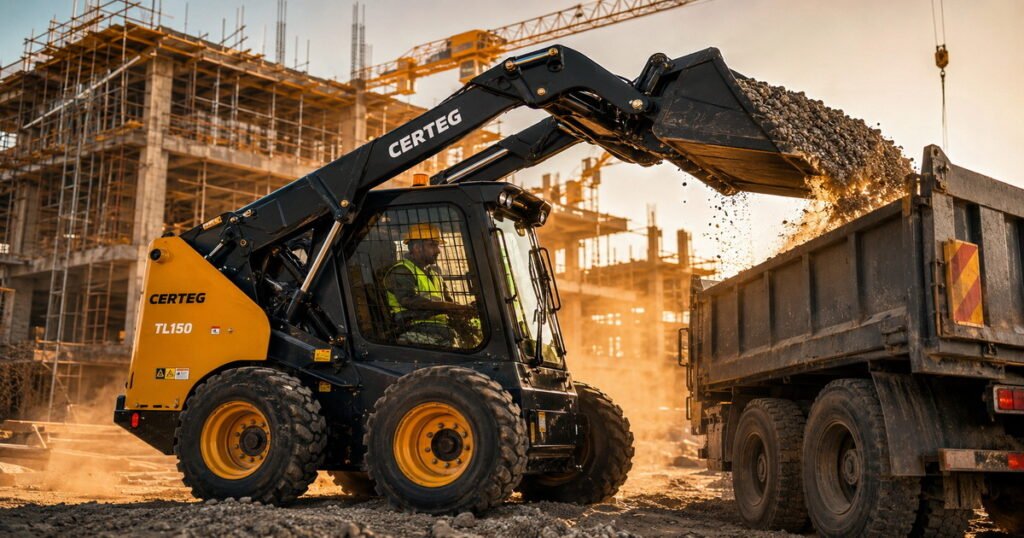
What Makes a “Biggest” Skid Steer in 2026?
When buyers search for the biggest skid steers on the market, they are usually comparing three things: rated operating capacity (ROC), engine power, and hydraulic performance. The Compact Equipment overview highlights that flagship skid steers from major OEMs often sit in the 75 to 100 hp range with ROCs between 2,600 and 3,500+ pounds, supported by high‑flow hydraulic packages for demanding attachments. [gushwork]
From a practical standpoint, “biggest” also includes cab comfort, visibility, stability, and electronics such as EH controls and premium displays, because productivity gains are increasingly driven by operator endurance and machine control, not only raw torque. [seo]
Key Big‑Frame Skid Steer Models Featured
Flagship Skid Steer Highlights
| Brand / Model | Power / Capacity (as described) | Notable Features |
|---|---|---|
| Bobcat S86 | High hp, multiple hydraulic flow modes (standard, high, super) with Premium Power Performance. gushwork | Focus on hydraulic versatility, strong breakout forces, and optimized weight‑to‑power ratio. gushwork |
| Case SV340B | 90 hp, ROC around 3,400 lb, bucket breakout force ~9,531 lb. gushwork | Vertical lift, optional high‑flow and enhanced high‑flow, 8‑inch LCD display and backup camera. gushwork |
| Gehl R260 | ROC ~2,600 lb, high‑flow up to ~35 gpm. gushwork | Radial lift, compact width (~67 in), hinge‑pin height over 10 ft for truck loading. gushwork |
| ASV VS‑75 | 75 hp with ROC ~3,500 lb, breakout force ~5,920 lb. gushwork | Max‑Series cab with 360° visibility, positioned as lower‑hp fuel savings with high capacity. gushwork |
| John Deere 332G | 100 hp class, large‑frame skid steer. gushwork | Tier 4 Final engine, EH boom performance package, switchable EH joysticks for shorter cycle times. gushwork |
| Caterpillar D3 Series | Multiple models in the D3 skid steer line. gushwork | Smart Attachments with automatic recognition, wider cab door, improved operator space and comfort. gushwork |
| Wacker Neuson SW32 | 100 hp, ROC ~3,200 lb. gushwork | Vertical lift, hinge‑pin height ~134.8 in, high visibility cab and strong service access. gushwork |
| Manitou 3300 V NXT:2 | ROC up to ~3,300 lb, 72 hp engine. gushwork | Vertical lift, hinge‑pin height ~131 in, optimized for all‑terrain use. gushwork |
| Kubota SSV75 | ROC ~2,690 lb with two‑speed travel. gushwork | Slide‑up front door, optional high‑flow, large rear fuel tank for all‑day operation. gushwork |
| JCB Teleskid 3TS‑8W | Telescopic boom skid steer. gushwork | Unique telescopic Powerboom with 13 ft+ lift height, forward reach, ability to dig below grade. gushwork |
These machines show how OEMs are pushing the limits on lift height, hydraulic flow, and operator technology, but the article does not deeply address lifecycle costs, terrain realities, or how smaller manufacturers and specialized builders like Certeg fit into a modern fleet strategy. [seo]
Skid Steer vs Compact Track Loader – How I Advise Customers
As someone who has helped spec machines for contractors in roadbuilding, agriculture, demolition, and rental, I rarely start with “what’s the biggest model you can buy.” Instead, I walk customers through a simple framework. [scubemarketing]
Step‑by‑Step Selection Framework
1. Define your primary surface.
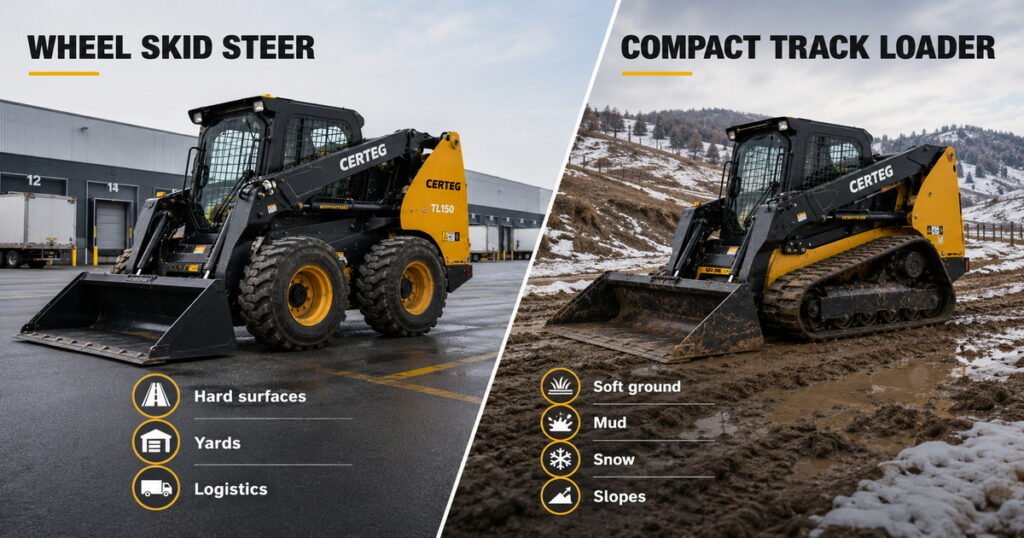
– Mostly concrete and asphalt? A wheel skid steer offers lower purchase cost and faster travel speeds. [cat]
– Soft soils, mud, snow, or steep grades? A compact track loader (CTL) spreads ground pressure and improves traction. [cat]
2. Clarify the heaviest routine task.
– Regularly lifting heavy pallets, loading high‑side trucks, or handling silage? You need higher ROC and vertical lift geometry.
– Primarily grading, backfilling, or snow removal? Focus on hydraulic flow and tool carrier versatility.
3. Match attachments to hydraulic capability.
– Cold planers, forestry mulchers, and high‑flow snow blowers demand high‑flow circuits and robust cooling. [cat]
– Basic buckets, forks, and light brooms can operate on standard flow, which reduces cost.
4. Consider operator skill and fatigue.
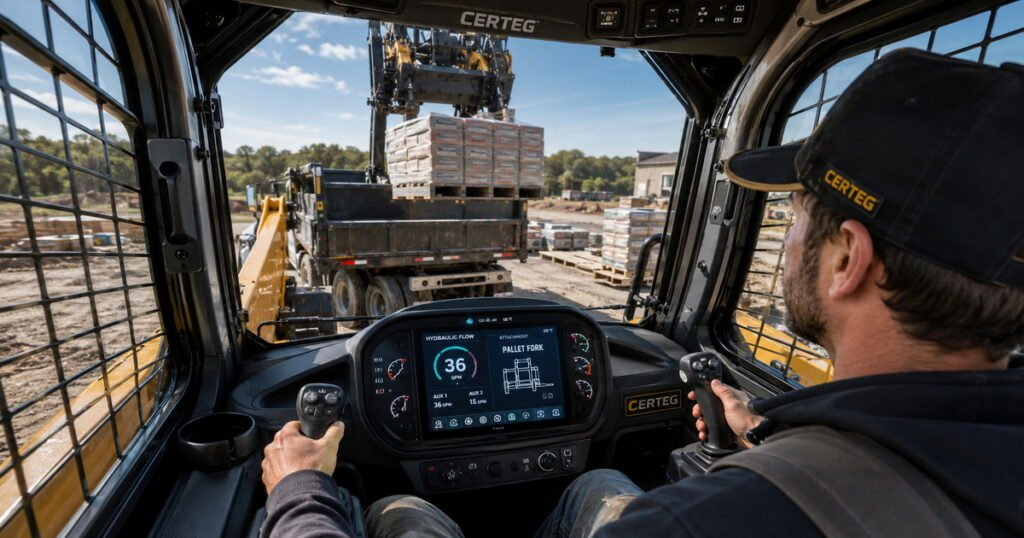
– Newer operators benefit from EH controls, clear displays, and intuitive safety features, which many modern machines, including Certeg’s, now integrate as standard or optional. [gushwork]
5. Think globally about parts and support.
– For fleets operating in multiple regions, availability of parts, modular components, and remote support can outweigh minor differences in breakout force or lift height. [scubemarketing]
By structuring the decision this way, buyers shift from “biggest spec” to “best fit loader”—which is where mid‑size and heavy‑duty models from manufacturers such as Certeg become compelling alternatives to the headline‑grabbing flagships. [seo]
How Certeg Positions Its Skid Steer and Compact Track Loaders
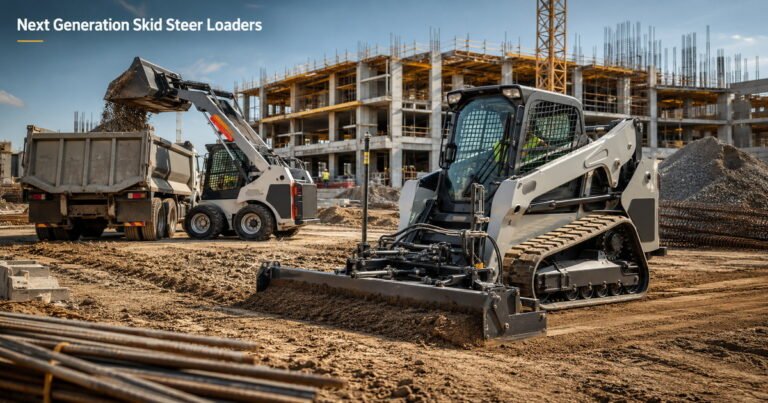
As a manufacturer focused on skid steer loaders (both wheeled and tracked) and related construction machinery, Certeg designs machines specifically to balance power, undercarriage configuration, and attachment compatibility for global jobsite conditions.
Powertrain and Undercarriage Options
Certeg’s product strategy emphasizes offering different power and drivetrain combinations so that customers can match machines to region‑specific fuel quality, emission requirements, and terrain. [scubemarketing]
– Wheel Skid Steers:
Designed for contractors who work predominantly on prepared surfaces, logistics yards, plants, and road projects, where speed between tasks and lower undercarriage costs matter most. [seo]
– Compact Track Loaders (CTLs):
Built for soft grounds, agricultural environments, and year‑round outdoor work, where traction and low ground pressure are critical. [cat]
Unlike many global brands that sell a limited range of configurations into export markets, Certeg can adapt engine power bands, hydraulic packages, and cab features for different customer profiles—from price‑sensitive rental fleets to high‑spec owner‑operators. [scubemarketing]
When the Biggest Flagship Isn’t the Best Choice
In my consulting work, I often see buyers drawn to 100‑hp flagship skid steers because they appear to be “future‑proof.” However, once we map projects, attachments, and operating conditions, the final choice is often different. [gushwork]
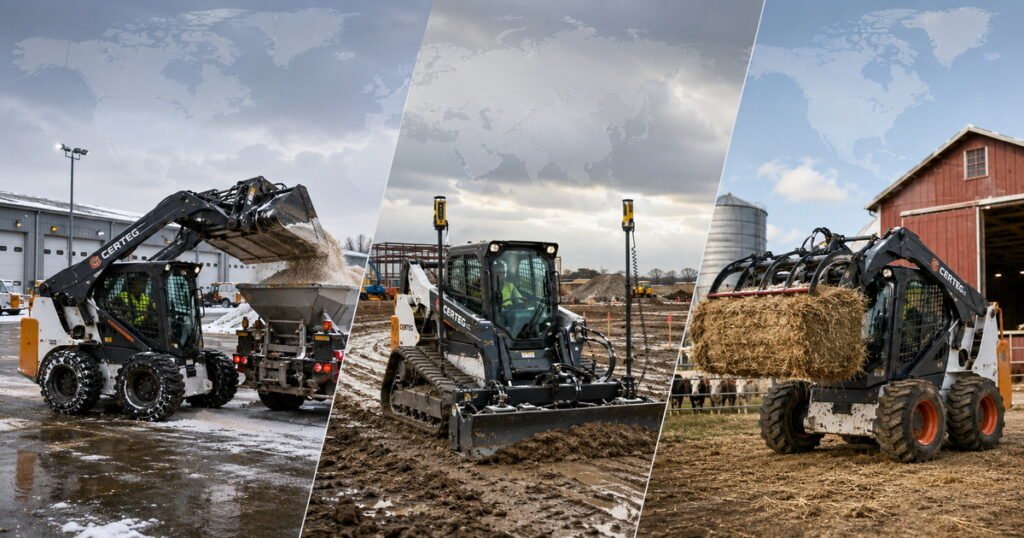
Scenario 1 – Municipal road maintenance
– Original thinking: Buy a top‑end 100‑hp skid steer from a premium brand with maximum ROC for winter snow and summer milling.
– Field reality: The machine spends most of its time with buckets and brooms, with only occasional use of high‑flow tools. A mid‑frame wheel skid steer with a reliable high‑flow package and lower fuel consumption provides better value.
– Where Certeg fits: Certeg can supply a wheel skid steer with high‑flow hydraulics and rugged winterization options, without the overhead of a full flagship package. [seo]
Scenario 2 – Agriculture and feed operations
– Original thinking: Buy a large vertical lift skid steer for loading feed and handling bales.
– Field reality: The work is often on loose, uneven surfaces, and operators need all‑weather reliability and low ground disturbance. A track loader with an appropriate ROC is more efficient and reduces rutting.
– Where Certeg fits: Certeg’s compact track loaders can be tuned for agricultural conditions, providing sufficient capacity without oversizing the machine. [cat]
These examples highlight why application‑driven selection matters more than simply chasing the biggest skid steer on paper. [scubemarketing]
Practical Buyer Checklist – Choosing Your Next Skid Steer or CTL
To translate this into an actionable process, here is a concise checklist you can use when comparing flagship OEM models and Certeg offerings.
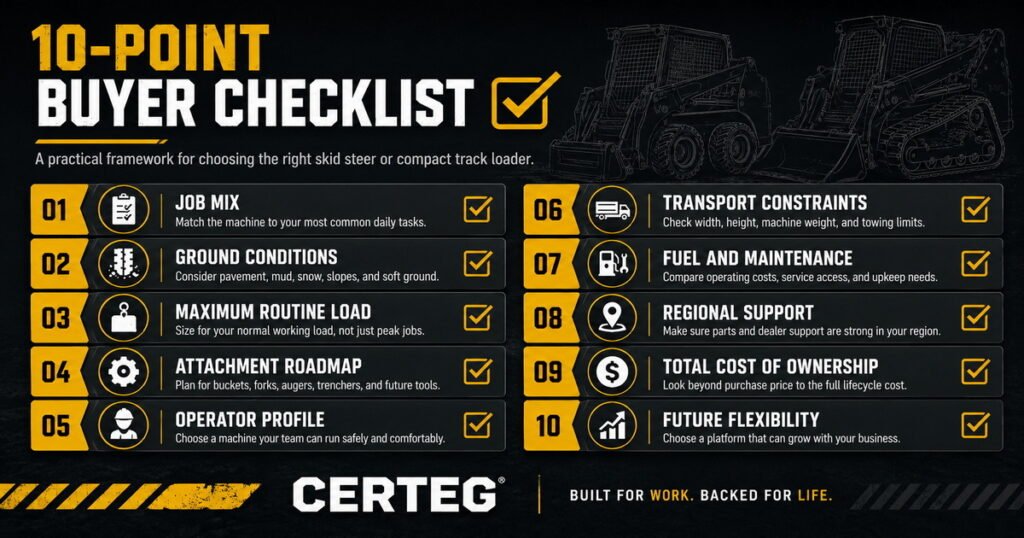
10‑Point Checklist
1. Job mix:
– Percentage of time in earthmoving, material handling, snow, or specialty attachment work.
2. Ground conditions:
– Predominantly hard or soft surfaces; seasonal weather extremes.
3. Maximum routine load:
– Heaviest pallet, bucket, or attachment you handle weekly—not just once a year.
4. Attachment roadmap:
– List high‑flow vs standard‑flow tools planned over the next 3–5 years. [seo]
5. Operator profile:
– Single experienced owner‑operator or multiple shift operators of varying skill levels.
6. Transport constraints:
– Trailer capacity, bridge laws, and width restrictions for access roads or plant gates.
7. Fuel and maintenance:
– Daily service access, filter availability, common parts across your fleet. [seo]
8. Regional support:
– Availability of authorized service, dealer or distributor network, and remote support.
9. Total cost of ownership (TCO):
– Not just financing costs—factor fuel burn, tires/tracks, downtime, and resale. [seo]
10. Future flexibility:
– Whether the machine configuration can adapt to new attachments or job types without major re‑investment.
Certeg’s role is to help buyers configure skid steer loaders and CTLs that score well against this checklist rather than simply competing on headline horsepower numbers. [scubemarketing]
Call to Action – Configure a Certeg Loader for Your Jobsite
Once readers understand where the biggest skid steers excel—and where more tailored machines make sense—you should offer a clear, specific call to action.
Share your typical ground conditions, attachments, and lifting needs, and our Certeg team will configure a loader package—including wheel or track options and hydraulic packages—optimized for your fleet’s real work.
FAQ (with Schema Potential)
FAQ 1 – What is considered a “big” skid steer in today’s market?
In 2026, a “big” skid steer typically refers to machines with rated operating capacities above 2,600 pounds and engine outputs in the 75 to 100 horsepower range, often paired with high‑flow hydraulics. These units are designed to handle heavy pallet loads, demanding attachments, and high‑cycle loading tasks such as truck loading or feed handling. [gushwork]
FAQ 2 – When should I choose a compact track loader instead of a wheel skid steer?
Choose a compact track loader when you work frequently on soft, muddy, snowy, or uneven terrain, or when you need to minimize ground disturbance in landscaping and agricultural applications. Tracks spread machine weight over a larger area, improving traction and stability, while wheel skid steers remain more cost‑effective for hard surfaces and yard work. [cat]
FAQ 3 – Do I need high‑flow hydraulics on my skid steer?
You need high‑flow hydraulics if you plan to run attachments such as cold planers, forestry mulchers, high‑capacity snow blowers, or heavy‑duty planers that require higher flow and pressure. For buckets, forks, light brooms, and many standard tools, a well‑designed standard‑flow system is often sufficient and more cost‑efficient. [cat]
FAQ 4 – How does Certeg support international customers for skid steer and CTL purchases?
Certeg focuses on global customers with diverse ground conditions and power requirements, offering configurable skid steer and compact track loader packages tailored to regional fuel quality, climate, and job profiles. By working through export‑oriented distribution and service partners, Certeg aims to provide consistent parts availability, technical support, and training for customers outside its home market. [scubemarketing]
FAQ 5 – How can I make my skid steer or CTL investment future‑proof?
To future‑proof your investment, prioritize flexible hydraulics, robust auxiliary power, and a cab layout that supports multiple operator skill levels, rather than only chasing maximum horsepower. Consider a loader platform that can support new attachments, upgraded control packages, and remote monitoring as your fleet and project mix evolve. [innovationvisual]
References
1. Compact Equipment – These Are the Biggest Skid Steers on the Market (accessed 2026‑05‑16). [gushwork]
2. Gushwork – SEO Strategy for Heavy Equipment Sales. [gushwork]
3. Wellows – E‑E‑A‑T Checklist for SEO: Strengthen Content with LLM Insights. [wellows]
4. Searchflex – How To Optimise Product Pages for SEO (2026 Checklist). [searchflex]
5. SEO.com – SEO for Heavy Equipment Companies: 7 Pro Tips. [seo]
6. Innovation Visual – Google’s EEAT Guidelines – How To Remain Compliant. [innovationvisual]
7. ThisIsNovos – The Ultimate Guide to Optimising Product Pages (PDPs) for SEO. [thisisnovos]
8. Caterpillar – Skid Steer Loaders Product Overview. [cat]
9. Scubemarketing – Heavy Equipment Marketing: Proven Digital Strategies. [scubemarketing]
10. Stellar Content – The Complete Guide to Google E‑E‑A‑T. [stellarcontent]
Hot Tags: Skid Steer Loader, Manufacturers, Customized, Custom, Suppliers, Buy, Cheap, Quality, Advanced, Durable, in Stock, Made in China, Price, Quotation