
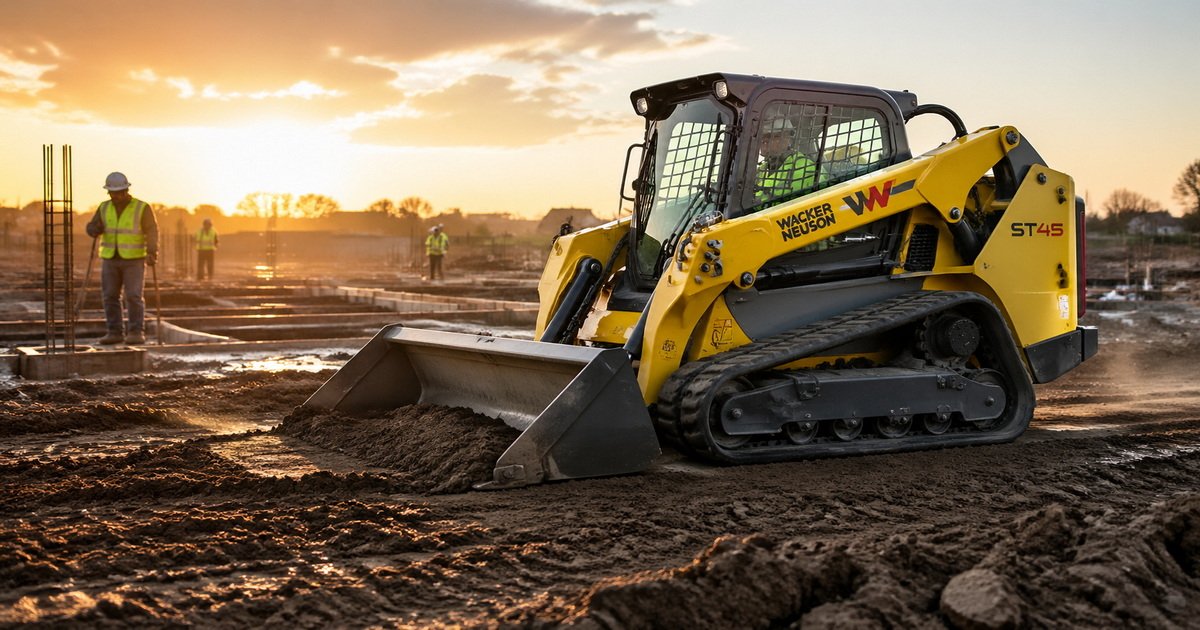
Wacker Neuson Compact Track Loaders vs. Modern Skid Steers: A Field‑Tested Guide for Contractors and Fleet Managers
Content Menu
● Why Compact Track Loaders Have Become the New Jobsite Standard
● Wacker Neuson Compact Track Loaders: Key Features That Matter On Site
>> 1. Model Lineup and Power Range
>> 2. Cab Design and Operator Comfort
>> 3. Control Options for Different Operator Profiles
>> 4. Engine and Warranty: Kohler Diesel Power
>> 5. Hydraulic Performance and Tractive Effort
● Wacker Neuson CTLs vs. Wheeled Skid Steers: Which Should You Choose?
>> Practical Comparison: Tracks vs. Wheels
● Matching a CTL to Your Applications
>> Step 1: Define Your Primary Tasks
>> Step 2: Consider Underfoot Conditions
>> Step 3: Size for Transport and Access
● Getting More Productivity from Each Loader
>> Maintenance Practices That Reduce Downtime
>> Utilization and Job Planning
● How Contractors Now Research CTLs and Skid Steers
● Content & UX Best Practices for Compact Equipment Pages
● Clear CTA: Turn Specs into Action
● FAQs: Compact Track Loaders, Skid Steers, and Wacker Neuson
>> Q1. Is a compact track loader always better than a wheeled skid steer?
>> Q2. How often do Wacker Neuson CTL tracks need to be replaced?
>> Q3. What makes Wacker Neuson CTLs easier to service than some competitors?
>> Q4. Are high‑flow hydraulics worth it for most contractors?
>> Q5. How important is the four‑year / 4,000‑hour engine warranty on Wacker Neuson CTLs?
As someone who spends a lot of time helping contractors choose and operate skid steer loaders and compact track loaders (CTLs), I’ve learned that spec sheets alone never tell the whole story. What really matters is how machines like the Wacker Neuson ST28, ST31, ST35, ST40, ST45 and ST50 perform in real jobs, in real ground conditions, under real budget pressure. [compactequip]
Why Compact Track Loaders Have Become the New Jobsite Standard
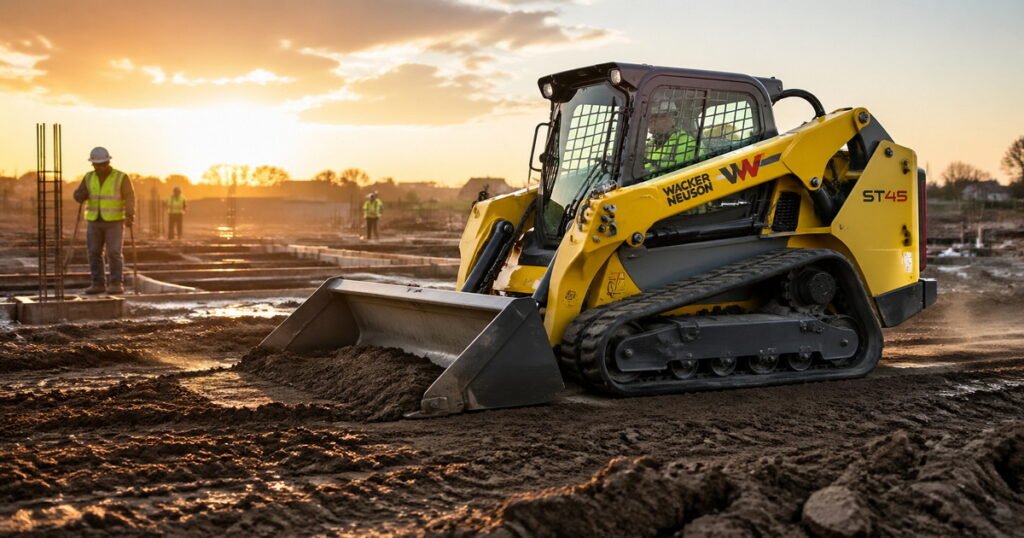
Over the last decade, compact track loaders have quietly moved from “nice to have” to “must have” on many construction and landscaping projects. Contractors are willing to pay more up front because CTLs offer better traction, lower ground pressure, and higher productivity on soft or uneven terrain. [landscapecontractor.com]
When I talk with fleet managers, they tend to highlight three core advantages of CTLs over wheeled skid steers:
– Traction in soft ground: Rubber tracks spread the machine weight over a larger area, so CTLs stay productive in mud, sand, and loose fill where skid steers start to spin. [wackerneuson]
– Lower ground disturbance: Reduced ground pressure makes CTLs the safer choice on finished surfaces, lawns, and sensitive subgrades. [wackerneuson]
– Attachment versatility: High‑flow hydraulics on models like the ST40 and ST50 allow CTLs to run power‑hungry attachments such as cold planers, large mulchers, and heavy trenchers. [forconstructionpros]
For firms that work year‑round, that extra working window in wet or shoulder seasons often justifies the investment in tracks very quickly. [landscapecontractor.com]
Wacker Neuson Compact Track Loaders: Key Features That Matter On Site
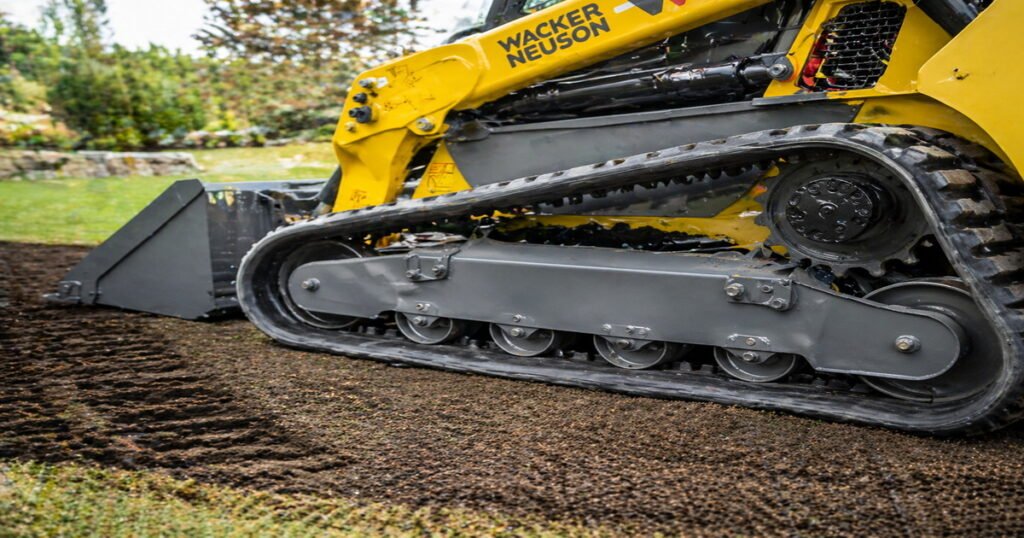
The original Wacker Neuson 2021 CTL spec guide emphasized cab comfort, daily service access, and a broad model range from the ST28 up to the ST50. Looking at those claims through a practitioner’s lens, several details stand out as genuinely useful rather than marketing fluff. [compactequip]
1. Model Lineup and Power Range
Wacker Neuson’s CTL range covers a wide spectrum of lift capacities, engine power, and hydraulic performance. That gives contractors some flexibility to match machine size to work type and transport constraints. [wackerneuson]
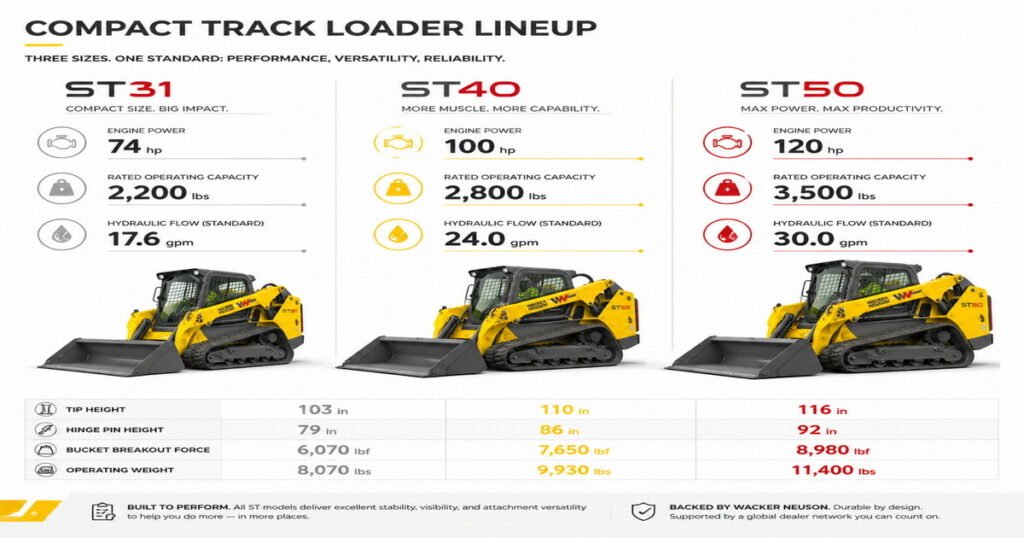
Typical lineup highlights include: [compactequip]
– ST28 & ST31 – Mid‑size compact track loaders aimed at general construction and landscaping where maneuverability and transport weight matter.
– ST35 & ST45 – Higher rated operating capacity for heavier pallet work, utility jobs, and more demanding attachments.
– ST40 & ST50 (around 100 hp) – High‑horsepower CTLs designed for demanding ground‑engaging work, higher travel speeds, and high‑flow attachments. [landscapecontractor.com]
From an operations perspective, this spread lets you standardize on a brand while still tailoring machine size to local regulations (transport weight limits) and typical job profiles. [wackerneuson]
2. Cab Design and Operator Comfort
When operators live in a cab for 8–10 hours, small design choices have big productivity impacts. Wacker Neuson has clearly invested in the operator environment: [compactequip]
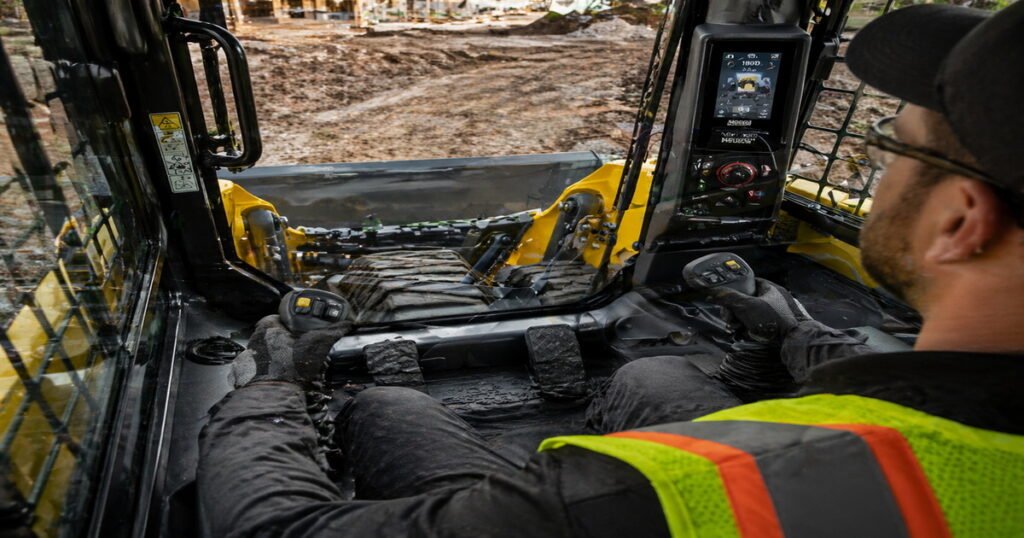
– Forward‑tipping cab that can be tilted even with the loader arms down, greatly improving access for maintenance and inspections. [compactequip]
– Angled pedals and foot bed that reduce fatigue in the ankles and knees during long days. [compactequip]
– Strategically positioned joysticks that feel intuitive and reduce shoulder strain. [landscapecontractor.com]
– High‑visibility cab design that improves sight lines to the attachment, tracks, and surrounding workers. [wackerneuson]
– 5.7‑inch color display with expanded functionality for machine settings, diagnostics, and operator preferences. [compactequip]
In practice, I see owner‑operators gravitate toward machines where cab layout feels “natural” within the first hour; Wacker Neuson’s cab design typically scores well in that category. [landscapecontractor.com]
3. Control Options for Different Operator Profiles
Crews often mix experienced operators (used to foot controls) with younger operators trained on ISO patterns. To support that, Wacker Neuson offers multiple control options: [landscapecontractor.com]
– Electric‑hydraulic (EH) hand‑foot controls for operators who prefer a traditional layout. [compactequip]
– Selectable EH (ISO and H‑pattern) so you can switch patterns to match operator training and personal preference. [compactequip]
On multi‑crew fleets, this flexibility shortens training time and cuts down on operator frustration when rotating between machines. [landscapecontractor.com]
4. Engine and Warranty: Kohler Diesel Power
Several Wacker Neuson CTLs use Kohler diesel engines with a focus on simplicity and uptime. From a maintenance and total cost of ownership perspective, a few points are important: [landscapecontractor.com]
– Maintenance‑free, regeneration‑free aftertreatment system eliminates DPF regeneration cycles and associated downtime. [landscapecontractor.com]
– No extra filters or extreme heat from regeneration cycles, which reduces the risk of operator error and peripheral component damage. [compactequip]
– Four‑year / 4,000‑hour engine warranty, which is particularly attractive for rental fleets and high‑utilization owner‑operators focused on resale value. [landscapecontractor.com]
In my discussions with fleet managers, long engine warranties are increasingly seen as a proxy for manufacturer confidence and a lever for better resale pricing. [wackerneuson]
5. Hydraulic Performance and Tractive Effort
Hydraulic power and tractive effort determine what your CTL can actually do with serious attachments in real dirt. Wacker Neuson’s medium‑frame loaders and CTLs are designed with: [forconstructionpros]
– Category‑leading hydraulic horsepower (standard and optional high‑flow) to power demanding tools. [forconstructionpros]
– High tractive effort that translates engine power to pushing force, critical for grading, backfilling, and working on slopes. [wackerneuson]
– Multiple travel speed stages for balancing fine control in tight spaces with faster cycle times on larger projects. [wackerneuson]
For example, technical data for models like the ST45 show strong breakout forces and high tractive effort, reinforcing their positioning for performance‑focused contractors. [wackerneuson]
Wacker Neuson CTLs vs. Wheeled Skid Steers: Which Should You Choose?
Most buyers today evaluate compact track loaders alongside wheeled skid steers, not in isolation. Both machine types share many components and attachments, but they behave very differently on site. [wackerneuson]
Practical Comparison: Tracks vs. Wheels
| Decision factor | Compact Track Loader (e.g., ST31, ST40) | Wheeled Skid Steer |
|---|---|---|
| Ground conditions | Excels in mud, sand, loose fill, slopes; low ground pressure minimizes rutting. landscapecontractor.com | Better on hard, dry ground; can struggle or stall in deep mud or loose soil. landscapecontractor.com |
| Surface protection | Gentler on turf, pavers, and finished subgrades due to track footprint. wackerneuson | Higher point loading can damage sensitive surfaces. |
| Purchase price | Higher initial cost due to undercarriage and track system. landscapecontractor.com | Generally lower purchase price for comparable power. |
| Maintenance | Track and undercarriage wear requires disciplined inspections and periodic replacements. landscapecontractor.com | Tire replacement is simpler and sometimes cheaper, depending on usage. |
| Productivity | Higher utilization in poor conditions and shoulder seasons; better stability with heavy attachments. landscapecontractor.com | Strong productivity on firm ground; faster travel on some hard surfaces. |
From an ROI perspective, CTLs tend to win when you:
– Work frequently in wet, soft, or mixed conditions.
– Do a lot of grading, landscaping, or work on finished surfaces.
– Use high‑flow, ground‑engaging attachments that demand stability and traction.
If your work is mostly on hard surfaces with frequent road travel between tight urban sites, a wheeled skid steer may still be the better choice for total lifecycle cost.
Matching a CTL to Your Applications
Choosing the right compact track loader is less about chasing the biggest numbers and more about aligning specs to your actual work mix. Based on real buyer behavior and fleet performance, here’s a structured approach that works well. [gushwork]
Step 1: Define Your Primary Tasks
List your top three revenue‑generating tasks, then rank them by time spent:
1. Material handling and pallet work.
2. Fine grading and backfilling.
3. Land clearing and heavy attachment use.
Machines like the ST28 and ST31 suit lighter grading and material handling, whereas ST40 and ST50 models shine when you run high‑flow attachments or push heavy loads for long cycles. [compactequip]
Step 2: Consider Underfoot Conditions
Ask yourself: “What does the ground look like 70% of the time?”
– If it’s soft or variable, prioritize track loaders and ground pressure ratings. [wackerneuson]
– If it’s firm and consistent, you can consider a mix of CTLs and skid steers for cost balance. [simplyfleet]
Technical data such as ground pressure, tractive effort, and travel speeds are worth scrutinizing when jobs regularly involve slopes, soft trenches, or sensitive surfaces. [wackerneuson]
Step 3: Size for Transport and Access
– Check common gate widths, trailer capacities, and bridge limits in your area.
– Verify that the operating weight and overall width of your chosen CTL fit your transport and access constraints. [wackerneuson]
Many contractors find that mid‑frame units like the ST31 strike a good balance between capacity and transport flexibility. [wackerneuson]
Getting More Productivity from Each Loader
Buying a strong machine is only half the equation; how you manage and maintain it will determine real‑world productivity. The best‑performing fleets consistently follow a few simple but disciplined practices. [heavyvehicleinspection]
Maintenance Practices That Reduce Downtime
Industry best practices for construction equipment management emphasize planned maintenance and utilization tracking. With CTLs, that usually looks like: [heavyvehicleinspection]
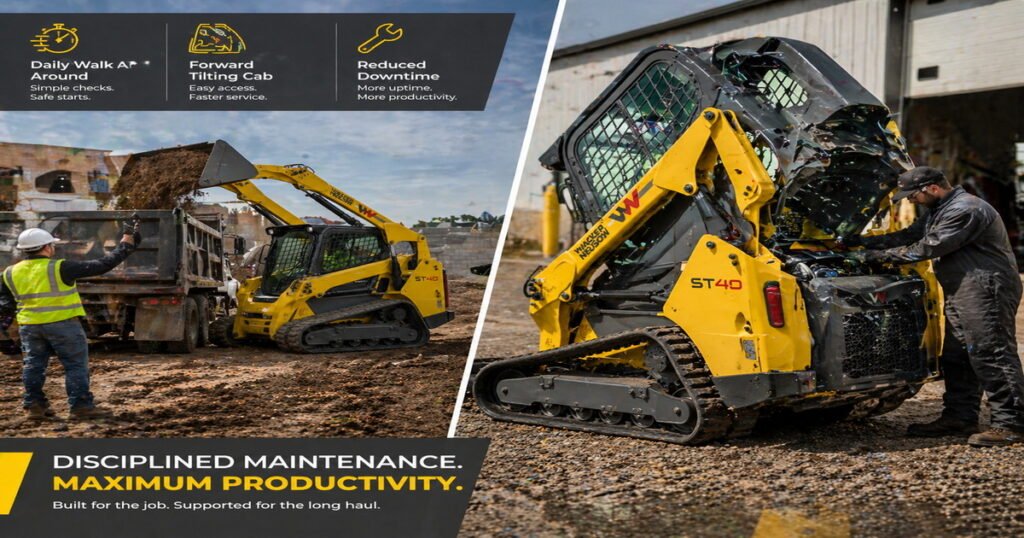
– Daily walk‑around checks: Inspect tracks, rollers, idlers, hydraulic connections, and attachment couplers before every shift. [simplyfleet]
– Leveraging the forward‑tilting cab on Wacker Neuson CTLs to quickly access service points and spot issues early. [compactequip]
– Using telematics or logbooks to track machine hours, fuel use, and error codes, then scheduling service based on actual utilization. [heavyvehicleinspection]
Because Wacker Neuson CTLs are designed with better service access (forward‑tipping cab, accessible daily checkpoints), it’s much easier for crews to stick to these routines. [wackerneuson]
Utilization and Job Planning
High‑performing contractors structure job plans around equipment capabilities to avoid idle time and overloading. Common strategies include: [simplyfleet]
– Allocating the right machine to each project based on lift capacity, reach, and underfoot conditions. [simplyfleet]
– Scheduling tasks to minimize unnecessary machine travel and repositioning. [heavyvehicleinspection]
– Standardizing attachments and quick couplers across similar machines to maximize flexibility. [heavyvehicleinspection]
Data from modern equipment management platforms shows that even modest improvements in utilization can significantly lower cost per productive hour. [simplyfleet]
How Contractors Now Research CTLs and Skid Steers
As equipment research moves online, your future buyers are reading detailed spec guides, expert reviews, and practical how‑tos long before they talk to a sales rep. In the compact equipment category, they consistently search for information such as: [salesfunnelprofessor]
– “best compact track loader for landscaping,”
– “Wacker Neuson ST31 vs Bobcat,”
– “track loader operating cost per hour.”
Modern SEO strategies for heavy and construction equipment emphasize educational content, clarity on specs, and honest discussion of pros and cons. Pages that clearly explain how a machine is used, what it does well, and where it might not be ideal tend to attract more qualified, purchase‑ready leads. [scubemarketing]
This is exactly why spec‑focused guides to Wacker Neuson CTLs perform well online: they answer the questions serious buyers are already asking. [wackerneuson]
Content & UX Best Practices for Compact Equipment Pages
If you are presenting Wacker Neuson CTLs or similar skid steer loaders on your own site, structure and UX matter as much as the technical data. A few actionable guidelines: [salesfunnelprofessor]
– Keep paragraphs short and highlight key specs or benefits in bold to help scanners. [scubemarketing]
– Use tables for model comparisons and spec summaries because they are easier to digest than long text blocks. [gushwork]
– Add internal links between related equipment pages, such as “compact track loaders,” “wheeled skid steers,” and “attachments.” [scubemarketing]
– Make sure images are optimized and compressed so the page loads quickly even on jobsite connections. [scubemarketing]
These UX choices not only improve user satisfaction but also support stronger search visibility in a competitive equipment market. [salesfunnelprofessor]
Compare ST31, ST40, and ST50 specs side by side with your current fleet.
FAQs: Compact Track Loaders, Skid Steers, and Wacker Neuson
Q1. Is a compact track loader always better than a wheeled skid steer?
No. CTLs excel in soft ground, variable weather, and sensitive surfaces, while skid steers can be more economical on firm, paved, or indoor jobs where tracks offer less added value. [landscapecontractor.com]
Q2. How often do Wacker Neuson CTL tracks need to be replaced?
Track life depends heavily on surface type, operator behavior, and maintenance, but following best practices for undercarriage care can significantly extend service life compared with neglect. [heavyvehicleinspection]
Q3. What makes Wacker Neuson CTLs easier to service than some competitors?
The forward‑tilting cab, accessible service points, and open undercarriage design simplify daily checks and major service, reducing the time technicians spend reaching critical components. [compactequip]
Q4. Are high‑flow hydraulics worth it for most contractors?
High‑flow circuits are most valuable if you routinely run power‑hungry attachments like cold planers, big mulchers, and heavy trenchers; otherwise, standard‑flow may be more cost‑effective. [forconstructionpros]
Q5. How important is the four‑year / 4,000‑hour engine warranty on Wacker Neuson CTLs?
A longer engine warranty reduces risk for high‑utilization fleets and supports higher resale value, making total cost of ownership more predictable over the first ownership cycle. [compactequip]
References
1. Compact Equipment – “Wacker Neuson Track Loaders Summarized — 2021 Spec Guide” [compactequip]
2. Wacker Neuson – “Compact Track Loaders Product Range” [wackerneuson]
3. Wacker Neuson – “Technical Data – ST45 (example CTL technical data)” [wackerneuson]
4. Landscape Contractor – “Wacker Neon’s range of skid steers and compact track loaders” [landscapecontractor.com]
5. ForConstructionPros – “[EXCLUSIVE] New Wacker Neuson Medium-frame Skid Steers and Compact Track Loaders” [forconstructionpros]
6. SimplyFleet – “8 Best Practices in Construction Equipment Management (2026)”[simplyfleet]
7. Heavy Vehicle Inspection – “7 Strategies to Reduce Downtime and Enhance Productivity in Construction Equipment” [heavyvehicleinspection]
8. Sales Funnel Professor – “Construction Equipment Digital Marketing for Dealers”[salesfunnelprofessor]
9. Scube Marketing – “The Complete SEO Checklist for Farm Equipment Dealers”[scubemarketing]
10. Gushwork – “SEO Strategy for Heavy Equipment Sales” [gushwork]
Hot Tags: Skid Steer Loader, Manufacturers, Customized, Custom, Suppliers, Buy, Cheap, Quality, Advanced, Durable, in Stock, Made in China, Price, Quotation