
Keep Your Hydraulic System Cool: How to Choose the Best Auxiliary Hydraulic Cooler for Your Skid Steer or Track Loader
Content Menu
● Why Skid Steer Hydraulics Overheat
● What an Auxiliary Hydraulic Cooler Actually Does
● Key Performance Specs: BTUs, Flow and Pressure
>> Cooling Capacity (BTUs per Hour)
>> System Pressure Compatibility
● Choosing the Right Cooler: A Practical Checklist
>> 1. Start with Your Use Case
>> 2. Match Cooling Capacity to Your Attachment
>> 3. Verify Flow Range and Plumbing Strategy
>> 4. Consider Height, Weight and Profile
>> 5. Look Beyond Specs: Build Quality and Support
● Rent vs Buy: Total Cost of Ownership
● Installation and Safety: Doing It Right
● Maintenance: Small Habits, Big Gains
● Don’t Ignore Couplers and Core Cooling
● Where Certeg Skid Steer Loaders Fit In
● Skid Steer Cooler Selection Summary Table
● Call to Action: Design Your Cooling Strategy with Certeg
● Frequently Asked Questions (FAQ)
>> Q1. Do I really need an auxiliary cooler if my skid steer already has high‑flow hydraulics?
>> Q2. Will a roof‑mounted cooler reduce my attachment power?
>> Q3. How often should I clean the cooler’s screens and fins?
>> Q4. Can I install an auxiliary cooler myself, or do I need a dealer?
>> Q5. What other changes, besides a cooler, help prevent overheating?
The best auxiliary hydraulic cooler for your skid steer or compact track loader is the one that matches your machine’s flow, pressure and duty cycle, while keeping hydraulic temperatures stable under your toughest attachments and ambient conditions. In practice, that means looking beyond “BTUs per hour” and choosing a high‑quality, roof‑mounted cooler that is correctly sized, installed and maintained for your specific loader, attachment and jobsite. [genroe]
Why Skid Steer Hydraulics Overheat
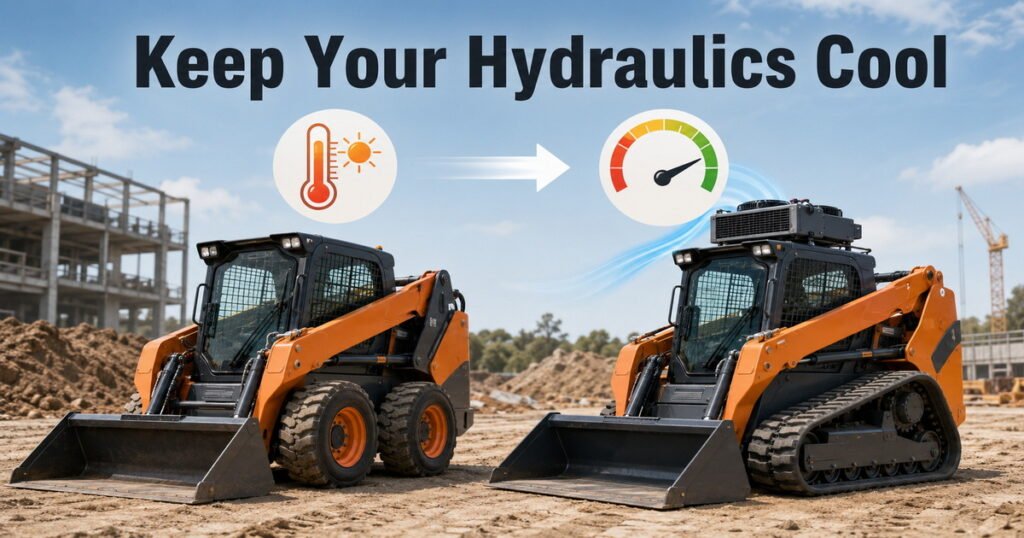
High‑flow hydraulic circuits in modern skid steers and track loaders are engineered to run demanding attachments like forestry mulchers, rock saws, trenchers and cold planers for long periods. But when you combine continuous high‑flow operation with hot climates, dusty jobsites and restricted cooling packages, system temperature can climb rapidly. [loftness]
When hydraulic oil gets too hot, operators are forced to idle or shut down the machine, productivity drops, and component life suffers due to accelerated wear on pumps, motors, seals and O‑rings. Persistent overheating also increases the risk of blowing out radiators or suffering premature failure of the attachment itself, especially in heavy mulching and land‑clearing work. [facebook]
What an Auxiliary Hydraulic Cooler Actually Does
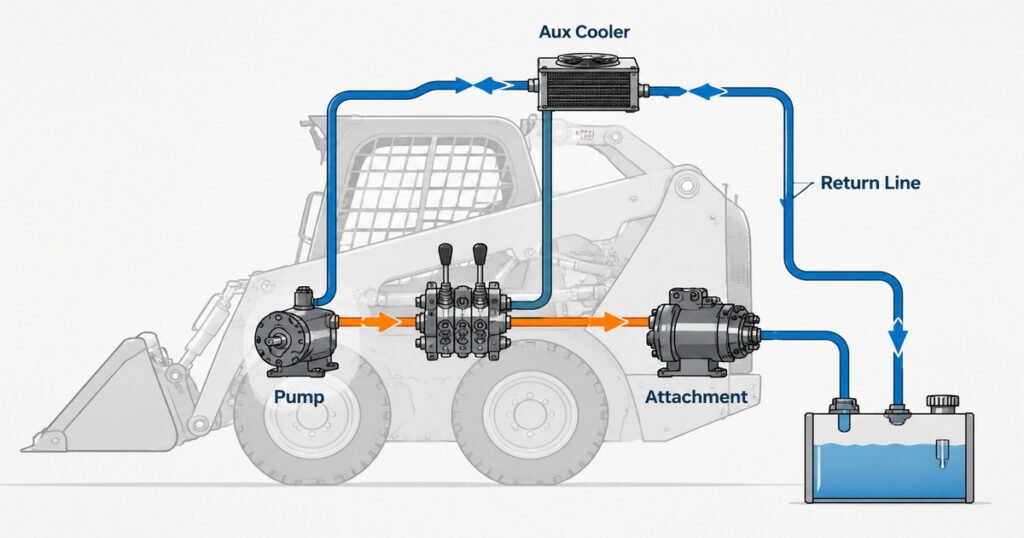
An auxiliary hydraulic cooler is an add‑on cooling module that mounts on the loader (most commonly on the cab roof) and ties into the hydraulic circuit to provide extra heat rejection beyond the factory cooling package. By increasing the surface area and airflow across an aluminum‑brazed core, the cooler sheds additional BTUs from the hydraulic oil before it returns to the tank or attachment, keeping operating temperatures within a safe band. [forconstructionpros]
Manufacturers like Fecon, Loftness and FAE design these units specifically for high‑duty skid‑steer and track‑loader work, with reinforced cores, robust electric fan packages and low‑profile housings that minimize impact risk in tight forestry or demolition environments. When properly sized, an auxiliary cooler can be the difference between working all day or stopping every hour to let the machine cool down. [stucchiusa]
Key Performance Specs: BTUs, Flow and Pressure
Cooling Capacity (BTUs per Hour)
The No. 1 spec to evaluate is cooling capacity, typically expressed in BTUs per hour. Higher‑capacity coolers can reject more heat from the hydraulic oil, which is critical when running continuous‑duty, high‑flow attachments in hot climates. [genroe]
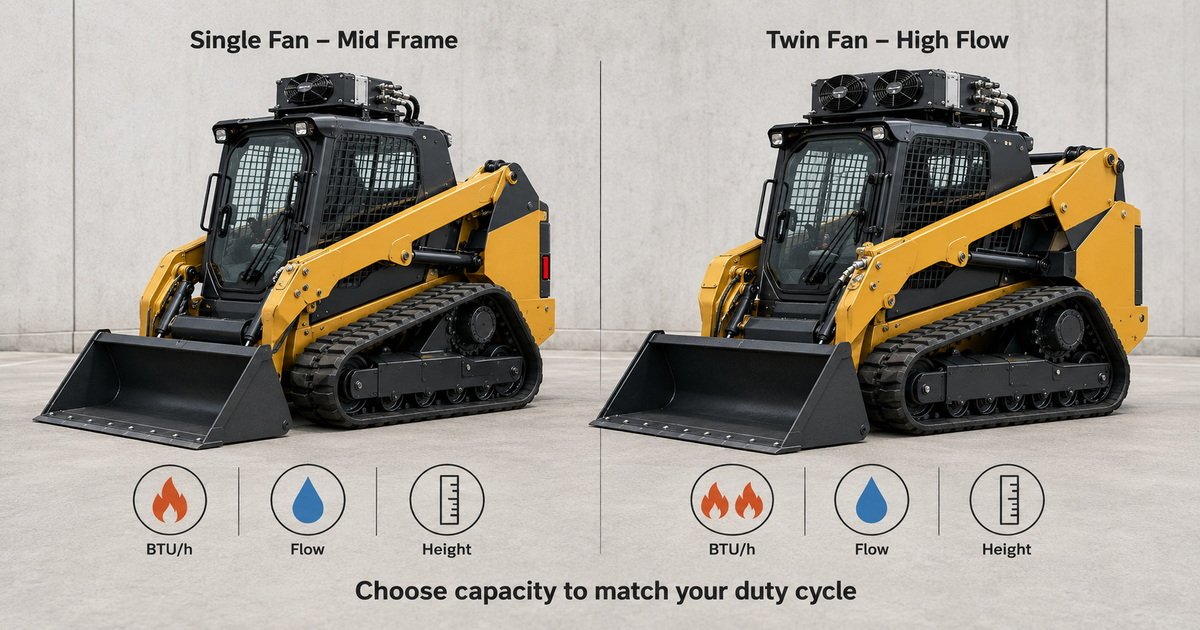
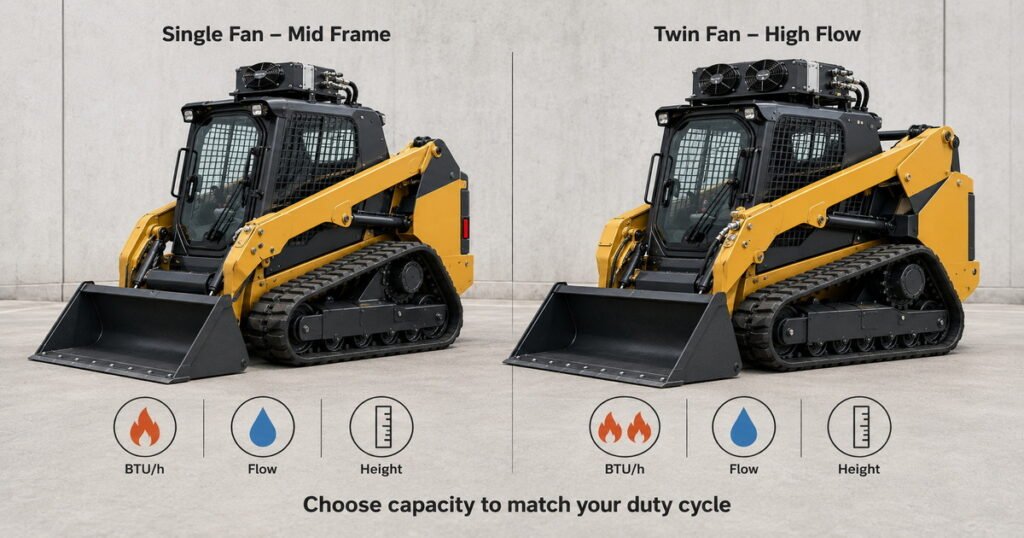
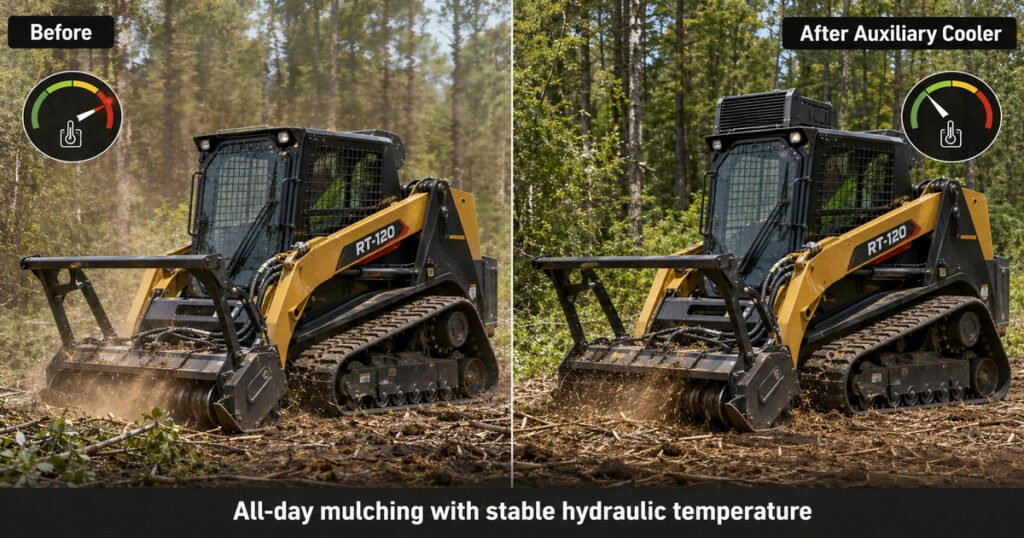
For example, roof‑mounted auxiliary coolers in the market today offer roughly 95,000 BTU/h for single‑fan “mid‑frame” machines and up to 150,000 BTU/h for twin‑fan units on large loaders. If your attachment regularly pushes your hydraulic temps above 180 °F during summer mulching, stepping up to a high‑capacity cooler can trim operating temperatures by 10‑15 °F and substantially reduce downtime. [loftness]
Flow Rate (GPM)
Next, confirm the cooler’s rated flow range in gallons per minute (GPM) against your loader’s auxiliary circuit and the attachment’s requirements. Many modern coolers are designed for flows in the 10‑60 GPM range, covering everything from standard‑flow skid steers to high‑flow compact track loaders. [stucchiusa]
A cooler that is undersized for your actual flow will become a restriction and generate additional heat, while one that is grossly oversized for a small machine may be unnecessarily heavy and costly. The goal is to select a cooler whose flow rating overlaps your loader’s maximum auxiliary flow without creating backpressure or compromising attachment performance. [tractorbynet]
System Pressure Compatibility
Auxiliary coolers must also match the pressure levels of your carrier and attachments. While coolers are generally plumbed into the low‑pressure (return) side of the circuit, they still see significant pressure fluctuations during operation. Reputable units are built with high‑strength cores, housings and fittings rated for common skid‑steer pressures, but you should always confirm compatibility with your machine’s psi and the attachment OEM guidelines. [tractorbynet]
Choosing the Right Cooler: A Practical Checklist
1. Start with Your Use Case
Begin by documenting how you actually use your loader:
– Attachment type and duty cycle: forestry mulcher 8 hours/day, cold planer, brush cutter, trencher, etc. [facebook]
– Hydraulic configuration: standard vs high‑flow, maximum GPM and psi, case‑drain requirements. [stucchiusa]
– Ambient conditions: typical summer highs, dusty vs clean environments, altitude. [ehhydraulics]
Operators running dedicated mulching or asphalt milling in 90+ °F conditions with high‑flow circuits are the most likely to benefit from a roof‑mounted auxiliary cooler. [facebook]
2. Match Cooling Capacity to Your Attachment
Based on your duty cycle, choose a cooler with enough BTU/h capacity to keep your oil temperature inside the target band recommended by your machine manufacturer (often around 130–180 °F under load). [stucchiusa]
– Mid‑frame skid steers with intermittent high‑flow work can often run well with single‑fan units around 95,000 BTU/h. [loftness]
– Large track loaders and full‑day mulching operations typically require twin‑fan units around 140,000–150,000 BTU/h. [forconstructionpros]
3. Verify Flow Range and Plumbing Strategy
Confirm that the cooler’s flow capacity fully covers your loader’s auxiliary circuit and recommended attachment flow. Well‑engineered roof‑mounted coolers are designed to allow full hydraulic flow to the attachment from either direction, with minimal restriction and no risk of damage to the cooler itself. [genroe]
In many retrofits, the cooler is plumbed into the return line from the attachment back to the machine, using appropriate check valves or manifolds to prevent reverse flow through low‑pressure components. Work with a qualified dealer or hydraulic technician to design the circuit; incorrect plumbing can both reduce cooling effectiveness and introduce safety risks. [tractorbynet]
4. Consider Height, Weight and Profile
Roof‑mounted coolers add height and weight to the machine, which affects transport, clearance and stability. Modern designs deliberately use a low‑profile housing (often under 13 in tall) to minimize the risk of impact with branches or overhead obstacles on height‑restricted jobsites. [forconstructionpros]
If you frequently work in garages, tunnels or dense timber, check the total machine height with the cooler installed and confirm you can still safely access your typical jobsites. [genroe]
5. Look Beyond Specs: Build Quality and Support
Specs alone do not guarantee uptime. Prioritize:
– Durable, corrosion‑resistant construction (aluminum‑brazed cores, reinforced housings). [loftness]
– Quality fans and motors with thermostatic control for on‑demand cooling. [ehhydraulics]
– Accessible service points: screens, fins and cores easy to inspect and clean. [forconstructionpros]
– OEM‑level documentation and support, including clear installation and operating manuals. [genroe]
A well‑supported cooler with proper documentation reduces installation time, improves safety and makes troubleshooting much easier over the life of the machine. [loftness]
Rent vs Buy: Total Cost of Ownership
Auxiliary hydraulic coolers are rarely treated as short‑term rental accessories; most manufacturers and contractors consider them permanent upgrades. Units are mounted and plumbed into the hydraulic and electrical systems, effectively becoming part of the loader’s configuration rather than a swap‑on attachment. [stucchiusa]
List prices typically start around the mid‑four‑figure range and rise with capacity, fan count and machine‑specific mounting kits. While that upfront cost is significant, many operators report that reduced downtime, lower maintenance costs and extended component life deliver a positive return on investment over a single season of heavy work. [facebook]
Installation and Safety: Doing It Right
Core Installation Steps
Exact procedures vary by model and machine, but the installation flow is broadly consistent: [genroe]
1. Disconnect machine power and secure the loader to prevent unintended movement. [genroe]
2. Mount the cooler to the roof or designated frame location using OEM‑approved brackets and hardware. [loftness]
3. Plumb hydraulic hoses into the correct section of the circuit (commonly the return line), ensuring proper routing and avoiding sharp bends, pinch points or abrasion areas. [tractorbynet]
4. Connect electrical wiring to the machine harness, respecting fuse ratings and following OEM instructions for thermostatic control and fan activation. [forconstructionpros]
Cabs with certified ROPS/FOPS structures should not be drilled or modified without explicit manufacturer guidance, as this can compromise operator protection. [genroe]
Operating Safety
Once installed, coolers are largely “out of sight, out of mind,” but they still introduce specific safety considerations: [forconstructionpros]
– Never place hands or tools near rotating fan blades while power is on. [forconstructionpros]
– Inspect hose routing regularly to avoid chafing or rubbing that could lead to a high‑temperature leak on the machine or operator. [stucchiusa]
– Keep the cooler clean and free of debris to maintain airflow and prevent hot spots on the core. [forconstructionpros]
Proper operator training and adherence to OEM manuals significantly reduce the risk of incidents and ensure the cooler delivers its intended performance. [loftness]
Maintenance: Small Habits, Big Gains
Auxiliary coolers are relatively simple to maintain, but they respond dramatically to regular attention. A typical maintenance routine includes: [loftness]
– Visual inspections for loose bolts, cracked housings, damaged fins or hydraulic leaks. [genroe]
– Hydraulic and electrical connection checks to confirm all fittings, connectors and harnesses are secure. [forconstructionpros]
– Cleaning screens and fins with compressed air or a shop vacuum to remove dust and debris. [genroe]
Keeping both the auxiliary cooler and the factory cooling package clean often delivers temperature reductions on par with more expensive hardware upgrades, especially when combined with high‑flow coupler improvements recommended by hydraulic specialists. [ehhydraulics]
Don’t Ignore Couplers and Core Cooling
Industry experience shows that some skid‑steer overheating issues can be traced not just to undersized coolers, but to flow restrictions at couplers and neglected factory radiators. Standard flat‑face couplers can generate excess heat in high‑flow applications, while dirty or partially blocked cores reduce overall cooling efficiency. [facebook]
Upgrading to high‑flow auxiliary coupler kits and thoroughly cleaning the OEM cooling package with professional coil cleaners can sometimes lower hydraulic temperatures by 10–15 °F even before adding a roof‑mounted cooler. For best results, treat auxiliary cooling as part of a system‑wide strategy that also includes coupler selection, hose sizing, attachment matching and routine cleaning. [ehhydraulics]
Where Certeg Skid Steer Loaders Fit In
As a global manufacturer of skid steer and compact track loaders, Certeg designs machines to operate reliably across diverse power levels, attachments and work conditions. Our loaders are built with robust hydraulic systems and cooling packages, but we recognize that certain applications—full‑day mulching, asphalt milling, extreme heat—warrant additional auxiliary cooling capacity. [stucchiusa]
For these use cases, we support the integration of properly sized roof‑mounted hydraulic coolers, high‑flow coupler upgrades and optimized hose routing to help customers achieve maximum uptime and component life. Whether you are running wheeled or tracked Certeg loaders, our engineering and application teams can help you specify a cooling solution that matches your machine, attachment and environment. [stucchiusa]
Skid Steer Cooler Selection Summary Table
| Factor | Why It Matters | Practical Target for High‑Flow Work |
|---|---|---|
| Cooling capacity (BTU/h) | Determines how much heat the cooler can reject from hydraulic oil. genroe | 95,000 BTU/h for mid‑frame; 140,000–150,000 BTU/h for large loaders with continuous mulching. loftness |
| Flow range (GPM) | Ensures the cooler can handle your machine’s auxiliary flow without restriction. genroe | Match cooler range to machine’s rated flow; confirm coverage up to your max GPM. loftness |
| Pressure compatibility | Protects cooler components and avoids failure on pressure spikes. tractorbynet | Rated for skid‑steer return‑line pressures; always confirm with OEM data. genroe |
| Mounting profile | Affects machine height, impact risk and cab integrity. genroe | Low‑profile roof mount under ~13 in added height, using approved brackets. genroe |
| Maintenance access | Drives long‑term performance and reliability. genroe | Easy access to screens, fins, hoses and electrical connectors for regular cleaning. genroe |
Call to Action: Design Your Cooling Strategy with Certeg
If your skid steer or compact track loader is regularly hitting hydraulic temperature limits—or if you’re planning to add a high‑flow attachment for continuous‑duty work—it’s time to design a cooling strategy, not just buy a single component. [stucchiusa]
Contact the Certeg application engineering team to review your loader model, attachment lineup and jobsite conditions. We can recommend the right combination of auxiliary hydraulic cooler, coupler upgrade and maintenance practices to keep your machine productive all day, in any climate. [stucchiusa]
Frequently Asked Questions (FAQ)
Q1. Do I really need an auxiliary cooler if my skid steer already has high‑flow hydraulics?
High‑flow systems increase attachment performance, but they also generate more heat; if you run continuous‑duty attachments in hot environments and frequently hit high temperature alarms, an auxiliary cooler is one of the most effective ways to stabilize temperatures and protect components. [stucchiusa]
Q2. Will a roof‑mounted cooler reduce my attachment power?
Quality coolers are engineered to allow full hydraulic flow to the attachment in either direction, with minimal restriction, so when properly sized and installed they should not noticeably reduce attachment performance. [forconstructionpros]
Q3. How often should I clean the cooler’s screens and fins?
In dusty construction or forestry environments, visual inspection and cleaning with compressed air or a shop vacuum should be part of your weekly routine, and daily during heavy mulching seasons. [forconstructionpros]
Q4. Can I install an auxiliary cooler myself, or do I need a dealer?
Experienced technicians can often perform the installation using OEM manuals and mounting kits, but incorrect plumbing or cab modifications can compromise safety; working with a qualified dealer or hydraulic specialist is recommended. [tractorbynet]
Q5. What other changes, besides a cooler, help prevent overheating?
Upgrading to high‑flow couplers, thoroughly cleaning the factory cooling package and matching attachments to machine capabilities can significantly reduce hydraulic temperatures and improve uptime. [ehhydraulics]
References
1. Compact Equip – “Keep Your Cool: How to Pick an Auxiliary Hydraulic Cooler for Your Track Loader or Skid Steer.” https://compactequip.com/skid-steers/keep-your-cool-how-to-pick-an-auxiliary-hydraulic-cooler-for-your-track-loader-or-skid-steer/ [genroe]
2. Loftness – “Cool Flow Hydraulic Oil Cooler.” https://www.loftness.com/product/cool-flow/ [loftness]
3. ForConstructionPros – “Loftness Cool Flow Hydraulic Oil Cooler.” https://www.forconstructionpros.com/equipment/fleet-maintenance/hydraulic-system-components/product/12160648/loftness-specialized-equipment-cool-flow-hydraulic-oil-cooler [forconstructionpros]
4. Stucchi USA – “Auxiliary Hydraulic Kits & Prevent Skid Loader Overheating When Mulching.” https://www.stucchiusa.com/auxiliary-kits/ and https://www.stucchiusa.com/blog/prevent-skid-loader-overheating-when-mulching/ [stucchiusa]
5. EH Hydraulics – “Stop Skid Loader Overheating During Mulch Work.” https://www.ehhydraulics.com/blog/Stop-Skid-Loader-Overheating-During-Mulch-Work_b23650 [ehhydraulics]
6. TractorByNet – “Adding hydraulic cooler to skid steer.” https://www.tractorbynet.com/forums/threads/adding-hydraulic-cooler-to-skid-steer.285226/ [tractorbynet]
7. Facebook Skid Steer User Group – “Auxiliary cooler temperature results for Cat 299D2 XHP with Fecon head.” (user discussion). https://www.facebook.com/groups/skidsteer/posts/4067886556789004/ [facebook]
8. Genroe – “Technical Blogging that Ranks on Google.” https://www.genroe.com/blog/7-steps-technical-blogging-ranks/12073 [genroe]
9. Ahrefs Blog – “11 Easy-to-Follow Tips to Optimize Your Blog Posts for SEO.” https://ahrefs.com/blog/how-to-optimize-blog-posts-for-seo/ [ahrefs]
Hot Tags: Skid Steer Loader, Manufacturers, Customized, Custom, Suppliers, Buy, Cheap, Quality, Advanced, Durable, in Stock, Made in China, Price, Quotation