
How to Choose the Right Cold Planer for Your Skid Steer or Compact Track Loader
Content Menu
● What a Cold Planer Attachment Actually Does
● Skid Steer vs Compact Track Loader for Cold Planing
● Matching Hydraulic Flow and Pressure to Your Cold Planer
● Choosing the Right Cutting Width and Depth
>> Typical cutting width options
● Critical Features: Oscillation, Tilt, Side Shift and Depth Control
● Drum Design, Picks and Tooth Quality
● Machine and Attachment Compatibility Checklist
● Operator Best Practices from the Field
● Self‑Levelling and High‑Pressure Systems
● Real‑World Use Cases: Where Cold Planers Shine
● Buy vs Rent: Understanding Costs and Utilization
● How Certeg Supports Skid Steer and Track Loader Cold Planer Users
● Simple 5‑Step Checklist to Pick the Right Cold Planer
● Call to Action: Plan Your Next Cold Planer Setup with Certeg
● Frequently Asked Questions (FAQ)
>> 1. What size cold planer should I use with my skid steer?
>> 2. Do I need a high‑flow skid steer for a cold planer?
>> 3. Can I run the same cold planer on both asphalt and concrete?
>> 4. How often do cold planer picks need to be replaced?
>> 5. Is a compact track loader always better than a wheeled skid steer for cold planers?
If you rely on a skid steer or compact track loader for asphalt and concrete work, choosing the right cold planer attachment will make the difference between clean, productive cuts and costly downtime. As a manufacturer at Certeg, working with both wheeled skid steers and compact track loaders in real jobsites worldwide, I see every day how well‑matched cold planers can unlock serious productivity, while poor matches quickly burn money, fuel and operator patience. [skidsteerattachments]
What a Cold Planer Attachment Actually Does
A cold planer (also called a milling planer or asphalt planer) is a powerful attachment that uses rotating picks to mill and remove a controlled layer of asphalt, concrete, or caprock. Instead of ripping everything out, it shaves material to a precise depth so you can repair surfaces, improve drainage, or prepare for overlays. [equipmentandcontracting]
On large highway jobs, self‑propelled planers can chew an entire lane in a single pass, but for skid steers and compact track loaders the attachment typically ranges from 12 to 48 in of cutting width. Narrow drums excel at tight patches and trench work, while wider drums boost production on parking lots and road edges. [simex]
Skid Steer vs Compact Track Loader for Cold Planing
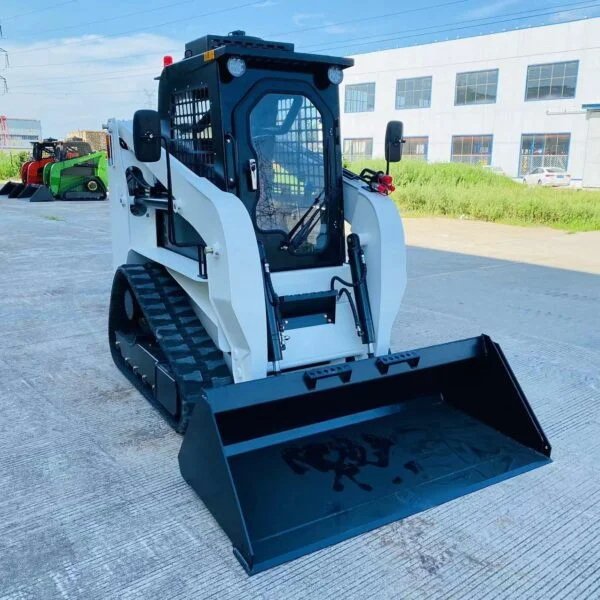
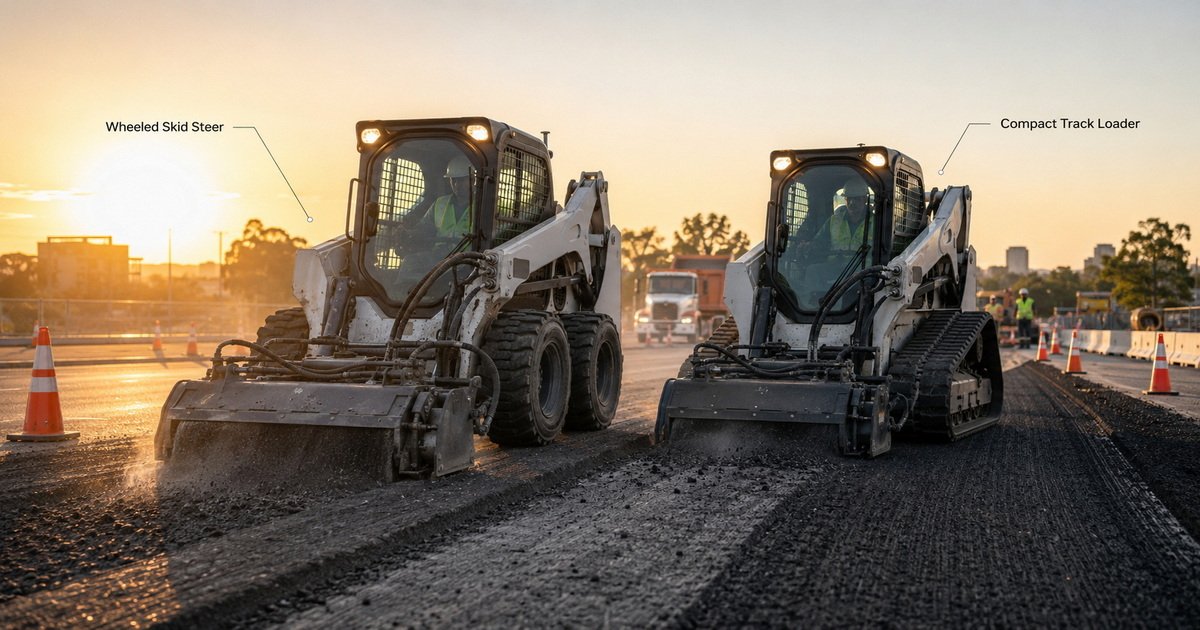
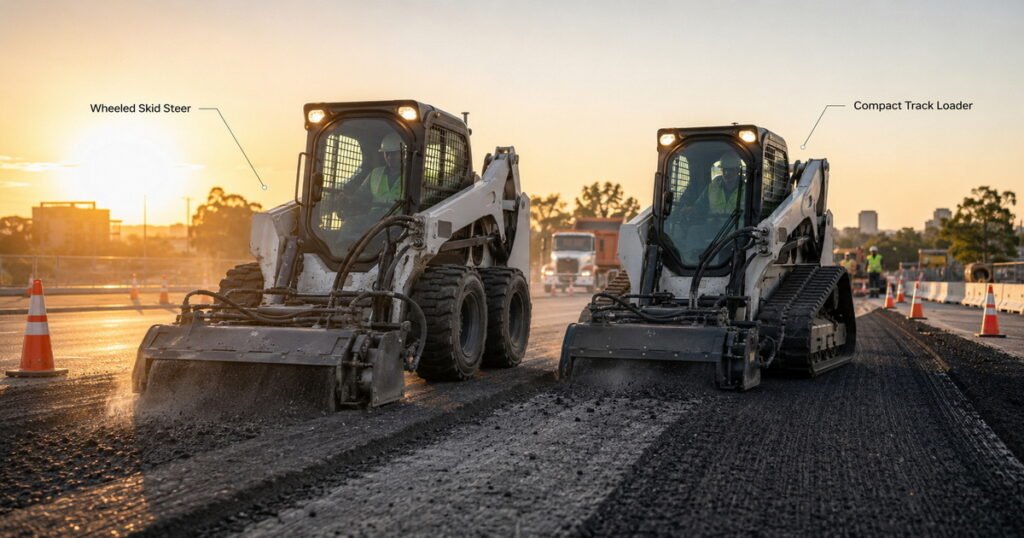
Both wheeled skid steers and compact track loaders (CTLs) can run cold planers effectively, but they behave differently under load. [zh-cn.bison-machinery]
– Compact track loaders
– Provide better stability and traction, especially on uneven or soft ground. [skidsteers]
– Reduce bouncing, which helps maintain a consistent milling depth.
– Have higher undercarriage costs because tracks wear quickly under abrasive milling debris.
– Wheeled skid steers
– Often cheaper to own in abrasive milling environments because tires cost less than tracks.
– Can be equipped with solid or foam‑filled tires to handle constant milling without flats. [constructionequipmentguide]
– May run slightly rougher, but a good planer with isolation features can compensate.
Practical rule: choose a CTL when you need maximum stability and traction, and a wheeled skid steer when you want lower undercarriage cost per hour and can dedicate a machine to milling. [skidsteers]
Matching Hydraulic Flow and Pressure to Your Cold Planer
If you only remember one technical rule, make it this: match the cold planer’s hydraulic requirements to your loader’s hydraulic capabilities. [equipmentandcontracting]
Most skid steer cold planers require:
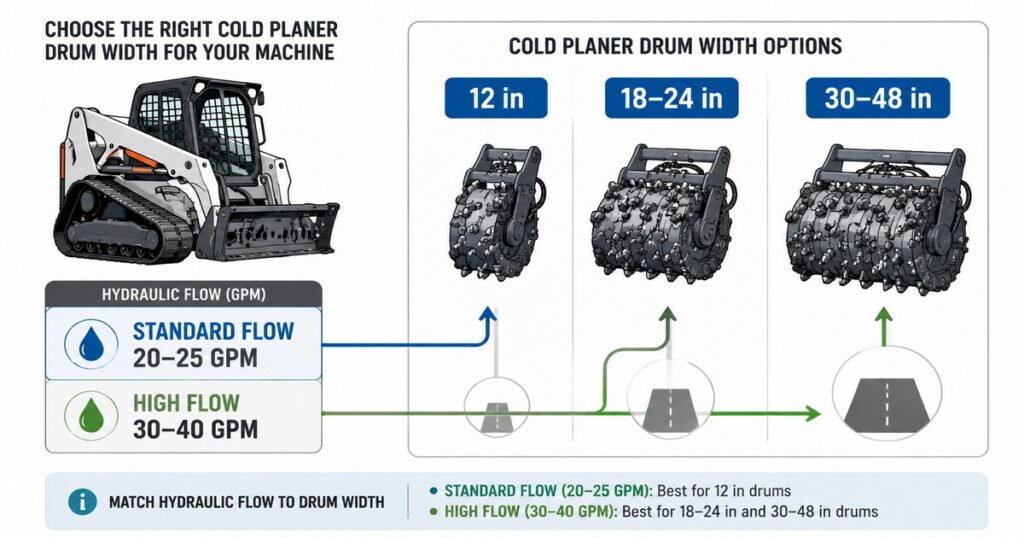
– Flow: typically 25–40 GPM for most models (standard/”low flow” planers may start around 15–20 GPM). [skidsteerattachments]
– Pressure: often 3,000–4,500 PSI, with some newer designs rated higher for high‑pressure systems. [equipmentandcontracting]
Standard‑flow vs high‑flow
– Standard‑flow (often called “low flow” by attachment makers)
– Integrates with standard skid steer auxiliary circuits.
– Fits smaller drums (e.g., 12–18 in) and shallower cuts. [skidsteerattachments]
– Ideal for patching, trench edges and light milling.
– High‑flow
– Required for larger drums (18–48 in) and deeper cuts.
– Delivers higher production, but demands a matching high‑flow machine. [equipmentandcontracting]
– Some brands now support enhanced high‑flow or high‑pressure systems for even more output. [cat]
From an OEM perspective at Certeg, we strongly recommend checking:
1. Auxiliary GPM and PSI on your skid steer or CTL data plate or manual.
2. Cold planer spec sheet for minimum and maximum flow and pressure.
3. Whether your machine supports electrical controls (for tilt, side shift, depth) that the planer requires. [kellytractor]
Choosing the Right Cutting Width and Depth
The cutting width of a cold planer is one of the biggest decisions you’ll make. [skidsteerattachments]
Typical cutting width options
| Drum width | Best for | Key trade‑off |
|---|---|---|
| 12 in | Tight utility trenches, edge work, small patches | Very precise but slow on open areas |
| 18 in | General patching, trench perimeters, most road rehab tasks | Great all‑rounder, popular with contractors |
| 24 in | Larger patches, parking lots, overlay removal | Needs more flow and power |
| 30–48 in | High‑production milling, wide cuts near curbs | High‑flow only, heavier and more demanding |
[simex]
Cutting depth usually ranges:
– Up to 4–5 in for lighter or standard‑flow planers. [equipmentandcontracting]
– Up to about 6 in for most high‑flow skid steer planers. [skidsteerattachments]
When we consult customers, we rarely recommend jumping straight to the widest drum. A 24 in unit can outperform a 48 in planer at real‑world depths because it keeps the machine in its sweet spot for speed and torque.
Critical Features: Oscillation, Tilt, Side Shift and Depth Control
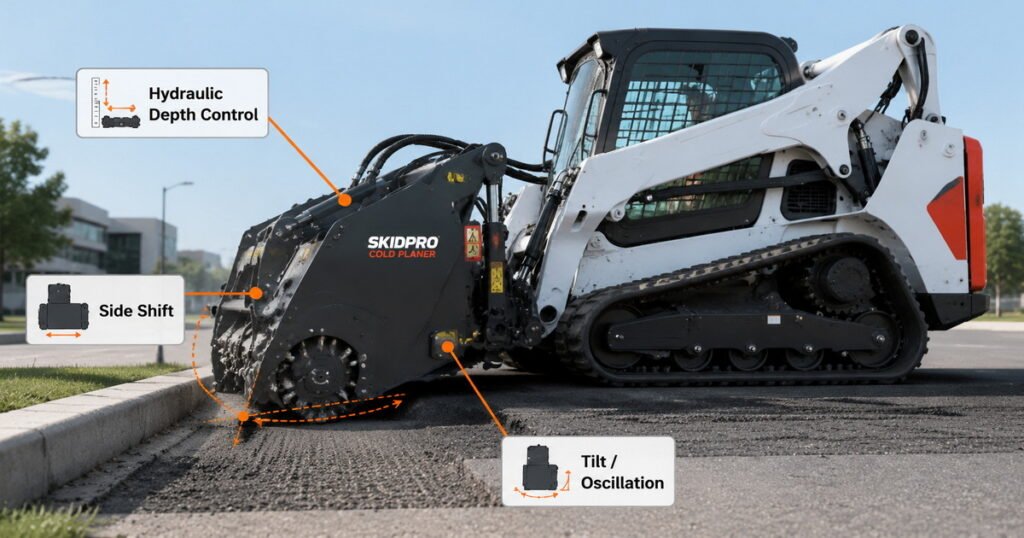
Modern cold planers are far from simple “on/off” tools. The best models offer fine control over machine position and cut geometry, which directly affects surface quality and productivity. [globalspec]
Key features to look for:
– Hydraulic depth control
– Adjusts cut depth from the cab instead of manual skis.
– Essential when working around manholes, curb transitions, or variable overlays. [equipmentandcontracting]
– Oscillation and tilt
– Allow the drum to follow existing contours or intentionally cut new slopes for drainage swales. [globalspec]
– Reduce the need for multiple passes or rework.
– Side shift
– Slides the drum left or right so you can mill right up to curbs, walls, and structures. [compactequip]
– Combined with a frame wider than the host machine, this minimizes hand‑work and saw cutting.
– Independent left/right depth control (on some high‑flow models)
– Lets you correct cross‑slope and match uneven surfaces more precisely. [equipmentandcontracting]
For contractors running Certeg skid steers and CTLs in urban patching work, we usually prioritize hydraulic depth control and side shift before anything else, because they eliminate a lot of manual labour and reduce safety risks near traffic.
Drum Design, Picks and Tooth Quality
The drum and picks (teeth) are the heart of a cold planer. Poor tooth quality or wrong patterns can double your fuel consumption and still deliver worse results. [bluediamondattachments]
– Pick terminology
– Industry is standardizing on the term “picks” instead of “bits” or “teeth.”
– Asphalt and concrete picks differ in shape and material; make sure you spec the right type for your dominant application. [constructionequipmentguide]
– Drum patterns
– Standard spacing for general asphalt milling.
– Fine‑tooth drums for smoother concrete finishes or texturing. [constructionequipmentguide]
– Tooth quality and serviceability
– High‑quality carbide picks reduce wear and improve cut quality. [bluediamondattachments]
– Look for designs where you don’t have to crawl under the planer to change picks. [bluediamondattachments]
– Easy access covers and included pick tools are a big plus.
In practical terms, plan for daily or every‑other‑day pick inspection on heavy work, because stuck picks will wear flat and damage the holders, which are far more expensive than the picks themselves. [constructionequipmentguide]
Machine and Attachment Compatibility Checklist
To simplify decision‑making, here is a quick compatibility checklist we use with Certeg customers before recommending any cold planer. [globalspec]
1. Host machine class
– Rated operating capacity and tipping load must safely handle the attachment weight and milling forces.
2. Hydraulic flow and pressure
– Confirm machine GPM and PSI meet or exceed planer requirements.
3. Electrical interface
– Does your machine provide the necessary 14‑pin or OEM‑specific connections for tilt, side shift, and depth?
4. Physical frame width
– Planer frame should allow milling up to curbs and walls without hitting the loader.
5. Job mix
– % of asphalt vs concrete, patch size, trench work, drainage improvements, etc.
Operator Best Practices from the Field
Even the best‑matched planner and loader combo can underperform if operators use poor technique. Over years of field visits and customer feedback, a few practices stand out. [constructionequipmentguide]
– Never use float mode while milling
– Float is helpful for grading with a bucket, but disastrous with a cold planer because it lets the attachment ride up and down, ruining depth control. [skidsteerattachments]
– Use deliberate down pressure
– Lock the lift arms at a fixed height and apply enough down pressure that the drum locks in the cut. [skidsteerattachments]
– If the planer “skates” across the surface, increase down pressure before changing depth or speed. [skidsteerattachments]
– Control speed carefully
– Planing speed is often in the 10–20 ft/min range depending on material and depth. [constructionequipmentguide]
– Use creep control or speed management (where available) to keep a consistent pace.
– Maintain dust control
– Milling generates heavy dust; water kits or dust suppression systems improve visibility and help meet regulatory requirements. [constructionequipmentguide]
As a manufacturer, we also emphasize operator training on depth control, pick maintenance and safe milling speeds as one of the cheapest ways to extend attachment life and reduce unplanned downtime. [equipmentandcontracting]
Self‑Levelling and High‑Pressure Systems
Cold planers have seen notable innovation in the last few years, especially around self‑leveling systems and high‑pressure hydraulic compatibility. [cat]
– Self‑levelling cold planers
– Automatically maintain a constant milling depth, even when the ground surface or machine attitude changes. [compactequip]
– Improve cut consistency and reduce operator fatigue, particularly on long passes.
– High‑pressure rated attachments
– Some modern planers are now rated up to 6,000 PSI, anticipating the next wave of high‑pressure loader platforms. [skidsteers]
– This future‑proofs your fleet and allows you to leverage more powerful machines as they enter your yard.
For Certeg customers running mixed fleets, we often recommend looking ahead to these features if you plan to keep the attachment for 7–10 years, as loader technology continues to evolve.
Real‑World Use Cases: Where Cold Planers Shine
From a contractor or municipality standpoint, cold planers unlock a broad range of profitable tasks. [skidsteers]
– Pothole and patch repair
– Mill around the damaged area to create a clean, vertical edge for patches.
– Drainage corrections
– Cut shallow swales or cross‑slope adjustments to eliminate standing water.
– Overlay preparation
– Remove existing layers before new overlays to control overall pavement thickness.
– Utility and trench work
– Precise cuts for utility trenches and patches without over‑excavation. [constructionequipmentguide]
– Curb and manhole adjustments
– Mill around manholes or curbs to match new elevations.
These are exactly the types of jobs where a Certeg skid steer or CTL paired with a properly‑sized cold planer delivers rapid ROI: you mobilize quickly, work in tight spaces, and avoid bringing in a dedicated milling machine for relatively small areas.
Buy vs Rent: Understanding Costs and Utilization
Cold planers are among the more expensive skid steer attachments, so the buy vs rent decision deserves careful analysis. [equipmentandcontracting]
Typical cost ranges for skid steer/CTL cold planers:
– Purchase: roughly USD 20,000–40,000, depending on width, flow class, and features. [skidsteerattachments]
– Rental:
– Daily: about USD 250–720
– Weekly: about USD 800–1,400
– Monthly: about USD 2,400–3,600
If you run milling work only a few weeks per year, renting can make more sense and keeps you on the latest models. If you’re a paving, utility, or municipal contractor with frequent patching and overlay prep, owning a planer and matching skid steer or CTL tends to pay for itself relatively quickly. [skidsteerattachments]
How Certeg Supports Skid Steer and Track Loader Cold Planer Users
As a manufacturer specializing in skid steer loaders (wheeled and tracked), we design our Certeg machines to be cold‑planer ready from day one. In practice, that means:
– Offering standard and high‑flow hydraulic packages sized for common 18–24 in planers.
– Structuring loader frames and quick‑attach plates to maximize curbside reach and stability.
– Providing guidance on tire vs track setups optimized for milling environments.
When we work with customers globally, our process usually includes a brief application interview (job types, typical patch sizes, preferred brands) and then a recommended loader + cold planer pairing that balances productivity and ownership cost.
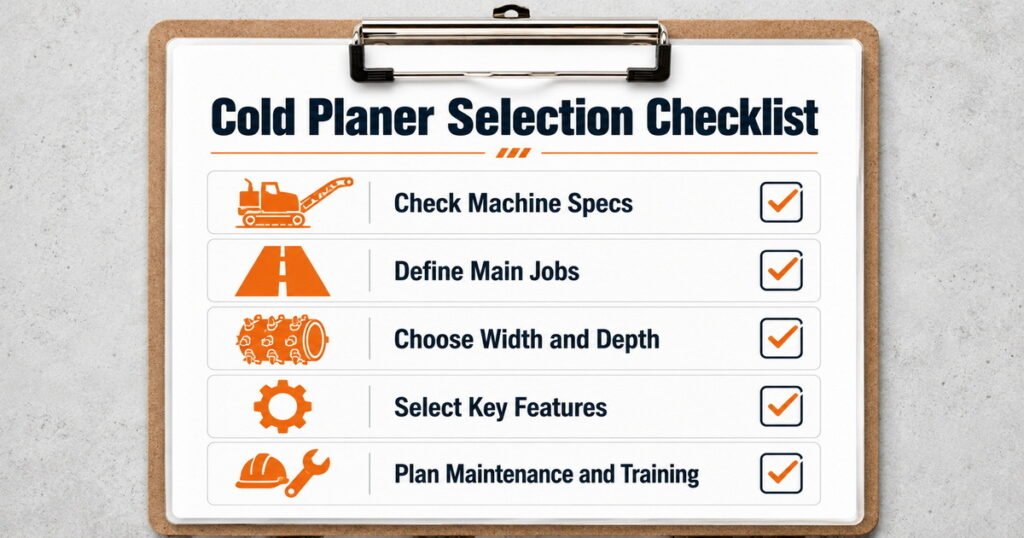
Simple 5‑Step Checklist to Pick the Right Cold Planer
For quick reference, here’s a step‑by‑step selection checklist you can share with your team or save as a jobsite SOP. [globalspec]
1. Confirm machine specs
– Note your skid steer/CTL’s hydraulic flow (GPM), pressure (PSI), and rated operating capacity.
2. Define your main jobs
– Patching, trenching, drainage, overlay prep, or general rehab?
3. Choose cutting width and depth
– Start with 18–24 in for most contractors unless you have clear high‑production needs.
4. Select essential features
– Prioritize hydraulic depth control, side shift, and tilt; add self‑levelling if budget allows.
5. Plan maintenance and training
– Set daily pick inspection, cleaning routines, and operator training on proper down pressure and speed.
Call to Action: Plan Your Next Cold Planer Setup with Certeg
If you’re planning to add a cold planer attachment to your fleet or want to re‑evaluate an existing setup, now is the time to align your skid steer or compact track loader with the right attachment for the jobs you actually do.
Get in touch with Certeg’s team to review your current machines, typical projects, and budget, and we’ll help you specify a cold planer‑ready skid steer or compact track loader configuration that delivers safe, reliable milling performance for years to come.
Frequently Asked Questions (FAQ)
1. What size cold planer should I use with my skid steer?
Most contractors find that an 18–24 in cold planer offers the best balance between precision and productivity on skid steers and compact track loaders. Smaller widths suit tight patches and trenches, while wider drums are better for high‑production parking lot or road work. [equipmentandcontracting]
2. Do I need a high‑flow skid steer for a cold planer?
Many smaller cold planers are designed for standard‑flow hydraulics, but most mid‑ to large‑width planers (18–48 in) require high‑flow systems to perform as advertised. If your machine does not have high‑flow, focus on compatible narrow drums or consider upgrading the machine before buying an oversized planer. [skidsteers]
3. Can I run the same cold planer on both asphalt and concrete?
Yes, many cold planers can work on both materials as long as you use proper picks and drum patterns for each application. For frequent concrete work, consider dedicated concrete picks and possibly a fine‑tooth drum to achieve the required surface finish. [globalspec]
4. How often do cold planer picks need to be replaced?
Under heavy daily use on asphalt or concrete, picks may need to be replaced daily or every other day, depending on material hardness and operator technique. Regular inspection and rotation prevent seized picks, which can damage holders and dramatically increase operating cost. [constructionequipmentguide]
5. Is a compact track loader always better than a wheeled skid steer for cold planers?
Not always. Compact track loaders offer superior traction and stability, especially on uneven terrain, but their tracks can wear quickly in abrasive milling environments. Wheeled skid steers with solid or foam‑filled tires can deliver lower undercarriage cost per hour, particularly if you dedicate a machine to milling. [zh-cn.bison-machinery]
6. When does renting a cold planer make more sense than buying?
If your milling needs are occasional or seasonal, renting a cold planer on a daily or weekly basis can be cost‑effective and keep you on current models. Contractors with frequent patching and overlay prep work often see faster payback by owning their own planer and compatible loader. [skidsteerattachments]
References
1. Compact Equipment – How to Pick the Right Cold Planer Attachment for a Skid Steer or Compact Track Loader (Richard Ries, June 5, 2024). [Continue reading]
2. SkidSteerAttachments.ca – Cold Planer Attachments: Flow, Teeth, Cost & When to Rent.
https://skidsteerattachments.ca/cold-planer-attachments [skidsteerattachments]
3. SkidSteers.com – What is a Cold Planer? Equipment Overview & Guide.
https://www.skidsteers.com/blog/what-is-a-cold-planer/ [skidsteers]
4. Equipment & Contracting – Cold Planer Attachments 101: Selection Tips, Usage, and More.
https://equipmentandcontracting.com/cold-planer-attachments-101-selection-tips-usage-and-more/ [equipmentandcontracting]
5. Blue Diamond Attachments – How to Choose a Cold Planer and Extreme Duty Series 2 Self‑Leveling Cold Planers.
https://www.bluediamondattachments.com/blog/cold-planer-comparison [bluediamondattachments]
https://compactequip.com/attachments/blue-diamond-attachments-launches-self-leveling-cold-planers-for-skid-steers-and-compact-track-loaders/ [compactequip]
6. Construction Equipment Guide – Saving Time, Money by Maintaining Cold Planer Attachments.
https://www.constructionequipmentguide.com/saving-timemoney-by-maintaining-cold-planer-attachments/18178 [constructionequipmentguide]
7. GlobalSpec – Cold Planers Selection Guide: Types, Features, Applications.
https://www.globalspec.com/learnmore/building_construction/building_construction_tools_machines/cold_planers [globalspec]
8. John Deere – D‑Series Cold Planer Attachments for Skid Steers and CTLs.
https://utilitycontractormagazine.com/john-deere-unveils-new-cold-planer-attachment-lineup/ [utilitycontractormagazine]
9. Simex – The Widest Asphalt Cold Planer for Skid Steer Loaders (PL 2000).
https://www.simex.it/en-gb/news/news/the-widest-asphalt-cold-planer-for-skid-steer-loaders-the-pl-2000-in-florence [simex]
Hot Tags: Skid Steer Loader, Manufacturers, Customized, Custom, Suppliers, Buy, Cheap, Quality, Advanced, Durable, in Stock, Made in China, Price, Quotation