
Choosing the Right Skid Steer Tires in 2026: A Practical Field Guide from a Certeg Operator’s Perspective
Content Menu
● How to Choose the Best Tires for Your Skid Steer Loader in 2026
● Why Skid Steer Tire Choice Matters More Than You Think
● Pneumatic vs Solid Skid Steer Tires: Which Is Right for Your Jobsite?
>> Pneumatic Skid Steer Tires: Bias vs Radial
>> Solid Skid Steer Tires: Flat-Proof, Built for Abuse
● Comparing Skid Steer Tire Types for Real-World Applications
● Don’t Ignore Load Capacity, Ply Rating, and OEM Specs
● Application-Based Tire Selection: A Practical Checklist
>> Step 1: Map Your Primary Surfaces
>> Step 2: Define Your Duty Cycle
>> Step 3: Score Your Debris and Hazard Level
● Expert Maintenance Practices That Dramatically Extend Tire Life
>> Daily and Weekly Checks That Actually Matter
>> Operator Behavior: The Hidden Tire Killer
>> Tire Rotation and Replacement Strategy
● Tracks vs Tires on Skid Steer Loaders: Where Tires Still Win
● Where Certeg Adds Value in Skid Steer Tire Configuration
● Call to Action: Configure the Right Skid Steer and Tire Package with Certeg
● FAQs: Skid Steer Tire Selection and Maintenance
>> Q1. How often should I replace skid steer tires?
>> Q2. Are solid skid steer tires worth the higher price?
>> Q3. Can I mix different tire types or brands on one skid steer?
>> Q4. What is the most important daily tire maintenance task?
>> Q5. When should I choose radial over bias pneumatic tires?
As someone who has spec’d, run, and optimized skid steer loaders for years — both wheeled and tracked — I can tell you this: the “right” tire choice often determines whether your machine is a profit center or a constant headache on site. Getting skid steer tire selection and maintenance right is one of the fastest ways to cut downtime, extend machine life, and keep operators safe and productive. [tirereview]
How to Choose the Best Tires for Your Skid Steer Loader in 2026
If you’re running a skid steer loader (wheeled or track-converted) in construction, demolition, landscaping, or industrial yards, your tires are not just a consumable; they are a controllable cost lever. Choosing the right tire type, tread, and construction for your application can extend service life by months, improve traction, and reduce fuel burn. [yohta-blog.yokohama-oht]
From the Certeg side, when we configure skid steer loaders for global clients, we now treat tires as an integrated part of the machine spec — not an afterthought — because jobsite conditions and operator habits consistently make or break tire ROI. [maxamtire]
Why Skid Steer Tire Choice Matters More Than You Think
Most teams obsess over rated operating capacity and attachments but treat tires as a line item to be minimized. In practice, tires are one of the most expensive wear components on a skid steer and have a direct impact on:
– Productivity (traction, stability, operator comfort) [yohta-blog.yokohama-oht]
– Safety (sidewall integrity, puncture resistance) [lesschwab]
– Total cost of ownership (replacement frequency, unplanned downtime) [yohta-blog.yokohama-oht]
Industry experts consistently recommend starting with where and how you operate — surface conditions, load, and duty cycle — before you even look at brands or price. [yohta-blog.yokohama-oht]
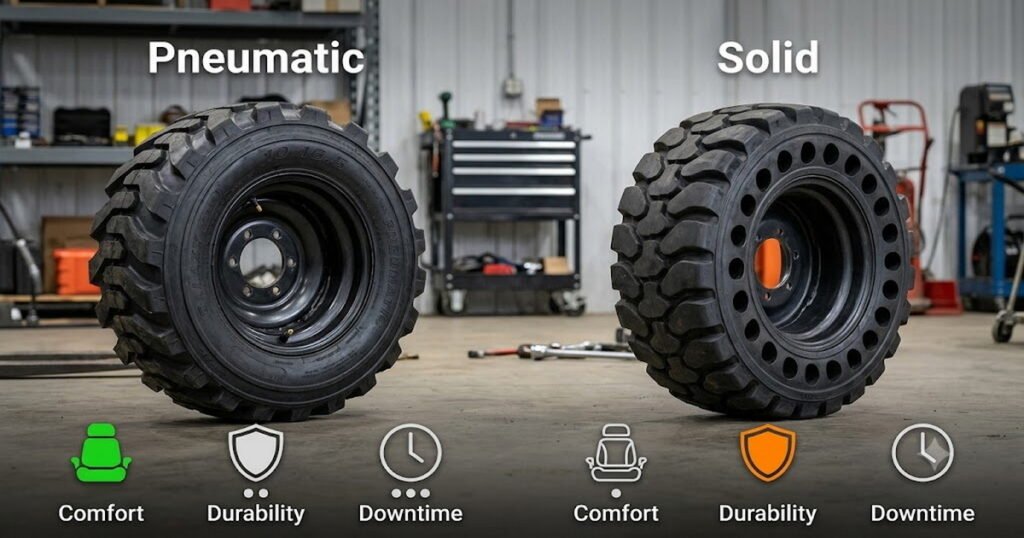
Pneumatic vs Solid Skid Steer Tires: Which Is Right for Your Jobsite?
The original article rightly explains that most skid steer tires fall into two main categories: pneumatic (air-filled) and solid. However, many buyers still underestimate how different these feel and behave on real jobs.
Pneumatic Skid Steer Tires: Bias vs Radial
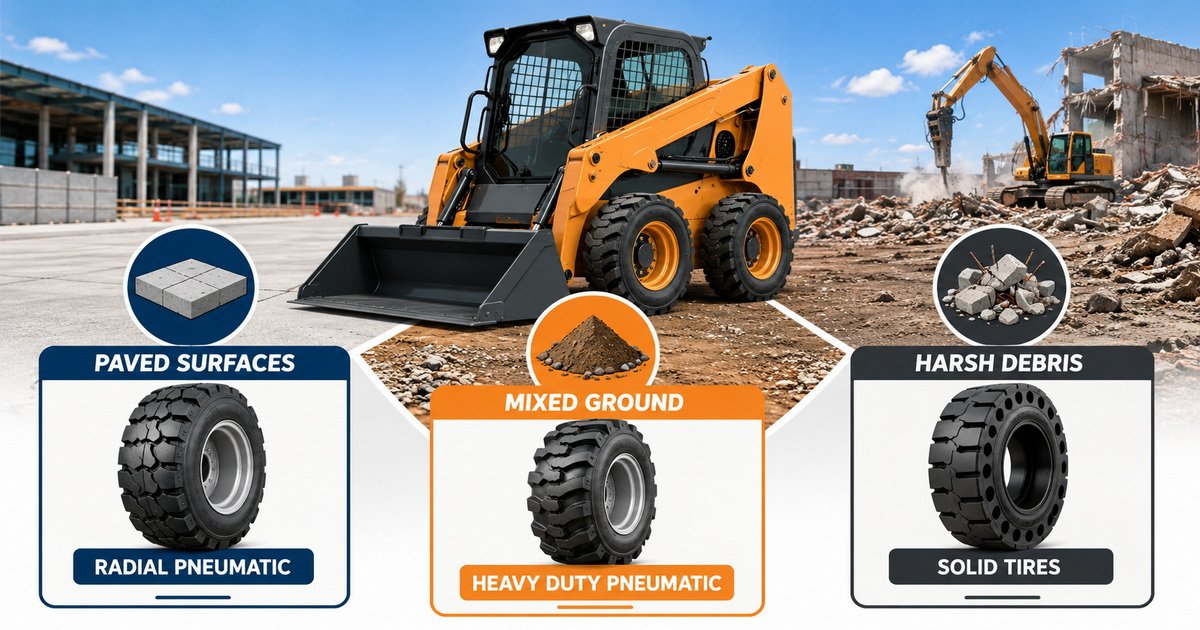
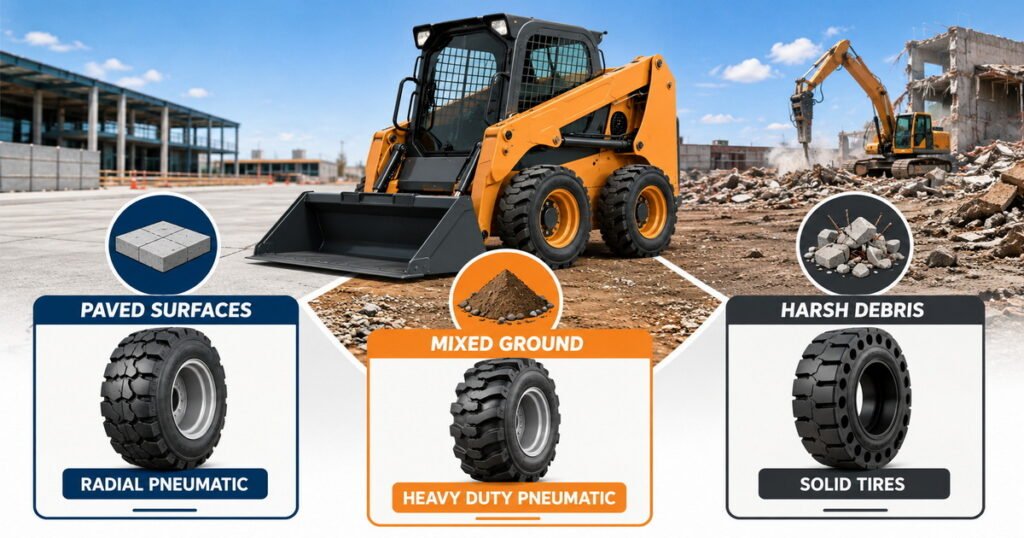
Pneumatic tires remain the standard choice because they’re more affordable upfront and provide a smoother ride for the operator. Within this category, you’ll typically choose between bias-ply and radial construction:
– Bias-ply pneumatic tires
– Lower purchase cost and widely available.
– Traditionally designed for off‑highway applications with tough sidewalls.
– Best when you operate at low speeds on soil, gravel, or mixed surfaces.
– Radial pneumatic tires
– Higher initial cost but improved traction and heat resistance. [lesschwab]
– Better for higher-speed travel and long runs on hard, paved surfaces.
– Often deliver better fuel economy and ride comfort in mixed-use fleets.
Leading manufacturers offer heavy‑duty pneumatic options for demanding work — for example, Trelleborg’s SK‑900 series and OTR Engineered Solutions’ WorkBoss A/T, both designed for durability and performance on hard surfaces and in dirt.
When to choose pneumatic tires:
– You need maximum operator comfort over long shifts.
– Your sites are relatively clean, with limited risk of sharp debris.
– You want a lower upfront cost and can manage proactive maintenance.
Solid Skid Steer Tires: Flat-Proof, Built for Abuse
Solid tires cost more initially but often last significantly longer and eliminate flats entirely, which can be a game-changer on harsh jobsites. Models like OTR’s WorkBoss HD or Trelleborg’s Brawler HPS Solidflex are engineered for severe-duty environments where downtime is unacceptable.
Key advantages of solid tires include:
– Flat-proof construction — no punctures and no air-related failures.
– Extremely high cut and tear resistance, ideal for demolition, scrap, and recycling yards. [yohta-blog.yokohama-oht]
– Consistent traction in both forward and reverse, especially in aggressive tread designs.
Modern solid tires incorporate aperture designs or elliptical openings to help absorb shock and reduce operator fatigue, narrowing the comfort gap with pneumatics.
When to choose solid tires:
– Your skid steers work in demolition, scrap, waste, or heavily contaminated sites.
– You routinely lose tires to rebar, sharp rock, or metal fragments.
– Downtime from flats is more costly than the higher purchase price.
Comparing Skid Steer Tire Types for Real-World Applications
| Tire type | Best for surfaces | Comfort level | Puncture resistance | Typical use cases |
|---|---|---|---|---|
| Bias pneumatic | Dirt, gravel, uneven off‑road terrain | Good | Moderate, depends on ply rating | Earthmoving, landscaping, light construction |
| Radial pneumatic | Asphalt, concrete, mixed routes bobcatofpittsburgh | Very good | Moderate, better heat resistance | Municipal work, road crews, material handling |
| Foam-filled pneumatic | Mixed harsh terrain with debris tirereview | Fair (stiffer feel) | High, near flat-proof | Heavy construction, utility work, high puncture risk |
| Solid | Demolition, scrap, transfer stations yohta-blog.yokohama-oht | Fair to good (aperture) | Very high, flat-proof | Demolition, recycling, industrial yards, waste handling |
This kind of matrix is exactly what we walk through with Certeg customers before locking in a loader configuration for their region and application. [forconstructionpros]
Don’t Ignore Load Capacity, Ply Rating, and OEM Specs
Many tire failures are not caused by “bad tires” but by mis-matched load ratings and ignoring the machine manufacturer’s recommendations. Leading engineers emphasize matching the tire’s ply rating and load capacity to the OEM spec and actual operating loads. [lesschwab]
From an expert perspective, you should:
– Always confirm the ply rating matches or exceeds your machine and attachment setup.
– Avoid “downgrading” to cheaper, lighter tires to save a few dollars up front. [yohta-blog.yokohama-oht]
– Consider your heaviest attachments (e.g., cold planers, heavy buckets) and typical payload, not just the base machine.
Under-specifying tires tends to show up as premature wear, sidewall failures, or bead damage — all of which can be minimized by staying within OEM guidelines and following construction tire best practices. [lesschwab]
Application-Based Tire Selection: A Practical Checklist
One of the biggest gaps in many tire guides is that they remain theoretical. Below is a field-tested decision process we use with fleet clients to match skid steer tires to real jobsites.
Step 1: Map Your Primary Surfaces
Rank your top three daily surfaces, such as:
– Hard surfaces: concrete, asphalt, pavers.
– Soft surfaces: dirt, clay, sand.
– Aggressive environments: demolition rubble, scrap, rebar, sharp rock.
For predominantly hard surfaces, radial pneumatics or solid tires with non-directional tread patterns are usually your best bet. For mixed dirt and hard surfaces, a deep non-directional pneumatic, like OTR’s WorkBoss A/T, can deliver solid traction and longevity. [bobcatofpittsburgh]
Step 2: Define Your Duty Cycle
Ask your operators and supervisors:
– How many hours per day does each machine run?
– How much travel distance vs. stationary work is typical?
– How often are attachments swapped and what are the heaviest ones?
High-hour, multi-shift machines benefit more from solid or foam-filled tires, especially where flats are common, while low-hour machines in lighter applications can stay with bias pneumatics. [tirereview]
Step 3: Score Your Debris and Hazard Level
On a 1–5 scale, rate your jobsite for sharp debris (1 = very clean, 5 = extreme).
– Scores 1–2: Standard pneumatic (bias or radial) with correct ply rating is usually sufficient.
– Scores 3–4: Heavy-duty pneumatics, possibly foam-filled, should be on the table. [tirereview]
– Score 5: Consider moving to solid tires to eliminate flat-related downtime. [yohta-blog.yokohama-oht]
Expert Maintenance Practices That Dramatically Extend Tire Life
The original article touches on maintenance, but from an operations consultant’s perspective, this is where many fleets are leaving real money on the table. Industry sources agree on several best practices that consistently extend tire life across construction fleets.
Daily and Weekly Checks That Actually Matter
Experts in tire and construction equipment maintenance recommend simple, repeatable checks: [maxamtire]
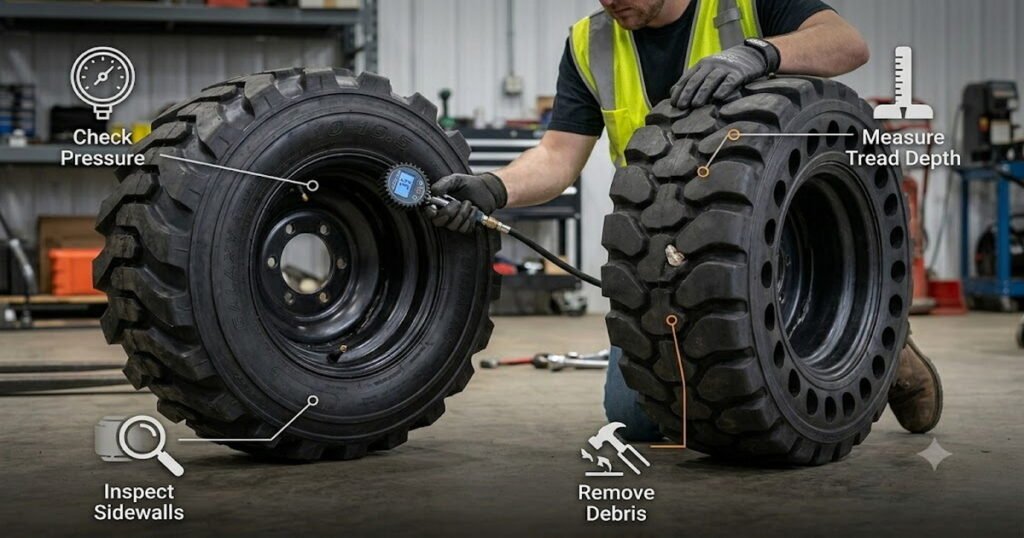
– Check air pressure daily on pneumatic tires, ideally before each shift, with tires still cool. [yohta-blog.yokohama-oht]
– Inspect tread for cuts, missing lugs, embedded debris, and abnormal wear patterns. [maxamtire]
– Inspect sidewalls carefully for cracks, bulges, or deep cuts that indicate internal damage. [tirereview]
– Never mix vastly different tire types, constructions, or diameters on the same machine. [sttc]
For solid tires, you won’t be checking pressure, but regular inspections for chunking, deep cuts, or structural damage are still essential to avoid unexpected failures. [yohta-blog.yokohama-oht]
Operator Behavior: The Hidden Tire Killer
OEMs and tire manufacturers repeatedly highlight how operator habits can accelerate or reduce wear: [sttc]
– Aggressive counter-rotation and spinning tires in place dramatically increase tread wear.
– Overloading the machine or running too fast builds heat and stresses the carcass. [lesschwab]
– Poor route planning through deep mud, sharp rubble, or hidden debris leads to avoidable damage. [maxamtire]
Training operators to use smoother steering inputs, take wider turns, and respect load limits is one of the cheapest ways to extend tire life and reduce replacement frequency. [sttc]
Tire Rotation and Replacement Strategy
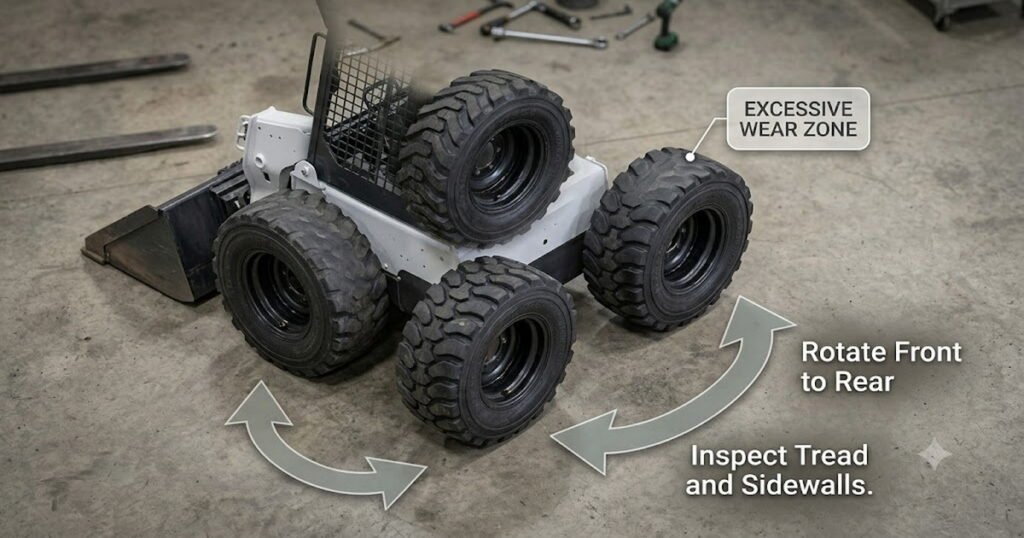
On skid steers, front tires typically wear faster because they carry more load when the bucket is full and during aggressive turns. Rotating tires can even out wear patterns and delay replacement. [sttc]
Advanced practice for fleets:
– Track hours and conditions per set of tires.
– Record rotation dates, depth measurements, and operating surfaces.
– Schedule replacements proactively before catastrophic failures halt a critical job. [maxamtire]
Tracks vs Tires on Skid Steer Loaders: Where Tires Still Win
With compact track loaders gaining popularity, many teams ask when it still makes sense to run a wheeled skid steer with premium tires. Industry sources note that skid steers with tires excel on even ground and paved surfaces, where they can travel faster and avoid the accelerated wear tracks experience on hard surfaces. [prairielandpartners]
Certeg customers often choose wheeled skid steers with high-quality radial or heavy-duty pneumatic tires when they:
– Work primarily on concrete, asphalt, or stabilized yards.
– Need more travel speed and lower running costs than a track machine.
– Want lower undercarriage maintenance costs over the machine’s life.
Tracks still excel in soft, muddy, or highly uneven terrain, but for many urban, industrial, and yard applications, well-selected tires on a skid steer remain the more economical solution. [prairielandpartners]
Where Certeg Adds Value in Skid Steer Tire Configuration
As a manufacturer focused on skid steers and compact construction equipment, Certeg doesn’t just supply machines; we help global customers configure loader, powertrain, and tire packages that match local conditions.
From a practical standpoint, that means:
– Pre-spec’d tire options for different regions (e.g., high-heat, high-abrasion, or mixed-climate). [maxamtire]
– Application-based recommendations (demolition, aggregates, landscaping, industrial yards).
– Guidance on maintenance protocols that align with your fleet size and operator skill level. [tirereview]
If you’re comparing wheeled and tracked loaders or trying to standardize tire choices across multiple sites, this consultative approach avoids the trial-and-error that many smaller fleets endure.
Call to Action: Configure the Right Skid Steer and Tire Package with Certeg
If you’re unsure whether to choose bias, radial, foam-filled, or solid tires — or you’re weighing the move from wheeled skid steers to tracked machines — you don’t need to guess. Share your main applications, surfaces, and annual operating hours, and we’ll help you configure a Certeg skid steer loader and tire package that minimizes downtime and maximizes lifetime ROI.
Reach out to our team for a tailored recommendation, or request a quote that compares at least two different tire configurations for your typical jobs so you can make a data-driven decision for your fleet.
FAQs: Skid Steer Tire Selection and Maintenance
Q1. How often should I replace skid steer tires?
There is no fixed hour limit because replacement depends on tread depth, visible damage, traction loss, and operating conditions, but experts recommend regular inspections and proactive replacement before cracks, missing lugs, or excessive spinning begin to compromise performance and safety. [sttc]
Q2. Are solid skid steer tires worth the higher price?
Solid tires typically pay off in high-debris, high-puncture environments like demolition and scrap where avoiding flats and unplanned downtime is more valuable than the lower comfort and higher upfront cost. [yohta-blog.yokohama-oht]
Q3. Can I mix different tire types or brands on one skid steer?
Manufacturers advise against mixing drastically different tire types, constructions, or diameters on the same machine because it can lead to uneven wear, poor handling, and potential safety issues. [sttc]
Q4. What is the most important daily tire maintenance task?
For pneumatic tires, checking and maintaining proper air pressure according to OEM recommendations is the single most impactful task to prevent premature wear and structural failures. [yohta-blog.yokohama-oht]
Q5. When should I choose radial over bias pneumatic tires?
Radial tires are usually the better choice when your skid steer spends significant time on paved or hard surfaces at higher speeds, or when ride comfort and fuel efficiency are priorities; bias tires make sense for lower-speed, off-road, cost-sensitive applications. [bobcatofpittsburgh]
References
1. – Compact Equipment – “Get Rolling with the Right Tires for Your Skid Steer” (Pam Kleineke, Managing Editor) – [link]
2. – Yokohama OHT – “Matching Skid Steer Tires to Application” – [link] [yohta-blog.yokohama-oht]
3. – Tire Review – “Skid Steer Tire/Track Maintenance Tips” – [link] [tirereview]
4. – Yokohama OHT – “Five Tips for Longer Lasting Construction Tires” – [link] [yohta-blog.yokohama-oht]
5. – Maxam Tire – “How to Best Maintain Your Construction Equipment Tires” – [link] [maxamtire]
6. – Les Schwab – “Construction Tire Types and When To Replace Them” – [link] [lesschwab]
7. – STTC – “Which Tires Wear Faster on Skid Steers?” – [link] [sttc]
8. – Bobcat of Pittsburgh – “A Beginner’s Guide to Skid Steer Tires” – [link] [bobcatofpittsburgh]
9. – Prairieland Partners – “Choosing Between Tracks and Tires on a Skid Steer Loader” – [link] [prairielandpartners]
10. – For Construction Pros – “Tips for Maximum Skid-Steer Tire Performance” – [link] [forconstructionpros]
Hot Tags: Skid Steer Loader, Manufacturers, Customized, Custom, Suppliers, Buy, Cheap, Quality, Advanced, Durable, in Stock, Made in China, Price, Quotation