
Crawler Skid Excavator Guide for Contractors: Mini Excavator, Track Loader and Telehandler in One
Content Menu
● What Is a Crawler Skid Excavator?
● Why the Two‑Piece Side Boom Matters
>> Limitations of Traditional Mono Boom Mini Excavators
>> How the Side‑Mounted, Two‑Piece Boom Changes the Game
● Multi‑Tool Capability: From Excavator to Loader to Material Handler
>> Using Skid Loader Buckets for Bulk Material Handling
>> Forks and Below‑Grade Material Placement
>> Quick‑Couplers and Attachment Strategy
● Balancing Productivity and Finish Quality
>> Fast Travel for Production Work
>> Controlled Slow Speed for Precision Tasks
● Where Crawler Skid Excavators Deliver the Most Value
>> Limitations and When to Use Dedicated Machines
● Getting the Most from a Crawler Skid Excavator
● How Certeg‑Style Engineering Aligns with Crawler Skid Excavator Needs
● Mini Excavator vs Crawler Skid Excavator vs CTL vs Telehandler
● Clear Call to Action for Contractors
● FAQ
>> Q1: Is a crawler skid excavator a replacement for a full fleet of compact machines?
>> Q2: How difficult is it for operators to adapt to the two‑piece boom?
>> Q3: Does the higher travel speed increase track wear or maintenance?
>> Q4: Can crawler skid excavators run the same attachments as my existing skid steers?
>> Q5: Are crawler skid excavators suitable for rental fleets?
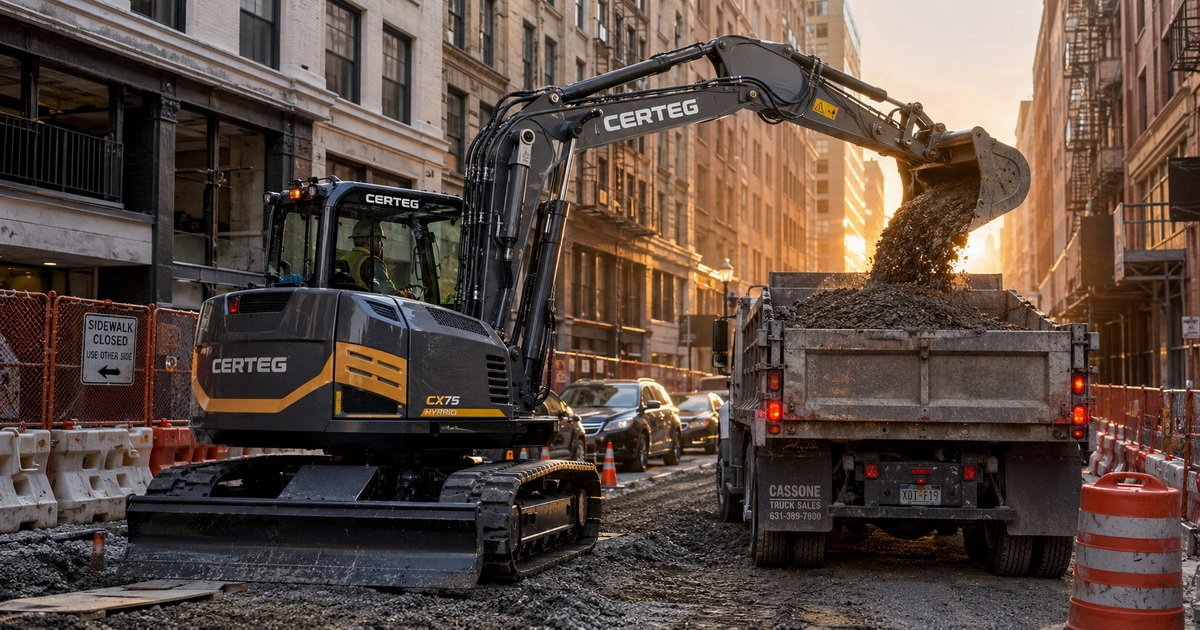
A crawler skid excavator is a hybrid machine that combines the digging power of a mini excavator, the loading capability of a compact track loader, and the reach of a telehandler into a single, highly maneuverable tracked unit, designed to help contractors do more work with fewer machines, less fuel, and smaller crews.
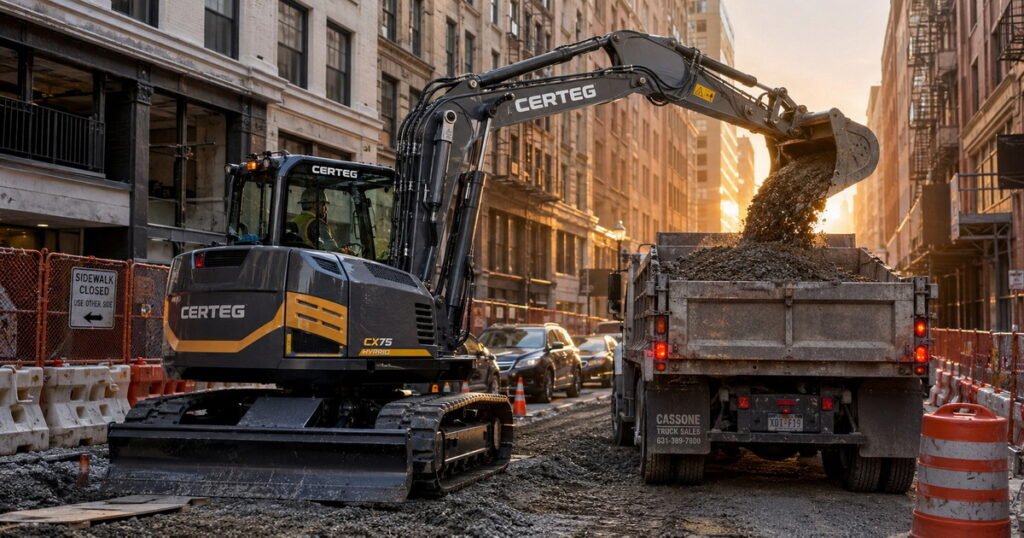
On modern construction and utility jobsites, doing more with fewer machines and fewer people is no longer a nice‑to‑have, it is a survival strategy for contractors under pressure from tighter margins, labor shortages, and rising fuel costs. From my perspective working with contractors who run excavator fleets across roadwork, utility, and landscaping projects, the crawler skid excavator has emerged as one of the most interesting multi‑purpose machines because it aims to replace a mini excavator, compact track loader (CTL), and telehandler with a single unit. When it is specified and used correctly, this hybrid approach can cut equipment moves, reduce idle time, and free operators to focus on higher‑value work instead of constantly swapping machines. [gushwork]
What Is a Crawler Skid Excavator?
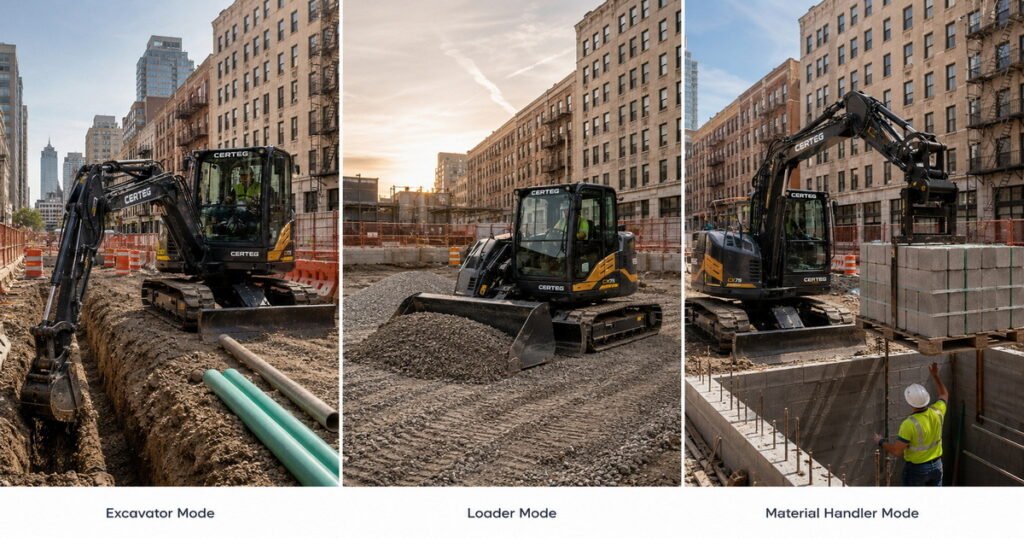
A crawler skid excavator is a compact, tracked machine that offers 360‑degree cab rotation like a mini excavator but uses a side‑mounted, two‑piece boom and skid‑style quick‑coupler so it can work as an excavator, a compact track loader, or a telehandler‑style material handler depending on the attachment fitted. The core idea is simple: instead of moving three machines to site (mini excavator, CTL, telehandler), you move one machine that can dig, load, lift, and place materials above and below grade.
Key characteristics include:
– Tracked undercarriage for traction and low ground pressure in soft or uneven terrain
– 360‑degree upper‑structure rotation for digging and loading in tight spaces
– Side‑mounted, two‑piece boom that folds in tight or reaches out like a telehandler
– Skid‑style quick‑coupler to run loader buckets, forks, grapples, trenchers, and more
– Travel speed up to about 10 km/h (6.2 mph) on some models, roughly twice a typical mini excavator and similar to CTLs
On a typical day, an operator might trench like a mini excavator in the morning, swap to a bucket and grade like a CTL after lunch, then finish by lifting and placing pallets the way a telehandler would. [my-equipment]
Why the Two‑Piece Side Boom Matters
Limitations of Traditional Mono Boom Mini Excavators
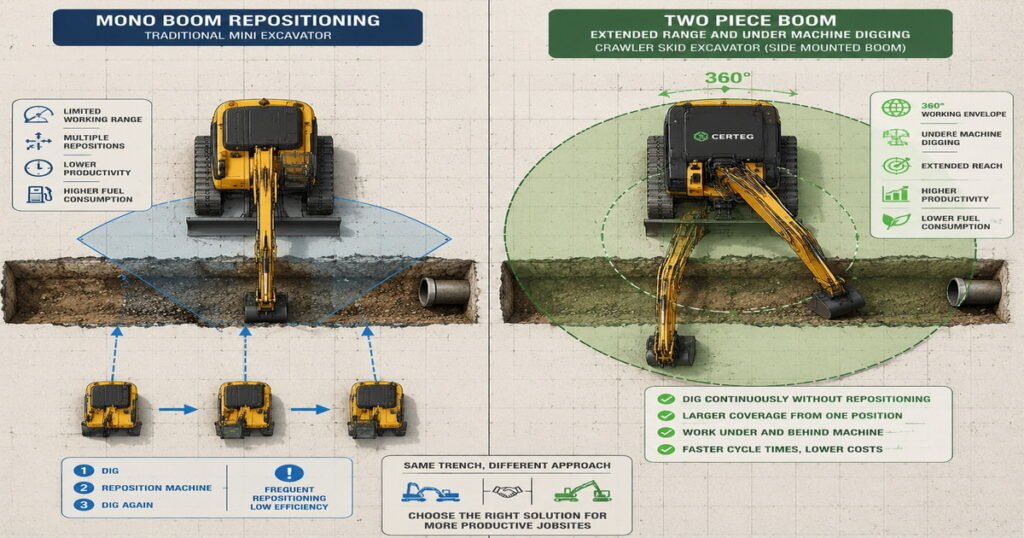
Most conventional mini excavators use a mono boom, where the main arm pivots mainly up and down and relies on the dipper stick to reach, pull, and dig. This design is proven and powerful, but it has two practical limitations that contractors feel every day:
– It needs more space to swing and work near structures or traffic lanes
– It struggles to work very close to the machine without constant repositioning
On crowded urban jobsites or narrow roadside work zones, mono boom machines can be forced into awkward positions, leading to extra time, more track wear, and sometimes additional small equipment or manual labor to finish what the excavator cannot reach efficiently. [seo]
How the Side‑Mounted, Two‑Piece Boom Changes the Game
Crawler skid excavators use a side‑mounted, articulated boom with multiple joints, including a joint that allows limited side‑to‑side motion. By bending or straightening each joint in sequence, the boom can either extend almost straight out in any direction or fold back in on itself for maximum compactness.
Practical jobsite benefits include:
– Larger working envelope from a single machine position, reducing repositioning
– Ability to dig back towards and even under the machine when trenching
– Compact 360‑degree footprint, often only slightly wider than the machine body itself
– Easier operation in tunnels, under bridges, or beneath overhead lines because the boom needs only slightly more headroom than the cab
Example: If a traditional mono boom mini excavator and a crawler skid excavator start a trench at the same distance from the machine, the mono boom unit will eventually have to stop and reposition as the trench approaches the machine, while the crawler skid excavator can continue digging towards and under its own tracks. Over a full day, this means fewer interruptions, less fuel burned during repositioning, and less surface damage from constant tracking. [my-equipment]
Multi‑Tool Capability: From Excavator to Loader to Material Handler
Using Skid Loader Buckets for Bulk Material Handling
The two‑piece boom allows the crawler skid excavator to operate with larger skid steer buckets, in some cases up to about 0.98 cubic yards (0.75 cubic meters), which is significant for a compact machine. Operators can brace the loader bucket against the dozer blade during grading and ground leveling, distributing forces into the frame and reducing stress on the boom joints.
From a contractor’s point of view, this gives you:
– Faster loading cycles compared with a small excavator bucket
– More stable grading in tight urban or residential work areas
– Less wear concentration on boom pins and bushings over the machine’s life
For contractors running fleet‑wide fuel and maintenance tracking, the ability to do both digging and CTL‑style loading with one machine can simplify preventive maintenance and spare parts stocking. [webfx]
Forks and Below‑Grade Material Placement
Swapping the bucket for pallet forks transforms the crawler skid excavator into a compact material handler with better articulation than a mono boom excavator and more precise placement flexibility than many telehandlers. With reach around 14.5 feet (4.5 m) on roughly six‑ton machines and up to about 18 feet (5.5 m) on ten‑ton models, the machine can place pallets and heavy items on or off trucks, staging areas, and structures.
A unique advantage is below‑grade placement:
– Pipes and manhole components can be lifted from a staging zone
– Materials can be lowered directly into trenches or pits
– Workers avoid manual wheelbarrow “chains” or repeated re‑handling of materials
For utility and hardscape contractors, this often pays off in reduced manual labor and better safety because fewer people need to work inside the trench at the same time. [my-equipment]
Quick‑Couplers and Attachment Strategy
The quick‑coupler is central to realizing the machine’s value. Modern systems let operators switch between buckets, forks, grapples, mowers, or specialty tools without leaving the cab, drastically reducing downtime between tasks. Some systems also allow attachments to be used in reverse, optimizing angles for back‑dragging, cutting, or specialized trenching while fully leveraging the boom’s extended range.
From an equipment management standpoint, this encourages contractors to think in terms of attachments as a fleet strategy, not just machines: [webfx]
– Standardize couplers and key attachments across your excavators and CTLs
– Plan day‑by‑day attachment schedules so the crawler skid excavator runs near 100% utilization
– Use the same attachment suite across multiple Certeg machines where possible to reduce total cost of ownership [ltmgloader]
Balancing Productivity and Finish Quality
Fast Travel for Production Work
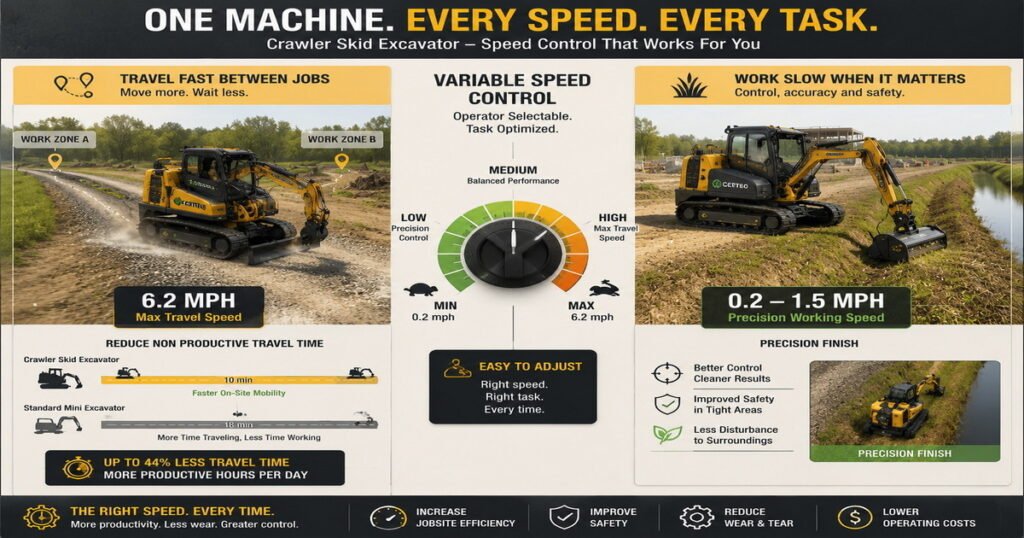
On many jobsites, about 15% of an excavator’s working day is spent simply traveling between tasks. Crawler skid excavators that can travel at up to roughly 6.2 mph (10 km/h) have a significant advantage over standard mini excavators, which usually top out at about half that speed.
This higher travel speed delivers:
– Faster movement between trench sections or work zones
– Less unproductive time when shifting from excavation to loading or material handling
– Closer parity with CTLs and skid steers, simplifying overall jobsite choreography [my-equipment]
For contractors juggling tight schedules and penalties for late completion, these incremental time savings compound over weeks of work.
Controlled Slow Speed for Precision Tasks
Certain applications demand the opposite of speed: ditch cleaning, sweeping, snow removal, and flail mowing all require slow, consistent travel speeds to achieve a clean, professional finish. To support this, some crawler skid excavators feature an advanced speed management system that lets the operator set a target top speed and maintain it automatically, even with the throttle fully open.
Benefits of speed control include:
– Uniform mowing and sweeping results with fewer missed spots
– Reduced operator fatigue because they no longer have to “feather” the controls constantly
– Safer operation near workers, trees, traffic, and obstacles
Systems with multiple preset speed settings (in some cases up to 20 levels) allow operators to switch seamlessly from slow precision work to fast travel between work areas. This aligns with broader heavy‑equipment best practices, where matching travel speed, hydraulic flow, and attachment type is key to both productivity and component life. [seo]
Where Crawler Skid Excavators Deliver the Most Value
Job Types and Use Cases
Based on how contractors currently deploy compact equipment, crawler skid excavators tend to provide the most value in:
– Utility trenching and pipe work where below‑grade material placement and compact footprints reduce trench width and shoring requirements
– Roadside construction and maintenance, where working inside a single traffic lane minimizes closures and traffic control costs
– Urban infill and tight access projects where overhead and lateral clearance limit traditional machines
– Hardscape and landscaping, where the same unit can dig, move materials, set blocks, and grade with frequent attachment changes [mechmaxx]
In these environments, replacing three machines with one is not just about saving acquisition cost, but also simplifying logistics—one trailer, one operator, and fewer scheduling conflicts. [gushwork]
Limitations and When to Use Dedicated Machines
Despite the advantages, crawler skid excavators are not the right solution for every fleet or project. Scenarios where dedicated machines still win include:
– High‑volume loading at large quarries or plants, where a full‑size loader’s bucket capacity and breakout force outclass compact hybrids
– Extreme reach or height requirements, where a dedicated telehandler or long‑reach excavator is necessary
– Highly specialized tasks such as deep foundation work, where tool and boom requirements exceed compact machine capabilities [seo]
Getting the Most from a Crawler Skid Excavator
Adding a crawler skid excavator to a fleet is most successful when it is treated as a strategic capability rather than a novelty machine. Drawing on both manufacturer experience and industry best practices, contractors should: [gushwork]
1. Define priority jobs
Identify the 3–5 recurring jobs (for example, utility trenching, sidewalk replacement, small subdivision infrastructure) where the machine can realistically replace at least two separate units.
2. Standardize attachments
Build an attachment plan that covers buckets, forks, trenchers, and at least one specialty tool (such as flail mower or grapple) using compatible couplers across the fleet. [my-equipment]
3. Train operators on boom articulation
Invest time in operator training so crews fully understand how to use the two‑piece boom for under‑machine digging, below‑grade placement, and compact swing patterns.
4. Optimize jobsite traffic patterns
Treat the crawler skid excavator as a high‑mobility hub, redesigning material flows so it handles both digging and short‑haul material moves on site. [mechmaxx]
5. Track utilization and total cost
Monitor machine hours, attachment usage, and fuel to quantify how effectively the crawler skid excavator is replacing mini excavators, CTLs, and telehandlers over a 6–12 month period. [webfx]
Contractors who follow a disciplined rollout like this typically see clearer ROI and fewer conflicts with existing fleet operations. [gushwork]
How Certeg‑Style Engineering Aligns with Crawler Skid Excavator Needs
As a manufacturer focused on excavators and other construction machinery for diverse job conditions, we pay particular attention to matching engine power, hydraulic systems, and undercarriage robustness to the way contractors actually work. For crawler skid‑type machines, that translates into several design priorities: [ltmgloader]
– Durable, high‑response hydraulics optimized for frequent attachment changes and variable flow tools
– Reinforced boom structures and pivot points to absorb both excavator‑style digging loads and loader‑style pushing forces
– Robust track systems suited to repeated travel cycles at higher speeds across uneven worksites [ltmgloader]
By treating crawler skid excavators as serious production machines rather than niche gadgets, manufacturers can help contractors adopt them with confidence, knowing they are built for real‑world abuse and long service life. [wgcontent]
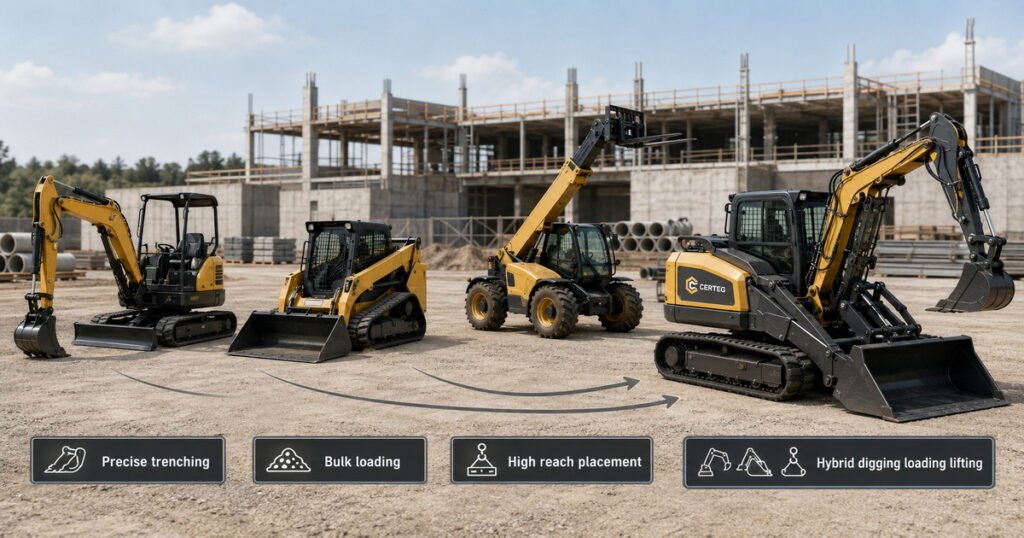
Mini Excavator vs Crawler Skid Excavator vs CTL vs Telehandler
Role Comparison Table
Below is a simplified comparison based on typical use‑cases and the crawler skid excavator configuration described above. [mechmaxx]
| Machine type | Best at | Typical limitations | Crawler skid excavator advantage |
|---|---|---|---|
| Mini excavator | Precise digging, trenching, compact rotation | Limited loading capacity, slower travel, mono boom needs more repositioning | Two‑piece boom, faster travel, ability to load trucks and work under machine |
| Compact track loader (CTL) | Bulk loading, grading, high travel speed mechmaxx | No 360‑degree rotation, limited digging depth, less reach mechmaxx | 360‑degree rotation with CTL‑style bucket capability and similar travel speeds |
| Telehandler | High reach material placement, pallet handling my-equipment | Larger footprint, limited below‑grade reach, less suited to trenching my-equipment | Compact footprint, below‑grade placement, better maneuverability in tight sites |
| Crawler skid excavator | Hybrid digging, loading, and material handling | Not a high‑volume specialist, requires operator training on boom articulation | Replaces multiple machines on suitable jobsites, reduces equipment moves and labor |
Clear Call to Action for Contractors
If you are evaluating whether a crawler skid excavator belongs in your fleet, the most effective next step is to see the machine work on your type of jobsite. Arrange a demo that mirrors your real tasks—such as utility trenching with below‑grade pipe placement, single‑lane roadwork, or tight urban infrastructure work—and compare its cycle times and fuel use directly against your current mini excavator, CTL, and telehandler combination. Then speak with a Certeg or local dealer representative about configuring engine power, hydraulics, and attachments to match your core projects and regional regulations. [webfx]
FAQ
Q1: Is a crawler skid excavator a replacement for a full fleet of compact machines?
A crawler skid excavator can often replace a mini excavator plus a CTL and sometimes a telehandler on specific jobs, but high‑volume or extreme reach applications still call for dedicated machines. [mechmaxx]
Q2: How difficult is it for operators to adapt to the two‑piece boom?
Most experienced excavator or CTL operators adapt quickly, especially with structured training that focuses on under‑machine digging, compact swing, and below‑grade placements. [wgcontent]
Q3: Does the higher travel speed increase track wear or maintenance?
Higher travel speeds can increase track wear if operators treat the machine like a high‑speed vehicle, but proper training and adherence to manufacturer guidelines keep wear within expected ranges. [webfx]
Q4: Can crawler skid excavators run the same attachments as my existing skid steers?
Many models use skid‑style quick‑couplers and compatible hydraulic flows, making it possible to share a wide range of attachments across your fleet, subject to weight and flow limits. [my-equipment]
Q5: Are crawler skid excavators suitable for rental fleets?
Yes, particularly in regions with dense urban projects and utility work, as renters appreciate a single machine that can handle multiple tasks; clear operator training and attachment labeling are essential. [gushwork]
References
1. Compact Equip – “What’s a Crawler Skid Excavator? A Mini Excavator, Track Loader and Telehandler in One” (2022). [Link]
2. WebFX – “SEO Strategies for Heavy Equipment Companies” (2026). [Link] [webfx]
3. Gushwork – “SEO Strategy for Heavy Equipment Sales” (2026). [Link] [gushwork]
4. SEO.com – “SEO for Heavy Equipment Companies: 7 Pro Tips” (2026). [Link] [seo]
5. ServiceTitan – “Construction SEO: The Definitive Guide” (2025). [Link] [servicetitan]
6. WGContent – “E‑E‑A‑T for Content Quality” (2025). [Link] [wgcontent]
7. Wellows – “E‑E‑A‑T Checklist for SEO: Strengthen Content with LLM” (2026). [Link] [wellows]
8. LTMG – “Your Professional Excavator Supplier” – Excavator product overview. [Link] [ltmgloader]
9. Mechmaxx – “The Ultimate Buyer’s Guide to Mini Skid Steer Loaders (2025)” (2025). [Link] [mechmaxx]
10. My‑Equipment – “How Does a Mini Skid Steer Optimize Construction Jobs” (2024). [Link] [my-equipment]
Hot Tags: Excavator, Manufacturers, Customized, Custom, Suppliers, Buy, Cheap, Quality, Advanced, Durable, in Stock, Made in China, Price, Quotation