
Economy Grade Control Systems for Compact Track Loaders: A Practical 2026 Guide for Contractors
Content Menu
● What Is an Economy Grade Control System for Compact Machines?
● Key Components of Economy Grade Control Systems
● Trimble Earthworks GO Overview: A Leading Economy Solution
● Typical Applications for Entry-Level Grade Control
● Installation and Setup: How “Plug-and-Grade” Really Works
● Pricing and Configuration Options for Economy Grade Control
● Slope-Only vs Dual-Laser Modes
● Upgrade Paths: From Economy Grade Control to Full 3D
● Operational Insights: Training, Learning Curve and Best Practices
● Maintenance and Calibration Requirements
● ROI and Payback for Local Contractors
● Selecting the Right Compact Machine and Attachment
● Step-by-Step Implementation Plan for First-Time Users
● Why Technology Is No Longer Only for Large Contractors
● Partnering with Certeg for a Complete Compact Grading Solution
● Take the Next Step with Certeg
● FAQ: Economy Grade Control Systems for Compact Loaders
>> FAQ 1: What is the difference between economy grade control and full 3D machine control?
>> FAQ 2: Can I install an economy grade control system myself?
>> FAQ 3: How often do I need to recalibrate my entry-level grade control system?
>> FAQ 4: Is an economy grade control system worth it for small contractors?
>> FAQ 5: Can I upgrade from an economy system to a more advanced platform later?
Entry-level grade control systems for compact track loaders and skid steers are transforming them into precise grading machines that can rival small dozers on many small and mid-size projects. By understanding how these systems work, what they cost, and how to upgrade over time, contractors can boost accuracy, reduce rework, and win more profitable jobs.
What Is an Economy Grade Control System for Compact Machines?
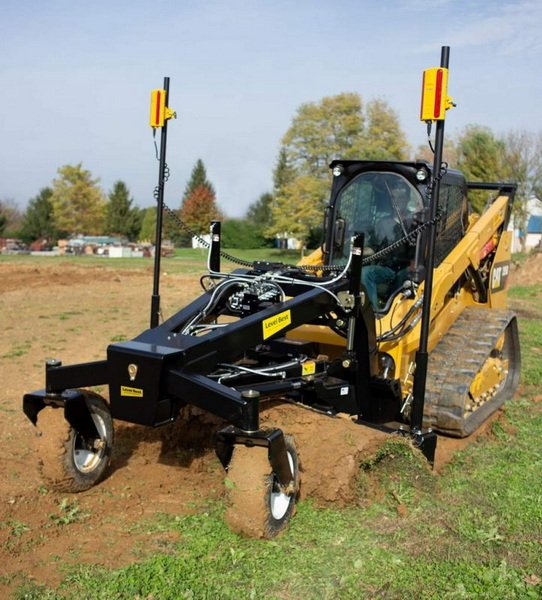
Economy or entry-level grade control systems are 2D solutions designed to give compact track loaders and skid steers consistent elevation and slope control without the cost and complexity of full 3D machine control. Instead of grading purely by eye, operators use sensors, laser receivers, and a control box to automatically maintain a target height or slope across the site.
These systems are built specifically for local contractors and owner-operators who handle small to medium jobs and need a fast, affordable way to improve surface quality, reduce passes, and cut material waste.
Key Components of Economy Grade Control Systems
Most economy grade control packages for compact loaders share a similar hardware stack:
– Control box or main unit: Interprets laser signals and sensor feedback to control the blade.
– Laser receivers: Mounted on masts, these detect a rotating laser plane and translate it into elevation information.
– Inertial or angle sensors: Measure blade and attachment position to maintain precise slope angles.
– Cables and harnesses: Connect sensors and receivers to the control box and machine hydraulics.
– Operator interface or display: Shows grade information and mode selection in an intuitive format.
Modern entry-level systems are designed so contractors can install the hardware with minimal or no tools, often in just a few minutes.
Trimble Earthworks GO Overview: A Leading Economy Solution
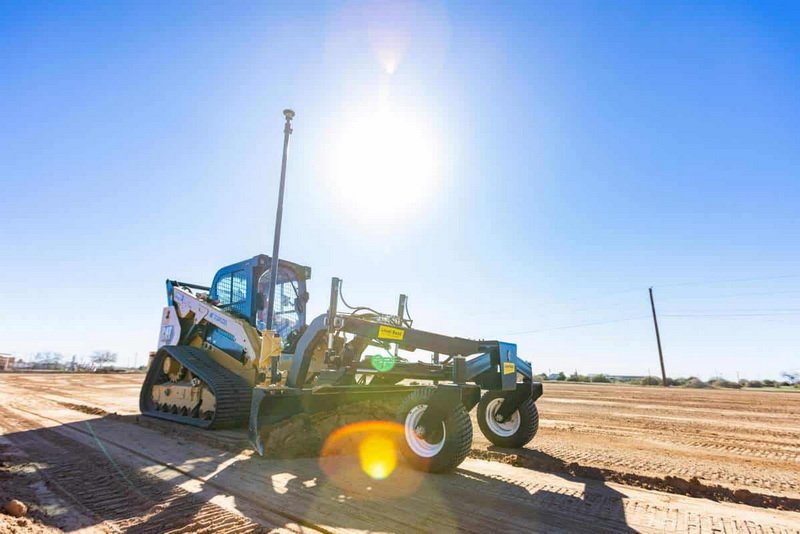
One widely used economy grade control option for compact equipment is Trimble Earthworks GO, which is built specifically for compact grading attachments and small contractors. It is compatible with popular box blades and grader attachments from several manufacturers.
With this type of system, operators mount the main control unit to the attachment, snap on the laser receivers, connect a few cables, and are ready to grade. Some users can complete initial installation in just a few minutes, which shows how much the process has been simplified for new users.
Typical Applications for Entry-Level Grade Control
Economy grade control systems are most effective on projects where 2D control is sufficient:
– Walkways and pedestrian paths
– Residential driveways and building pads
– Sports fields and recreational surfaces
– Landscaping and yard reconstruction
– Small commercial building sites and parking areas
Because compact track loaders and skid steers can access tight or sensitive locations, pairing them with a 2D grade control system lets contractors deliver finished surfaces that look like they were done with larger, more expensive equipment.
Installation and Setup: How “Plug-and-Grade” Really Works
Modern economy systems are positioned as some of the easiest-to-install grade control options on the market. A typical workflow looks like this:
1. Mount the main control unit to the compact grading attachment.
2. Attach the laser receivers to their masts.
3. Connect the cables between the control box, sensors, and machine hydraulics.
4. Power up the system and follow prompts to complete calibration.
No extra tools are usually required for the basic installation steps, and most contractors can complete installation and initial calibration in a single morning or afternoon. Dealers and regional specialists are typically available to provide on-site support, best practices training, and help with configuring the system for specific jobs.
Pricing and Configuration Options for Economy Grade Control
Economy-grade product families are structured to offer a lower upfront cost and a clear upgrade path. A common price range is from about USD 6,000 to slightly over USD 10,000, depending on the configuration and dealer pricing.
Common configuration tiers include:
– Slope-only mode: One side of the blade is manually controlled, while the system automatically maintains the selected blade slope using internal sensors.
– Dual-laser mode: The system uses two laser receivers to automate the blade elevation on both sides, significantly simplifying precise grading over larger areas.
This structure lets small contractors start with a simple configuration and upgrade capabilities as job requirements and budgets grow.
Slope-Only vs Dual-Laser Modes
| Feature | Slope-Only Mode | Dual-Laser Mode |
|---|---|---|
| Control strategy | Operator controls one side manually; system holds target slope on the other side. | System controls both sides to maintain design elevation and slope. |
| Best for | Simple driveways, small pads, single-slope surfaces. | Sports fields, large pads, car parks, more complex surfaces. |
| Learning curve | Low; ideal for first-time grade control users. | Moderate; requires understanding of dual receiver operation. |
| Typical cost | Lower end of the USD 6,000+ range. | Upper end of the USD 10,000+ range. |
| Upgrade potential | Can move to dual-laser by adding components. | Can transition to more advanced 2D or full 3D platforms. |
Upgrade Paths: From Economy Grade Control to Full 3D
A key advantage of modern entry-level systems is that they fit into a scalable technology roadmap. Contractors can start with a 2D economy system and later move into a premium grade control platform for compact attachments.
In many cases:
– Existing laser receivers can be reused when stepping up to the premium platform.
– Adding hardware modules and an upgraded display allows a transition from simple dual-laser 2D workflows to higher-end 2D or 3D capabilities.
– Full 3D solutions use GNSS or total-station-based sensors combined with digital designs to support complex contours, variable slopes, and connected workflows.
This protects the initial investment and makes it easier to adopt more advanced technology as project demands evolve.
Operational Insights: Training, Learning Curve and Best Practices
New users can typically learn the basics of an economy grade control system in a single morning or afternoon, which is essential for small fleets that cannot afford extended downtime. There is always a learning curve, however, and contractors should plan time for operators to understand system modes and limitations.
Best practices include:
– Starting with a simple project, such as a driveway or small pad, to build operator confidence.
– Using dealer or technology partner training resources for hands-on instruction and job-type-specific tips.
– Encouraging operators to treat the system as a precision tool while maintaining strong situational awareness and safe operating habits.
Maintenance and Calibration Requirements
Once an economy grade control system has been installed and calibrated correctly, it requires relatively little ongoing adjustment. In general:
– Re-calibration is needed when the system is moved to a new grading attachment or when significant changes are made to the existing attachment.
– Many suppliers recommend recalibrating approximately every six months if there is concern about joint looseness, wear, or hydraulic modifications.
Regularly checking attachment wear, hydraulic performance, and mounting stability will help ensure long-term accuracy and reliability.
ROI and Payback for Local Contractors
Beyond technical features, contractors need to know whether an economy grade control system will pay for itself. While exact numbers vary from fleet to fleet, several consistent benefits drive return on investment:
– Reduced rework and fewer passes: More accurate first passes mean fewer corrections and less double work.
– Lower material waste: Tight control over elevation reduces over-cutting and excess backfill or aggregate use.
– Higher daily productivity: Operators complete more jobs per week, especially on repetitive small pads and walkways.
– Improved surface quality: Better finishes can justify premium pricing and improve customer satisfaction.
For many small contractors, the combination of reduced labor hours per job and the ability to bid more complex grading work can justify the system cost over a relatively short payback period.
Selecting the Right Compact Machine and Attachment
To unlock the full value of an economy grade control system, contractors must match the machine, attachment, and control package.
Important considerations:
– Machine type: Compact track loaders often provide better flotation and traction for fine grading than wheeled skid steers on soft or uneven ground.
– Attachment selection: Box blades, graders, and other laser-compatible attachments must support stable mast mounting and predictable blade movement.
– Hydraulic capabilities: Adequate auxiliary hydraulics and smooth proportional controls help maintain accurate, responsive blade control.
– Transport and access: Smaller frame sizes reduce access issues and surface damage on residential or dense urban sites.
Compact machines with the right hydraulic and attachment interfaces will make it easier to realize the full benefits of grade control technology.
Step-by-Step Implementation Plan for First-Time Users
For contractors new to economy grade control, a structured deployment plan reduces risk and speeds adoption.
1. Define target jobs
Identify recurring projects where consistent grade is essential and rework is costly, such as residential pads, small car parks, or sports courts.
2. Select the machine and attachment
Choose a compact track loader or skid steer with stable hydraulics and a compatible grading attachment.
3. Choose the grade control configuration
Start with slope-only for basic jobs, or dual-laser if you frequently grade larger, flat areas and sports fields.
4. Schedule installation and training
Allocate at least half a day for installation, calibration, and operator training, using dealer support if needed.
5. Pilot on low-risk projects
Use two or three smaller jobs as pilot sites to refine workflows and confirm productivity gains.
6. Standardize settings and workflows
Document preferred system settings, laser setups, and typical grading passes to make performance repeatable across crews.
Following these steps helps teams move from curiosity to confident daily use with minimal disruption.
Why Technology Is No Longer Only for Large Contractors
Technology suppliers are increasingly focusing on local contractors and owner-operators instead of only large civil firms. Compact machines equipped with entry-level grade control now give small fleets access to capabilities that were once limited to full-size dozers and motor graders.
With a modest investment in training and a willingness to learn, small contractors can see clear benefits from the first jobs on which they deploy grade control, including cleaner surfaces, fewer callbacks, and more predictable schedules.
Partnering with Certeg for a Complete Compact Grading Solution
Choosing the right economy grade control system is only half of the equation; it also requires reliable, well-matched machines and attachments. As a global manufacturer of excavators, skid steer loaders, compact track loaders, road rollers, forklifts, tractors, and tracked carriers, Certeg can help:
– Configure compact track loaders or skid steers with the hydraulic and electrical provisions needed for 2D grade control.
– Match grading attachments to machine size and core applications.
– Plan future fleet upgrades, including rollers and tractors, to support more complex siteworks and finishing tasks.
Combining robust machines with the right grade control technology enables contractors to build a compact yet powerful grading fleet.
Take the Next Step with Certeg
If you are ready to move beyond eyeball grading and bring consistent precision to small and mid-size sites, now is the right time to explore economy grade control for your compact machines. Get in touch with Certeg’s team to discuss your grading challenges, choose the right compact track loader or skid steer and grading attachment, and plan a pilot project that proves the business value of grade control on your own jobs. By acting now, you can build a more efficient, more competitive fleet that is ready for the next generation of construction work.
Contact us to get more information!
FAQ: Economy Grade Control Systems for Compact Loaders
FAQ 1: What is the difference between economy grade control and full 3D machine control?
Economy grade control typically uses 2D laser or slope control to maintain a constant elevation or slope relative to a reference plane, which is ideal for flat or simple surfaces. Full 3D machine control relies on GNSS or total station data and digital designs to guide the machine in three dimensions, supporting more complex contours, variable slopes, and large-scale infrastructure work.
FAQ 2: Can I install an economy grade control system myself?
Yes, many modern systems are designed for self-installation using straightforward mounting and cabling steps that do not require special tools. Some contractors still prefer working with a dealer or technology partner for the first installation to ensure optimal calibration and to receive in-depth training.
FAQ 3: How often do I need to recalibrate my entry-level grade control system?
After the initial setup, recalibration is generally required when the system is moved to a different grading attachment or when significant mechanical or hydraulic changes are made. As a preventive measure, many users choose to check calibration every few months or at set service intervals, especially if they suspect wear or loosening of components.
FAQ 4: Is an economy grade control system worth it for small contractors?
For many small contractors, the combination of reduced rework, faster grading, and higher-quality surfaces can quickly offset the initial investment. The key is to use the system regularly on repeatable jobs and to invest in operator training so that the technology is used effectively rather than treated as an occasional add-on.
FAQ 5: Can I upgrade from an economy system to a more advanced platform later?
Yes, several economy systems are designed with a clear upgrade path to more advanced 2D or full 3D platforms. Contractors can often reuse components such as laser receivers and simply add hardware modules and a new display, which reduces the cost and complexity of scaling up as project requirements become more demanding.
Reference URL:
1. https://compactequip.com/business/quick-qa-we-discuss-economy-grade-control-systems-and-trimble-earthworks-go-with-john-boss/
Hot Tags: Gps For Skid Steer, Gps Grading System For Skid Steer, Economy Grade Control Systems, Trimble Earthworks GO, Machine Control Technology, Construction Grade Control, Earthmoving Technology, Excavator Grade Control, Construction Automation, Digital Construction Solutions