
The Complete Guide to Trencher Attachments for Skid Steers and Compact Track Loaders: Selection, Operation, and ROI Maximization
Content Menu
● Why Trencher Attachments Outperform Traditional Excavation Methods
>> Speed and Precision Advantages
>> Enhanced Operator Safety and Comfort
● Selecting the Right Trencher Attachment: Critical Specifications
>> Matching Depth and Width Requirements
>> Ground Conditions and Teeth Selection
>> Hydraulic Flow and Host Machine Compatibility
● Advanced Trencher Attachment Features and Technologies
>> Drive System Configurations
>> Precision Depth Control Systems
>> Crumber Systems and Spoil Management
>> Optional Enhancement Features
● Proper Trencher Attachment Operation: Best Practices
>> Pre-Operation Safety Protocol
>> Common Operational Mistakes to Avoid
● Maintenance Requirements for Maximum Attachment Lifespan
>> Intensive Maintenance Intervals
>> Host Machine Maintenance Integration
● Skid Steer vs. Compact Track Loader: Optimal Host Machine Selection
>> Performance Comparison for Trenching Applications
>> Matching Equipment to Project Demands
● Financial Analysis: Trencher Attachment ROI and Cost Justification
>> Investment Breakdown and Payback Periods
>> Market Demand and Rental Revenue Potential
● Regulatory Compliance and Safety Standards
>> OSHA Trenching and Excavation Requirements
>> State-Specific Requirements
>> Liability and Risk Management
● Industry Trends and Future Developments
>> Sustainability and Environmental Considerations
● Maximizing Your Trencher Attachment Investment
● Transform Your Excavation Capabilities with Certeg Equipment Solutions
>> 1. What is the typical lifespan of a trencher attachment chain?
>> 2. Can trencher attachments cut through rock or concrete?
>> 3. How does standard-flow vs. high-flow hydraulics affect trencher performance?
>> 4. What are the most common trencher attachment maintenance mistakes?
>> 5. What width trench can I expect from different attachment configurations?
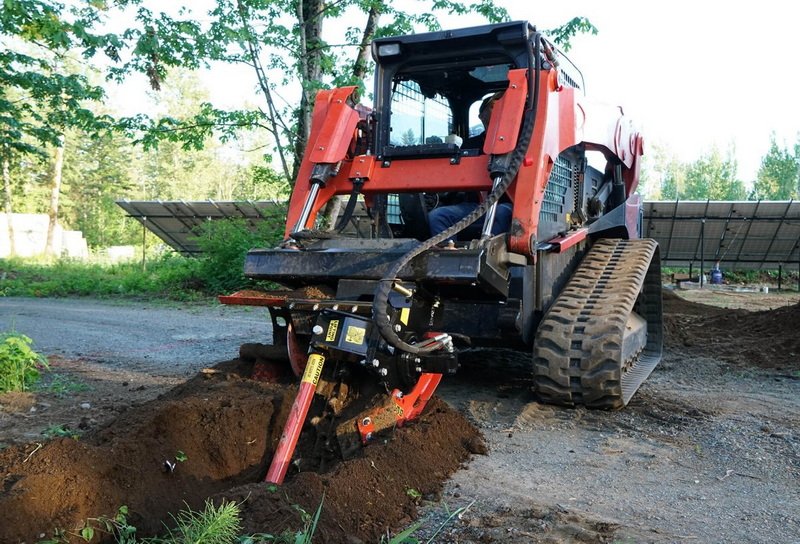
Trencher attachments transform skid steers and compact track loaders into precision excavation tools, enabling contractors to complete utility installations, drainage systems, and irrigation projects faster and more cost-effectively than traditional excavation methods. For construction professionals seeking to maximize equipment versatility while minimizing capital expenditure, understanding how to properly select and operate trencher attachments is essential for project success and profitability.
Modern trencher attachments deliver narrow trench cuts as precise as 4 inches wide, significantly reducing ground disturbance, spoil volume, and backfill settlement compared to excavators or backhoes. With the global trencher attachment market reaching $461.6 million in 2025 and contractors reporting up to 25% labor cost reductions through attachment adoption, these tools represent a strategic investment for equipment fleets.
Why Trencher Attachments Outperform Traditional Excavation Methods
Speed and Precision Advantages
Trencher attachments attached to skid steers or compact track loaders deliver superior speed compared to manual excavation or backhoe operations. Operators can maintain consistent trench width and depth throughout the entire cut, eliminating the need for repeated measurements or corrections. The continuous chain cutting action produces finely pulverized spoil that returns easily into trenches, reducing air pockets and minimizing post-project settlement issues.
Key performance benefits include:
– Trench widths ranging from 4 to 14 inches with depths up to 60 inches
– Cutting speeds that reduce project timelines by 30% or more compared to manual methods
– Precision depth control systems maintaining consistent excavation throughout entire runs
– Minimal surface disruption, protecting surrounding landscaping and hardscaping
Cost Efficiency and ROI
Trencher attachments maximize return on investment by transforming existing skid steers and compact track loaders into specialized excavation tools without requiring dedicated trenching equipment. Contractors specializing in utility installations report reducing fuel consumption by 15% and achieving 20% increases in annual revenue by completing more jobs with faster turnaround times.
The capital expenditure advantage is substantial—trencher attachments range from $4,000 to $10,000, representing a fraction of dedicated trenching machine costs while delivering comparable performance for most residential and commercial applications. Equipment rental companies recognize trenchers as high-ROI attachments due to premium hourly rental rates and consistent demand from irrigation contractors, cable installers, and utility trenching specialists.
Enhanced Operator Safety and Comfort
Operating a trencher attachment from an enclosed skid steer or compact track loader cab provides significant safety advantages over walk-behind trenchers or manual excavation. Operators benefit from climate-controlled environments, 360-degree visibility (particularly with compact track loaders), and protection from flying debris and dust. Modern equipment features like creep control enable consistent reverse travel speeds, essential for maintaining uniform trench quality without operator fatigue.
Selecting the Right Trencher Attachment: Critical Specifications
Matching Depth and Width Requirements
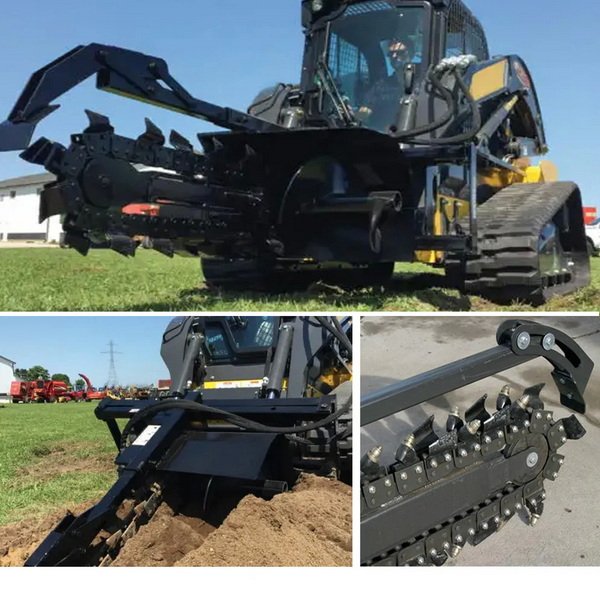
Determining required trench dimensions represents the fundamental first step in trencher attachment selection. Attachments for skid steers and compact track loaders accommodate depths from 30 to 60 inches using boom lengths of 2 to 5 feet.
Common configuration options:
– 4-foot boom with 6-inch chain: Most popular general-purpose configuration for utility lines and irrigation
– 3-foot boom with 4-inch chain: Ideal for fiber optic cables and narrow drainage applications
– 5-foot boom with 8-12 inch chain: Heavy-duty utility trenching and drainage systems
As chain width increases, maximum achievable depth typically decreases due to hydraulic flow limitations and spoil removal constraints. For projects requiring simultaneous maximum width and depth, dedicated walk-behind or ride-on trenchers may prove more appropriate than attachment-based solutions.
Ground Conditions and Teeth Selection
Matching trencher chain and teeth configurations to soil conditions is critical for productivity, cost control, and equipment longevity. Using inappropriate teeth combinations slows production, increases fuel consumption, and accelerates wear on both the attachment and host machine.
Teeth configuration guide:
| Chain Type | Teeth Configuration | Ideal Ground Conditions | Best Applications |
|---|---|---|---|
| Tooth Every Station (TES) | Standard teeth on every link | Light to moderately compacted sandy/loam soils | General residential trenching, irrigation systems |
| Tooth Every Other Station (TEOS) | Alternating tooth pattern | Wet, sticky clay, gumbo conditions | Drainage trenching in high-moisture areas |
| Rock/Frost 50/50 | 50% bullet teeth, 50% cup teeth | Frozen ground, highly compacted soil, rocky conditions | Winter utility work, hard-packed substrates |
| Shark Tooth 70/30 | 70% shark teeth, 30% cup teeth | Compacted soil, light frost, baked clay, shale | Urban infrastructure projects, hardpan conditions |
| Full Shark Tooth | 100% shark teeth | Fracturable rock, shale, caliche | Rock trenching, extreme hardness applications |
Tungsten or carbide teeth deliver superior longevity in abrasive or rocky conditions but command premium pricing, while standard earth teeth provide cost-effective performance in softer soils. Some manufacturers offer hybrid configurations interspersing various tooth types—such as combining earth teeth with cup-shaped teeth for improved spoil removal and cleaner trench finishes.
Hydraulic Flow and Host Machine Compatibility
Proper matching between trencher attachment hydraulic requirements and host machine auxiliary hydraulic capabilities ensures optimal performance and prevents equipment damage. Skid steers and compact track loaders feature either standard-flow (8-30 gpm at 3,000-3,500 psi) or high-flow (30-50 gpm at 4,000-5,000 psi) auxiliary hydraulic systems.
Standard-flow systems adequately power trencher attachments for most residential and light commercial applications, while high-flow configurations deliver double the torque and chain pull force, enabling operators to tackle severe ground conditions at steeper cutting angles. The approximate $1,300 price premium for high-flow trencher models typically proves worthwhile only for contractors specializing in challenging excavation conditions.
Certeg’s skid steers, compact track loaders, and excavators offer versatile hydraulic flow options, ensuring compatibility with the full range of trencher attachment configurations to meet diverse project demands.
Advanced Trencher Attachment Features and Technologies
Drive System Configurations
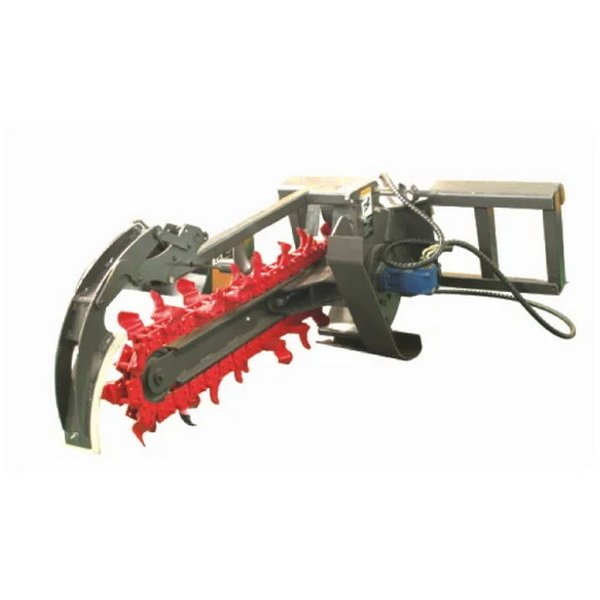
Trencher attachments employ either direct motor drives or chain reduction drives, each offering distinct performance characteristics. Direct drive systems provide higher chain speeds suitable for loose, sandy soils but sacrifice torque and long-term durability.
Heavy-duty chain reduction drives utilize planetary gearboxes to multiply motor output torque, delivering superior digging power in compacted or rocky conditions while maintaining attachment longevity. Premium manufacturers incorporate high-quality hydraulic motors rated for flow rates up to 39 gpm paired with robust epicyclic gearbox systems that amplify torque while ensuring reliability under demanding workloads.
Proper balance between chain speed and torque prevents common operational problems—excessive speed causes spoil to spray around the work area, while insufficient speed leaves material in the trench bottom requiring additional passes.
Precision Depth Control Systems
Precision depth control systems maintain consistent trench depth throughout entire excavation runs, eliminating manual measuring and reducing operator workload. Adjustable skid plates mounted flush with ground level serve as depth references, with some advanced models offering three preset depth positions for rapid adjustment between different project specifications.
This automation capability proves particularly valuable for large-scale utility installations where depth consistency directly impacts code compliance and system functionality.
Crumber Systems and Spoil Management
All quality trencher attachments include crumber assemblies that remove excavated soil from trenches and provide smooth, clean trench bottoms. The crumber position significantly impacts trenching efficiency—setting it too high causes spoil to fall back into the trench, forcing the chain to repeatedly remove the same material and dramatically reducing progress.
Conversely, positioning the crumber too low causes it to dig into ground surfaces, robbing the attachment of power and slowing chain speed. Pivoting crumber shoes and bars assist with soil removal, while adjustable auger systems move spoil to the side of trenches for easy backfilling.
Optional Enhancement Features
Modern trencher attachments offer numerous optional features that expand capabilities and improve productivity:
Bi-directional chain operation: Variable speed motors with reverse functionality clear chain stalls without manual intervention
Hydraulic side shift: Infinite positioning capability allows operators to trench adjacent to buildings or obstacles without repositioning the host machine
Low-profile dirt shields: Improve operator visibility while containing spoil spray
Built-in wear strips: Bolt-on replaceable components extend boom lifespan by protecting high-wear areas
Proper Trencher Attachment Operation: Best Practices
Pre-Operation Safety Protocol
Before beginning any trenching operation, contractors must call 811 to identify underground utility locations, as required by federal law. With 11 trench-related fatalities already reported in 2025, OSHA emphasizes that proper safety protocols prevent these tragedies.
Essential pre-operation steps:
– Complete comprehensive site surveys and hazard recognition assessments
– Verify all personal protective equipment (goggles, high-visibility clothing, appropriate footwear, gloves)
– Inspect trencher attachment and host machine for worn components or system malfunctions
– Confirm chain tension meets manufacturer specifications (typically 1.5-2 inches of sag)
– Check hydraulic connections, hoses, and fittings for leaks or damage
Optimal Cutting Techniques
Proper trenching technique maximizes productivity while minimizing equipment wear and fuel consumption. Operators should configure auxiliary hydraulics for continuous flow while the host machine travels slowly in reverse, utilizing creep control features when available.
Step-by-step trenching process:
1. Position the trencher ahead of the target start point to allow for gradual depth entry
2. Angle the boom approximately 45-65 degrees from horizontal for maximum performance in general trenching applications
3. Lower the trencher while reversing the loader at a controlled rate that prevents bottoming out the crumber
4. Let the chain do the work—avoid forcing the trencher nose straight into the ground, which causes stalling and excessive wear
5. Maintain consistent reverse travel speed for uniform trench dimensions throughout the cut
For deeper trench requirements or vertical wall work, operators can increase boom angles up to 90 degrees below grade, though this reduces travel speed, cutting efficiency, and spoil removal effectiveness.
Common Operational Mistakes to Avoid
Improper chain tension represents the most common operational error. Chains adjusted too tightly rob horsepower, reduce productivity, accelerate component wear, and can damage the attachment. Excessively loose chains risk walking off idlers or jumping sprockets. The correct tension allows 1.5-2 inches of chain hang from the underside of the boom, permitting spoil passage through the chain-sprocket interface while preventing stalls.
Using worn or dull teeth forces chains to work harder, increasing stretch and causing premature wear to other trencher components. In wider chain configurations, outside teeth perform most cutting and typically wear first, requiring inspection and replacement before interior teeth show significant deterioration.
Mispositioned crumbers and augers drastically reduce efficiency—operators should regularly verify optimal positioning and adjust as ground conditions change throughout projects.
Maintenance Requirements for Maximum Attachment Lifespan
Daily Maintenance Protocol
Establishing consistent daily maintenance routines extends trencher attachment service life while preventing costly mid-project failures.
Daily inspection checklist:
– Verify chain tension (adjust to 1.5-2 inch sag specification)
– Inspect teeth for excessive wear, damage, or missing components
– Check chain rollers for groove formation indicating replacement needs
– Clean attachment thoroughly using pressure washers to remove corrosive soil and debris
– Lubricate all grease points as identified in the maintenance manual (minimum daily service)
Intensive Maintenance Intervals
Beyond daily care, trencher attachments require periodic intensive maintenance at specified intervals:
Every 8-10 hours of operation:
– Lubricate front idler and idler bearings
– Inspect hydraulic hoses and connections for wear or leakage
– Verify all fasteners remain properly torqued
After each use:
– Power wash to remove all mud and embedded debris
– Clean and verify visibility of all safety decals and warning labels
– Allow chain to dry completely, then apply machine oil or protective coating
– Store indoors when possible to prevent rust formation
Every 500 hours:
– Perform hydraulic motor oil changes per manufacturer specifications
– Replace worn chains, idlers, or bearings showing significant deterioration
– Inspect and service planetary gearbox systems
Host Machine Maintenance Integration
Trencher attachment performance depends entirely on the host machine’s hydraulic system health and overall operational condition. Skid steer and compact track loader maintenance should follow manufacturer-recommended service schedules, including:
– Scheduled oil changes maintaining hydraulic fluid cleanliness
– Filter replacement preventing contamination of auxiliary hydraulic circuits
– Tire or track inspection ensuring proper host machine stability during trenching operations
– Cab filter cleaning maintaining operator visibility and comfort
– Corrosive environment protection through frequent washing, especially critical for agricultural applications
Certeg equipment is engineered for simplified maintenance access, reducing service time and extending productive equipment life for maximum operator efficiency.
Skid Steer vs. Compact Track Loader: Optimal Host Machine Selection
Performance Comparison for Trenching Applications
Both skid steers and compact track loaders effectively power trencher attachments, but each offers distinct advantages depending on project requirements and site conditions.
Skid steer advantages:
– Lower acquisition cost for budget-conscious operations
– Higher ground speed for repositioning between trench locations
– Excellent traction on firm surfaces including concrete and asphalt
– Wider attachment ecosystem with extensive third-party options
Compact track loader advantages:
– Superior soft ground flotation preventing sinking in mud, sand, or saturated soils
– Enhanced stability on slopes due to lower center of gravity
– Reduced ground pressure minimizing turf damage on landscaping projects
– 360-degree operator visibility improving safety awareness
– Higher lift capacity for handling spoil or materials
For trenching applications in variable weather conditions or undeveloped terrain, compact track loaders deliver more consistent performance. Projects in urban environments with firm surfaces may benefit from skid steer agility and lower operating costs.
Matching Equipment to Project Demands
| Project Type | Recommended Host Machine | Rationale |
|---|---|---|
| Residential irrigation installation | Skid steer | Minimal ground disturbance concerns, firm lawn surfaces |
| Utility trenching in wet climates | Compact track loader | Superior traction in muddy conditions, prevents job delays |
| Urban fiber optic installation | Skid steer | Tight access requirements, paved surface operations |
| Agricultural drainage systems | Compact track loader | Soft field conditions, minimal soil compaction |
| Golf course irrigation retrofit | Compact track loader | Turf protection priority, gentle ground pressure |
Certeg manufactures both skid steers and compact track loaders with optimized hydraulic systems specifically designed for demanding attachment applications, ensuring contractors have the right equipment foundation for any trenching project.
Financial Analysis: Trencher Attachment ROI and Cost Justification
Investment Breakdown and Payback Periods
Trencher attachments represent strategic investments that typically achieve payback within one to two trenching seasons for contractors with regular excavation work.
Initial investment components:
– Attachment purchase: $4,000-$10,000 depending on specifications and features
– High-flow upgrade (if required): Approximately $1,300 premium
– Specialty chains: $500-$1,500 for alternative tooth configurations
– Optional features: $300-$800 for hydraulic side shift, bi-directional motors, or precision depth control
Operational Cost Savings
Contractors adopting trencher attachments report substantial operational improvements across multiple cost categories:
Labor efficiency gains:
– 25% reduction in labor costs through faster project completion
– Elimination of manual digging crews for utility installations
– Single-operator capability replacing multi-person excavation teams
Equipment utilization optimization:
– Transforms existing skid steers into specialized excavation tools
– Eliminates rental costs for dedicated trenching equipment
– 15% fuel consumption reduction compared to excavator trenching methods
Revenue expansion opportunities:
– 30% faster project completion enabling increased job volume
– Competitive bidding advantages through lower operating costs
– Service offering expansion without additional equipment acquisition
Market Demand and Rental Revenue Potential
Equipment rental companies identify trencher attachments as high-ROI assets commanding premium hourly rates. Strong demand from irrigation contractors, cable installation specialists, and utility trenching professionals ensures consistent utilization. The compact design and attachment versatility make trenchers particularly attractive to contractors seeking to maximize revenue from existing skid steer fleets without dedicating capital to single-purpose machines.
Regulatory Compliance and Safety Standards
OSHA Trenching and Excavation Requirements
While trencher attachments create relatively narrow excavations, projects may still trigger OSHA trenching and excavation standards (29 CFR 1926.651 & 1926.652) requiring specific protective measures:
Mandatory safety requirements:
– Safe egress systems (ladders, ramps, stairways) in trenches 4 feet or deeper, with maximum 25-foot lateral travel distance
– Protective systems (sloping, benching, shoring, shielding) whenever trench depth exceeds 5 feet, unless excavating stable rock
– Daily inspections by competent persons, especially following rain events or site condition changes
– Atmospheric testing for hazardous conditions (oxygen deficiency, gas accumulation) when trenches exceed 4 feet depth
– Protection from water accumulation and adjacent structure stability concerns
State-Specific Requirements
California’s Cal/OSHA regulations often exceed federal standards, requiring additional compliance measures:
– Controlled Access Zones (CAZ) designation for excavation work areas
– Material placement restrictions keeping spoil and equipment at least 2 feet from trench edges
– Enhanced protective system design requirements per specific California code sections
Contractors operating across multiple states should verify local regulations, as requirements vary significantly by jurisdiction.
Liability and Risk Management
Non-compliance with excavation safety standards exposes contractors to severe consequences beyond financial penalties:
– Civil litigation liability following injuries or property damage
– Reputational damage affecting bid opportunities and client relationships
– Criminal negligence charges in cases involving preventable fatalities
– Insurance premium increases reflecting elevated risk profiles
Establishing comprehensive safety training programs and maintaining rigorous compliance documentation protects both workers and business operations.
Industry Trends and Future Developments
Technology Integration
The trencher attachment market continues evolving with automation and precision technologies enhancing productivity and safety. Modern compact track loaders feature advanced control systems that integrate with trencher attachments for improved operator efficiency. Telematics integration enables remote monitoring of attachment performance, maintenance requirements, and operational efficiency.
Sustainability and Environmental Considerations
Growing emphasis on sustainable construction practices drives demand for low-emission host machines paired with efficient trencher attachments. European markets particularly emphasize equipment combining energy-saving hydraulics, advanced automation technologies, and compliance with stringent environmental standards. The narrow trenches produced by attachment-based systems inherently reduce ground disturbance compared to traditional excavation methods, aligning with environmental impact minimization objectives.
Market Growth Projections
The global trencher attachment market demonstrates robust growth trajectories, with North American infrastructure investment and renewable energy development driving demand. Wind and solar farm construction requires extensive trenching for electrical distribution systems, creating substantial opportunities for contractors equipped with efficient trenching capabilities. The compact excavator and skid steer attachment segments show particular strength due to their versatility in navigating narrow passages while delivering precise, clean cuts.
Maximizing Your Trencher Attachment Investment
Strategic trencher attachment selection, proper operation, and diligent maintenance transform skid steers and compact track loaders into highly profitable excavation tools. Contractors who master these elements achieve dramatic productivity improvements, cost reductions, and competitive advantages in utility installation, drainage, and irrigation markets.
Key success factors include:
– Precise specification matching to project demands and ground conditions
– Proper host machine compatibility ensuring adequate hydraulic flow and power
– Operator training emphasis on correct techniques and safety protocols
– Rigorous maintenance schedules preventing costly downtime and extending equipment life
– Regulatory compliance protecting workers and business interests
Transform Your Excavation Capabilities with Certeg Equipment Solutions
Certeg’s comprehensive equipment lineup—including skid steers, compact track loaders, excavators, and specialized attachments—provides contractors with integrated solutions for every trenching application. Our engineering focus on hydraulic system optimization, maintenance accessibility, and operator comfort ensures maximum productivity and profitability across diverse project demands.
Whether you’re expanding your service offerings, replacing aging equipment, or launching new utility installation operations, Certeg delivers the power, precision, and reliability your business demands. Our construction machinery meets global power requirements for building projects of any scale, from residential irrigation to commercial infrastructure development.
Ready to expand your equipment capabilities with trencher attachments? Contact Certeg today to discuss how our construction machinery solutions can transform your excavation efficiency and project profitability. Our team of equipment specialists will help you select the optimal skid steer or compact track loader configuration matched to your specific operational requirements, ensuring you achieve maximum ROI from day one.
Visit our website or call our sales team to schedule a demonstration and discover why leading contractors worldwide trust Certeg for their most demanding excavation projects.
Frequently Asked Questions
1. What is the typical lifespan of a trencher attachment chain?
Trencher chain lifespan varies significantly based on ground conditions, proper maintenance, and operational techniques, typically ranging from 200 to 800 hours of active trenching. Chains used primarily in soft, sandy soils with proper tension maintenance and regular cleaning can approach the upper end of this range, while rocky or abrasive conditions accelerate wear. Replacing worn teeth promptly before they become excessively dull extends overall chain life by reducing stretch and shock loads to other components. Proper post-use cleaning and oiling prevents corrosive soil damage that significantly shortens chain service life.
2. Can trencher attachments cut through rock or concrete?
Trencher attachments equipped with specialized rock chains featuring carbide or tungsten teeth can cut through fracturable rock, shale, and caliche, but they are not designed for solid rock or concrete applications. Full shark tooth chain configurations handle these toughest conditions, though cutting speed and efficiency decrease substantially compared to soil trenching. For projects requiring extensive rock or concrete cutting, dedicated rock saws or concrete cutting equipment deliver superior performance and prevent trencher attachment damage. Contractors should carefully assess ground conditions before commencing work and select appropriate equipment for the specific material hardness encountered.
3. How does standard-flow vs. high-flow hydraulics affect trencher performance?
Standard-flow hydraulics (8-30 gpm at 3,000-3,500 psi) adequately power trencher attachments for most residential and light commercial applications in normal soil conditions. High-flow systems (30-50 gpm at 4,000-5,000 psi) deliver approximately double the torque through the trencher drive shaft and double the chain pull force, enabling operators to tackle severe ground conditions at steeper cutting angles while maintaining productivity. The $1,300 typical price premium for high-flow trencher models proves cost-effective for contractors regularly encountering compacted, rocky, or frozen ground conditions, but standard-flow configurations satisfy needs for most general excavation work.
4. What are the most common trencher attachment maintenance mistakes?
The most frequent maintenance error involves improper chain tension adjustment—chains set too tight rob power and accelerate wear, while excessively loose chains risk jumping sprockets or walking off idlers. Neglecting post-use cleaning allows corrosive soils to remain on chains and components, significantly shortening equipment lifespan, particularly in high-moisture environments. Continuing to operate with worn teeth reduces cutting efficiency while increasing chain stretch and component stress. Insufficient lubrication of front idlers and grease points accelerates bearing failure. Finally, failing to integrate host machine maintenance with attachment care results in hydraulic system contamination or power loss that compromises trencher performance regardless of attachment condition.
5. What width trench can I expect from different attachment configurations?
Trencher attachment chain widths typically range from 4 to 14 inches, with specific options dependent on manufacturer models and boom configurations. The most popular general-purpose configuration features a 6-inch wide chain suitable for utility lines, irrigation systems, and cable installations. 4-inch chains provide precision cuts for fiber optic cables, narrow drainage applications, and projects where minimal ground disturbance is critical. 8-12 inch chains accommodate heavy-duty utility trenching, large-diameter pipe installations, and drainage systems requiring wider excavation. As chain width increases, maximum achievable depth typically decreases due to hydraulic flow limitations and spoil removal constraints, requiring careful specification matching to project requirements.
Citations:
1. https://compactequip.com/attachments/properly-picking-and-operating-a-trencher-attachment-for-skid-steers-and-track-loaders/
2. https://www.futuremarketinsights.com/reports/trencher-attachment-market
3. https://www.theutilityexpo.com/news/top-trencher-advancements-every-utility-contractor
4. https://www.ditchwitch.com/sk-attachments/
5. https://natecintl.com/its-time-to-train-now-on-trenching-excavation-safety-to-proper-osha-standards/
6. https://www.osha.gov/trenching-excavation
7. https://www.osha.gov/sites/default/files/publications/osha2226.pdf
8. https://pro-quipllc.com/skid-steer-attachments-can-increase-roi-for-contractors/
9. https://www.spartanequipment.com/blog/skid-steer-trencher-attachment-maintenance-the-basics/
10. https://skidpro.com/mini-skid-steer-vs-compact-track-loader/
11. https://skidpro.com/how-rental-companies-leverage-high-roi-attachments-for-better-profits/
12. https://equipmentandcontracting.com/optimizing-trencher-use-best-practices-for-key-earthmoving-machines/
13. https://www.hopenn.com/blog/skid-steer-vs-compact-wheel-loader-vs-compact-track-loader/
14. https://www.gregorypoole.com/skid-steer-maintenance/
15. https://www.gregorypoole.com/skid-steer-loader-vs-compact-track-loader/
16. https://www.cat.com/en_US/articles/ci-articles/skid-steer-maintenance.html
17. https://finance.yahoo.com/news/construction-machinery-attachment-industry-report-080300864.html
18. https://typhonmachinery.com/skid-steer-vs-mini-excavator-which-beast-do-you-need-for-your-project/
Hot Tags:Trencher Attachment for Skid Steer, Skid Steer Trencher Attachment, Trencher Skid Steer Attachment, Skid Steer Ditcher, Caterpillar Skid Steer Trencher Attachment, Skid Steer Trencher, Skidsteer Trencher, Cat Skid Steer Trencher Attachment, Skid Steer Trencher Attachments, Skid Steer Trenching Attachment