
Top Manual Pallet Truck Manufacturers and Suppliers in Czech Republic (2026 Updated: Expert Selection Guide)
Content Menu
● Why Source Manual Pallet Trucks from Czech Republic
● How We Evaluated These Manufacturers
● Leading Manual Pallet Truck Manufacturers in Czech Republic
>> ATLET Czech Distribution Network
>> Regional Manufacturing Collaboratives
● Czech Manufacturing vs. Global Competition: Strategic Positioning
● Avoiding Common Procurement Pitfalls
● Comprehensive Buyer’s Guide for Manual Pallet Truck Procurement
>> Factory Verification Process
>> Logistics and Import Considerations
>> Contract Terms and Quality Assurance
● Technical Specifications: What to Demand from Suppliers
● Manual Pallet Truck Market Outlook and Procurement Strategy
>> 1.How do I verify that a manufacturer’s ISO 9001 certification is current and legitimate?
>> 2.What is the realistic minimum order quantity for custom specifications from Czech manufacturers?
>> 3.How can I identify material grade substitution in fork construction during inspection?
>> 5.Should I conduct factory audits in person or rely on third-party inspection services?
The Czech Republic has emerged as a strategic manufacturing base within Central Europe’s material handling equipment sector, particularly for manual pallet trucks and warehouse logistics solutions. With machinery and industrial equipment accounting for a significant portion of the nation’s USD 20+ billion export economy, Czech manufacturers have developed robust production capabilities that serve European and global markets. As the global manual pallet truck market grows from USD 17.4 billion in 2024 toward an estimated USD 27+ billion by 2034, procurement managers increasingly look to Central European suppliers for quality, compliance, and cost-effectiveness. [importglobals]
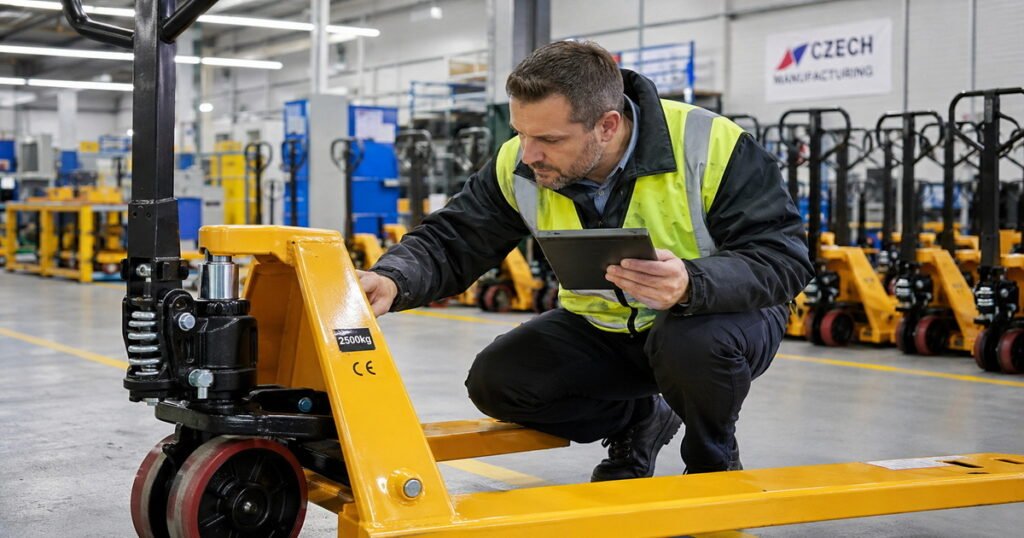
Why Source Manual Pallet Trucks from Czech Republic
Czech Republic’s strategic position in the European manufacturing landscape offers distinct advantages for B2B buyers. The country’s machinery sector benefits from proximity to Germany—which accounts for approximately 32% of Czech exports—creating deep supply chain integration and technology transfer opportunities. European material handling equipment production maintains stringent quality standards, with the regional market projected to grow at 5.45% CAGR through 2033, driven by logistics automation and e-commerce expansion. [facebook]
The nation’s manufacturing infrastructure supports comprehensive quality control frameworks aligned with EU regulations and international ISO standards. Third-party verification services from organizations like SGS Czech Republic ensure that processes, products, and systems meet both statutory and contractual requirements. This regulatory environment creates accountability that benefits international buyers seeking compliant, certified suppliers. [sgs]
How We Evaluated These Manufacturers
Professional procurement requires transparent evaluation methodology. Our assessment framework examines six critical dimensions that distinguish reliable manual pallet truck suppliers from marginal operators:
– Certification compliance: Active ISO 9001 quality management certification, verifiable through IAF CertSearch database; CE marking for European market access; environmental certifications including RoHS compliance [iso]
– Production capacity and infrastructure: Minimum 5,000-unit annual capacity; documented quality control checkpoints; material traceability systems for steel grades and hydraulic components
– Technical expertise: In-house R&D capabilities; engineering support for custom specifications; load testing facilities meeting EN 1757-1 standards for manual pallet trucks
– OEM/ODM flexibility: Minimum order quantity accommodations; customization options for fork dimensions, wheel configurations, and capacity ratings; private labeling services
– Supply chain reliability: Average lead times under 45 days; documented on-time delivery rates above 92%; transparent communication protocols
– Market reputation: Minimum 5 years operational history; verifiable client references from European or North American buyers; financial stability indicators
These criteria address common procurement pitfalls including unverified certifications, inconsistent material quality, and unrealistic capacity claims that plague international sourcing initiatives.
Leading Manual Pallet Truck Manufacturers in Czech Republic
Certeg Machinery
Certeg has established itself as a flexible, customer-focused manufacturer specializing in material handling equipment including manual pallet trucks, semi-electric stackers, and forklift solutions. The company serves global markets with particular strength in accommodating small and medium-sized brands seeking reliable OEM partnerships. Certeg’s engineering team provides comprehensive customization support, adapting fork lengths (typically 1150mm-2400mm), wheel materials (nylon, polyurethane, or rubber), and capacity specifications (2000kg-5000kg standard range) to meet specific operational requirements.
The manufacturer emphasizes transparent communication throughout the procurement cycle, from initial specification review through quality inspection and logistics coordination. Production facilities implement multi-stage quality control, including welding inspection, hydraulic system pressure testing, and load capacity verification before shipment. Certeg’s approach addresses a critical industry pain point: many suppliers quote attractive pricing but fail to maintain consistent quality across production batches, particularly when switching between standard and custom orders.
For buyers prioritizing development partnership over transactional relationships, Certeg offers technical consultation on design optimization, material selection for specific operating environments (cold storage, chemical facilities, outdoor applications), and compliance documentation for various international markets. The company maintains competitive minimum order quantities, making them accessible to distributors and end-users without massive volume commitments.
ATLET Czech Distribution Network
ATLET operates an established distribution and service network throughout Czech Republic, representing Linde, CAT Lift Trucks, Unicarriers, and Mitsubishi material handling equipment. While primarily focused on electric forklifts and powered equipment, their manual pallet truck portfolio includes robust models designed for intensive warehouse operations. The company’s strength lies in comprehensive after-sales support, including spare parts availability and technical service—critical considerations for buyers operating multi-brand fleets requiring standardized maintenance protocols. [forklift-international]
ATLET’s certifications align with European manufacturing standards, and their access to major brand engineering resources enables customization for specialized applications. However, minimum order quantities typically favor larger procurement volumes, and lead times may extend during peak production periods for customized specifications.
Regional Manufacturing Collaboratives
Czech Republic hosts several medium-sized manufacturers operating within industrial clusters near Ostrava and Prague, serving primarily European regional markets. These facilities often specialize in component manufacturing—fork assemblies, hydraulic pump units, wheel and castor systems—creating partnership opportunities for buyers seeking to diversify supply chains or develop hybrid sourcing strategies. [forklift-international]
While individual production capacities may be limited (typically 1,000-3,000 units annually), these manufacturers offer advantages in rapid prototyping, short-run custom production, and technical problem-solving for unique applications. Quality control varies significantly; thorough factory audits focusing on material testing capabilities, welding certifications, and in-process inspection protocols are essential before engagement.
Czech Manufacturing vs. Global Competition: Strategic Positioning
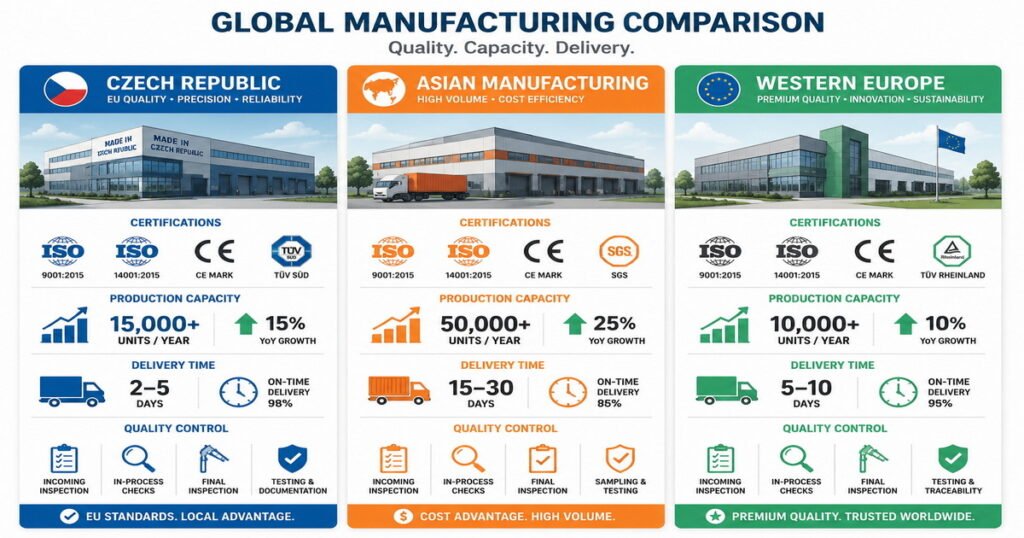
Understanding where Czech suppliers fit within the global manual pallet truck landscape helps buyers make strategic sourcing decisions. The comparison table below highlights key differentiators:
| Factor | Czech Republic Manufacturers | Asian Manufacturers | Western European Manufacturers |
|---|---|---|---|
| Average MOQ | 50-200 units | 200-500 units | 100-300 units |
| Lead Time | 35-50 days | 45-70 days | 25-40 days |
| Customization Flexibility | High (moderate tooling costs) | Moderate (high setup costs for small batches) | High (premium pricing) |
| Compliance Documentation | CE, ISO 9001 standard; RoHS available | Varies widely; verification critical | Comprehensive; highest standards |
| Price Positioning | Mid-range (15-25% below Western Europe) | Lowest (30-40% below Western Europe) | Premium positioning |
| Communication Efficiency | English proficiency moderate-high; EU time zones | Variable English skills; 6-12 hour time difference | Excellent; same-day responsiveness |
This positioning makes Czech suppliers particularly attractive for mid-volume buyers (500-5,000 annual units) seeking European quality standards without premium pricing, or those requiring customization support with moderate tooling investments. [marketdataforecast]
Avoiding Common Procurement Pitfalls
Fifteen years of industry experience reveals recurring mistakes that compromise supplier relationships and product quality. Here are critical “insider” considerations rarely discussed in public forums:
The ISO certification expiration trap: Many factories display ISO certificates prominently but allow certifications to lapse between audit cycles. Always verify current certification status through the IAF CertSearch database (www.iaf.nu) or request the certificate number and issuing body for independent verification. Legitimate manufacturers provide this information immediately; evasive responses signal potential compliance issues. [iso]
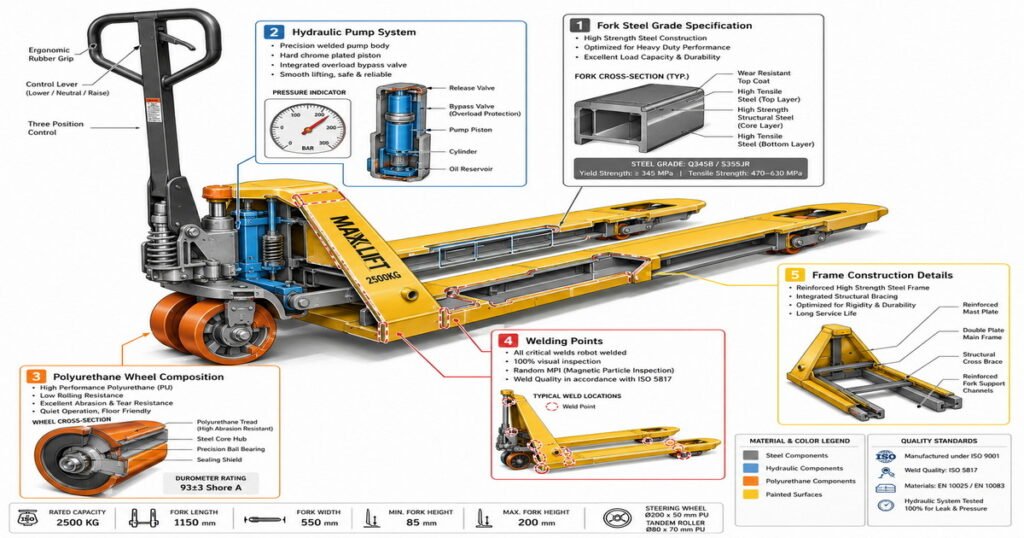
Material grade substitution in cost reduction: Manual pallet trucks experience their highest failure rates in fork tine bending and cracking, directly related to steel grade quality. Reputable manufacturers use minimum S355J2 grade steel (or equivalent EN 10025-2 specification) for fork construction. Request material certifications (mill test certificates) for critical components during negotiation, and include random material testing provisions in purchase agreements for orders exceeding 100 units.
Hydraulic pump quality indicators: The manual pallet truck’s hydraulic lifting system represents approximately 18-22% of total production cost. Inferior pumps fail prematurely (under 10,000 pump cycles) and cause operator frustration. During factory audits, examine whether manufacturers use recognized hydraulic component suppliers (such as Italian or German specialized producers) or generic components. Request documented pump cycle testing results—quality manufacturers test to 50,000+ cycles minimum.
Wheel and castor durability specifications: Polyurethane wheel quality varies dramatically based on durometer rating, polyester vs. polyether formulation, and manufacturing process. Buyers operating in cold storage environments (below 0°C/32°F) must specify polyester-based polyurethane to prevent premature hardening and cracking. This technical detail is rarely volunteered by suppliers but critically impacts operational lifespan in specific environments.
Payment term structures and quality correlation: Industry data shows inverse correlation between aggressive payment terms (100% advance payment) and quality consistency. Established manufacturers accept 30-50% deposits with balance against inspection or shipping documents. Suppliers demanding full advance payment often lack working capital—a red flag indicating potential financial instability or new market entry without established reputation.
Comprehensive Buyer’s Guide for Manual Pallet Truck Procurement
Pre-Qualification Phase
Before requesting quotations, develop detailed specifications covering operational requirements, not just basic dimensions. Critical parameters include:
– Load capacity requirements with safety factor (typically 1.25x maximum anticipated load)
– Fork dimensions: length, width, and fork thickness; ensure compatibility with pallet sizes in your operation
– Wheel specifications: material type (nylon for smooth floors, polyurethane for general use, rubber for outdoor applications), wheel diameter (affecting rolling resistance and obstacle clearance), and bearing type
– Lift height requirements (standard 200mm; some applications require 400mm+ high-lift models)
– Operating environment factors: temperature range, floor condition, frequency of use (light, medium, or intensive duty classification)
Factory Verification Process
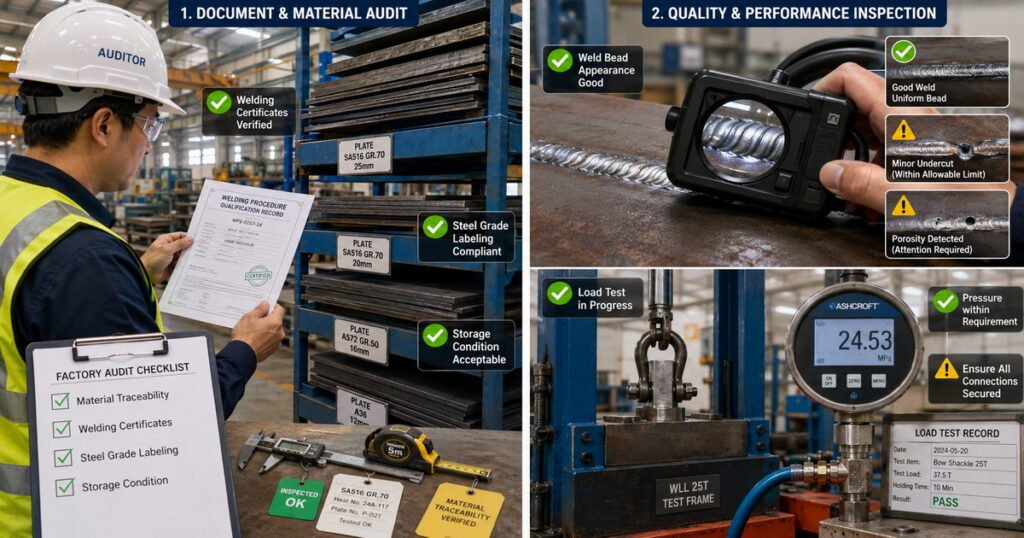
Virtual factory tours have limitations; critical suppliers warrant in-person audits or third-party inspection services. Focus audit attention on:
1. Material storage and identification systems: Are steel plates and components clearly labeled with grade certifications? Disorganized material storage suggests quality control weaknesses.
2. Welding quality and certification: Manual pallet truck frame integrity depends entirely on welding quality. Verify that welders hold current certifications (EN ISO 9606 or equivalent), and examine finished welds for consistent penetration, minimal spatter, and proper grinding.
3. Testing and inspection stations: Quality manufacturers implement in-process inspection at minimum three stages: post-welding frame inspection, hydraulic system pressure testing (typically 1.5x rated capacity), and final load testing. Request to observe testing procedures during audit.
4. Quality documentation systems: Review inspection records for previous production runs. Consistent documentation indicates systematic quality management; missing or incomplete records suggest reactive rather than preventive quality approaches.
Sample Evaluation Protocol
Initial sample orders (typically 2-5 units) provide critical quality validation before volume commitments. Implement structured testing:
– Visual inspection: Paint quality, weld finishing, component fit and alignment
– Dimensional verification: Confirm fork dimensions, overall width, and lowered height match specifications within ±3mm tolerance
– Functional testing: Perform 100 complete lift/lower cycles, examining hydraulic response, handle comfort, and wheel rotation smoothness
– Load testing: Test at 125% rated capacity for stability and structural integrity
– Durability simulation: If resources permit, conduct accelerated wear testing (1,000+ cycles under rated load) to identify premature failure modes
Logistics and Import Considerations
Czech Republic’s EU membership simplifies customs procedures for European buyers. For North American, Asian, and other markets, consider:
– Container optimization: Standard 20-foot container capacity is approximately 160-180 manual pallet trucks (depending on model); 40-foot high-cube containers accommodate 380-420 units
– Incoterms selection: FOB (Free on Board) provides cost transparency but requires freight management; CIF (Cost, Insurance, and Freight) simplifies logistics but may include premium freight rates
– Import duties and certifications: Verify HS code classification (typically 8427.90) and applicable duty rates for destination country; confirm whether supplier provides documentation for import compliance
Contract Terms and Quality Assurance
Purchase agreements should explicitly address:
– Quality standards reference: Specify applicable EN standards (EN 1757-1 for manual pallet trucks) and acceptance criteria
– Inspection rights: Include provisions for third-party inspection before shipment, with clear rejection criteria and remediation processes
– Warranty terms: Industry standard is 12 months from delivery date; negotiate extended warranty for critical components (hydraulic systems, load wheels)
– Spare parts availability: Confirm supplier commitment to maintain spare parts inventory for minimum 5 years post-purchase
– Performance guarantees: For significant volume commitments, include delivery schedule guarantees with penalty clauses for delays exceeding agreed tolerance (typically ±7 days)
Technical Specifications: What to Demand from Suppliers
Professional procurement managers should request comprehensive technical documentation that goes beyond marketing specifications:
Material Specifications
– Fork material grade and thickness (minimum 60mm for 2500kg capacity units)
– Frame steel grade and wall thickness
– Hydraulic cylinder material and seal specifications
– Wheel material formulation, hardness rating, and load capacity per wheel
Performance Specifications
– Hydraulic system operating pressure range
– Pump stroke volume and lift height per pump cycle
– Wheel bearing load ratings and expected lifespan
– Load test certification at 125% rated capacity
– Fork deflection measurements at maximum load
Compliance Documentation
– CE Declaration of Conformity with applicable directive references
– ISO 9001 certificate (with issuing body and expiration date)
– Material certificates for critical components (mill test certificates)
– Load testing reports with date, capacity tested, and pass/fail criteria
– RoHS compliance declaration if applicable to destination market
Manual Pallet Truck Market Outlook and Procurement Strategy
The global manual pallet truck segment generated USD 17.4 billion in 2024 and maintains projected growth of 5.1% CAGR through 2034, driven by persistent demand from SMEs and budget-conscious operations. Despite warehouse automation trends, manual pallet trucks remain essential for environments where cost-effectiveness, simplicity, and reliability outweigh automation benefits—particularly in smaller warehouses, retail backrooms, and manufacturing facilities with moderate material handling requirements. [gminsights]
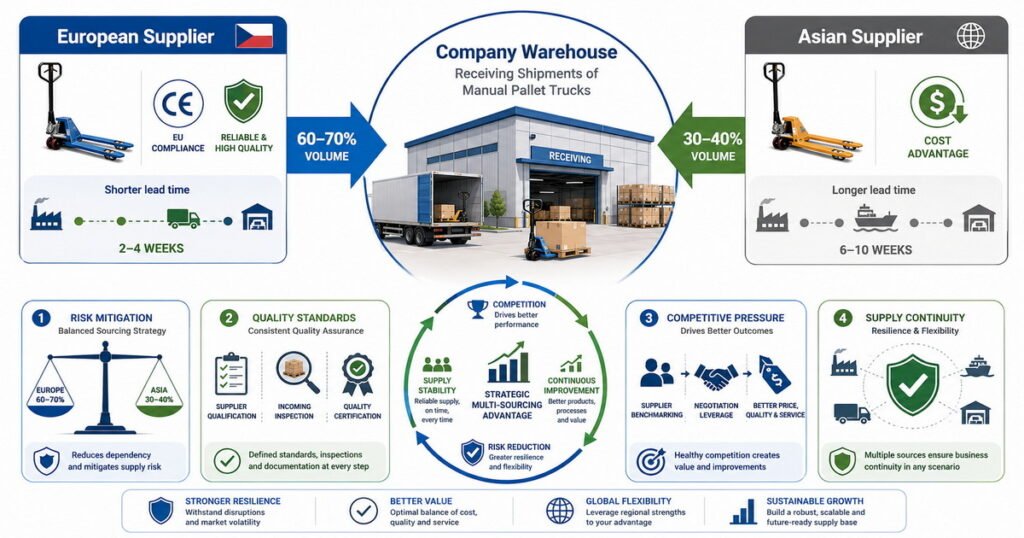
European manufacturers, including Czech suppliers, face competitive pressure from Asian producers offering 30-40% lower pricing, but maintain market position through quality consistency, compliance assurance, and responsive customer service. For procurement managers, this competitive dynamic creates negotiation opportunities: leverage competitive pricing while emphasizing quality documentation, material certifications, and customization support as differentiators worth premium positioning. [marketdataforecast]
Strategic buyers should consider multi-sourcing approaches, particularly for operations requiring 200+ units annually. Dividing orders between a primary European supplier (60-70% of volume) and secondary Asian supplier (30-40% of volume) mitigates supply chain risk while maintaining quality standards for critical applications. This approach also creates competitive pressure that encourages continuous improvement from both suppliers.
Call To Action
The Czech Republic’s position within European manufacturing creates compelling opportunities for procurement managers seeking quality manual pallet trucks with reasonable pricing and responsive service. Success requires moving beyond superficial supplier comparisons toward systematic evaluation of certifications, production capabilities, and technical expertise. Manufacturers like Certeg demonstrate that smaller, specialized suppliers often provide superior customization support and communication efficiency compared to large, volume-focused operations—particularly valuable for buyers requiring flexibility and partnership orientation rather than purely transactional relationships.
European material handling equipment markets will continue evolving as automation technology advances and sustainability requirements tighten, but manual pallet trucks remain fundamental tools for countless operations worldwide. Selecting suppliers who invest in quality systems, maintain transparent communication, and demonstrate technical expertise positions your procurement strategy for long-term success regardless of market fluctuations. Whether sourcing 50 units for a single warehouse or 5,000 units for a distribution network, the evaluation framework and verification processes outlined here provide the foundation for confident, informed supplier selection.
Frequently Asked Questions
1.How do I verify that a manufacturer’s ISO 9001 certification is current and legitimate?
Use the International Accreditation Forum’s IAF CertSearch database (www.iaf.nu/cersearch) to independently verify certifications. Request the certificate number, issuing certification body name, and expiration date from your supplier. Cross-reference this information in the database. Legitimate certificates list the specific manufacturing facility address—ensure this matches your supplier’s production location. Be wary of certificates issued by unknown certification bodies or those lacking accreditation marks from recognized national accreditation organizations (such as UKAS, ANAB, DAkkS). Some manufacturers present expired certificates or certificates issued to parent companies rather than the specific production facility; always verify the scope of certification covers manual pallet truck manufacturing specifically. [iso]
2.What is the realistic minimum order quantity for custom specifications from Czech manufacturers?
Czech manufacturers typically accommodate custom specifications (fork length modifications, special wheel configurations, custom paint colors) starting at 50-100 units, though some may quote higher MOQs (150-200 units) depending on tooling requirements. Customization involving new mold creation (such as unique handle designs) requires significantly higher volumes (500+ units) to justify tooling costs. For comparison, Asian manufacturers often require 200-500 unit MOQs for similar customizations due to production line setup economics. If your requirement is below 50 units, consider selecting from existing standard configurations or negotiate tooling cost sharing where you pay separate tooling fees (typically USD 800-2,500 depending on complexity) plus per-unit pricing for smaller quantities. [marketdataforecast]
3.How can I identify material grade substitution in fork construction during inspection?
Material grade verification requires either mill test certificates (material certification documents from steel suppliers) or destructive testing through spectrometric analysis, which is impractical for most buyers. Practical approaches include: (1) Contractually require suppliers to provide mill test certificates for fork steel, specifically documenting material grade (S355J2 or equivalent) and carbon content; (2) Include random material testing provisions in purchase agreements for orders exceeding 100 units, where you reserve the right to send fork samples for independent laboratory analysis; (3) During factory audits, examine material storage areas and verify steel suppliers—reputable manufacturers source from recognized European or certified Asian steel mills and maintain material traceability documentation. Physical inspection clues include fork weight (quality steel has consistent density) and welding characteristics (inferior grades show different heat-affected zones and weld penetration patterns, observable by experienced inspectors).
4.What are the typical lead times from order confirmation to delivery for manual pallet trucks from Czech Republic?
Standard configuration orders typically require 35-50 days from deposit payment to ready-for-shipment status. This timeline includes approximately 7-10 days for material procurement, 18-25 days for fabrication and assembly, 3-5 days for quality inspection and finishing, and 2-3 days for packaging. Custom specifications may extend lead times by 10-15 days if tooling modifications are required. Add shipping time based on destination: approximately 10-14 days to Western European destinations via road freight, 25-35 days to North American East Coast ports via ocean freight, 35-45 days to Asian destinations. During peak production seasons (typically September-November as buyers prepare for year-end inventory), lead times may extend by 7-14 days. Establish realistic timelines in purchase agreements with ±7-day tolerance rather than fixed delivery dates to accommodate normal production variability. [marketdataforecast]
5.Should I conduct factory audits in person or rely on third-party inspection services?
The answer depends on order value and relationship strategic importance. For initial orders below USD 20,000 or exploratory supplier evaluation, third-party inspection services (such as SGS, Bureau Veritas, or regional providers like Pro QC) offer cost-effective verification at approximately USD 350-600 per inspection day. These services provide standardized inspection reports covering production capacity, quality systems, and sample product evaluation. For strategic relationships involving annual volumes exceeding USD 100,000 or complex customization requirements, in-person factory audits by your technical team provide superior assessment. Direct audits enable detailed technical discussions, process observation during production, and relationship building with factory management and engineering teams. Hybrid approaches work well: conduct initial third-party inspection to verify basic capabilities, then schedule in-person audit before significant volume commitments. Include your quality manager or engineering representative to assess technical capabilities beyond what general inspection services evaluate. [proqc]
Hot Tags: Forklift, Manufacturers, Customized, Custom, Suppliers, Buy, Cheap, Quality, Advanced, Durable, in Stock, Made in China, Price, Quotation