
Next-Generation Track Loaders: How SmartGrade Technology Is Quietly Redefining Compact Loaders
Content Menu
● What Makes a Track Loader “Next-Gen”?
● Inside John Deere’s 333G SmartGrade Compact Track Loader
● Smart Attachments and the Rise of the “Configurable Loader”
● Why Compact Loaders Are Gaining Strategic Importance
● What These Trends Mean for Buyers
● How Contractors Should Evaluate Next-Gen Track Loaders
● Compact Track Loader vs. Skid Steer: Choosing the Right Platform
● How to Communicate Experience and Authority in Equipment Content
● How 3D Grade Control Changes the Economics of Small Jobs
● Implementation Playbook for Fleet Managers
● Clear Call to Action for Certeg
● FAQs About Next-Gen Track Loaders and Smart Skid Steers
>> 1. Do I really need 3D grade control on a compact track loader?
>> 2. What is the difference between a compact track loader and a skid steer?
>> 3. How does DozerMode help my operators?
>> 4. Are smart attachments worth the price premium?
>> 5. How is the compact loader market expected to grow?
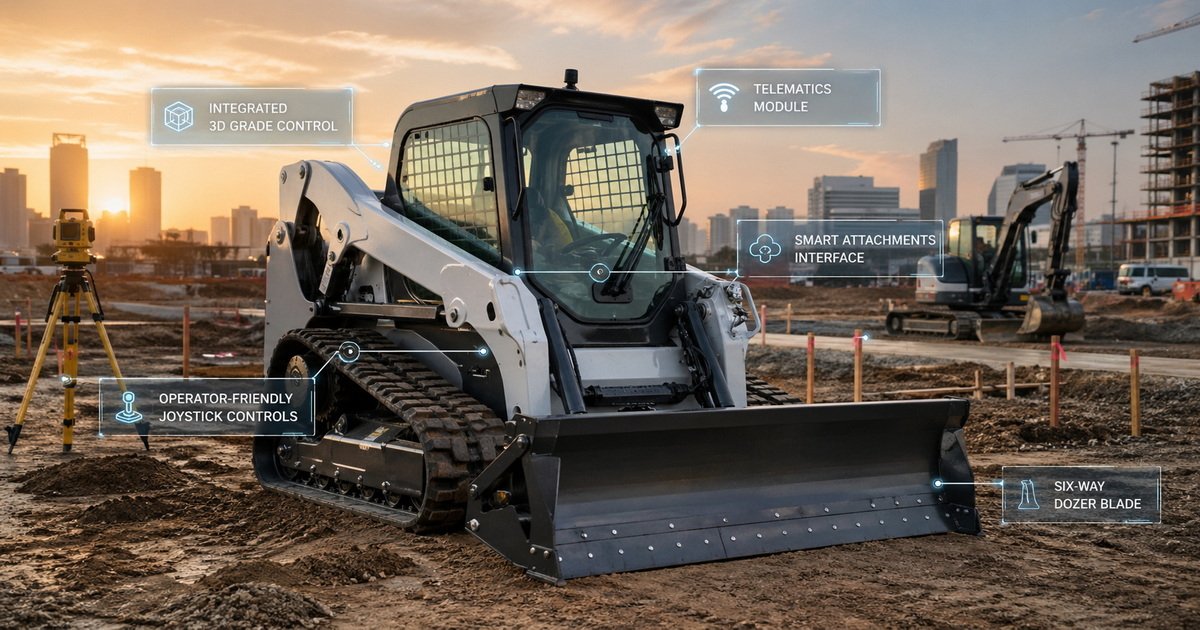
As someone who has spent years walking job sites, talking with operators and helping OEMs refine their machines, I can say this with confidence: next-gen compact track loaders are no longer just “small loaders” — they are precision grading tools, data hubs and profit machines in one package. The John Deere 333G SmartGrade is one of the clearest examples of where the entire skid steer and track loader market is heading — toward integrated intelligence, fewer passes and higher ROI per hour on site. [compactequip]
What Makes a Track Loader “Next-Gen”?
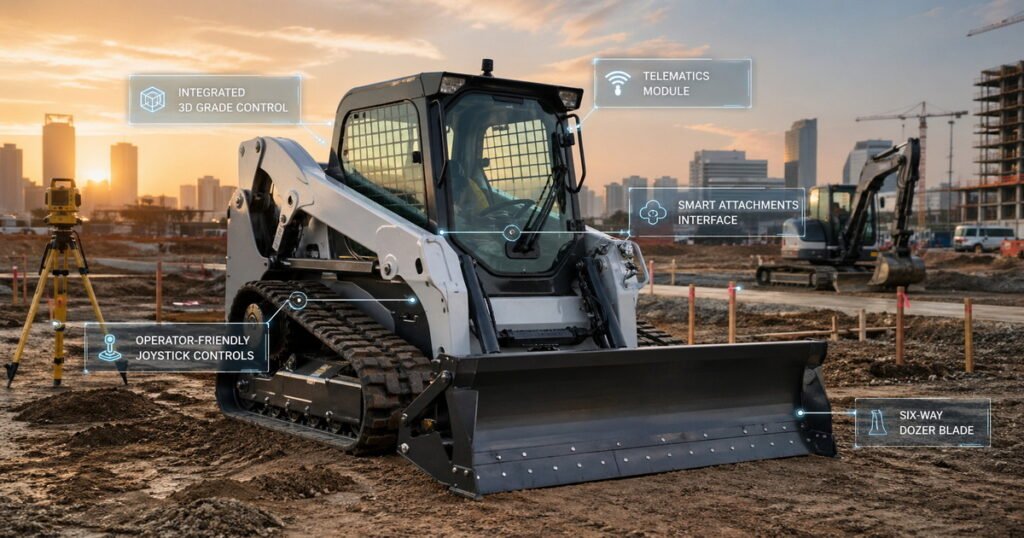
Modern compact track loaders and skid steers are evolving from purely mechanical workhorses into digitally assisted, application‑specific tools designed for grading, loading and site prep in tight environments. [futuremarketinsights]
Manufacturers are leading this shift in several ways: [deere]
– Integrating 2D and 3D grade control into the machine from the factory, instead of relying only on bolt‑on laser systems.
– Designing hybrid platforms such as “compact dozer loaders” that merge a CTL chassis with a true six‑way dozer blade.
– Adding “smart” attachments that communicate with the machine to unlock tailored control modes and semi‑automation.
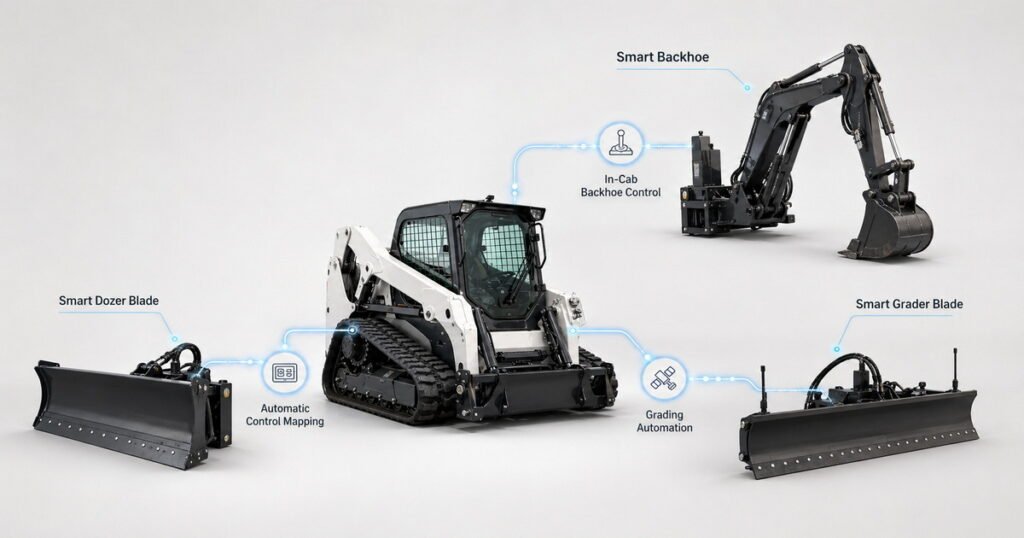
Case’s DL550B, for example, combines the footprint of a compact track loader with a dozer C‑frame and blade, backed by full 2D and 3D machine control for grading and loading. Caterpillar’s Smart Dozer Blade, Grader Blade and Backhoe for D3 Series track loaders and skid steers automatically adapt the machine’s control layout to each attachment and introduce grader automation and in‑cab backhoe control. [compactequip]
From a contractor’s standpoint, the common thread is clear: more precise work in fewer passes, with less operator fatigue and a shorter learning curve for new hires. [deere]
Inside John Deere’s 333G SmartGrade Compact Track Loader
The John Deere 333G SmartGrade is among the first compact track loaders to ship with fully integrated 3D grade control as a factory option, not a dealer add‑on. That matters because integration is what allows the machine, the attachment and the guidance system to behave like a single, coherent grading platform. [compactequip]
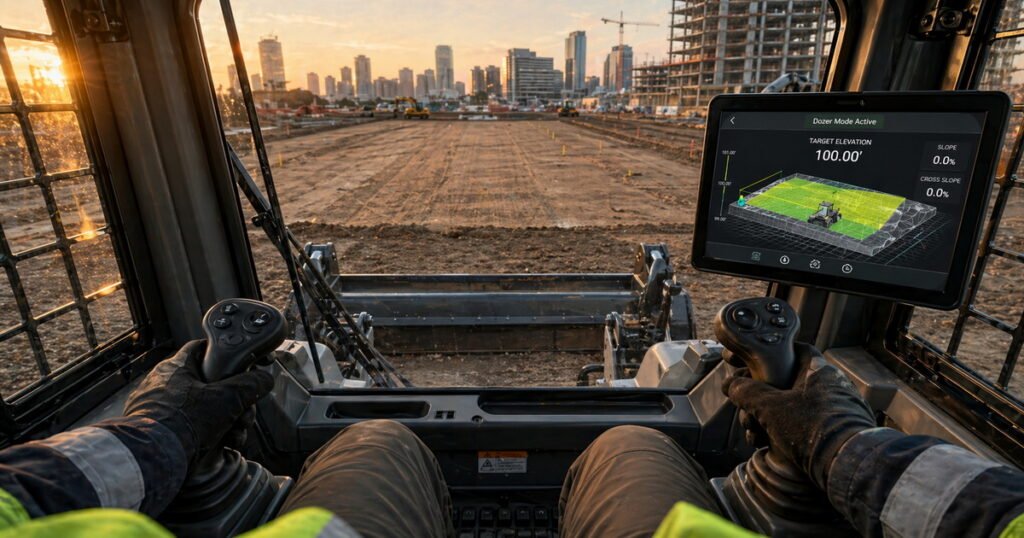
Key elements of the 333G SmartGrade package include: [deere]
– SmartGrade 3D control: Uses GNSS and a digital terrain model to guide the blade to finished grade automatically.
– DozerMode controls: With a button press, the EH joystick mimics a crawler dozer pattern, helping dozer‑trained operators feel at home.
– John Deere six‑way dozer blade: A purpose‑built attachment that can cut grade and spread material with 2D/3D automation from Topcon. [compactequip]
During the product launch, Deere’s construction and forestry marketing team emphasized that SmartGrade was designed not just for large contractors, but also for smaller site development, road building and landscaping firms that need dozer‑level accuracy in a compact footprint. In practical terms, that means fewer passes, fewer re-worked areas and fewer survey callbacks, especially on parking lots, building pads and fine‑grading around structures. [deere]
Smart Attachments and the Rise of the “Configurable Loader”
Caterpillar’s Smart Attachments illustrate another pillar of the next‑gen track loader story: configurable control intelligence in the attachment ecosystem. [compactequip]
Cat’s Smart Dozer Blade, Grader Blade and Backhoe do more than bolt onto a coupler: [compactequip]
– The loader recognizes the attachment and automatically re‑maps hydraulic functions and joystick commands.
– The Smart Grader Blade can run automation routines to maintain grade with minimal operator input.
– The Smart Backhoe lets the operator use the loader’s in‑cab controls instead of traditional backhoe levers, simplifying training.
As a UX‑driven content strategist, this is an important story to tell buyers: you are no longer buying an isolated machine — you are buying into a smart attachment ecosystem that future‑proofs your investment and simplifies fleet standardization. [compactequip]
Why Compact Loaders Are Gaining Strategic Importance
From 2026 onward, compact loaders are expected to grow steadily as urbanization, tight job sites and labor constraints intensify. Several market reports point in the same direction: [fortunebusinessinsights]
– The global compact loader market is valued around 5.6 billion USD in 2026, with projections rising to roughly 7.6 billion USD by 2036 at a CAGR of about 3.1 percent. [futuremarketinsights]
– Another analysis projects compact loader revenues climbing from about 10.78 billion USD in 2026 to more than 15.58 billion USD by 2033 at roughly 5.4 percent CAGR. [coherentmarketinsights]
– Compact wheel loaders alone are estimated to account for over 70 percent of segment share, driven by construction, mining, agriculture and urban development. [fortunebusinessinsights]
The strategic takeaway for contractors and fleet owners is that compact equipment is no longer peripheral — it is a core productivity platform, especially on constrained or urban sites where full‑size dozers and loaders are impractical. This is precisely where high‑tech track loaders like the 333G SmartGrade and advanced skid steers plug into the long‑term demand curve. [coherentmarketinsights]
What These Trends Mean for Buyers
From the perspective of an equipment strategist advising fleets, next‑gen track loaders change the calculus of machine selection in three important ways: [futuremarketinsights]
1. Capex vs. versatility
A fully‑featured compact track loader with SmartGrade can replace or defer the purchase of a dedicated small dozer on certain projects. That means one machine covers grading, backfilling, loading and support work with quick attachment changes.
2. Productivity per operator hour
When the machine’s 3D system takes over fine grade control, less‑experienced operators can produce near‑expert results. This mitigates the impact of skilled labor shortages and shortens the payback period.
3. Data and risk management
Integrated grade control and telematics help document the as‑built surface and fuel usage, and support remote diagnostics. This reduces disputes over grade accuracy and minimizes unexpected downtime.
For OEMs like Certeg — especially those offering both track and wheel skid steer loaders — it is critical to communicate how your platforms align with this market direction: integrated control readiness, attachment ecosystems, and application‑specific packages for construction, landscaping and municipal work. [fortunebusinessinsights]
How Contractors Should Evaluate Next-Gen Track Loaders
When I walk a customer through a buying decision, we focus on use cases, control intelligence and total lifecycle cost, not just horsepower and bucket capacity. [coherentmarketinsights]
Use this simple evaluation framework:
1. Define your core jobs
– Site development, road building, fine grading, landscaping or mixed fleet support.
– Confined urban work vs. open rural sites.
2. Match undercarriage and platform
– Compact track loader for soft soils, slopes and all‑weather traction.
– Wheel skid steer for hard surfaces, yards and frequent roading between sites. [futuremarketinsights]
3. Assess control technology level
– No automation: Basic hydraulics and manual grading.
– 2D grade control: Laser or cross‑slope support for pads and simple slopes.
– Fully integrated 3D control: Needed when tolerances are tight and designs are complex, like multifamily foundations or road projects. [deere]
4. Evaluate attachment ecosystem
– Dozer blades, graders and backhoes that integrate with the machine’s controls.
– Compatibility with existing buckets, forks and specialty tools across your fleet.
5. Plan for operator onboarding
– Check how quickly a new operator can become productive in DozerMode or Smart attachment modes.
– Confirm dealer training, demo programs and after‑sales support.
By framing the purchase this way, buyers quickly see where next‑gen track loaders deliver hard, measurable benefits versus conventional units. [fortunebusinessinsights]
Compact Track Loader vs. Skid Steer: Choosing the Right Platform
Below is a concise comparison that many of your visitors will look for when considering Certeg’s track and wheel platforms. [coherentmarketinsights]
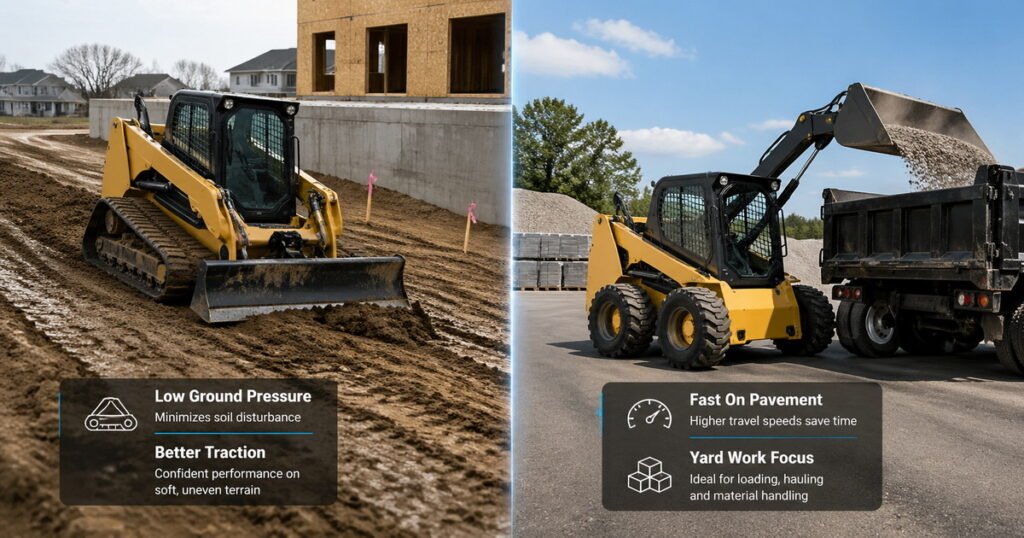
Operational Focus: Track Loader vs. Wheel Skid Steer
| Factor | Compact Track Loader (e.g., 333G SmartGrade) | Wheel Skid Steer Loader |
|---|---|---|
| Ground conditions | Soft, muddy, uneven terrain; slopes futuremarketinsights | Paved yards, concrete, compacted base fortunebusinessinsights |
| Ride and traction | Smoother ride, higher traction under load futuremarketinsights | Faster on hard surfaces, agile in yards fortunebusinessinsights |
| Ground pressure | Low ground pressure, reduced rutting futuremarketinsights | Higher pressure, more surface wear fortunebusinessinsights |
| Ideal applications | Fine grading, site prep, landscaping compactequip | Material handling, loading trucks, yard work fortunebusinessinsights |
| Undercarriage cost | Higher initial cost, track maintenance futuremarketinsights | Lower initial cost, simpler maintenance fortunebusinessinsights |
| Control tech adoption | Early adopter of integrated 3D grade control compactequip | Increasingly available but less common today futuremarketinsights |
When positioning your own Certeg lineup, anchor the narrative in application fit and total cost per finished cubic meter moved, not just machine price.
How to Communicate Experience and Authority in Equipment Content
From a Google E‑E‑A‑T standpoint, construction equipment content performs best when it clearly demonstrates real‑world experience, deep expertise and verifiable data. [venntov]
Here are practical ways to embed that into your skid steer and track loader articles: [jiemian]
– Show first‑hand experience: Reference field demos, operator interviews or internal test projects instead of rewriting spec sheets.
– Cite independent data: Link to market reports and technical documents when discussing industry growth or performance claims. [futuremarketinsights]
– Structure content for AI and search: Use clear H2 and H3 headings that map to real user questions (e.g., “How Does 3D Grade Control Reduce Rework?”).
– Add social proof: Highlight customer case stories, ROI outcomes or quotes from project managers.
In short, the more your article sounds like it was written by someone who actually runs machines and manages projects, the more trust it earns — both from human readers and search engines. [eesel]
How 3D Grade Control Changes the Economics of Small Jobs
One of the biggest misconceptions I hear is that 3D grade control is “overkill” for compact loaders and small jobs. In reality, that is precisely where it can transform margins.
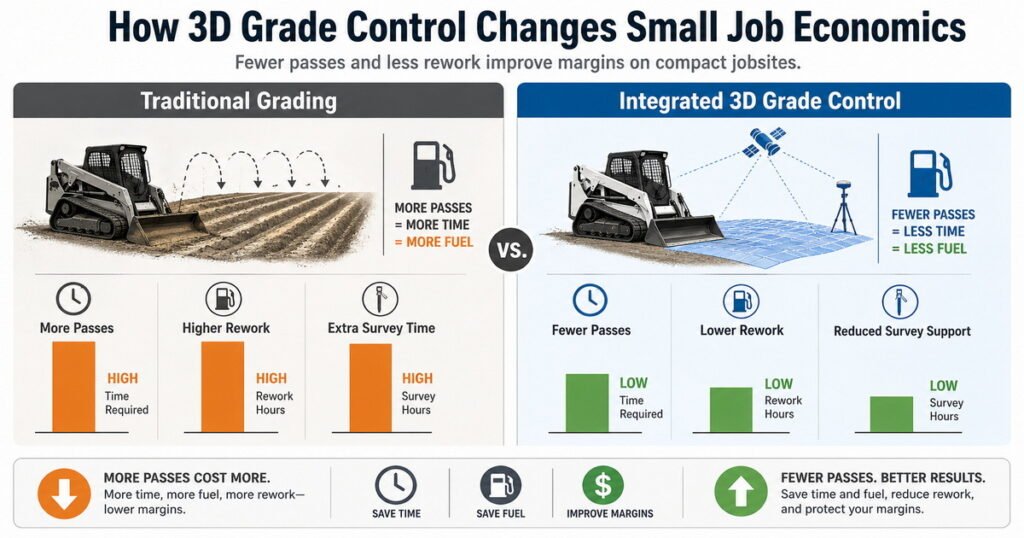
On tight urban sites, crews often lose time to staking, checking, re‑checking and fixing overcuts and low spots around structures and utilities. With an integrated system like SmartGrade, the operator sees the model directly in the cab, and the blade automatically maintains the target elevation within a tight tolerance. [coherentmarketinsights]
Typical benefits owners report on compact machines with integrated grade control include: [futuremarketinsights]
– Fewer passes to reach final grade, especially on multi‑slope pads.
– Reduced need for survey support and re‑staking on repetitive work.
– Less material waste from over‑excavation and over‑filling.
– More predictable day‑to‑day productivity, simplifying scheduling.
For a contractor running a few skid steers or track loaders, these efficiencies often return the technology investment within a season, particularly in busy site development or subdivision work. [coherentmarketinsights]
Implementation Playbook for Fleet Managers
If you manage a mixed fleet and want to bring next‑gen track loaders or high‑tech skid steers into your operation, follow this staged rollout approach: [fortunebusinessinsights]
1. Pilot on a high‑impact crew
Assign the first SmartGrade‑equipped CTL to a foreman who is open to technology and works high‑visibility projects. Track key metrics like passes per job, rework incidents and survey call‑backs.
2. Standardize attachments and models
Limit your lineup to a small set of loader models and “smart‑ready” attachments. This reduces training complexity and simplifies spare parts and maintenance.
3. Build internal champions
Encourage early adopters to train other operators. Capture short internal videos explaining how to use DozerMode, set up 3D jobs and swap automated attachments safely.
4. Integrate telematics and reporting
Connect grade control and telematics data to your project management systems so that hours, fuel and work quantities support bidding and job costing.
5. Review yearly upgrade paths
As new versions of grade control software, joysticks and sensors arrive, align hardware upgrades with major machine replacement cycles to avoid fragmented tech across the fleet.
This structured rollout ensures your investment in next‑gen track loaders and skid steers translates into repeatable, fleet‑wide productivity gains, rather than isolated “techy” machines on the lot. [fortunebusinessinsights]
Clear Call to Action for Certeg
Ready to move beyond “good enough” grading and turn your compact loaders into true profit machines? Talk to the Certeg engineering team today to configure a next generation compact track loader or skid steer package — including smart ready attachments and control options — tailored to your soil conditions, applications and export market.
Share a recent project or typical site challenge with us, and we will recommend a track or wheel loader configuration that cuts passes, reduces rework and accelerates operator ramp up, so your next bid is both more competitive and more predictable.
FAQs About Next-Gen Track Loaders and Smart Skid Steers
1. Do I really need 3D grade control on a compact track loader?
For small, one‑off jobs with loose tolerances, you may be fine with manual grading or basic 2D systems. But if you regularly build pads, parking lots or road sections to a known design, integrated 3D control can cut passes, rework and survey costs enough to justify the investment within a season. [futuremarketinsights]
2. What is the difference between a compact track loader and a skid steer?
A compact track loader uses rubber tracks, offering lower ground pressure and better traction on soft or uneven surfaces, while a skid steer uses wheels and excels on hard surfaces and yard work. Track loaders generally cost more upfront but can operate longer in poor underfoot conditions with less surface damage. [fortunebusinessinsights]
3. How does DozerMode help my operators?
DozerMode on machines like the 333G SmartGrade remaps the EH joystick layout so it feels like a crawler dozer, making it easier for dozer‑experienced operators to transition to a compact track loader without relearning control habits. [deere]
4. Are smart attachments worth the price premium?
Smart attachments like Cat’s Smart Dozer Blade, Grader Blade and Backhoe enable automatic control mapping, grading automation and in‑cab control functions that can significantly reduce training time and boost precision. For contractors that frequently change attachments or run multiple operators, the time savings and higher finish quality often outweigh the added cost. [compactequip]
5. How is the compact loader market expected to grow?
Industry research suggests that the compact loader market will grow steadily through the 2030s, with estimates ranging from about 3 to 5 percent CAGR depending on segment and region. Growth is supported by urban construction, infrastructure upgrades and the need for maneuverable, versatile equipment on constrained sites. [coherentmarketinsights]
References
1. Compact Equipment – “Next Gen Track Loaders: John Deere’s 333G SmartGrade Joins the League of High-Tech Compact Loaders” [compactequip]
2. John Deere – “333G Compact Track Loader Specifications and SmartGrade Information” – Product PDF – [https://www.deere.com/assets/pdfs/common/products/sync/DKAGCTL333-333G-compact-track-loader.pdf] [deere]
3. Future Market Insights – “Compact Loader Market: Global Market Analysis Report 2036” [futuremarketinsights]
4. Fortune Business Insights – “Compact Loader Market Size, Share, Growth Report 2034” [fortunebusinessinsights]
5. Coherent Market Insights – “Compact Loader Market Size, Trends & Forecast 2026–2033” [coherentmarketinsights]
6. Venntov – “Experience Matters: How to write content for Google’s EEAT guidelines” [venntov]
7. eesel AI – “A Practical Guide to SEO for Construction Companies” [eesel]
Hot Tags: Skid Steer Loader, Manufacturers, Customized, Custom, Suppliers, Buy, Cheap, Quality, Advanced, Durable, in Stock, Made in China, Price, Quotation