
Top Landscaping Attachments for Skid Steers & Track Loaders in 2025–2026
Content Menu
● Why Skid Steers & Track Loaders Dominate Modern Landscaping
>> 2. Superior Maneuverability
● Core Landscaping Attachments for Skid Steers & Track Loaders
>> 1. Trenchers: Fast, Clean Utility & Irrigation Trenching
>> 2. Rotary Tillers: Preparing Perfect Seedbeds & Garden Beds
>> 3. Powered Landscape Rakes: Smoothing, Leveling & Debris Removal
>>> When to Use a Powered Rake
>> 4. Seeders: Fast, Even Grass & Ground Cover Installation
>> 5. Smart Box Blades & Laser Graders: Precision Grading for Sports Fields & Foundations
>>> What They Do
>>> When to Use Smart Grading Tools
● Advanced & Specialty Attachments for Maximum Productivity
>> 1. Augers: Fast, Accurate Hole Digging for Posts & Trees
>> 2. Grapples: Handling Rocks, Logs & Debris Efficiently
>> 3. Brush Cutters & Mulchers: Clearing Overgrown Areas
>>> When to Use a Brush Cutter
>> 4. Pallet Forks & Material Handlers: Moving Hardscape & Supplies
● How to Choose the Right Attachments for Your Skid Steer or Track Loader
>> 1. Match Attachment Size to Machine Size
>> 2. Consider Soil Type and Job Conditions
>> 3. Prioritize Quick‑Change Systems
>> 4. Calculate ROI: Labor Savings vs. Attachment Cost
● Real‑World Case Study: How a Landscaping Company Doubled Productivity
● How Certeg Supports Your Landscaping Business
● Action Step: Build Your Ideal Landscaping Fleet
● Frequently Asked Questions (FAQ)
>> 1. What are the most essential landscaping attachments for a skid steer?
>> 2. Can I use the same attachments on both skid steers and compact track loaders?
>> 3. How do I choose between a skid steer and a track loader for landscaping?
>> 4. Are smart grading systems worth the investment for landscaping?
>> 5. How can I maximize the ROI of my landscaping attachments?
For landscape contractors, skid steer loaders and compact track loaders are no longer just “small loaders” — they’re versatile, multi‑tasking platforms that can replace several dedicated machines on a jobsite. With the right landscaping attachments, a single Certeg skid steer or track loader can handle everything from site prep and grading to planting, trenching, and cleanup.
This guide covers the most effective landscaping attachments for skid steers and track loaders in 2025–2026, including:
– Core attachments every landscaper needs
– Advanced “smart” tools for precision work
– How to match attachments to soil type and job size
– Real‑world productivity gains and ROI tips
Whether running a small residential crew or a large commercial landscaping business, this article will help choose the right tools to maximize uptime, reduce labor, and win more bids.
Why Skid Steers & Track Loaders Dominate Modern Landscaping
Before diving into specific attachments, it’s worth understanding why skid steers and compact track loaders have become the backbone of modern landscaping operations.
1. Unmatched Versatility
A single Certeg skid steer or track loader can perform dozens of different tasks simply by changing attachments:
– Clearing brush and debris
– Trenching for irrigation and utilities
– Preparing seedbeds and lawns
– Installing pavers, retaining walls, and fences
– Snow removal and site cleanup
This versatility means fewer machines on the jobsite, lower transport costs, and faster job turnover.
2. Superior Maneuverability
Skid steers and compact track loaders are ideal for:
– Tight urban lots and backyard projects
– Working around existing structures, trees, and utilities
– Navigating soft or uneven ground (especially with rubber tracks)
Their compact size and zero‑turn capability let operators work efficiently in spaces where larger excavators or wheel loaders can’t go.
3. Lower Operating Costs
Compared to larger equipment, skid steers and track loaders typically offer:
– Lower fuel consumption
– Reduced wear on tires/tracks when switching between attachments
– Easier maintenance and lower repair costs
For landscaping businesses, this translates into higher profit margins per job.
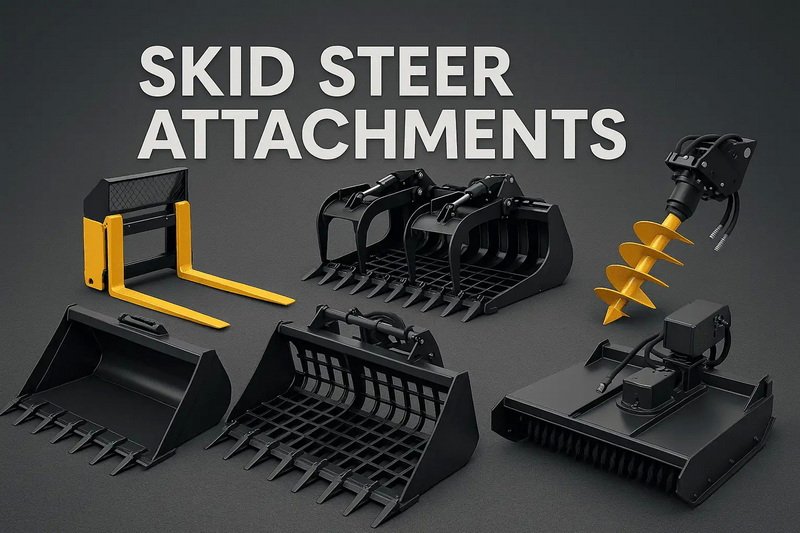
Core Landscaping Attachments for Skid Steers & Track Loaders
These are the “must‑have” attachments that form the foundation of any serious landscaping fleet.
1. Trenchers: Fast, Clean Utility & Irrigation Trenching
A skid steer or track loader trencher is essential for:
– Installing underground irrigation lines
– Running electrical, data, and gas lines
– Creating drainage trenches and French drains
Key Features to Look For
– Adjustable depth control (typically 3–6 ft)
– Multiple chain types for different soils (rock, clay, sand)
– Sealed bearings to resist dirt and moisture
– Reversible hydraulic motor to free the machine if it gets stuck
When to Use a Trencher
– On residential and commercial properties where trenching is frequent
– In areas with mixed soil conditions (rocky patches, compacted clay)
– When precision trench width and depth are required (e.g., for drip irrigation)
Pro Tip: Pair a trencher with a backfill blade or box blade to quickly backfill and grade the trench, reducing manual labor and speeding up the job.
2. Rotary Tillers: Preparing Perfect Seedbeds & Garden Beds
A skid steer or track loader tiller transforms compacted or rocky soil into a loose, workable seedbed for:
– Lawns and turf installation
– Vegetable gardens and flower beds
– Landscaping renovations and site prep
Key Features to Look For
– Bi‑directional operation (forward and reverse tines)
– Hydraulic offset capability to work close to walls and fences
– Depth gauge wheels for consistent till depth
– Ripper shanks to break up hardpan and compacted layers
When to Use a Tiller
– Before seeding or sod installation
– In areas with heavy clay or sun‑baked soil
– For large commercial projects where hand tilling is impractical
Pro Tip: For best results, till in two passes at right angles to create a uniform, clod‑free seedbed.
3. Powered Landscape Rakes: Smoothing, Leveling & Debris Removal
A powered landscape rake (also called a power box rake or Harley rake) is one of the most versatile tools in a landscaper’s arsenal. It can:
– Remove rocks, roots, and debris from the surface
– Grade and level soil for lawns, driveways, and walkways
– Pulverize clods and create a smooth, even finish
Key Features to Look For
– Wider than the machine to cover tracks and avoid ruts
– Carbide‑tipped teeth or studs for long wear life
– Gauge wheels to control depth and prevent over‑grading
– Bi‑directional operation and variable speed control
When to Use a Powered Rake
– After excavation or grading to clean and level the surface
– Before seeding or sod installation to create a perfect seedbed
– For sports fields, parks, and large commercial properties
Pro Tip: Angle the rake slightly to windrow rocks and debris, then use a bucket or grapple to remove them from the site.
4. Seeders: Fast, Even Grass & Ground Cover Installation
Once the soil is prepared, a skid steer or track loader seeder ensures:
– Consistent seed distribution
– Proper seed‑to‑soil contact for better germination
– Faster coverage than hand seeding
Key Features to Look For
– Large seed box with agitator to prevent bridging
– Ground‑drive system for accurate seed metering
– Front and rear rollers to press seed into the soil
– Forward and reverse operation for maximum flexibility
When to Use a Seeder
– On large lawns, sports fields, and commercial properties
– For erosion control and ground cover on slopes
– In combination with a tiller and powered rake for a complete seeding system
Pro Tip: Calibrate the seeder for the specific seed type and rate, and lightly topdress with straw or mulch to protect the seed.
5. Smart Box Blades & Laser Graders: Precision Grading for Sports Fields & Foundations
For jobs that demand exact grades and slopes, smart box blades and laser grading systems are game‑changers.
What They Do
– Perform rough and precision grading with one attachment
– Create perfectly flat surfaces for athletic fields, foundations, and pavements
– Reduce the need for manual staking and string lines
Key Features to Look For
– 2D or 3D laser receiver system for automatic blade control
– In‑cab controls to adjust grade and slope on the fly
– Floating front axle to maintain a level blade on uneven ground
– Hinged cutting edge for accurate grading in both directions
When to Use Smart Grading Tools
– Athletic fields, golf courses, and parks
– Commercial foundations, parking lots, and driveways
– Any project where a precise, repeatable grade is critical
Pro Tip: Even if a full 3D system isn’t in the budget, a 2D laser system can dramatically improve grading accuracy and reduce rework.
Advanced & Specialty Attachments for Maximum Productivity
Beyond the core tools, these advanced attachments let landscapers take on more complex jobs and stand out from the competition.
1. Augers: Fast, Accurate Hole Digging for Posts & Trees
A skid steer or track loader auger is ideal for:
– Fence posts, sign posts, and light poles
– Tree planting and shrub installation
– Footings for decks, pergolas, and small structures
Key Features to Look For
– Hydraulic motor with high torque for tough soils
– Multiple bit sizes (6–18 in) for different applications
– Depth gauge and adjustable skid shoes for consistent hole depth
When to Use an Auger
– On residential and commercial fencing projects
– For tree and shrub installation in large landscapes
– In areas with rocky or compacted soil where hand augers struggle
Pro Tip: Use a tree spade attachment for transplanting mature trees, then finish with an auger for smaller plantings.
2. Grapples: Handling Rocks, Logs & Debris Efficiently
Grapples (brush grapples, rock grapples, and root grapples) are essential for:
– Clearing brush, logs, and stumps
– Moving rocks and boulders for retaining walls and hardscapes
– Loading and unloading debris and mulch
Key Features to Look For
– High‑strength steel construction with replaceable wear parts
– Side plates that can be removed for oddly shaped loads
– Hydraulic rotation for precise placement
When to Use a Grapple
– Land clearing and site prep projects
– Hardscaping jobs involving stone and boulders
– Cleanup after storms or demolition
Pro Tip: Pair a grapple with a dump hopper or trailer to quickly move debris off the jobsite.
3. Brush Cutters & Mulchers: Clearing Overgrown Areas
For overgrown fields, rights‑of‑way, and property lines, brush cutters and mulchers:
– Cut through thick brush, small trees, and saplings
– Mulch vegetation in place, reducing disposal costs
– Prepare sites for grading and planting
Key Features to Look For
– Heavy‑duty push bar to knock down brush before cutting
– Helical tooth pattern for fine mulch and minimal ground disturbance
– Direct‑drive hydraulic motor for maximum power and reliability
When to Use a Brush Cutter
– Land clearing for new developments and utilities
– Maintenance of parks, trails, and easements
– Preparing overgrown lots for landscaping
Pro Tip: Use a stump grinder attachment after clearing to remove stumps below grade.
4. Pallet Forks & Material Handlers: Moving Hardscape & Supplies
Pallet forks and material handlers are critical for:
– Unloading pallets of pavers, retaining wall blocks, and stone
– Handling rolls of sod, mulch, and soil
– Moving tools, equipment, and supplies around the jobsite
Key Features to Look For
– Adjustable tines to fit different pallet sizes
– Rigid rear support for stability and visibility
– High lift capacity to handle heavy loads safely
When to Use Pallet Forks
– On hardscaping and paver projects
– For large commercial landscaping jobs with bulk materials
– In combination with a dump trailer or hopper for efficient material handling
Pro Tip: Use a sod layer attachment for large sod installations to reduce labor and improve consistency.

How to Choose the Right Attachments for Your Skid Steer or Track Loader
Selecting the right attachments isn’t just about the job — it’s about matching the tool to the machine, soil conditions, and business goals.
1. Match Attachment Size to Machine Size
– Small skid steers (under 1,500 lb operating weight) work best with light‑duty tillers, small trenchers, and compact rakes.
– Medium machines (1,500–2,500 lb) can handle larger tillers, trenchers, and powered rakes.
– Large skid steers and track loaders (over 2,500 lb) are ideal for heavy‑duty grapples, large augers, and brush cutters.
Always check the manufacturer’s recommended attachment weight and hydraulic flow requirements.
2. Consider Soil Type and Job Conditions
– Rocky or compacted soil: Use a trencher with rock chain, ripper shanks on the tiller, and a heavy‑duty grapple.
– Clay or wet soil: Choose a tiller with bi‑directional tines and a powered rake with gauge wheels to avoid rutting.
– Sandy or loose soil: A standard trencher chain and light‑duty rake are usually sufficient.
3. Prioritize Quick‑Change Systems
A universal quick‑attach coupler system lets operators:
– Switch attachments in minutes, not hours
– Use attachments from multiple brands on the same machine
– Reduce downtime and increase machine utilization
For Certeg machines, ensure attachments are compatible with the OEM coupler or a widely supported universal system.
4. Calculate ROI: Labor Savings vs. Attachment Cost
When evaluating an attachment, ask:
– How many hours of manual labor will it save per job?
– How many jobs per year will use this attachment?
– What is the payback period (attachment cost ÷ annual labor savings)?
For example, a powered rake that saves 4 hours of hand raking per job on 20 jobs per year can easily justify its cost in one season.
Real‑World Case Study: How a Landscaping Company Doubled Productivity
A mid‑sized landscaping contractor in the U.S. Midwest upgraded its fleet with Certeg skid steers and the following attachments:
– Trencher for irrigation and utilities
– Powered landscape rake for site prep and grading
– Seeder for lawns and sports fields
– Auger and grapple for fencing and tree work
Results after one season:
– 40% reduction in labor hours for site prep and grading
– 30% increase in jobs completed per month
– 25% higher profit margin due to lower labor and equipment costs
The key was using one machine with multiple attachments instead of relying on several dedicated machines and crews.
How Certeg Supports Your Landscaping Business
As a manufacturer of excavators, skid steer loaders, compact track loaders, rollers, forklifts, tractors, and track transporters, Certeg is built to meet the global demand for versatile, reliable construction machinery.
For landscaping and site‑work applications, Certeg skid steers and track loaders offer:
– Full hydraulic transmission for smooth, precise control
– Robust frames and undercarriages for tough job conditions
– Compatibility with a wide range of attachments for maximum flexibility
Whether a contractor, rental company, or distributor, Certeg can help:
– Choose the right machine size and configuration for the market
– Source or recommend high‑quality landscaping attachments
– Optimize the fleet for maximum uptime and ROI
Action Step: Build Your Ideal Landscaping Fleet
Ready to turn your Certeg skid steer or track loader into a landscaping powerhouse?
1. Audit current jobs — What tasks take the most time and labor?
2. Prioritize 2–3 core attachments (e.g., trencher, powered rake, seeder) that will deliver the fastest ROI.
3. Talk to your Certeg dealer or representative about machine compatibility, attachment options, and financing.
Contact Certeg today to discuss your landscaping equipment needs and get a tailored recommendation for your fleet.
Contact us to get more information!

Frequently Asked Questions (FAQ)
1. What are the most essential landscaping attachments for a skid steer?
For most landscapers, the core attachments are a trencher, rotary tiller, powered landscape rake, seeder, and auger. These cover site prep, grading, planting, and utility work on most residential and commercial jobs.
2. Can I use the same attachments on both skid steers and compact track loaders?
Yes, most skid steer attachments are compatible with compact track loaders that use the same quick‑attach coupler system. Always verify hydraulic flow and weight limits with the attachment and machine manuals.
3. How do I choose between a skid steer and a track loader for landscaping?
Choose a skid steer for hard surfaces, tight spaces, and high‑speed jobs. Choose a compact track loader for soft, wet, or sensitive ground where low ground pressure and traction are critical.
4. Are smart grading systems worth the investment for landscaping?
For jobs that require precise grades (sports fields, foundations, parking lots), a 2D or 3D laser grading system can significantly reduce rework and labor. For basic grading, a standard box blade or powered rake may be sufficient.
5. How can I maximize the ROI of my landscaping attachments?
Focus on attachments that replace the most manual labor (e.g., powered rake vs. hand raking, seeder vs. hand seeding). Track labor hours saved per job and calculate the payback period to justify each purchase.
Hot Tags:Skid Steer Landscaping Attachments, Track Loader Landscaping Attachments, Skid Steer Attachments For Landscaping, Landscaping Attachments For Track Loaders, Skid Steer Land Clearing Equipment, Compact Loader Landscaping Tools, Skid Steer Grapple Attachment, Skid Steer Brush Cutter Attachment, Skid Steer Landscape Rake, Heavy Duty Landscaping Attachments