
How to Match a High-Powered Brush Cutter to a Skid Steer or Track Loader in 2026
Content Menu
● What a Skid Steer Brush Cutter Really Does
● Core Keyword Strategy and Audience Focus
● Brush Cutter Types for Skid Steers and Track Loaders
>> Rotary Mulcher (Disc Mulcher)
>> Drum-Style Forestry Mulcher
● Matching Brush Cutter Width to the Carrier
● Understanding Hydraulic Flow and Attachment Requirements
● Cutting Capacity and Application Limits
● Skid Steers vs Compact Track Loaders for Brush Cutting
● Forestry Guarding and Machine Protection
● Operator Technique, Site Preparation and Safety
● Maintenance Practices That Extend Service Life
● Simple Framework for Choosing a Brush Cutter Setup
● Build a Safer, More Productive Brush-Cutting Setup
>> 1. What size brush cutter should I use on my skid steer?
>> 2. Do I need high-flow hydraulics for a high-powered brush cutter?
>> 3. Can I run a high-flow brush cutter on a standard-flow machine?
>> 4. How often should I service my skid steer brush cutter?
>> 5. Is a compact track loader better than a skid steer for brush cutting?
Equipping a skid steer or compact track loader with the right brush cutter turns overgrown land into profitable work while protecting your machine, operators and budget. A poor match between cutter, hydraulics and application leads to underperformance, downtime, and serious safety risks.[1]

What a Skid Steer Brush Cutter Really Does
A skid steer or track loader brush cutter is a hydraulically driven attachment designed to cut thick grass, brush and small trees in a single pass. When correctly matched, it allows one carrier to handle everything from pasture reclamation to roadside maintenance and forestry understory clearing.[1]
Key brush-cutter applications include:[1]
– Land clearing for construction and utilities
– Fence line and right-of-way maintenance
– Forestry understory and fuel-load reduction
– Site preparation for agriculture and landscaping
Modern brush cutters for skid steers and compact track loaders are engineered to integrate with standard-flow and high-flow hydraulics, giving owners multiple performance tiers and price points.[1]
Core Keyword Strategy and Audience Focus
This guide speaks to owners and buyers searching for high powered brush cutters for skid steers and compact track loaders and similar phrases, helping them make confident decisions in 2026. It focuses on real-world scenarios for contractors, rental fleets, municipalities and landowners who rely on compact equipment for frequent land-clearing work.[1]
Readers who benefit most include:[1]
– Contractors operating skid steers or compact track loaders year-round
– Municipal and utility crews maintaining corridors and roadsides
– Landowners reclaiming pastures, fence lines and field edges
– Rental fleet managers specifying versatile, durable brush cutter attachments
Brush Cutter Types for Skid Steers and Track Loaders
Brush-clearing attachments for compact equipment generally fall into three main designs, each with distinct performance characteristics.[1]
Rotary Blade Brush Cutter
A rotary blade cutter uses one to four heavy blades under a reinforced deck to cut and shred ground-level vegetation. This design suits tall grass, saplings and light to medium brush where speed and simplicity matter.[1]
Key traits:[1]
– Typically rated for trees in the 2–5 in diameter range, depending on flow and model
– Straightforward maintenance and familiar operation for most operators
– Competitive pricing for contractors entering brush-cutting work
Some heavy-duty rotary models are engineered to handle significantly larger saplings when operated within the recommended technique and duty cycle.[1]
Rotary Mulcher (Disc Mulcher)
Rotary mulchers use a heavy spinning disc with hardened teeth to cut and mulch brush and small trees. This design produces a finer mulch than many standard rotary decks and is often favored in land-clearing and vegetation management work.[1]
Typical advantages:[1]
– Strong performance in mixed brush and small trees
– Aggressive cutting action with good material processing
– Effective for jobs requiring more thorough mulching of tops and slash
Because of the higher inertia and tooth systems, these heads generally demand more robust hydraulics and careful attention to operating technique.[1]
Drum-Style Forestry Mulcher
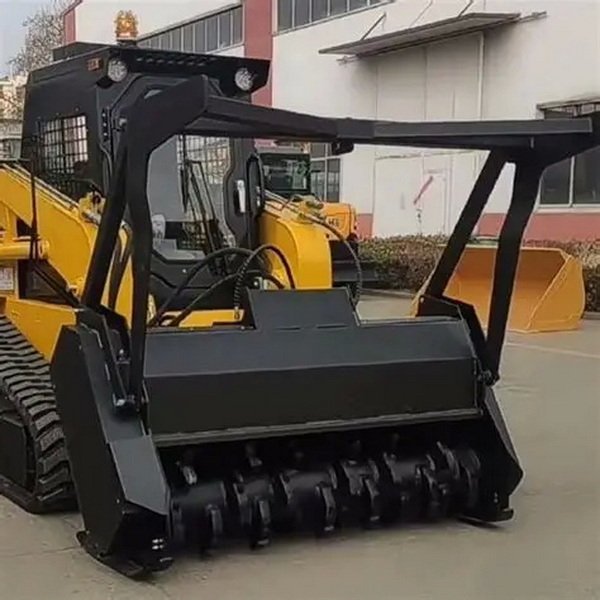
Drum mulchers use a horizontal drum fitted with teeth to grind trees and dense brush into fine mulch. These tools are often chosen for the heaviest land-clearing projects and right-of-way vegetation control.[1]
Key characteristics:[1]
– Designed for consistent, deep cutting in heavy material
– Often paired with high-flow or enhanced high-flow carriers
– Typically used in forestry, pipeline and utility corridor work
Some knife-style drum systems are optimized to work efficiently on both standard-flow and high-flow skid steers or compact track loaders when paired correctly.[1]
Matching Brush Cutter Width to the Carrier
Cutting width affects coverage, stability and power use, so it should be aligned with the carrier rather than selected purely for maximum path size.[1]
Important considerations:[1]
– The loader’s rated operating capacity must safely handle the attachment weight, including debris buildup.
– Wider decks increase power demand and can overload undersized hydraulic systems.
– Transport and site access constraints may favor mid-size widths even on larger carriers.
Compact and mid-frame machines often work well with narrower or mid-width cutters, while larger skid steers and compact track loaders can support wider decks when hydraulics and lift capacity align.[1]

Understanding Hydraulic Flow and Attachment Requirements
Hydraulic flow and pressure largely determine how much work a brush cutter can perform in a given time. Matching the attachment to the machine’s auxiliary hydraulic system prevents performance issues and component damage.[2]
Common auxiliary hydraulic categories:[2]
– Standard-flow systems suited to lighter brush-cutting and utility tasks
– High-flow or enhanced high-flow systems engineered for power-hungry tools such as heavy brush cutters and forestry mulchers
Key matching steps:[2]
– Confirm the machine’s flow and pressure specifications for the auxiliary circuit.
– Compare those values to the brush cutter’s required flow range and pressure rating.
– Ensure any case-drain requirements and motor protection features are met.
Running a high-demand cutter on a low-flow machine leads to slow rotor speeds, poor cutting and potential overheating, while oversupplying flow or pressure can damage the cutter’s hydraulic motor and related components.[2]
Cutting Capacity and Application Limits
Brush cutters and mulchers are rated for maximum cutting diameter, which indicates the largest typical tree size they are designed to process under proper operation.[1]
Typical capacity bands:[1]
– Light-duty grass and brush units geared toward small vegetation
– Standard-duty cutters targeting moderate brush and small saplings
– Heavy-duty and forestry heads capable of handling larger saplings and small trees
Respecting these limits reduces stress on blades, teeth, gearboxes and loader arms and helps owners avoid costly repairs and downtime.[1]
Skid Steers vs Compact Track Loaders for Brush Cutting
Both skid steers and compact track loaders can power high-output brush cutters, but their undercarriage designs make them better suited to different conditions.[3]
Skid steers generally excel on:[3]
– Hard, flat or paved surfaces
– Jobs with frequent travel on firm ground
– Operations where initial purchase cost is a major factor
Compact track loaders typically perform better on:[3]
– Soft, uneven or sloped terrain
– Forestry and land-clearing projects with loose soil or debris
– Sites where reduced ground disturbance and improved traction are priorities
Contractors often choose skid steers for mixed construction work and compact track loaders for the most demanding brush and mulching applications, especially when combined with high-flow hydraulics and guarding.[3]
Forestry Guarding and Machine Protection
High-powered brush cutting produces flying debris, dust and impact hazards, so carrier guarding is a central part of a safe setup.[4]
Common guarding elements include:[4]
– Front door systems with impact-resistant glazing
– Protective guards for cab windows, work lights and hydraulic components
– Reinforced structures around the cab top and engine bay
– Additional shielding for hoses and vulnerable lines in the front frame
Machines offered in forestry or brush-clearing configurations often integrate these protections with high-flow hydraulics, upgraded cooling systems and robust frames, making them well aligned with drum mulchers and extreme-duty rotary cutters.[4]
Operator Technique, Site Preparation and Safety
Consistent results with a high-powered brush cutter depend on operator skill, site assessment and adherence to safety practices.[5]
Core operating habits that support safe, productive work:[5]
– Inspect the job site on foot and identify wire, rocks, stumps and hidden obstacles.
– Establish and respect exclusion zones to protect personnel and property.
– Start with conservative cutting speeds, adjusting advance rate as the machine and attachment respond.
Best practice also includes keeping the cutter deck low and stable, avoiding steep or unstable slopes that may compromise balance, and performing a controlled cooldown period before shutdown when the attachment and hydraulics have been under heavy load.[5]
Maintenance Practices That Extend Service Life
Brush cutters and mulchers work in demanding conditions, so regular maintenance is essential to preserve performance and manage lifecycle cost.[5]
Typical maintenance focus areas:[5]
– Daily checks of blades or teeth, fasteners, hoses and guards
– Scheduled greasing of bearings and inspection of belts or drive systems
– Periodic replacement or rotation of cutting edges and wear components
Following the manufacturer’s maintenance schedule and documenting work performed supports reliability and can help with warranty compliance and resale value.[5]
Simple Framework for Choosing a Brush Cutter Setup
A structured framework helps match the right brush cutter to the machine and application.[6]
Key decision steps:[6]
– Define primary vegetation type and desired finish.
– Align attachment design with machine hydraulic capacity and lift capabilities.
– Assess terrain, slope and soil conditions to choose between wheels and tracks.
– Specify guarding and cab protection appropriate to debris and tree size.
– Evaluate purchase and ownership costs against expected utilization and revenue.
Using this type of framework makes it easier for contractors, fleet managers and landowners to justify their investment and select attachments and carriers that work together efficiently.[6]
Build a Safer, More Productive Brush-Cutting Setup
To make brush-cutting work profitable and sustainable, align the attachment type, hydraulic capacity, machine platform and guarding level with the vegetation and terrain you face every season. Use the selection framework above to define your requirements, then work with your equipment supplier to choose a skid steer or compact track loader and brush cutter combination that delivers reliable performance, protects operators and simplifies maintenance for long-term success.Contact us to get more information![6]

Frequently Asked Questions
1. What size brush cutter should I use on my skid steer?
The size should match the machine’s rated operating capacity and hydraulic output, not just the physical width you can mount. Many mid-size machines operate effectively with cutters in the 60–72 in range, balancing coverage with power demands and stability.[1]
2. Do I need high-flow hydraulics for a high-powered brush cutter?
High-flow hydraulics are often recommended for heavy-duty rotary cutters and forestry mulchers, especially when frequent tree cutting is expected. Standard-flow systems can power lighter-duty cutters for grass and brush, but higher-flow circuits generally unlock faster recovery and more aggressive cutting in dense material.[2]
3. Can I run a high-flow brush cutter on a standard-flow machine?
Running a high-flow brush cutter on a standard-flow skid steer or compact track loader usually results in poor rotor speed and potential overheating, and may damage hydraulic components. Matching the attachment’s flow and pressure requirements with the carrier’s auxiliary specifications is critical before connecting and operating the tool.[2]
4. How often should I service my skid steer brush cutter?
Skid steer brush cutters normally require daily inspection and cleaning, particularly after working in heavy vegetation. Additionally, following the manufacturer’s recommended greasing intervals and scheduled replacement of belts, blades or teeth helps prevent unplanned downtime and premature wear.[5]
5. Is a compact track loader better than a skid steer for brush cutting?
A compact track loader usually offers better traction and stability in soft, uneven or forested terrain, making it a strong choice for intensive brush-cutting projects. Skid steers may still be preferred on hard, level ground or where lower purchase cost and faster travel on firm surfaces are priorities.[3]
Citations:
[1] https://www.perplexity.ai/search/d24b5c44-aaff-457a-9a57-c142df4d46b0
[2] https://www.perplexity.ai/search/7b3c992f-22d3-47f7-8cc9-b73e5d642fd7
[3] https://www.perplexity.ai/search/f0efeea6-8bb3-4342-b1f2-b18cfa010587
[4] https://www.perplexity.ai/search/0ffdd51c-ce86-4aeb-ab9d-222848ebc895
[5] https://www.perplexity.ai/search/78069b69-c943-4541-943a-3bfa252b5645
[6] https://www.perplexity.ai/search/69058c1c-f08d-42e3-b9fc-36bbb9c30d62
Hot Tags:Skid Steer with Brush Cutter, Brush Cutters for Skid Steers, Skid Steer Brush Cutter, High Powered Brush Cutter, Brush Cutter For Track Loader, Skid Steer Brush Cutter Attachment, Hydraulic Brush Cutter Skid Steer, Forestry Brush Cutter Loader, Heavy Duty Brush Cutter Attachment, Skid Steer Land Clearing Equipment