
Choosing the Right Skid Steer Loader & Attachments for Your Job (2025 Guide)
Content Menu
● Why Skid Steer Loaders Are Still Essential in 2025
● 1. Define Your Primary Application First
>> Common Skid Steer Applications
● 2. Choose the Right Skid Steer Size & Capacity
>> Skid Steer Size Classes (2025)
● 3. Vertical Lift vs. Radial Lift: Which Is Right for You?
● 4. Tracks vs. Wheels: Matching Ground Conditions
>> Compact Track Loaders (CTLs)
● 5. Hydraulic Flow & Attachment Compatibility
>> Understanding Hydraulic Flow
>> Attachment Compatibility Checklist
● 6. Controls, Cab, and Operator Comfort
● 7. Choosing the Right Skid Steer Attachments
>> Step 1: Match Attachments to Your Applications
>> Step 2: Size and Weight the Attachment Correctly
>> Step 3: Prioritize Quality and Durability
● 8. Certeg Skid Steer Loaders: Built for Global Construction Needs
● 9. Practical Selection Checklist (2025)
● 10. Get the Right Skid Steer for Your Fleet
● Frequently Asked Questions (FAQ)
>> 1. What is the difference between a skid steer loader and a compact track loader (CTL)?
>> 2. How do I know if an attachment is compatible with my skid steer?
>> 3. Should I choose a vertical lift or radial lift skid steer for landscaping?
>> 4. What hydraulic flow do I need for a trencher or auger?
>> 5. Can I use the same attachments on different brands of skid steers?
If you’re in construction, landscaping, agriculture, or any industry that moves dirt, debris, or materials, a skid steer loader is one of the most versatile machines you can own. But simply buying “a skid steer” isn’t enough — the real value comes from matching the right machine size, lift type, and attachments to your specific jobs and terrain.
This guide walks you through every step of choosing the right skid steer loader and attachments, using real‑world data, 2025 market trends, and practical selection criteria. Whether you’re comparing Certeg, Bobcat, Caterpillar, or other brands, this will help you make a smarter, more profitable decision.

Why Skid Steer Loaders Are Still Essential in 2025
Skid steer loaders remain the backbone of compact equipment fleets worldwide, and for good reason:
– Unmatched versatility – A single skid steer can handle digging, grading, lifting, snow removal, and land clearing when paired with the right attachments.
– Compact footprint – They fit in tight spaces where larger loaders can’t go, making them ideal for urban construction, landscaping, and warehouse work.
– High ROI – With low operating costs and the ability to run multiple attachments, skid steers deliver strong productivity per dollar invested.
In 2025, the market is shifting toward:
– Higher hydraulic flow (25–35+ GPM) to power demanding attachments like trenchers and mulchers.
– More vertical‑lift models for material handling and truck loading.
– Increased use of compact track loaders (CTLs) on soft or sensitive ground.
Choosing the right skid steer and attachments isn’t just about specs — it’s about matching the machine to your work, your site conditions, and your long‑term productivity goals.
1. Define Your Primary Application First
Before looking at specs, clearly define what you’ll use the skid steer for most of the time. This drives every other decision: size, lift type, tracks vs. wheels, and attachments.
Common Skid Steer Applications
| Application | Typical Tasks | Key Machine Needs |
|---|---|---|
| Construction | Loading trucks, moving materials, digging, backfilling, demolition | Medium–large frame, vertical lift, high ROC, high-flow hydraulics |
| Landscaping | Grading, moving soil/rock, stump removal, mulching, snow removal | Small–medium frame, radial or vertical lift, good visibility, versatile attachments |
| Agriculture & Farming | Manure handling, bale moving, fencing, light excavation | Medium frame, radial lift, good traction, durable tires/tracks |
| Site Preparation & Lot Clearing | Tree removal, brush clearing, debris hauling, grading | Medium–large frame, high breakout force, grapples, mulchers, rakes |
| Material Handling & Warehousing | Pallet moving, loading/unloading, stacking | Vertical lift, high ROC, fork attachments, smooth ride, good visibility |
If your work is split across multiple applications (e.g., 40% construction, 30% landscaping, 30% material handling), prioritize the heaviest or most frequent task, then choose a machine that can still handle the others reasonably well.
2. Choose the Right Skid Steer Size & Capacity
Skid steers are typically grouped into three size classes. Matching the right size to your workload prevents underperformance and unnecessary wear.
Skid Steer Size Classes (2025)
| Size Class | Rated Operating Capacity (ROC) | Typical Horsepower | Best For |
|---|---|---|---|
| Small-frame | Up to ~1,750 lbs (790 kg) | Under 50 hp | Residential landscaping, small lots, tight spaces, light material handling |
| Medium-frame | ~1,750–2,200 lbs (790–1,000 kg) | 50–70 hp | Commercial landscaping, small–medium construction, farming, site prep |
| Large-frame | 2,200+ lbs (1,000+ kg) | 70+ hp | Heavy construction, demolition, large-scale site prep, high-volume material handling |
Key considerations:
– ROC (Rated Operating Capacity) is the maximum weight the machine can lift before tipping. Always choose a ROC that comfortably exceeds your typical load.
– Operating weight affects stability and traction. Heavier machines are more stable but may damage soft surfaces.
– Breakout force (bucket/boom) determines how well the machine digs and lifts in tough conditions. Higher is better for rock, frozen ground, and heavy materials.
3. Vertical Lift vs. Radial Lift: Which Is Right for You?
The lift path is one of the most important — and often overlooked — choices when selecting a skid steer.
Vertical Lift Skid Steers
– Lifts the load almost straight up, then extends forward at maximum height.
– Achieves maximum reach at full height, making it ideal for loading trucks, placing materials on walls, and working in confined vertical spaces.
– Best for:
– Material handling (pallets, bricks, blocks)
– Loading dump trucks and trailers
– Warehouse and yard work
Radial Lift Skid Steers
– Lifts the load in an arc, with maximum reach closer to the ground.
– Excels at digging, grading, and backfilling because it maintains good reach while the bucket is low.
– Best for:
– Digging holes and trenches
– Grading and leveling
– Lot clearing and light excavation
How to Choose
– If >60% of your work is material handling and loading, choose a vertical lift.
– If >60% of your work is digging, grading, and site prep, choose a radial lift.
– If your work is mixed, a vertical lift often offers more flexibility, especially if you frequently load trucks.
4. Tracks vs. Wheels: Matching Ground Conditions
The choice between tracks and wheels depends on your typical working environment.
Wheeled Skid Steers
Pros:
– Faster travel speed (often 7–11+ mph)
– Lower maintenance and operating cost
– Better on hard, flat surfaces (pavement, concrete, compacted gravel)
Cons:
– Less traction on soft, muddy, or uneven ground
– Higher ground pressure can damage lawns and soft surfaces
Best for:
– Urban construction, warehouses, supply yards
– Paved or well‑compacted sites
– Contractors who move frequently between sites
Compact Track Loaders (CTLs)
Pros:
– Lower ground pressure, better floatation on soft, muddy, or sensitive ground
– Superior traction and stability on slopes and uneven terrain
– Better ride quality and operator comfort on rough ground
Cons:
– Higher initial cost and track replacement cost
– Slightly slower travel speed
– More complex maintenance
Best for:
– Landscaping on lawns and gardens
– Soft or muddy sites (wetlands, riverbanks, construction in rain)
– Steep slopes and uneven terrain
2025 trend: More contractors are choosing CTLs for landscaping and sensitive sites, while reserving wheeled skid steers for hard‑surface and high‑speed applications.
5. Hydraulic Flow & Attachment Compatibility
A skid steer is only as capable as the attachments it can run. Matching hydraulic flow and attachment compatibility is critical.
Understanding Hydraulic Flow
– Standard flow: Typically 15–22 GPM. Good for buckets, forks, grapples, and light‑duty attachments.
– High flow: 25–35+ GPM. Required for demanding attachments like trenchers, augers, mulchers, and snow blowers.
– High‑flow XPS / high‑pressure options: Some models (e.g., Cat 270 XE) offer even higher flow and pressure for the most demanding tools.
Rule of thumb:
– If you plan to use augers, trenchers, mulchers, or snow blowers, choose a high‑flow machine.
– If you mainly use buckets, forks, and grapples, standard flow is usually sufficient.
Attachment Compatibility Checklist
Before buying a skid steer, verify:
1. Quick‑attach system:
– Universal quick‑attach (ISO) is standard on most modern skid steers and CTLs.
– Some older or mini skid steers use proprietary couplers (e.g., Bobcat MT, ASV mini).
2. Hydraulic connections:
– Number of circuits (single, double, triple auxiliary)
– Flow rate (GPM) and pressure (PSI)
3. Mounting plate dimensions:
– Width and pin spacing must match your attachments.
4. Weight and ROC limits:
– Never exceed the machine’s rated operating capacity with attachments.
Always check the manufacturer’s compatibility guide for your specific skid steer model and the attachments you plan to use.
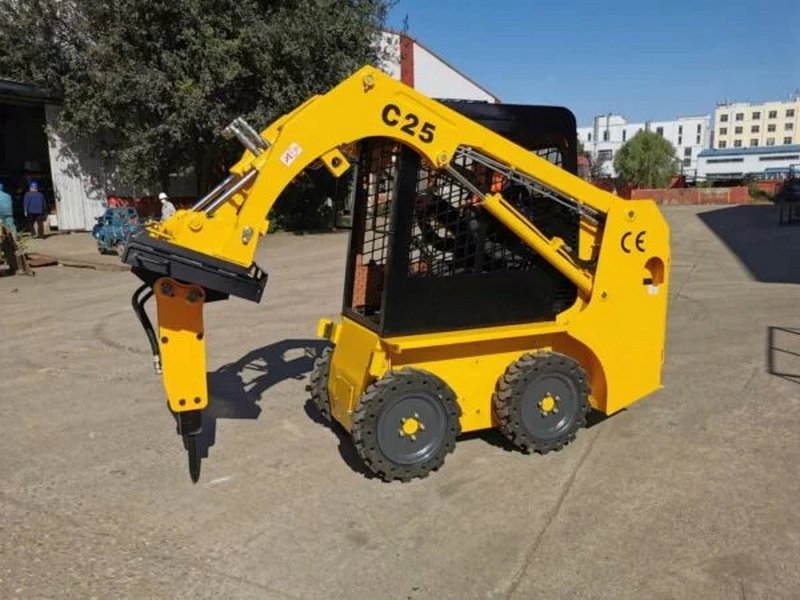
6. Controls, Cab, and Operator Comfort
Operator comfort directly impacts productivity and safety, especially on long shifts.
Control Types
– Lever and pedal controls: Traditional, intuitive for experienced operators.
– Joystick controls (ISO pattern):
– Left joystick: Drive and steer
– Right joystick: Boom and bucket
– Easier to learn, reduces operator fatigue, and improves precision.
Most modern skid steers now come with joystick controls as standard or optional.
Cab Features to Look For
– Enclosed cab with HVAC: Essential for year‑round work in extreme heat or cold.
– Pressurized cab: Keeps dust and debris out, improving air quality and visibility.
– Good visibility: Large windows, low‑profile ROPS, and minimal blind spots.
– Suspension seat: Reduces vibration and fatigue on rough ground.
– Digital display: Shows engine hours, fuel level, hydraulic pressure, and fault codes.
2025 expectation: Top‑tier skid steers now offer premium cabs with heated/ventilated seats, large displays, and advanced diagnostics, similar to larger excavators and loaders.
7. Choosing the Right Skid Steer Attachments
Attachments transform a skid steer from a simple loader into a multi‑tool workhorse. Here’s how to choose the right ones for your work.
Step 1: Match Attachments to Your Applications
| Application | Must-Have Attachments |
|---|---|
| Material Handling | Pallet forks, bale spears, grapples, buckets |
| Site Prep & Lot Clearing | Buckets, grapples, rakes, blades, stump grinders, mulchers |
| Grading & Backfilling | Grading buckets, blades, rakes, land planes |
| Digging & Trenching | Augers, trenchers, backhoe arms, digging buckets |
| Land Management | Brush cutters, flail mowers, stump grinders, tree pullers |
| Soil Care | Landscape rakes, soil tillers, soil conditioners, seeders |
| Snow Removal | Snow buckets, snow pushers, snow plows, snow blowers |
| Cleanup & Sweeping | Angle brooms, pickup brooms, sweepers |
Step 2: Size and Weight the Attachment Correctly
– Never overload the machine: Choose attachments that stay well within the skid steer’s ROC and hydraulic capacity.
– Width matters: Wider attachments (e.g., large snow pushers, wide rakes) require more power and stability.
– Hydraulic requirements: Ensure the attachment’s flow and pressure needs match your machine’s capabilities.
Step 3: Prioritize Quality and Durability
– OEM or high‑quality aftermarket attachments last longer and perform better than cheap, generic models.
– Look for:
– Hardened cutting edges and wear plates
– Heavy‑duty steel construction
– Properly sized hydraulic cylinders and hoses
– Safety features (e.g., retention pins, guards)
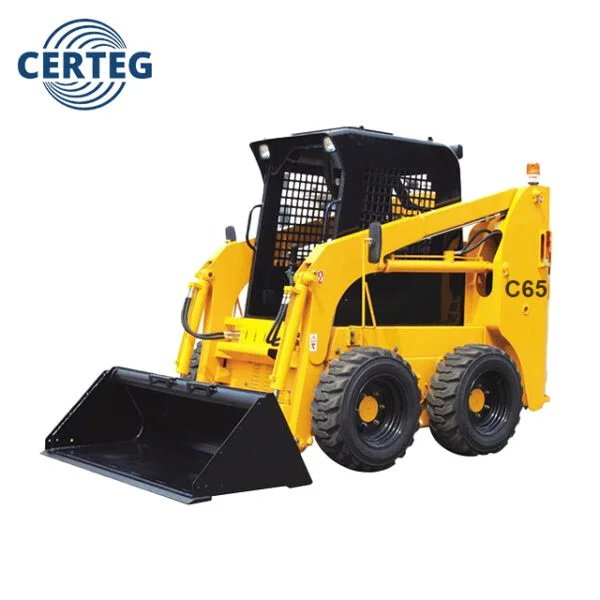
8. Certeg Skid Steer Loaders: Built for Global Construction Needs
As a manufacturer of excavators, skid steer loaders, rollers, forklifts, tractors, and track carriers, Certeg designs machines to meet diverse global demands:
– Robust construction: Frames and undercarriages built for heavy‑duty, long‑term use in tough environments.
– High breakout force and lift capacity: Optimized for digging, grading, and material handling on construction and infrastructure sites.
– Global power options: Machines configured for different fuel types and emissions standards, making them suitable for markets worldwide.
– Attachment flexibility: Designed to work with a wide range of universal and OEM‑style attachments, giving contractors maximum versatility.
If you need a skid steer that can handle everything from urban construction to rural infrastructure projects, Certeg offers a balanced combination of power, durability, and global support.
9. Practical Selection Checklist (2025)
Use this checklist when evaluating skid steer loaders and attachments.
Skid Steer Selection
– Primary application defined (construction, landscaping, agriculture, etc.)
– Size class chosen (small, medium, large frame)
– Lift type selected (vertical or radial)
– Tracks vs. wheels decided based on ground conditions
– Hydraulic flow matched to planned attachments (standard vs. high flow)
– Quick‑attach system verified (universal vs. proprietary)
– Cab and controls evaluated for operator comfort and safety
Attachment Selection
– Attachments matched to primary applications
– Attachment weight and size within machine ROC
– Hydraulic requirements (flow, pressure, circuits) compatible
– Mounting plate and quick‑attach system compatible
– Quality and durability assessed (steel thickness, wear parts, safety features)
10. Get the Right Skid Steer for Your Fleet
Now that you know how to choose the right skid steer loader and attachments, it’s time to act.
If you’re evaluating Certeg skid steer loaders for construction, landscaping, or infrastructure projects, contact a Certeg dealer or distributor today. Request the latest specifications, discuss attachment compatibility for your region, and arrange a demo or site visit to see how a Certeg skid steer performs on your typical jobs.
Don’t just buy a machine — invest in the right machine and the right attachments to maximize productivity, safety, and long‑term ROI.
Frequently Asked Questions (FAQ)
1. What is the difference between a skid steer loader and a compact track loader (CTL)?
A skid steer loader uses wheels and “skids” to turn, while a compact track loader uses continuous rubber tracks. CTLs offer lower ground pressure, better traction on soft or uneven ground, and a smoother ride, but are typically more expensive and have higher maintenance costs than wheeled skid steers.
2. How do I know if an attachment is compatible with my skid steer?
Check three things:
1. The quick‑attach system (universal vs. proprietary).
2. The hydraulic flow and pressure requirements vs. your machine’s specs.
3. The attachment’s weight and size vs. your skid steer’s rated operating capacity and dimensions. Always consult the manufacturer’s compatibility guide.
3. Should I choose a vertical lift or radial lift skid steer for landscaping?
For mostly grading, digging, and site prep, a radial lift is often better. For mixed work that includes a lot of loading trucks or placing materials at height, a vertical lift offers more flexibility. Many landscapers choose vertical lift for its versatility.
4. What hydraulic flow do I need for a trencher or auger?
Most trenchers and augers require high‑flow hydraulics (typically 25–35+ GPM). Always check the attachment manufacturer’s specs and match them to your skid steer’s auxiliary hydraulic flow rating.
5. Can I use the same attachments on different brands of skid steers?
Many attachments with universal quick‑attach plates can be used across brands, but you must verify:
– Mounting plate dimensions and pin spacing.
– Hydraulic connections (number of circuits, flow, pressure).
– Weight and ROC limits. Some OEM attachments are designed specifically for one brand and may not fit others.
Hot Tags:Skid Steer Loader Uses, Best Skid Steer for Landscaping,Best Skid Steer, Chinese Mini Skid Steer, Skid Steer Buying Guide, Skid Steer Loader Attachments, Skid Steer For Construction, Skid Steer For Landscaping, Compact Equipment Selection, Skid Steer Versatility